
Cardiff Airport destinations in 2026 are expanding with new routes, more weekly flights, and higher capacity, especially on Mediterranean and North African sunshine routes. This article explains every major Cardiff Airport destination for 2026, what new routes are launching, and how the airport’s network is changing over the coming seasons.
- What is Cardiff Airport and how does it fit into the UK network?
- Which Cardiff Airport destinations are available in 2026?
- What new Cardiff Airport routes are launching in 2026?
- How is TUI changing Cardiff Airport’s route network in 2026?
- What role does Ryanair play in Cardiff Airport destinations?
- What are the main seasonal patterns in Cardiff Airport destinations?
- Which Cardiff Airport destinations are best for beach holidays?
- How can Cardiff passengers reach UK and Irish cities from Cardiff Airport?
- What infrastructure changes support Cardiff Airport’s 2026 route expansion?
- How does Cardiff Airport’s 2026 route list affect nearby Bristol and London airports?
- What should Cardiff travellers watch for beyond 2026?
What is Cardiff Airport and how does it fit into the UK network?
Cardiff Airport (airport code CWL) is South Wales’ main commercial airport, located about 12 miles southwest of Cardiff city centre near Rhoose in the Vale of Glamorgan. It acts as a regional hub for passengers from Cardiff, Bridgend, Rhondda Cynon Taf, Newport, and large parts of South and West Wales who prefer to avoid London and Bristol for certain leisure routes.
Historically Cardiff Airport operated long‑haul services and major European point‑to‑points, but after the 2000s it shifted focus to a leisure‑oriented, short‑haul charter and scheduled network. Today airlines such as TUI, Ryanair, and others use it as a base for Mediterranean beach holidays, religious charters, and some UK domestic and Irish connections.
Cardiff Airport’s current structure includes a single passenger terminal, short‑ and medium‑haul aircraft stands, and a small but growing cargo area. The airport company has publicly stated ambitions to double passenger numbers over the next decade through infrastructure upgrades, more airlines, and expanded route choice, which means the 2026 destination set is part of a longer‑term growth strategy.
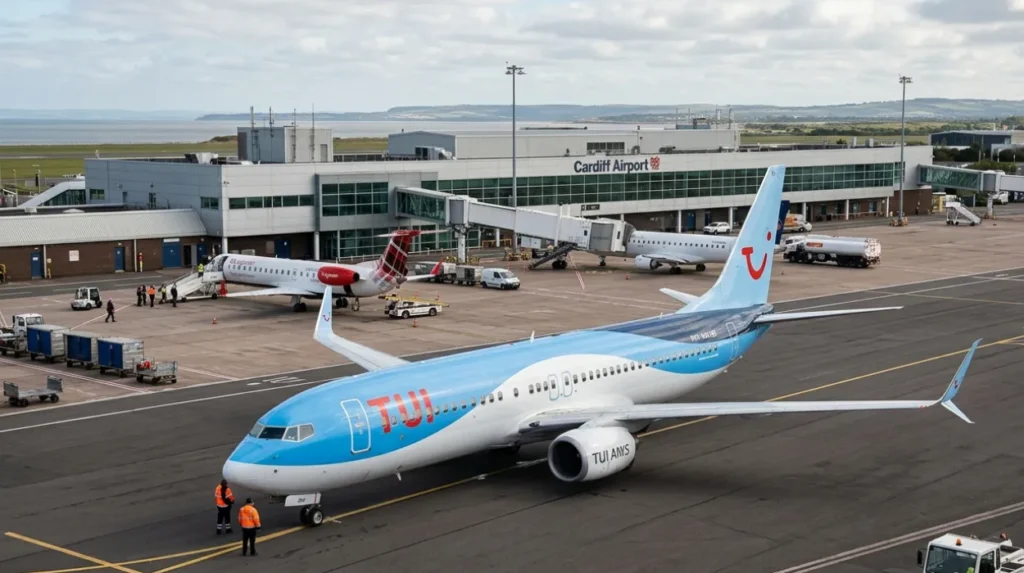
Which Cardiff Airport destinations are available in 2026?
In 2026 Cardiff Airport serves around 25 destinations split across Europe, North Africa, and the Middle East, mainly via TUI’s summer‑season programme and Ryanair’s year‑round operations. The largest clusters are in Spain (Balearic and Canary Islands), Turkey, Greece, Egypt, and Portugal, with additional routes to the UK, Ireland, and the Channel Islands.
Key destination groups in 2026 include:
- Mediterranean beach resorts: Palma de Mallorca (Spain), Alicante (Spain), Las Palmas and Lanzarote (Canary Islands), Antalya (Turkey), Heraklion (Crete, Greece).
- North African and Middle East sun: Hurghada (Egypt), Enfidha (Tunisia), and associated Red Sea and North African beach resorts.
- Western European cities and leisure hubs: Faro (Portugal), Belfast (Northern Ireland), Knock (Ireland), and Jersey (Channel Islands).
This mix lets Cardiff‑based travellers choose from all‑inclusive beach holidays, religious pilgrimages, city breaks, and short‑haul visiting‑friends‑and‑relatives trips without switching airports.
What new Cardiff Airport routes are launching in 2026?
Two major new year‑round‑market routes are launching from Cardiff Airport in summer 2026: Faro, Portugal and Hurghada, Egypt, both operated by TUI. The Faro route starts on 21 May 2026 with flights twice weekly on Thursdays and Sundays, while Hurghada begins on 2 May 2026, giving Cardiff passengers direct access to the Algarve and Red Sea coast respectively.
These routes are part of a broader 2026 expansion in which TUI bases a fourth aircraft at Cardiff Airport, increasing total summer‑season seats to over 250,000, up from around 205,000 in 2025. The additional aircraft also allows TUI to add or boost frequencies on existing routes such as Antalya, Gran Canaria, Palma de Mallorca, and Enfidha, which translates into more weekly departures and more departure‑day options for Cardiff‑based travellers.
From Cardiff Airport’s perspective, the two new routes reflect a strategic push to diversify away from over‑reliance on a narrow set of Mediterranean and Canary‑Island routes. By adding Portugal and Egypt, Cardiff gains better connectivity to affordable golf‑and‑beach holidays in the Algarve and to low‑cost, long‑days‑of‑sun packages in the Red Sea, which broadens its appeal for UK‑based leisure travellers.
How is TUI changing Cardiff Airport’s route network in 2026?
In 2026 TUI is running Cardiff Airport’s largest scheduled charter programme to date, with roughly 56 weekly flights across up to 25 destinations during peak season. The core of this network remains Spanish, Turkish, Greek, and North African beach markets, but the new Faro and Hurghada routes demonstrate a deliberate shift towards more diversified sun‑and‑city‑break options for Welsh passengers.
TUI’s decision to base a fourth aircraft at Cardiff for summer 2026 implies a long‑term commitment to continuing and possibly expanding the Cardiff‑based programme beyond a one‑off season. The airline explicitly describes the move as strengthening its relationship with Wales and positioning Cardiff Airport as a key base for Midlands and South Wales leisure travel demand.
Operationally, the extra aircraft means some routes see more departures per week rather than entirely new destinations. For example, popular routes such as Antalya, Gran Canaria, Palma de Mallorca, and Enfidha gain additional weekly flights, which reduces the pressure on peak‑day availability and improves load‑factor management for TUI. For passengers, this means more flexibility in choosing travel dates and better chances of securing mid‑week or early‑season departures without paying premium fares.
What role does Ryanair play in Cardiff Airport destinations?
Ryanair operates a smaller but structurally important set of Cardiff Airport routes that complement TUI’s leisure‑focused network. The airline typically runs year‑round or near‑year‑round services to destinations such as Belfast, Dublin, and Jersey, which target both leisure and visiting‑friends‑and‑relatives (VFR) traffic rather than pure beach holidays.
Ryanair’s model is based on high‑frequency, low‑fare point‑to‑point services, often using Boeing 737‑800 or 737 MAX aircraft. At Cardiff Airport this means relatively low‑cost flights to nearby UK and Irish cities, which sit beside TUI’s once‑weekly or twice‑weekly seasonal charters to Mediterranean resorts.
Because Ryanair’s network is more volatile than TUI’s charter programme, routes can start, stop, or change frequency with short notice. Cardiff Airport’s website and Ryanair’s own schedule pages show that the airport usually handles around 10–15 airlines and 20–40 flights per day, with Ryanair accounting for a notable share of that volume through its Belfast, Dublin, and Jersey rotations.
What are the main seasonal patterns in Cardiff Airport destinations?
Cardiff Airport’s destination list is highly seasonal, with the largest number of routes and highest weekly frequencies operating between roughly May and October. During these months the airport runs its full TUI‑driven sunshine‑route programme, including multiple Canary Islands, Balearic Islands, and Turkish resorts, plus the new Faro and Hurghada routes.
Outside the main summer season, the number of destinations and frequencies drops, leaving a leaner core of routes that Ryanair and other operators sustain. These typically include Belfast, Knock, Dublin, Jersey, and a small number of religious or special‑mission charters, which ensure the airport remains operational year‑round even when most leisure routes are suspended.
The seasonal pattern means Cardiff‑based travellers who book in early spring or late autumn often have fewer choices and may need to accept longer‑haul connections via London or Manchester for certain destinations. Conversely, peak‑season holiday‑makers enjoy more direct flights and more frequent departure dates, but may pay higher average fares and face higher competition for seats.
Which Cardiff Airport destinations are best for beach holidays?
Cardiff Airport is especially strong for beach‑focused holidays in Spain, Turkey, Greece, Egypt, Tunisia, and Portugal. Key beach destinations include:
- Palma de Mallorca (Spain): Balearic‑Island resort with long‑season flights, family‑friendly beaches, and late‑evening nightlife.
- Gran Canaria and Lanzarote (Spain): Canary‑Island sun‑and‑beach markets with year‑round‑like weather and all‑inclusive resorts.
- Antalya (Turkey): Mediterranean coast with historic old‑town districts and large resort‑belt on the Turkish Riviera.
- Heraklion (Crete, Greece): Major access point to the island’s beaches, hiking, and cultural sites.
- Enfidha (Tunisia): North African beach‑and‑value package‑tour destination.
- Hurghada (Egypt): Red Sea resort with snorkelling, diving, and desert‑safari options.
- Faro (Portugal): Algarve‑coast gateway with beaches, golf courses, and historic towns.
For Cardiff‑based families, couples, and groups, these routes support a mix of short‑breaks (seven‑night packages) and longer holidays, often marketed via major UK tour operators rather than pure low‑cost flights.
How can Cardiff passengers reach UK and Irish cities from Cardiff Airport?
Cardiff Airport offers several convenient year‑round or near‑year‑round options for UK and Irish city travel. The main examples are Belfast, Knock, and Jersey via Ryanair, with some additional or seasonal routes depending on demand and airline strategy.
Ryanair’s Belfast service links Cardiff Airport to Northern Ireland’s capital city, which is useful for both business and visiting‑friends‑and‑relatives travel. Knock and Jersey flights mainly serve religious‑tourism demand (Knock as a pilgrimage site) and leisure‑focused short breaks to the Channel Islands, respectively.
These routes help Cardiff Airport function as a regional hub for South Wales, reducing the need to transfer via London or Manchester for certain UK and Irish itineraries. However, because Ryanair’s network is route‑specific and profit‑driven, any individual route can be withdrawn if load factors or local competition change, so Cardiff‑based passengers should monitor the airline’s schedule updates regularly.
What infrastructure changes support Cardiff Airport’s 2026 route expansion?
Cardiff Airport’s 2026 destination growth is backed by ongoing infrastructure and capacity upgrades aimed at handling more passengers and more aircraft movements. These improvements include terminal‑side enhancements, expanded aircraft‑stand capacity, and investment in baggage‑handling and security systems to cope with higher holiday‑peak traffic.
Plans to double passenger numbers over a decade imply long‑term upgrades to car parking, road‑access links, and public‑transport connectivity, including better bus and coach arrangements to and from Cardiff city centre and surrounding counties. The airport authority also points to growing cargo operations, such as European Cargo’s weekly flights to China, as part of a broader strategy to diversify revenue beyond just passenger‑leisure business.
From a traveller’s perspective these changes translate into shorter queues, smoother security checks, and potentially newer gate‑lounging facilities, although the single‑terminal layout means space remains constrained compared with larger hubs. For Cardiff‑area residents and businesses, improved airport infrastructure can support tourism, freight, and regional economic development by making the airport more attractive to airlines and passengers alike.
How does Cardiff Airport’s 2026 route list affect nearby Bristol and London airports?
Cardiff Airport’s 2026 expansion, especially the new TUI‑launched routes to Faro and Hurghada, increases competition with Bristol Airport and London‑area airports for South and West Wales leisure traffic. Bristol already serves many of the same Mediterranean and North African destinations, but Cardiff’s bid to offer more direct, Wales‑focused options gives local passengers a stronger “fly local” incentive.
For residents in Cardiff, Newport, and the Valleys, choosing Cardiff over Bristol or London can mean shorter road‑transfer times, cheaper parking, and smaller‑scale terminals with shorter security and boarding queues. This competitive pressure can also push Bristol and London airports to maintain or improve their own Cardiff‑area marketing and rail‑and‑coach links to keep South Wales passengers loyal.
Moreover, Cardiff’s strategy of adding diverse sun‑and‑city destinations may prevent some South Wales travellers from defaulting to London‑based operators for package holidays. That could, in turn, encourage other airlines and tour operators to consider Cardiff as a viable base for additional routes if the 2026‑season performance meets revenue and load‑factor targets.

What should Cardiff travellers watch for beyond 2026?
Travellers planning beyond summer 2026 should expect Cardiff Airport’s destination list to remain sensitive to airline decisions, fuel costs, and geopolitical factors in popular leisure regions. For example, any instability in the Eastern Mediterranean, North Africa, or Middle East can lead to temporary suspensions or frequency cuts on routes to Turkey, Greece, Egypt, or Tunisia, regardless of Cardiff’s infrastructure plans.
On the positive side, Cardiff’s ambition to double passenger numbers and its growing role in TUI’s UK network suggest that additional routes or year‑round extensions could follow if 2026 demand and finances justify them. Potential future directions include strengthening city‑break routes to Western Europe, adding more religious‑tourism or VFR‑focused services, or even limited long‑haul or charter trials if the airport’s commercial case improves.
For Cardiff‑based passengers, the practical takeaway is to book early for peak‑season routes, monitor airline schedules for new or cut‑season routes, and consider mixed‑itinerary options (for example, flying TUI from Cardiff to a resort and returning via Ryanair from another airport) if Cardiff’s schedule does not match their exact dates. Cardiff Airport’s 2026 programme is the most extensive in recent years, but it still operates within the constraints of a regional airport, so flexibility and advance planning remain key.
How many destinations does Cardiff Airport have in 2026?
Cardiff Airport serves around 25 destinations in 2026 across Europe, North Africa, and the Middle East.