Key Points
- Historic Anniversary Return: Take That officially returned to Cardiff’s Principality Stadium on 16 June 2026, marking exactly 17 years to the day since their record-breaking The Circus Live tour first arrived at the venue in 2009.
- Theatrical Pop Revival: The performance served as a full-scale stadium redux of the iconic 2009 Circus concept, integrating a 40-strong troupe of trapeze artists, fire-eaters, tightrope walkers, and a 30-foot mechanical animatronic elephant.
- High-Profile Support Acts: Pop icon Belinda Carlisle opened the evening’s proceedings, followed by a high-energy, 25th-anniversary celebratory set from the Dublin-based rock band The Script.
- Fluid Presentation & Open Roof: The production utilised the full vertical and structural capacity of the stadium with its roof left open, transitioning seamlessly from vibrant pop numbers to a darker, fire-festooned “sinister carnival” sequence.
- Career-Spanning Setlist: The remaining trio—Gary Barlow, Mark Owen, and Howard Donald—delivered a comprehensive two-hour setlist combining massive 1990s hits with material from their contemporary catalogue, concluding with a large-scale pyrotechnic display.
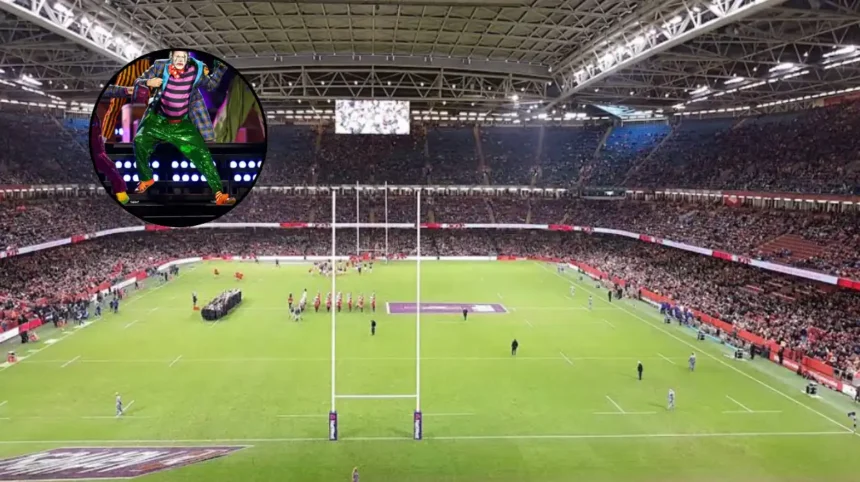
Cardiff (Cardiff Daily) June 17, 2026 – Seventeen years to the day after The Circus Live first debuted in the Welsh capital, the English pop triumvirate Take That successfully brought their reimagined, high-concept stadium spectacle back to a completely sold-out audience at the Principality Stadium. The production, which originally broke historical UK box office records in 2009 by selling over 600,000 tickets in less than five hours, was resurrected as a maximalist theatrical pop experience. Featuring a massive ensemble of aerialists, elaborate mechanical props, and a comprehensive selection from their 35-year musical career, Gary Barlow, Mark Owen, and Howard Donald performed inside a packed arena where the stadium’s retractable roof remained fully open to accommodate the extensive overhead acrobatics and final pyrotechnic displays.
- Key Points
- How Did the Support Acts Warm Up the Cardiff Crowd?
- What Was the Visual Concept Behind the Opening Sequence?
- How Did Take That Adapt the Original 2009 Circus Production?
- What Were the Standout Musical and Theatrical Highlights?
- How Did the Show Shift for the Sinister Carnival Finale?
- What Is the Background of This Particular Development?
- What Is the Prediction for How This Development Affects the Live Entertainment Audience?
How Did the Support Acts Warm Up the Cardiff Crowd?
The evening’s musical proceedings commenced with a dual-bill of established supporting artists designed to engage the multi-generational audience before the headliners emerged. As documented by Dianne Bourne of the Manchester Evening News, pop vocalist Belinda Carlisle opened the event in fine voice, performing a series of her well-known pop anthems, including “Circle in the Sand”, “Leave a Light On”, and “Heaven Is a Place on Earth”, while delivering a relaxed, barefoot dancing performance. Writing for Wales 247, reviewer Alice Gregory observed that Carlisle’s vocal delivery felt
“effortlessly confident, striking the perfect balance between nostalgia and getting the crowd ready for what was to come.”
Following Carlisle, Irish pop-rock group The Script took to the stage, currently celebrating their 25th anniversary as a band. Frontman Danny O’Donoghue utilized the full physical layout of the massive staging structure, leading the group through a dense, hit-filled setlist. According to the editorial team at It’s On Cardiff, the band
“warmed up the crowd brilliantly and proved to be a worthy support act,”
matching the energy levels they previously established during their headline appearance at Cardiff Castle last year.
The Script’s set list incorporated historical fan favourites alongside newer material, spanning tracks such as “Breakeven”, “Superheroes”, “The Man Who Can’t Be Moved”, and “Nothing”. Alice Gregory of Wales 247 highlighted that the performance culminated in a massive stadium-wide singalong during “Hall of Fame”, noting that the presentation was robust enough that younger attendees
“may have enjoyed the support acts even more than Take That themselves.”
What Was the Visual Concept Behind the Opening Sequence?
As the primary house lights dimmed, the stadium was structurally transformed into a traditional big-top circus environment. The opening sequence was strictly choreographed to mimic the structural unveiling of a theatrical production rather than a conventional rock or pop concert.
Giant red drapes closed around the central stage before a lone blue clown appeared to initiate the narrative arc of the evening.
According to reporting from It’s On Cardiff, the performance was guided by a mysterious “lady in red,” who was later revealed to be West End vocalist and television personality Zoe Birkett. Birkett acted as the master of ceremonies, directing the movements of a vast array of specialized circus performers.
These performers gathered around a prominent central dome structure on the main floor, systematically attaching physical balloons to a massive, light-blue hot air balloon suspended directly above the stage.
As reported by The i, this suspended hot air balloon hung still in the air throughout the sequence, serving as the central visual anchor for the production.
Amidst a deafening roar from the audience, the remaining three members of Take That made their physical entrance by emerging directly from a cluster of balloons, immediately establishing the high-camp, theatrical tone of the evening.
How Did Take That Adapt the Original 2009 Circus Production?
The 2026 iteration of The Circus Live represents a carefully modernised, stadium-scale redux of their record-breaking 2009 tour. While the original tour featured all five original members, including Robbie Williams and Jason Orange, the current production successfully adapted the intricate choreography and staging demands for the remaining trio of Barlow, Owen, and Donald.
As noted by the Manchester Evening News, prior to the tour’s launch, long-term fans had openly questioned how the complex staging would function without Jason Orange, who had historically been a core driver of the band’s physical dance routines.
The resulting performance addressed these absences by increasing the scale of the surrounding theatrical cast. Reviewers from The Guardian detailed a “maximal razzle-dazzle” approach, featuring a 40-strong contemporary troupe consisting of:
- Trapeze artists soaring across the high wires
- Tightrope walkers executing feats directly above the audience
- Fire-eaters and stilt-walkers
- Acrobats utilising German wheels
- Synchronised marching drummers and sequin-dressed dancers
The musical arrangements were overseen by long-time musical director Mike Stevens, who has collaborated with Take That since 1993. Stevens frequently stepped into the spotlight, contributing live saxophone solos that provided a musical contrast to the heavy electronic and pop backing tracks.
The physical presentation also revived several specific props from the 2009 tour. Mark Owen and Howard Donald demonstrated their continued physical athleticism by riding unicycles across narrow stage runways during up-tempo numbers, while Gary Barlow deliberately played his sequence for comedic effect, navigating the stage on a miniature bicycle.
What Were the Standout Musical and Theatrical Highlights?
The concert spanned over two hours, structured deliberately to alternate between massive, energetic pop spectacles and moments of stark musical intimacy.
The show opened at maximum velocity with “Greatest Day”—the primary single from their 2008 album The Circus—accompanied by a massive release of physical balloons, streamers, and confetti into the crowd.
The undisputed centerpiece of the production occurred during the performance of the fan-favourite anthem “The Garden”.
The three singers emerged atop a massive, 30-foot mechanical animatronic elephant. The puppet, structurally engineered to move realistically, required individual, dedicated performers to operate each leg and a separate technician to control the tail.
The mechanical beast slowly made a physical journey directly through the center of the audience toward the main stage, a moment described by Dianne Bourne of the Manchester Evening News as “even more mesmerising (and tear-inducing) than the first time around.
Following this progression, the band transitioned immediately into the glitzy, showgirl-inspired choreography of “Shine”. The setlist maintained a fluid balance between decades, featuring definitive 1990s hits like “Pray” (complete with the band’s original, camp dance routines), “A Million Love Songs”, and a cover of Barry Manilow’s “Could It Be Magic”.
These were performed alongside mid-career anthems like “Patience” and “The Flood”, as well as contemporary tracks from their ninth studio album, This Life, including the single “Windows”.
Between songs, the band members frequently interacted with the Welsh audience, utilizing local colloquialisms such as “what’s occurin’?” and “alright?”.
The trio openly joked about their age relative to the stadium itself, expressing humility regarding their sustained drawing power more than three decades after their initial formation in Manchester.
How Did the Show Shift for the Sinister Carnival Finale?
The second half of the concert subverted the bright, celebratory aesthetic of the traditional big-top circus, shifting toward a darker, more theatrical narrative.
The stage designs transformed into a “sinister carnival,” marked by the sudden appearance of giant, towering inflatable ringmasters that loomed over the performers.
This tonal shift culminated in a highly dramatic performance of their 1993 chart-topping cover of Dan Hartman’s “Relight My Fire”.
The production utilized intensive pyrotechnics, with large plumes of flames erupting simultaneously from the front to the back of the Principality Stadium.
Enhanced by the powerful live vocals of Zoe Birkett and the frantic movements of the expanded circus cast, the sequence was widely cited by critics as the most visually arresting segment of the night.
The main set concluded with an encore performance that brought the audience directly into the lighting design.
During the final performances of “Hold Up a Light” and “Rule the World”, tens of thousands of fans illuminated the stadium using their mobile phone lights. The entire event concluded beneath a coordinated, large-scale fireworks display launched directly above the open roof of the arena.
What Is the Background of This Particular Development?
The return of The Circus Live in 2026 marks a significant milestone in the broader context of British pop history and modern concert touring infrastructure.
Take That originally formed in Manchester in 1989 as a five-piece boy band consisting of Gary Barlow, Robbie Williams, Mark Owen, Howard Donald, and Jason Orange. After dominating the UK pop charts in the first half of the 1990s, the group disbanded in 1996 following the high-profile departure of Williams.
In 2005, the remaining four members reunited for a retrospective documentary, which catalyzed one of the most successful commercial comebacks in music history.
Their subsequent studio albums, Beautiful World (2006) and The Circus (2008), achieved multi-platinum status, firmly establishing them as a premier stadium-touring act.
The original 2009 Circus Live stadium tour represented the absolute zenith of this comeback era, grossing tens of millions of pounds and setting a benchmark for theatricality in pop music. Williams temporarily rejoined the group for the Progress album and tour in 2011, before both he and Jason Orange officially exited the lineup, leaving Barlow, Owen, and Donald to operate as a permanent trio from 2014 onward.
The decision to mount a full stadium revival of The Circus 17 years later highlights a growing trend within the live music industry: the replication and scaling up of historical legacy tours. By reviving a highly specific, beloved intellectual property like the Circus concept, Take That and their promoters, SJM Concerts, are capitalizing on deep-seated millennial nostalgia while simultaneously appealing to newer generations of fans who missed the original 2009 run.
This development occurs within an economic landscape where stadium pop shows are increasingly required to offer high-value, multi-sensory theatrical experiences to justify premium ticket pricing, which for this Cardiff date started at £71 for restricted views and escalated significantly for primary seating and hospitality packages.
What Is the Prediction for How This Development Affects the Live Entertainment Audience?
The critical and commercial success of Take That’s 2026 Circus Live stadium redux is highly likely to influence future consumer expectations and industry strategies within the live entertainment sector, directly affecting stadium concertgoers and live music consumers.
Firstly, this production establishes a clear precedent that legacy pop acts do not need to rely solely on standard “greatest hits” configurations to fill football stadiums; instead, they can successfully mount high-concept, narrative-driven revivals of specific historical tours.
For the average consumer, this means the live music landscape will likely see an increase in “anniversary” or “concept” reboots from other major 1990s and 2000s artists, transforming traditional concerts into complex, West End-style hybrid theatrical productions.
Secondly, the sheer scale of the production—incorporating 40 extra cast members, massive animatronics, and complex aerial rigging—sets a highly demanding benchmark for what constitutes “value for money” at a time when discretionary consumer spending is tightly monitored. As major daily publications like The Daily Telegraph observed, during periods of economic constraint, the comprehensive spectacle offered by such a generous production is actively admired by the public.
Consequently, audiences will likely become increasingly discerning, expecting a higher tier of visual production, supporting talent, and immersive staging if they are to pay premium stadium ticket prices. This may widen the market gap between elite, hyper-theatrical stadium productions and standard arena tours, forcing artists to continually innovate their live presentations to capture the public’s leisure spend.