Key Points
- Former Greater Manchester Mayor Andy Burnham has initiated a high-profile tour visiting Cardiff to engage directly with the Welsh public via social media.
- The campaign features an interactive “ask me anything” digital format inviting the public to scrutinise his wider political strategy and national policy platforms.
- This direct-to-consumer political drive forms part of a wider regional outreach strategy following Burnham’s transition back toward Westminster-focused governance.
- Observers frame the Welsh capital visit as a strategic pivot to secure broader geographic appeal outside his traditional Northern English stronghold.
- Media analysts emphasize that Burnham is seeking to separate his approach from conventional top-down Whitehall communication models by emphasizing grassroots transparency.
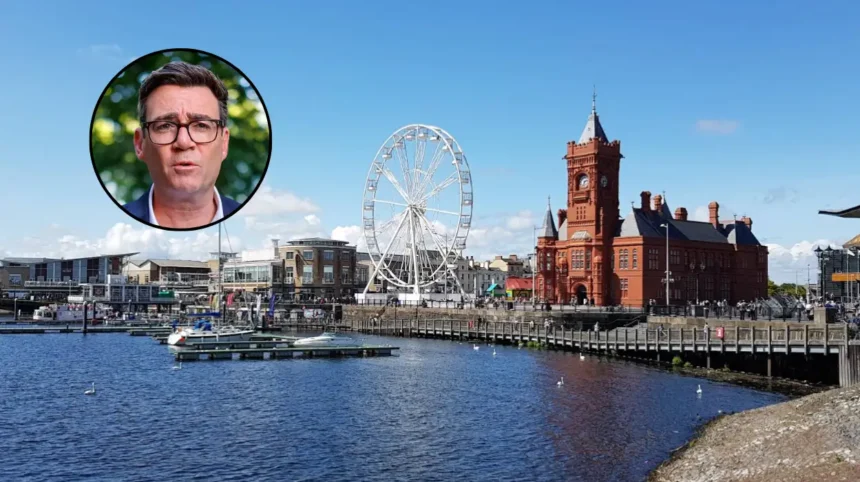
Cardiff (Cardiff Daily) July 17, 2026 — Leadership contender and prominent political figure Andy Burnham has formally expanded his national outreach apparatus with a coordinated digital and physical campaign stop in Cardiff, aiming to bypass conventional Westminster communications by launching a direct public engagement initiative. The former Greater Manchester Mayor distributed a video broadcast across multiple digital social media channels on Thursday afternoon, inviting Welsh citizens to query him directly on his long-term policy structures, regional reform agendas, and his overarching framework for the future administration of the United Kingdom. The strategic tour marks a distinct phase in his ongoing effort to broaden his political footprint across the devolved nations, attempting to synthesize a regional platform that translates effectively beyond his historical power bases in northern industrial towns.
What Is The Underlying Strategy Behind The Welsh Social Media Tour?
As reported by political correspondent Stephen Price of Nation.Cymru, the tour functions as an explicit “charm offensive” structured around an unfiltered digital town-hall mechanism. In his self-recorded public communication, Burnham explicitly linked the interactive engagement style to a fundamental break from standard party operations, stating that,
“When I said I was going to do politics differently, I meant it.”
Analysts point out that by launching an open-ended “ask me anything” forum from the steps of Welsh civic spaces, the campaign is designed to project an image of baseline accessibility and absolute accountability to electorates outside of England.
The approach intentionally leverages a rising public appetite for direct accountability, positioning the prospective national leader as an accessible alternative to conventional, highly managed media pools typically deployed by senior politicians.
According to reporting from political media outlets tracking the leadership transition, this public posture mirrors previous regional experiments Burnham utilized during his multi-term mayoralty in Greater Manchester, where localized public question-and-answer sessions were deployed to bypass traditional journalistic gatekeepers.
How Are Legal and Media Observers Documenting the Official Commentary?
The expanding campaign has generated intense scrutiny regarding structural policy commitments, particularly surrounding constitutional and democratic governance.
As documented by policy editor Kiran Stacey of The Guardian, the tour coincides with intense administrative pressure on the frontrunner regarding the direction of the national elections bill and broader voting infrastructure.
“If I had my way at the time, I would have made the bill much, much more comprehensive… But I was working within the confines, frankly, of an incremental approach – quite timid and limited.”
— Rushanara Ali, Former Democracy Minister
The systemic critique from senior party figures like Ali highlights the delicate balance Burnham must strike during his cross-border tours.
While attempting to reassure institutional frameworks, he is simultaneously being pushed by internal factions and smaller alternative parties to commit to sweeping national overhauls, including the swift establishment of a national commission on electoral reform and the formal introduction of proportional representation.
Furthermore, the fiscal positioning of this cross-border outreach remains under close financial evaluation. Senior economics correspondent Richard Partington of The Guardian noted in recent reporting that Burnham has simultaneously been working to adjust his broader macroeconomic stance in high-level discussions with major financial media entities.
This parallel economic strategy is explicitly engineered to stabilize institutional market confidence and appease City investors who remain highly sensitive to any potential loosening of long-term fiscal constraints by ascending leadership candidates.
Explore More Local Cardiff News
New £12m Cardiff Depot Speeds Up Transport for Wales Rail Repairs 2026
National Museum Cardiff Repairs Could Force Closure | Cardiff 2026
Background: What Led To This Inter-Regional Political Push?
The transition of Andy Burnham from a localized municipal administrator to a cross-border national campaigner follows his long-term tenure as the Mayor of Greater Manchester, a role he secured over three consecutive electoral cycles starting in 2017.
Throughout his municipal leadership, Burnham routinely targeted what he characterized as a deeply dysfunctional, “London-centric” political culture, utilizing his regional mandate to build out integrated public infrastructure programs such as the localized “Bee Network” transport system.
This specific regional governance model was frequently leveraged to demonstrate how devolved executive powers could outpace standard Whitehall legislative timelines.
However, political biographers and local government correspondents have noted that his metropolitan record faced complex internal structural hurdles.
While his administration achieved high baseline approval ratings for aggressive urban development, city-centre construction booms, and high-profile social initiatives regarding regional rough-sleeping and homelessness, critics frequently pointed to distinct ongoing difficulties.
Most notably, these included structural friction points regarding localized police force management and an enduring economic disconnect between the highly prosperous, revitalised Manchester city core and the surrounding post-industrial satellite towns.
His formal steps toward a Westminster re-entry—symbolized by intense focus on parliamentary vacancy developments such as the Makerfield by-election showcase—have necessitated a rapid evolution from purely regional advocacy to a comprehensive national strategy capable of appealing directly to voters within devolved nations like Wales.
Prediction: How Will This Campaign Model Affect the Welsh Electorate?
The deployment of interactive social media campaigns directly inside the Welsh capital is highly likely to alter how national leadership candidates engage with devolved electorates moving forward.
By establishing a precedent where a prominent Westminster leadership contender addresses the public outside of traditional centralized media studios, the Welsh public will likely demand a significantly higher degree of localized specificity regarding devolved financing, public services, and regional infrastructure investment.
For the local Welsh electorate, this development means that general, generic policy assurances from national political parties will face decreasing utility.
As cross-border digital town halls become standard practice, voters in Wales will have a more direct mechanism to demand clear answers on how centralized Westminster decisions interface with the specific legislative mandates of the Senedd.
This will force an evolution in political communication, shifting focus away from purely English municipal concerns toward a more integrated, multi-nation political discourse that actively accounts for regional complexities across the United Kingdom.