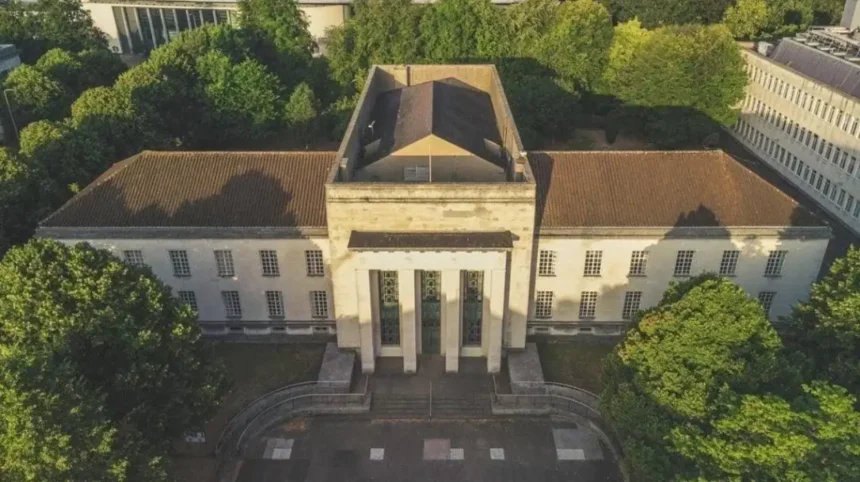
The Temple of Peace Cardiff is one of the city’s most distinctive heritage buildings. Officially known as the Temple of Peace and Health, it stands in Cathays Park within Cardiff’s Civic Centre. The Grade II listed building combines architecture, war remembrance, public health history and international cooperation.
- What is the Temple of Peace Cardiff?
- Why was the Temple of Peace built in Cardiff?
- When did the Temple of Peace Cardiff open?
- What does the architecture of the Temple of Peace Cardiff look like?
- What happened to the Temple of Peace after it opened?
- What is the Welsh Centre for International Affairs at the Temple?
- What is the Peace Garden at the Temple of Peace?
- Why is the Temple of Peace important to Cardiff?
- Why is the Temple of Peace a Grade II listed building?
- What archives and historical collections are held at the Temple of Peace?
- How can visitors experience the Temple of Peace Cardiff today?
- Why does the Temple of Peace Cardiff remain relevant today?
Opened on 23 November 1938, the building was established as a memorial to those who died in the First World War and as a permanent centre dedicated to peace and health. Its creation was strongly associated with David Davies, later Lord Davies of Llandinam, a Welsh industrialist, politician and internationalist who campaigned for international cooperation after the First World War.
Today, the Temple remains closely associated with the Welsh Centre for International Affairs (WCIA). The WCIA is a Welsh charity focused on global learning, international partnerships, peace, human rights and sustainable development. The building also contains archives and collections documenting Wales’ internationalist history.
What is the Temple of Peace Cardiff?
The Temple of Peace Cardiff is a Grade II listed building opened in 1938. It was created as a memorial to the First World War dead and as a centre for promoting peace, health, international cooperation and public service in Wales.
The Temple of Peace and Health occupies a prominent position in Cathays Park, the civic district at the centre of Cardiff. The surrounding area contains major public, cultural and educational institutions, making the Temple part of a wider concentration of Welsh civic heritage.
The building has two connected historical purposes. The first is remembrance. The Temple commemorates people who lost their lives during the First World War. The second is constructive internationalism. Its founders intended the building to support organisations and activities concerned with peace, health and cooperation.
The building is secular rather than religious. Its monumental appearance reflects its civic and memorial purpose rather than functioning as a conventional place of worship.
The Temple also represents an important stage in Wales’ international history. Its organisations supported ideas involving international cooperation, public education and the development of global citizenship.
Its current role continues through the Welsh Centre for International Affairs. The WCIA states that its work focuses on global learning, global action and global partnerships.
Why was the Temple of Peace built in Cardiff?
Construction of the Temple of Peace followed a long campaign led by Lord Davies of Llandinam. Cardiff Corporation provided land in Cathays Park, while public subscriptions and Davies’s financial support enabled Sir Percy Thomas’s design to reach completion in 1938.
Lord Davies began developing the idea of a Welsh Temple of Peace after the First World War. His vision connected war remembrance with the promotion of international cooperation.
A major milestone came in 1928, when Wales’ National War Memorial was unveiled in Alexandra Gardens, directly opposite the future Temple site. Cardiff Corporation subsequently provided land in Cathays Park for the project.
The project faced serious financial and economic difficulties. The Great Depression, which began in 1929 and severely affected Britain during the early 1930s, disrupted major construction projects.
Lord Davies responded by pledging financial support through a dedicated fund. The WCIA records that he pledged a “sink fund” in 1934 to cover more than three-quarters of the Temple’s construction costs. Public subscriptions provided additional funding, with people in Wales contributing more than £12,000 to the relevant memorial and headquarters funds.
The project therefore depended on a combination of private financial support, civic land provision and public contributions.
The building was designed by Sir Percy Thomas, one of Wales’ most prominent twentieth-century architects. Thomas was responsible for numerous important buildings in Wales and developed the Temple using a formal architectural language suited to its civic and memorial purpose.
Construction took place during the late 1930s. The building opened shortly before the outbreak of the Second World War in Europe in September 1939.
When did the Temple of Peace Cardiff open?
The Temple of Peace Cardiff officially opened on 23 November 1938. Minnie James of Dowlais performed the opening ceremony after losing three sons during the First World War, representing war-bereaved mothers from Wales at the event.
The opening ceremony established the building as both a memorial and a centre for future international cooperation.
Minnie James was a woman from Dowlais whose three sons died during the First World War. Her role gave the opening a direct connection with the families affected by the conflict.
She opened the building using a golden key. A procession involving 23 war mothers representing Britain, its Empire and the United States then entered the Temple.
The ceremony reflected the building’s central philosophy. It remembered the people who died while also expressing a commitment to peace and justice.
The timing was historically significant. The Temple opened only months before the beginning of the Second World War. Its creation therefore belongs to a period when international peace organisations faced increasing pressure from political instability, militarisation and the breakdown of collective security.
The opening dedication described the building as a memorial and a symbol of determination to pursue justice and peace. This combination of remembrance and international cooperation remains central to the Temple’s identity.
The ceremony also established a connection between individual wartime loss and wider civic responsibility. The Temple was intended to preserve the memory of those who died while supporting institutions working toward a more peaceful international system.
What does the architecture of the Temple of Peace Cardiff look like?
The Temple of Peace uses classical proportions, Portland stone, a monumental portico and formal interior spaces. Its design combines restrained 1930s public architecture with symbolic features created to express remembrance, civic responsibility, peace, health and international cooperation within Cardiff’s Civic Centre.
The building is recognised for its distinctive architectural composition. Cadw, the Welsh Government’s historic environment service, lists the Temple as a Grade II designated building under reference number 13740. It was designated on 19 May 1975, with the listing amended in 1999.
The principal exterior uses Portland stone ashlar, a finely cut stone finish associated with formal public architecture. The main entrance has a large central block flanked by lower wings.
A prominent portico forms the main architectural focus. It features four square pillars supporting an entablature. The entrance composition gives the building a strong civic presence within Cathays Park.
The architectural treatment refers to classical forms without reproducing a specific ancient Greek or Roman building. Cadw describes the building as having classical proportions with indirect references to classical orders and a character associated with public buildings of the 1930s.
The building also contains formal interior spaces designed around movement, ceremony and institutional activity.
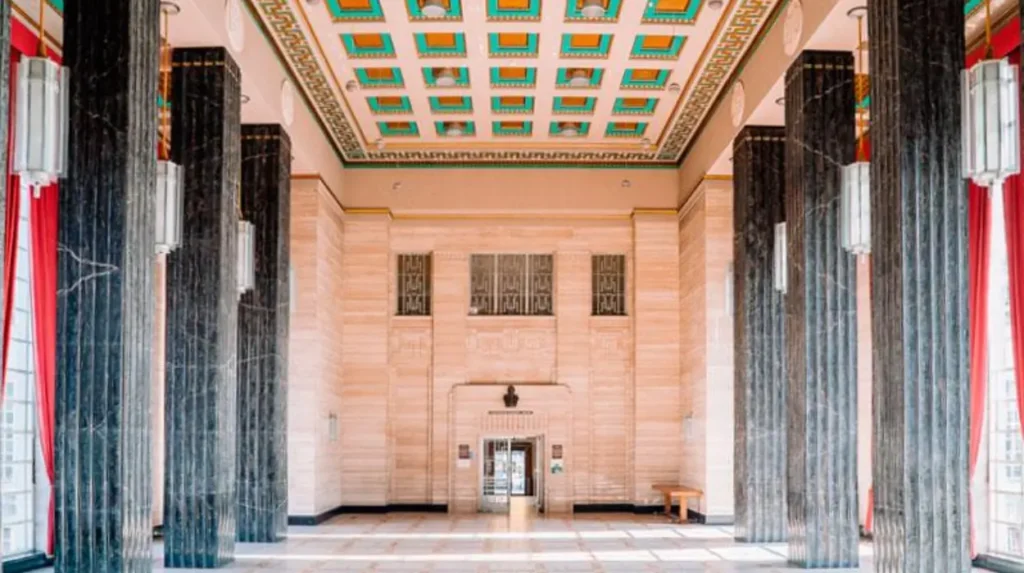
Historical design plans described an entrance hall using Greek Doric references, columns and a beamed and coffered ceiling. The entrance sequence leads toward the Temple itself and the crypt below.
The architectural design therefore supports the building’s symbolic function. Its scale, materials and symmetry distinguish it from ordinary office architecture.
The combination of memorial symbolism and administrative space also reflects the building’s original purpose. It was designed to accommodate organisations while simultaneously functioning as a national memorial.
What happened to the Temple of Peace after it opened?
The Temple of Peace developed from a memorial project into a permanent centre for international organisations and public education. Its institutional history includes the Welsh National Memorial Association, the League of Nations Union, United Nations Association Wales and the WCIA.
The Temple was closely connected with organisations working in international affairs and public health.
One important predecessor was the King Edward VII Welsh National Memorial Association, established to address tuberculosis and public health in Wales. The health element of the Temple’s original name reflects this broader Welsh public health tradition.
The building also became associated with the League of Nations Union, an organisation that promoted public understanding of the League of Nations and international cooperation after the First World War.
After the Second World War, the United Nations Association Wales became another important organisation connected with the building. The United Nations Association promoted awareness of the United Nations and international cooperation.
During the 1960s, concerns about the future of international affairs work in Wales led to discussions about creating a new organisation.
A 1968 Western Mail editorial argued for a Welsh centre that would encourage people in Wales to develop greater understanding of the wider world. In 1970, a formal proposal for the Welsh Centre for International Affairs was adopted by a committee established to mark the 25th anniversary of the United Nations.
The WCIA subsequently became the major organisation associated with the Temple.
This transition gave the building a continuing institutional role. Rather than remaining solely a historic memorial, the Temple became a working centre for education, international affairs and civic engagement.
What is the Welsh Centre for International Affairs at the Temple?
The Welsh Centre for International Affairs is the principal organisation associated with the Temple today. The charity uses the building to support global learning, international partnerships, peace, human rights and sustainable development, while venue activity helps fund its charitable work.
The Welsh Centre for International Affairs, commonly abbreviated as WCIA, is a Welsh charity based at the Temple of Peace.
Its work focuses on helping people in Wales engage with international issues. The organisation describes its main programmes as Global Learning, Global Action and Global Partnerships.
Global learning involves education and awareness about international issues. Global action supports participation and practical activity. Global partnerships connect organisations and communities with international networks.
The WCIA also promotes peace and human rights. These areas directly reflect the original purpose of the Temple.
The organisation’s presence gives the building an active function rather than reducing it to a static heritage attraction.
The Temple also operates as an event venue. According to the Temple of Peace, profits from venue activities support the WCIA and its charitable work. This creates a direct financial relationship between the building’s commercial use and its internationalist mission.
The current use therefore connects the Temple’s historical purpose with contemporary activity.
Its continuing operation as a working headquarters is also important for heritage interpretation. Visitors encounter a historic building that remains connected to international affairs rather than a structure preserved exclusively for display.
What is the Peace Garden at the Temple of Peace?
The Peace Garden behind the Temple of Peace contains more than 50 memorials connected with Welsh peace makers and peace movements. It extends the building’s memorial purpose into an outdoor heritage space within the wider Cathays Park Civic Centre.
The National Garden of Peace is located behind the Temple. It forms an important part of the site’s heritage landscape.
The garden contains more than 50 memorials associated with Welsh peace makers and peace movements. The WCIA provides a Peace Garden Memorials Trail to help visitors explore these commemorative features.
The garden expands the Temple’s remembrance function beyond its interior.
Its memorials represent different individuals, groups and movements associated with peace activity in Wales. The outdoor setting also creates a physical connection between the building and the surrounding Civic Centre.
The Peace Garden forms part of a broader heritage environment. Nearby landmarks include the Welsh Government offices, the Welsh College of Music and Drama, and Cardiff University buildings.
The land occupied by the Temple originally formed part of the Bute Gardens Estate associated with Cardiff Castle. Cardiff Corporation provided the land for the Temple project.
This history explains why the Temple occupies such an important position within Cathays Park.
The garden also supports educational use. A memorial trail provides a structured way to understand the individuals and organisations represented at the site.
For visitors researching Cardiff’s peace history, the Peace Garden provides an important complement to the architecture of the main building.
Why is the Temple of Peace important to Cardiff?
The Temple of Peace matters to Cardiff because it links local civic history with international affairs, war remembrance, architecture and Welsh public life. Its location beside major civic and educational buildings reinforces Cathays Park’s continuing institutional importance.
Cardiff’s identity as a civic and administrative centre is strongly represented in Cathays Park.
The Temple forms part of a concentration of major public buildings that includes City Hall, the National Museum Cardiff, the Law Courts and other institutional buildings. Its presence adds a distinct international and memorial dimension to this civic landscape.
The Temple also documents Wales’ participation in internationalist movements during the twentieth century.
Its history demonstrates that international cooperation was not solely a matter for national governments. Welsh organisations, campaigners and civic institutions developed their own programmes for promoting international understanding.
The building also provides evidence of changing approaches to war remembrance.
Traditional war memorials often focus on commemoration. The Temple combines remembrance with an active commitment to peace and international cooperation.
This distinction is important to understanding its historical significance.
The Temple also has architectural importance. Its Grade II listing formally recognises its special architectural and historic interest. Cadw’s listing records the building’s 1937–38 construction and identifies Sir Percy Thomas as its architect.
Its location also supports educational interpretation. Students, researchers, visitors and residents can examine the relationship between architecture, political history, international organisations and Welsh civic development within a concentrated area.
Explore more Area Guide
Llandaff Palace History: Exploring Cardiff’s Medieval Bishop’s Palace and Historic Ruins
Cardiff Castle Secrets: Discover Roman Ruins, Medieval Defences and Victorian Hidden History
Why is the Temple of Peace a Grade II listed building?
The Temple of Peace is a significant heritage site because its Grade II listing protects a nationally important 1930s building. The designation recognises its architectural character and historical association with Lord Davies’s campaign for peace and health.
In Wales, Cadw is responsible for the designation and protection of historic buildings and structures of special architectural or historic interest.
Grade II is one of the recognised categories of listed building in Wales. The Temple of Peace was designated on 19 May 1975 and carries listed building reference 13740.
The listing identifies the building as the Temple of Peace & Health.
Cadw’s description records its construction during 1937–1938 and identifies Sir Percy Thomas as the architect.
The listing also records key architectural characteristics, including the Portland stone exterior, central portico, square pillars, tall bronze window frames, formal wings and tiled roofs.
Listing protection is significant because it recognises the building as part of Wales’ historic environment.
The legal significance of listing extends beyond the visible façade. Cadw explains that a listed building includes the building itself and qualifying fixed structures or objects associated with it within its protected curtilage.
This framework helps preserve historic character while allowing responsible management of heritage buildings.
The Temple’s listing therefore reflects both physical architecture and historical importance.
Its heritage value derives from the combination of design, date, architect, memorial purpose and association with Lord Davies’ peace and health campaign.
What archives and historical collections are held at the Temple of Peace?
The Temple of Peace holds archives and collections documenting more than 85 years of internationalist activity. Materials include organisational records, library resources and collections associated with David Davies and international organisations headquartered at the Temple since its opening.
The WCIA describes itself as the guardian of the Temple’s historical archives and collections.
These resources provide evidence for research into Wales’ international relationships and peace movements.
The collections include material associated with David Davies and organisations that have operated from the Temple since 1938. The WCIA states that the Temple’s archival history spans more than 85 years.
Some historical records have been transferred to other Welsh archival institutions.
These include the National Library of Wales in Aberystwyth, Glamorgan Archives and Bangor Archives. The WCIA also directs researchers toward Archives Wales, a national discovery resource for archival collections in Wales.
The archive is important because the Temple’s history is institutional as well as architectural.
Documents relating to peace organisations, international affairs and public campaigns provide evidence of how Welsh organisations responded to international developments.
The collections also support academic and heritage research.
Researchers examining Welsh internationalism, peace history, the League of Nations, United Nations activity, public health and civic architecture can use archival material to establish connections between organisations and historical periods.
The Temple therefore functions as both a physical heritage site and a source of documentary evidence.
How can visitors experience the Temple of Peace Cardiff today?
Visitors can experience the Temple of Peace through its heritage setting, Peace Garden and organised activities. Access arrangements vary because the building operates as a working venue and charity headquarters, so visitors should check current information before planning a visit.
The Temple is located in Cathays Park, Cardiff, within the city’s central Civic Centre.
Its exterior can be understood alongside nearby landmarks and the wider civic architecture of the area.
The Peace Garden provides an outdoor heritage element. Visitors can explore its memorials and follow the Peace Garden Memorials Trail provided by the WCIA.
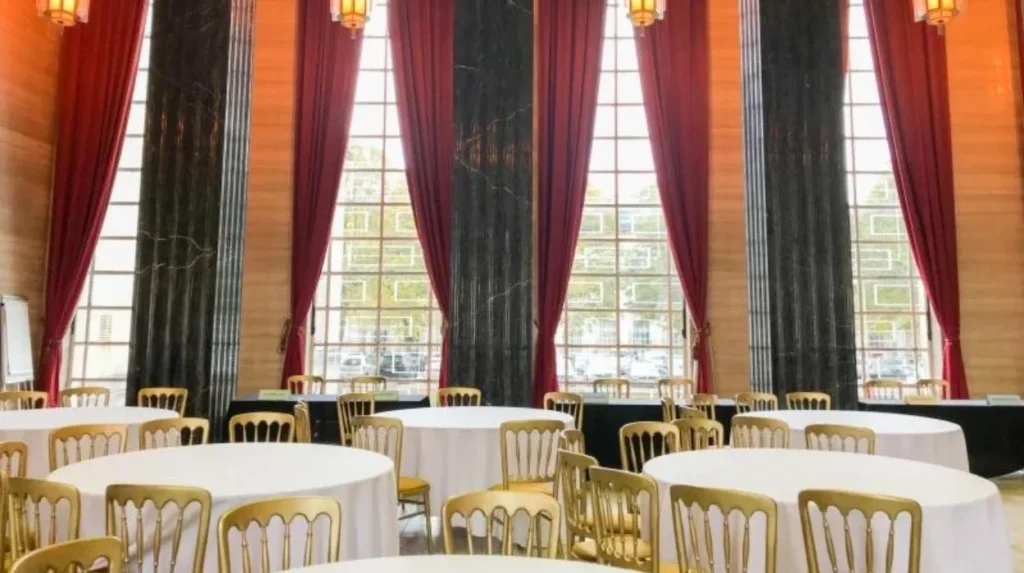
The building itself also operates as an event venue. This means access is influenced by the Temple’s active use for meetings, conferences, educational programmes and other activities.
The official Temple of Peace website provides information about venue use and the organisation’s current activities.
Visitors interested in the building’s history should distinguish between general access to the surrounding area and access to internal rooms.
The Temple is not simply a conventional museum with unrestricted daily gallery access. It is a working heritage building and the headquarters of an active charity.
This distinction is important for planning.
The surrounding Cathays Park area also allows visitors to combine the Temple with other major Cardiff civic and cultural landmarks.
The site therefore fits naturally into a wider Cardiff heritage itinerary focused on architecture, civic history, museums, education and public institutions.
Why does the Temple of Peace Cardiff remain relevant today?
The Temple of Peace remains relevant because its original themes continue through education, human rights, peacebuilding and international cooperation. Its archives, organisations, events and heritage spaces connect Cardiff’s twentieth-century internationalist traditions with contemporary civic and global issues.
The Temple’s continuing relevance comes from the relationship between heritage and active public work.
Its original purpose developed during the aftermath of the First World War, when international cooperation was viewed as an important response to the destruction caused by conflict.
The building opened in 1938, immediately before another major European war. Its survival provides a physical reminder of the challenges facing international peace initiatives during the twentieth century.
The WCIA continues to promote peace, human rights, sustainability and international engagement from the Temple.
These subjects remain part of contemporary public education.
The building also demonstrates how Cardiff participated in international affairs. Its institutional history connects Welsh organisations with wider movements involving the League of Nations, the United Nations and international cooperation.
The archive strengthens this relevance by preserving documentary evidence of those activities.
The Peace Garden adds another dimension. Its more than 50 memorials provide a physical record of Welsh peace makers and peace movements.
The Temple therefore has continuing relevance across several areas of Cardiff life.
It is an architectural landmark, a listed building, a memorial, an organisational headquarters, an archive location, an event venue and a centre for international education.
Its historical function and contemporary use remain closely connected.
For Cardiff, the Temple of Peace provides a direct link between local heritage and international civic engagement. Its continued operation ensures that the building remains part of the city’s active cultural and institutional landscape rather than existing solely as a preserved monument.
Conclusion
The Temple of Peace Cardiff is an important part of the city’s architectural, civic and international heritage. Opened in 1938, it was created through the vision of Lord Davies of Llandinam as both a memorial to the First World War dead and a centre dedicated to peace and health.
Designed by Sir Percy Thomas, the building is recognised by Cadw as a Grade II listed building. Its Portland stone exterior, monumental portico and formal classical references give it a distinctive position within Cathays Park.
Its history extends beyond architecture. Organisations associated with international cooperation, public health and peace have operated from the building across more than eight decades.
Today, the Welsh Centre for International Affairs continues this tradition through global learning, international partnerships, peace, human rights and sustainability.
The National Garden of Peace adds more than 50 memorials to Welsh peace makers and movements, while the Temple’s archives preserve documentary evidence of Wales’ internationalist history.
For Cardiff, the Temple of Peace represents the intersection of heritage, remembrance, architecture, international affairs and civic education. Its historic purpose remains visible in the building, its garden, its collections and its continuing institutional role.
What is the Temple of Peace Cardiff?
The Temple of Peace Cardiff, officially called the Temple of Peace and Health, is a Grade II listed building in Cathays Park. It opened in 1938 as a memorial to the First World War dead and a centre for peace and health.