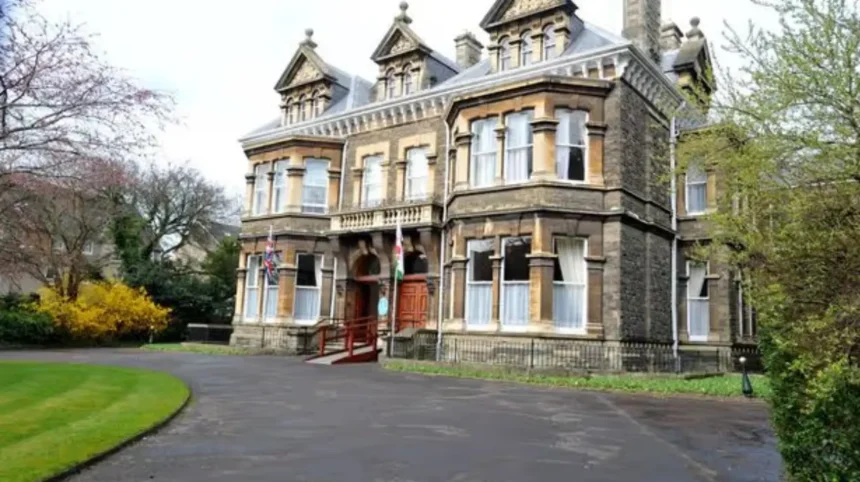
Mansion House Cardiff is one of the city’s best-known civic heritage buildings. Located on Richmond Road in Plasnewydd, the Grade II listed property combines late Victorian domestic architecture with more than a century of municipal use.
- What is Mansion House Cardiff?
- Who built Mansion House Cardiff and why was it constructed?
- When was Mansion House Cardiff built?
- What architectural style does Mansion House Cardiff have?
- Why does Mansion House Cardiff have two front doors?
- How did Mansion House Cardiff become a civic building?
- What is the Grade II listing of Mansion House Cardiff?
- What was Mansion House Cardiff used for after becoming a council property?
- What historic features can be found at Mansion House Cardiff?
- What is the connection between James Howell and Cardiff’s Mansion House?
- Why is Mansion House Cardiff important to the history of the city?
- How should visitors understand Mansion House Cardiff today?
The building was originally known as Grove House. It was commissioned by James Howell, the Cardiff retailer who established Howell’s department store and became one of the city’s prominent Victorian businessmen. Construction began in 1891, with the house completed around 1896.
The property later entered public ownership. Cardiff Corporation acquired the house in 1912, and it was officially opened as the Mansion House in 1913 as the official residence of the Lord Mayor of Cardiff.
Today, Mansion House remains associated with Cardiff’s civic administration. The building is used for official functions, receptions and other activities connected with the Lord Mayor. Cardiff Council identifies the Richmond Road property as the address for the Lord Mayor’s civic and charitable work.
Its importance comes from the combination of architecture, commercial history, municipal history and surviving historic fabric. Mansion House also provides a direct connection between Cardiff’s rapid nineteenth-century development and its modern civic identity.
What is Mansion House Cardiff?
Mansion House Cardiff is a Grade II listed civic building on Richmond Road in Plasnewydd. Built around 1896 as Grove House for retailer James Howell, it became Cardiff’s official Lord Mayor’s residence after the city council acquired it in 1912.
Mansion House stands in the Plasnewydd area of Cardiff, close to the wider Roath district. The property was created as a substantial private residence during a period when Cardiff was experiencing major economic and urban expansion.
The building was originally called Grove House. The name reflected its original role as a private family home rather than a civic institution. Its owner, James Howell, had already established himself as a successful retailer through his department store business in central Cardiff.
The house later became known as Mansion House because of its municipal function. Cardiff Corporation purchased the property in 1912, and its formal civic role began the following year.
The building is recorded by Coflein, the online database of the Royal Commission on the Ancient and Historical Monuments of Wales, under NPRN 409436. Coflein identifies it as a nineteenth-century house in the Plasnewydd community and records its original name, architectural form and connection with James Howell.
Mansion House is therefore not simply a historic residence. It is a surviving example of how a privately funded Victorian house became part of Cardiff’s civic infrastructure.
Who built Mansion House Cardiff and why was it constructed?
The Mansion House was commissioned by James Howell, the Cardiff retailer who founded Howell’s department store. Construction began in 1891, and the completed Grove House dates from about 1896. Its design reflected Howell’s wealth, family needs, and late Victorian Cardiff.
James Howell was born in Pembrokeshire in 1835 and established his Cardiff retail business in 1865. His company developed into one of the city’s major department stores. The business became strongly associated with St Mary Street and Cardiff’s commercial centre.
Howell required a large family residence. He had 11 children, creating a significant practical requirement for domestic space. Cadw’s historical material records that Grove House was designed with this family context in mind.
The location also reflected the development of Cardiff during the late nineteenth century. Cardiff had expanded rapidly through coal exports, port activity, commerce, manufacturing and population growth. Wealth generated through these industries supported substantial new houses and civic buildings.
Grove House represented the residential side of that economic transformation. It was not built as a public building. It was created as a private family residence for a successful Cardiff businessman.
Construction began in 1891 on land leased from Lord Tredegar, whose estate had significant influence over development in Cardiff. Cadw records the relationship between the site, Lord Tredegar’s land and the architects responsible for the building.
The house was completed around 1896. Its scale and architectural treatment reflected the financial position of its owner and the architectural ambitions of late Victorian Cardiff.
When was Mansion House Cardiff built?
Mansion House Cardiff was built around 1896, with construction beginning in 1891. The original building was called Grove House and was commissioned as James Howell’s family residence before becoming a Cardiff civic property in the early twentieth century.
The construction period is important because it places Mansion House within a major phase of Cardiff’s nineteenth-century expansion.
Coflein records the house as dating from approximately 1896. Cadw’s educational material states that building work began in 1891 and identifies 1896 as the year associated with the completed Mansion House.
The building belongs to a period when Cardiff developed substantial residential districts beyond the medieval and early industrial core. Areas such as Roath and Plasnewydd experienced extensive residential development as Cardiff’s population and economy expanded.
The property was therefore part of a wider urban transformation. Cardiff was becoming a major commercial and industrial centre, while successful business owners were establishing large houses in newly developing residential districts.
The date also explains the building’s architectural character. Late Victorian architecture frequently incorporated historical references, formal symmetry and carefully selected materials. Mansion House uses a restrained classical approach rather than the Gothic style found in some other major Victorian buildings.
Its survival provides physical evidence of the architectural standards associated with Cardiff’s prosperous commercial class at the end of the nineteenth century.
What architectural style does Mansion House Cardiff have?
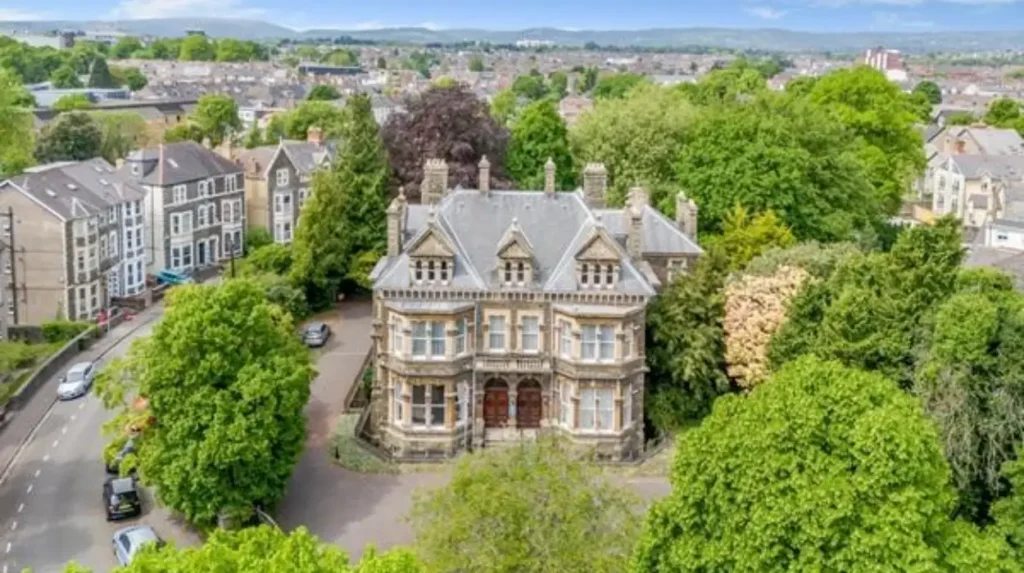
The building was designed by Habershon and Fawckner, architects associated with Cardiff and the Tredegar estate. It uses free Classical architecture, Pennant sandstone, Bath stone dressings, a hipped slate roof, symmetrical elevations, dormers, an upper balcony, and paired entrance doors.
Mansion House is described as a free Classical-style building. Coflein records a three-bay frontage, two principal storeys, attics and a basement.
The external walls use rock-faced Pennant sandstone. Pennant sandstone was widely used across South Wales and became a characteristic building material in Cardiff and surrounding areas. Lighter Bath stone is used for architectural dressings, creating contrast within the façade.
The roof is hipped and covered with slate. Bracketed eaves contribute to the building’s Victorian character.
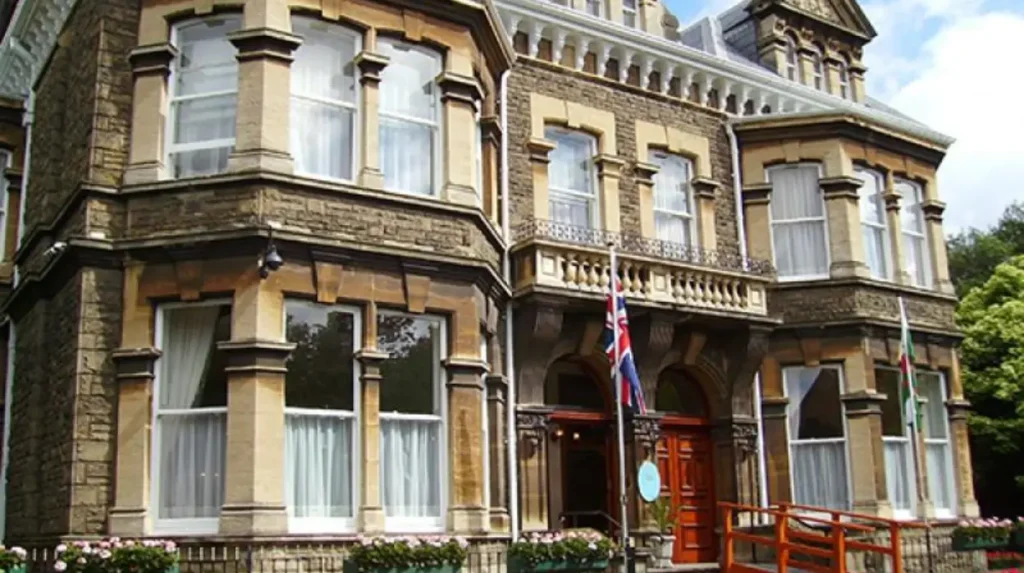
The front elevation is symmetrical. The central entrance arrangement creates a strong architectural focus. Above it, the building includes a balcony with a stone balustrade and open quatrefoil ironwork. The attic contains three full dormers with round-headed lights and pediments.
The architects were Habershon and Fawckner, a practice associated with projects in Cardiff and with the Tredegar estate. Cadw records that the architects worked on several Cardiff buildings, including Marlborough Road School and houses in Roath and Splott.
These details make the building significant beyond its civic function. Its materials, proportions and decorative elements demonstrate the architectural ambitions of an affluent Victorian household.
Why does Mansion House Cardiff have two front doors?
The paired entrance is one of Mansion House Cardiff’s most distinctive planning features. James Howell designed the house with the possibility of division into two residences. A dividing wall in the cellar supported this future arrangement while preserving the exterior.
The two entrances were a practical feature of the original design. James Howell wanted the property to remain adaptable as his family circumstances changed.
Cadw records that Howell had 11 children and that the house was deliberately designed so it could eventually be divided into two separate properties.
The paired entrance arrangement supported this potential division. Instead of constructing a completely new building later, the existing house could be adapted into separate residences.
Coflein also records the paired entrance and identifies it as part of the building’s original design.
The cellar provides further evidence of this planning strategy. A dividing wall was constructed in the basement, creating a structural arrangement that supported the possibility of separating the property.
This feature demonstrates that Mansion House was designed around practical household planning as well as architectural presentation.
The two entrances also contribute to the building’s symmetrical façade. They are therefore both functional and architectural elements.
For architectural historians, this arrangement provides evidence of how large Victorian houses were designed around changing family requirements. The building was not planned as a fixed monument. It was designed as a flexible domestic property with the potential for future subdivision.
How did Mansion House Cardiff become a civic building?
Mansion House became a civic property after Cardiff Corporation acquired it in 1912. It was formally opened as the Mansion House in 1913 and became the official residence of the Lord Mayor, linking a private Victorian home with municipal government.
James Howell died in 1909. Coflein records that the house remained unoccupied after his death before being sold to Cardiff City Council in 1912.
The acquisition changed the function of the property.
Grove House had been designed for private domestic life. After its purchase by the municipal authority, the building became connected with Cardiff’s civic leadership.
The property was officially opened as the Mansion House in 1913. Cardiff Newsroom describes it as the official residence of the Lord Mayors of the city.
This transition reflected the changing role of Cardiff itself. By the early twentieth century, the city had developed an established municipal administration and required buildings associated with civic representation.
The Mansion House provided a suitable setting for formal civic activities. Its scale and architectural character supported receptions, official meetings and ceremonial events.
The transition from Grove House to Mansion House also preserved the property rather than replacing it with a purpose-built civic structure.
The building therefore contains two distinct historical phases. The first relates to James Howell, Victorian commerce and private domestic life. The second relates to Cardiff Corporation, the Lord Mayor and municipal government.
What is the Grade II listing of Mansion House Cardiff?
As a Grade II listed building, Mansion House has recognised architectural and historic interest under Wales’s listed-building system. Its listing protects significant historic fabric and means alterations require appropriate heritage controls, supporting long-term conservation of the building’s character and significance.
Mansion House Cardiff is a Grade II listed building. The listing date is recorded as 24 May 2002, with Cadw identified as the source of the designation.
In Wales, listed buildings are recognised for their special architectural or historic interest. Listing is a heritage protection mechanism that controls significant changes to buildings of recognised importance.
The Grade II category is used for buildings of special architectural or historic interest. It is distinct from Grade II* and Grade I designations, which apply to buildings of progressively higher levels of national significance.
The listing of Mansion House recognises both its architecture and its historical associations.
Its architectural interest includes the free Classical composition, sandstone construction, Bath stone details, roof form, dormers, balcony and distinctive entrance arrangement. Its historic interest includes its connection with James Howell and its later role as Cardiff’s official Mansion House.
Listing does not mean that a building is frozen exactly as it was in the nineteenth century. It establishes a legal heritage framework for managing alterations and protecting significant features.
For Mansion House, this status helps maintain the physical evidence of its original construction and civic history.
Explore more Area Guide
Uncovering the Hidden History of Rumney Hall in Cardiff 2026
Guide to Independent Local Bookshops: Pontcanna, Cardiff 2026
What was Mansion House Cardiff used for after becoming a council property?
Mansion House functions as a civic venue rather than a conventional visitor attraction. The Lord Mayor uses the property for official duties, receptions, meetings, and civic functions. Its current role continues the building’s long connection with Cardiff municipal civic life.
The building has maintained a civic purpose for more than a century.
After Cardiff Corporation acquired the property, Mansion House became associated with the office of the Lord Mayor. Its rooms provided a setting for formal civic activities and municipal hospitality.
The building’s function differs from that of a museum. It is not primarily maintained as a static exhibition space. Instead, its significance is connected to continued civic use.
Cardiff Council continues to identify Mansion House on Richmond Road as the address of the Lord Mayor’s civic operation. Current council information lists the property as the location for the Lord Mayor’s charity administration.
The Lord Mayor is Cardiff’s civic figurehead and represents the city at formal occasions. The office is distinct from the political leadership provided by the council’s executive structures.
Mansion House provides a physical setting for this civic role.
Its continued use also demonstrates an important principle in historic-building conservation: a heritage building can retain relevance through active use.
The building’s present function preserves the connection established in 1913 while allowing its rooms and architectural features to remain part of Cardiff’s contemporary civic life.
What historic features can be found at Mansion House Cardiff?
Mansion House retains several features associated with its late Victorian design, including Pennant sandstone walls, Bath stone dressings, a hipped slate roof, symmetrical frontage, dormers, balcony detailing, a basement and the distinctive paired entrance arrangement.
The exterior provides the clearest evidence of the building’s original design.
The three-bay arrangement creates a balanced frontage. The two principal storeys are supplemented by attic accommodation and a basement.
Pennant sandstone forms the principal wall material. The rock-faced finish gives the exterior a substantial appearance and connects the house to the geological and architectural traditions of South Wales.
Bath stone appears in the dressings. This lighter stone creates visual definition around architectural elements.
The hipped slate roof sits above bracketed eaves. Slate was a standard roofing material for substantial Victorian buildings in Wales and Britain.
The attic level contains three full dormers. Their round-headed lights and pediments add vertical emphasis to the roofline.
The upper balcony has a stone balustrade and open quatrefoil ironwork. These details demonstrate the level of decorative treatment applied to a prosperous late Victorian residence.
The paired entrance is particularly significant because it reflects the original plan for potential subdivision.
The basement is also historically important because it contains evidence of the proposed division of the property.
Together, these features provide architectural evidence for understanding how Mansion House was planned, built and adapted.
What is the connection between James Howell and Cardiff’s Mansion House?
James Howell connected Mansion House with Cardiff’s nineteenth-century retail expansion. He founded his department-store business in 1865, built Grove House as his family residence, and left a lasting link between commercial success, residential architecture, and Cardiff civic heritage.
James Howell is central to the history of Mansion House.
He established his Cardiff business in 1865. The enterprise expanded into one of the city’s best-known department stores and became closely associated with St Mary Street.
Howell’s commercial success enabled him to commission a substantial private residence.
The house also reflected his family circumstances. With 11 children, Howell required a large home. The decision to incorporate paired entrances and a potential division between two residences demonstrates the practical planning behind the property.
The connection between the house and Howell’s retail business remained visible for decades.
In 2024, Cardiff Council announced the unveiling of a portrait of James Howell at Mansion House. The portrait had previously hung in the offices of Howell’s department store. It was transferred to the council after the former House of Fraser store closed in March 2023.
The portrait adds another layer to the building’s interpretation.
Mansion House therefore represents both Howell’s personal history and Cardiff’s commercial development. His residence survives as a civic building, while his retail legacy remains part of the city’s commercial history.
Why is Mansion House Cardiff important to the history of the city?
Mansion House Cardiff remains relevant because it connects Victorian commerce, residential architecture, municipal government, and modern civic activity in one surviving building. Its history documents Cardiff’s late nineteenth-century growth and the transformation of private wealth into public civic heritage today.
Cardiff’s nineteenth-century expansion created new relationships between commerce, residential development and civic administration.
Mansion House captures these relationships in a single property.
Its original owner, James Howell, represented the growing commercial class that benefited from Cardiff’s expanding economy. His department store operated in the city centre, while his family home was constructed in the developing residential area of Plasnewydd.
The property’s later purchase by Cardiff Corporation demonstrates a different phase of the city’s development. A private residence became a municipal asset and acquired a civic function.
This transition is historically important because it preserved a building associated with Cardiff’s Victorian commercial elite while giving it a public role.
The architectural record also documents late nineteenth-century construction methods and materials. Pennant sandstone, Bath stone, slate roofing and decorative ironwork all contribute to the building’s heritage significance.
Its civic use adds another layer.
Mansion House has served Cardiff’s Lord Mayors since the early twentieth century. The building continues to provide a setting for official activity, demonstrating that historic architecture remains integrated into the city’s administrative and ceremonial life.
The property is consequently relevant to several areas of Cardiff history: retail, architecture, urban development, local government and civic identity.
How should visitors understand Mansion House Cardiff today?
Visitors should understand Mansion House as a historic civic building rather than simply a Victorian mansion. Its importance comes from its architecture, James Howell connection, Grade II listing, municipal history, and continuing association with Cardiff’s Lord Mayor and official civic activities.
Mansion House occupies a different position from Cardiff attractions designed primarily for tourism.
Its principal identity is civic.
The building’s Richmond Road location places it within the historic residential development of eastern Cardiff. Its relationship with nearby Roath and Plasnewydd makes it part of the wider architectural history of the city.
Visitors interested in Cardiff’s heritage can use Mansion House as a reference point for understanding how the city changed during the nineteenth and twentieth centuries.
The property also demonstrates how historic buildings can acquire new purposes without losing their original architectural identity.
Its original role was domestic. Its later role became municipal. Its current role remains civic.
The best historical interpretation therefore considers all of these stages rather than treating the building only as the former home of James Howell.
The building’s Grade II listing provides additional evidence of its heritage value. The official record identifies its architectural form and materials, while Coflein documents its historical development and association with Howell.
Current Cardiff Council information confirms that Mansion House remains connected with the Lord Mayor’s official work.
Mansion House Cardiff consequently remains an important surviving part of the city’s built heritage. It links a nineteenth-century businessman, a Victorian family home, Cardiff Corporation and the modern office of the Lord Mayor in one historic property.
What is Mansion House Cardiff?
Mansion House Cardiff is a Grade II listed Victorian building on Richmond Road in Plasnewydd. It was originally called Grove House and was built for Cardiff businessman James Howell. It became the official residence of Cardiff’s Lord Mayor in 1913.