Cathays is one of Cardiff’s best-known central residential areas and has a substantial private rental market. Its location places renters close to Cardiff University, Cathays Park, the city centre, local shops, public transport, parks and major employment areas.
- What is Cathays like for renters?
- How did Cathays develop as a residential area?
- What types of rental property are available in Cathays?
- How much does renting in Cathays cost?
- What renting laws apply to Cathays tenants?
- What should renters check before moving into a Cathays property?
- What should students know when renting in Cathays?
- How should renters check a Cathays landlord or letting agent?
- How are deposits handled when renting in Cathays?
- What locations and transport factors matter when choosing a Cathays rental?
- What should renters budget for besides rent?
- What are the main advantages of renting in Cathays?
- What challenges should renters consider in Cathays?
- What should renters do before signing a Cathays rental contract?
- What does the future of renting in Cathays look like?
The area has a particularly strong student-rental identity, but its rental market is not limited to students. Young professionals, postgraduate students, couples and other households also rent flats, rooms and houses across Cathays and surrounding streets.
Cardiff’s rental market is part of a wider Welsh housing market shaped by population growth, employment, university demand, housing supply and changes in Welsh housing law. The Office for National Statistics reported an average private rent of £1,162 per month across Cardiff in June 2026, compared with £1,124 in June 2025. Average Cardiff rents varied considerably by property type and bedroom count.
The following guide explains the structure, costs, legal framework and practical considerations involved in renting in Cathays.
What is Cathays like for renters?
Renting in Cathays means living in a densely urban Cardiff neighbourhood close to universities, the city centre, shops, transport links, parks and everyday services. The area has a large private rental sector, with shared houses, flats and rooms serving students.
Cathays sits immediately north of Cardiff city centre and forms an important part of Cardiff’s inner urban area. Its location gives residents direct access to the university district, civic centre and central Cardiff.
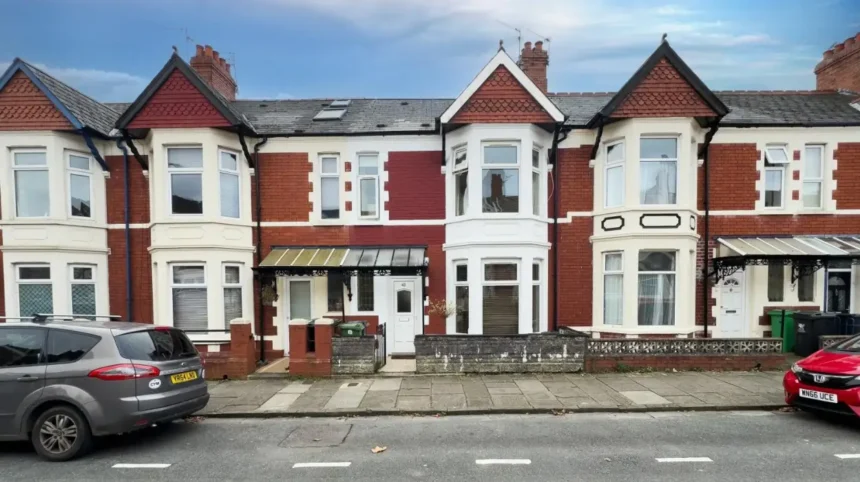
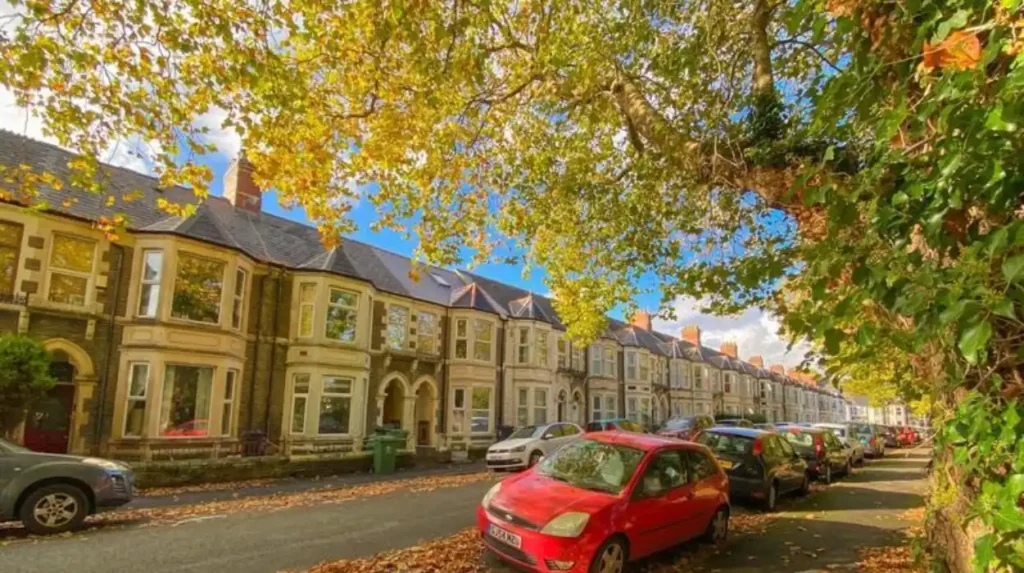
The neighbourhood contains a mixture of traditional terraced housing, converted properties, flats, purpose-built accommodation and shared houses. Property design varies considerably from street to street.
Colum Road, Cathays Terrace, Salisbury Road, Woodville Road and nearby streets contain significant concentrations of student and private rental accommodation. The exact housing mix changes across the neighbourhood.
Cathays Park is an important neighbouring area. It contains Cardiff’s civic centre, historic gardens, public institutions and university buildings. The relationship between Cathays and Cathays Park makes the district particularly well connected to central educational and administrative facilities.
Cardiff University identifies student houses in the Cathays and Roath areas as being close to its Cathays Park campus, Students’ Union and city centre. Its listed student houses include properties with shared kitchens serving groups of four to 11 students.
This proximity is one of the principal reasons rental demand remains closely associated with university life.
How did Cathays develop as a residential area?
Cathays became closely associated with Cardiff’s expansion during the nineteenth and early twentieth centuries. Cathays Park developed as a civic centre after Cardiff acquired land from the Bute Estate in 1897-1898, while nearby residential streets expanded alongside the growing population.
Cathays has a long connection with Cardiff’s urban development. The wider area changed substantially as Cardiff expanded during the nineteenth century and developed into a major industrial, commercial and administrative centre.
Cathays Park was particularly important to this transformation. The land was historically associated with the Bute Estate. Cadw records that Cathays Park originated as a private park laid out from 1812 and was purchased for public use in 1897.
The park was subsequently developed as a major civic centre. Its historic gardens include Alexandra Gardens, Gorsedd Gardens and Friary Gardens. Cadw designated Cathays Park as a registered historic park and garden in 2022.
The development of civic buildings changed the wider character of the district. Cardiff City Hall, the university buildings, law courts, National Museum Cardiff and other institutions established Cathays Park as an educational and administrative centre.
Cardiff Council’s conservation documentation records that the council purchased Cathays Park from the Bute Estate for public purposes and that detailed plans for development were prepared around the beginning of the twentieth century.
Residential development expanded around these civic and educational institutions. The result is a neighbourhood where historic streets sit alongside major institutional buildings and modern rental accommodation.
This history remains relevant to renters because property age differs substantially across the area. Older terraced houses often have different insulation, room layouts, windows, heating systems and maintenance requirements from newer flats.
What types of rental property are available in Cathays?
Rental demand in Cathays is strongly linked to Cardiff’s university population, central location and concentration of shared housing. Typical choices include rooms in shared houses, whole flats, terraced houses and student accommodation, with suitability depending on budget, contracts and needs.
The Cathays rental market contains several important accommodation formats.
Shared houses
Shared houses are a major feature of the local market. A shared house normally provides individual bedrooms alongside communal kitchens, bathrooms and living areas.
Student groups frequently rent entire houses together. The total rent is then divided between contract-holders according to the agreement.
Room size, number of bathrooms, kitchen capacity, heating arrangements and communal space are important when comparing shared houses.
Flats and apartments
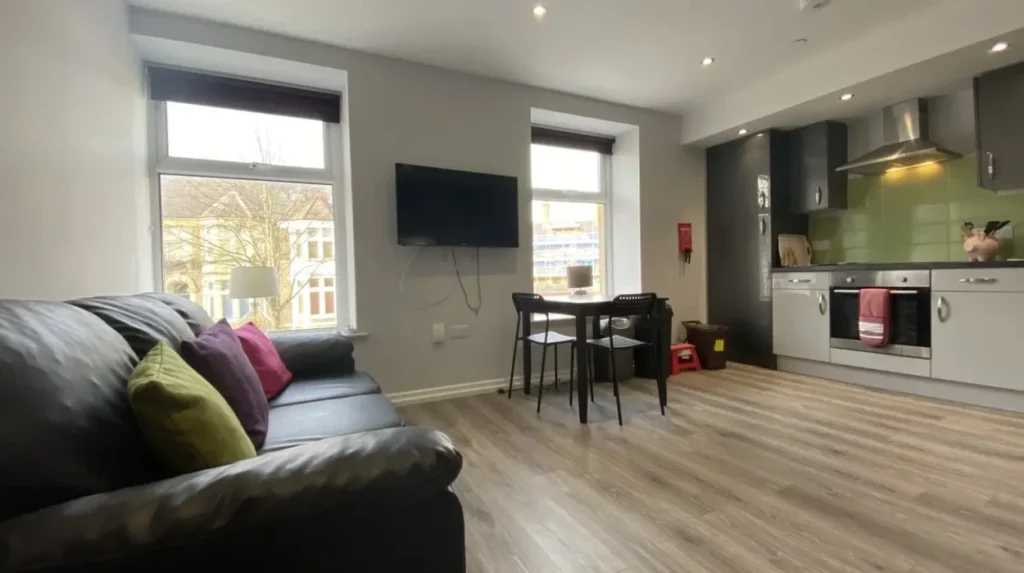
Flats provide an alternative to shared houses. They include purpose-built apartments and residential units created through the conversion of older buildings.
One-bedroom flats suit individual renters or couples who require private accommodation. Larger flats provide additional bedrooms for households that want to share.
Cardiff-wide ONS figures show the difference between property categories. In June 2026, the average private rent for flats and maisonettes in Cardiff was £984 per month, while the average for terraced properties was £1,162. These are Cardiff-wide figures rather than Cathays-specific prices.
Student accommodation
Purpose-built and university-managed accommodation also forms part of the wider Cathays rental environment.
Cardiff University lists student residences and houses close to the Cathays Park campus and city centre. Current university accommodation information includes Student Houses in Colum Road and Student Houses in the Village, with different accommodation formats and contract arrangements.
Traditional terraced houses
Traditional terraced properties are common across Cardiff’s inner neighbourhoods. These houses often provide several bedrooms and communal areas, making them suitable for group households.
Renters should inspect the physical condition carefully because building age varies and maintenance standards differ between individual properties.
How much does renting in Cathays cost?
Before renting in Cathays, compare the total monthly cost rather than headline rent alone. Check whether bills, broadband, furnishings, council tax, deposits, administration charges, parking and utilities are included, then confirm affordability against reliable income and the full contract period.
There is no single official average rent specifically for Cathays that applies to every property. Rental prices depend on bedroom number, property type, furnishing, condition, location, contract structure and whether bills are included.
The latest ONS Cardiff figures provide a useful market benchmark.
In June 2026, average Cardiff private rents were:
- One bedroom: £897 per month
- Two bedrooms: £1,073 per month
- Three bedrooms: £1,194 per month
- Four or more bedrooms: £1,685 per month
The city-wide average was £1,162 per month.
These figures should not be treated as exact Cathays asking rents. Individual Cathays properties can sit above or below Cardiff averages.
Renters should calculate the full housing budget. A property advertised at a lower monthly rent can become more expensive when electricity, gas, water, broadband and other household expenses are added.
Shared accommodation requires additional calculations. A four-bedroom house with four contract-holders distributes the rental cost differently from a one-bedroom flat occupied by one person.
The contract should clearly establish the rent payable and other financial responsibilities. Renters should also check how utility accounts are handled when several people share a property.
What renting laws apply to Cathays tenants?
Welsh renting law uses occupation contracts instead of traditional tenancy agreements for most private residential lets. Contract-holders receive written terms covering rent, responsibilities, repairs, notice and other rights. The Renting Homes framework also establishes property-condition and landlord-information requirements for renters.
The Renting Homes (Wales) Act 2016 fundamentally changed residential renting law in Wales. Most private residential renters now hold an occupation contract rather than a traditional tenancy agreement.
A renter is generally described in the legislation as a contract-holder.
The landlord must provide a written statement setting out the occupation contract. Rent Smart Wales states that the written statement explains the parties’ rights and responsibilities and is based on the Welsh Government model contract.
The legislation introduced important changes to renting arrangements, including stronger requirements concerning written contracts, property condition, succession and notice arrangements.
The Welsh legal framework also increased the standard no-fault notice period to six months under the relevant provisions. Law Wales identifies this as one of the significant changes introduced by the legislation.
Renters should therefore read the written statement rather than relying only on an online property advertisement or verbal agreement.
The document should be retained throughout the rental period. It provides an important record of rent, responsibilities and contractual arrangements.
Welsh law also places obligations on landlords concerning the condition and safety of rented dwellings.
What should renters check before moving into a Cathays property?
A Cathays rental should meet Welsh fitness-for-human-habitation standards and contain required safety measures. Landlords must provide appropriate smoke alarms, carbon-monoxide alarms where required, and electrical safety checks. Renters should inspect damp, heating, windows, locks, plumbing, ventilation and facilities.
The Fitness for Human Habitation requirements form an important part of Welsh rental law.
Welsh Government guidance states that landlords must satisfy specific requirements involving smoke alarms, carbon monoxide alarms and electrical safety. Electrical installations must be inspected and tested at least every five years.
A smoke alarm is required on every storey of a dwelling and must meet the relevant electrical and interconnection requirements.
A carbon monoxide alarm is required in rooms containing a gas appliance, oil-fired combustion appliance or solid-fuel combustion appliance under the relevant regulations.
Renters should still inspect the property themselves.
Particular attention is important in older terraced houses and converted properties. Check ceilings, walls, window frames, external walls and areas around bathrooms and kitchens for signs of damp or water damage.
Heating systems should operate correctly. Windows should close securely. External doors should have appropriate locks. Kitchen appliances should be checked for visible defects.
Bathrooms require adequate ventilation and functioning sanitation. Shared houses also require inspection of communal areas because problems affecting one part of the property can affect every resident.
Renters should photograph existing damage before occupation and keep dated records. This creates useful evidence about the property’s condition at the beginning of the contract.
What should students know when renting in Cathays?
Students renting in Cathays should verify university status, household arrangements, council-tax position, contract dates and deposit requirements. Cardiff Council provides student exemptions and discounts under defined conditions, while Welsh occupation-contract rules still apply to eligible private rentals and shared homes.
Cathays has a strong student housing market because of its proximity to Cardiff University and central Cardiff.
Students should distinguish between university accommodation and private rented accommodation. University residences operate under their own contractual arrangements, while eligible private rentals fall within the Welsh occupation-contract framework.
Council tax is another important consideration.
Cardiff Council states that full-time students can qualify for council-tax exemption when their course meets specified requirements. These include a course lasting at least one academic or calendar year, involving at least 24 weeks of study and at least 21 hours of study, tuition or work experience each week.
Properties occupied entirely by qualifying students can receive an exemption. A property with a mixture of students and non-students is treated differently under council-tax rules. Cardiff Council also provides rules for residents who are not counted when calculating council tax.
Students should obtain the required exemption evidence from their university or college when necessary.
Contract dates are also important. Student housing contracts often follow academic-year patterns. A renter should check the start date, end date, rent payment schedule and any obligations covering summer periods.
Group renters should also establish who is responsible for the contract. Joint occupation contracts can create shared responsibilities between contract-holders.
How should renters check a Cathays landlord or letting agent?
Households should assess Cathays rental properties by location, building condition, household composition, contract structure and recurring costs. Compare several properties, inspect before committing, verify landlord or agent compliance, document defects, understand notice provisions and retain copies of rental documents.
Rent Smart Wales provides the official registration and licensing framework for private landlords and letting agents in Wales.
Landlords letting domestic properties in Wales are required to register with Rent Smart Wales, subject to applicable exemptions. Landlords who undertake letting and management work themselves also require the relevant licence.
Letting and managing agents must also comply with the licensing requirements applicable to their activities.
Renters can use the Rent Smart Wales public register to check whether a landlord or agent is compliant.
This check is particularly important before paying money or signing an occupation contract.
Renters should also confirm the identity of the person or organisation receiving payments. The occupation contract should contain appropriate landlord information.
A 2026 Rent Smart Wales update confirms that landlords must provide their name and an address through the occupation contract and relevant documentation so that tenants have an address through which the landlord can be contacted.
For shared houses, renters should establish whether the property is subject to additional licensing or planning controls.
Cardiff Council operates specific planning controls relating to houses in multiple occupation, commonly abbreviated as HMOs. Its guidance states that when considering new HMO planning applications, the council assesses the concentration of existing HMOs within a 50-metre radius. The stated concentration threshold is above 20% of dwellings in Cathays and Plasnewydd, compared with 10% elsewhere in Cardiff.
This is relevant when assessing larger shared houses and their regulatory position.
How are deposits handled when renting in Cathays?
Rental deposits in Cathays are subject to Welsh tenancy-deposit protection rules when the relevant occupation contract and deposit conditions apply. Renters should obtain written confirmation of the deposit arrangements, understand deductions, retain evidence and check that required protection has been completed.
Welsh Government guidance states that landlords must protect qualifying rental deposits through a government-approved tenancy deposit protection scheme. The requirement applies where an occupation contract exists and the tenant paid the deposit after 6 April 2007.
A deposit is normally paid before occupation or at the beginning of the rental arrangement.
Renters should retain evidence of payment. Bank records, receipts and written communications provide useful documentation.
The condition of the property at move-in is also relevant to deposit disputes. A detailed inventory, supported by dated photographs, establishes the condition of rooms, furniture, appliances and fixtures.
Renters should report existing damage promptly rather than assuming that the landlord already knows about it.
At the end of the contract, legitimate deductions can depend on the condition of the property, contractual responsibilities and evidence supporting any claimed damage.
Deposit protection exists to provide a formal framework for qualifying deposits. Renters should check the information supplied about the protection scheme and retain those records until the rental has ended and the deposit has been resolved.
What locations and transport factors matter when choosing a Cathays rental?
Cathays renters benefit from a central location with convenient access to Cardiff University, Cathays Park, the city centre, local shops and public transport. The best property location depends on walking distance, daily destinations, transport needs, parking requirements and household priorities.
Location is one of the main reasons people choose Cathays.
Cardiff University’s accommodation information describes several university residences as being within walking distance of its Cathays Park campus and Cardiff city centre. Student Houses in Colum Road are listed as approximately 10 minutes from the university’s Main Building, while Student Houses in the Village are listed at approximately 15 minutes.
These university figures demonstrate the area’s central position, although actual journey times vary according to the specific property and destination.
Renters should map their regular journeys before signing a contract.
A student attending lectures on the Cathays Park campus should prioritise walking and cycling distance. A professional commuting elsewhere in Cardiff should assess bus, rail and road connections.
Parking requires separate consideration. Some older Cathays properties have limited or no private parking. Street parking conditions differ between locations.
Walkability is another major factor. Shops, cafés, pharmacies, university facilities and city-centre services are concentrated within the wider central area.
Renters should visit the property at different times of day when practical. Traffic, street activity, noise and parking availability can vary between daytime and evening periods.
What should renters budget for besides rent?
Renters should budget for more than monthly rent. Total housing expenditure can include utilities, broadband, council tax where applicable, contents insurance, transport, food, deposits, furnishings and moving costs, with shared households needing clear arrangements for dividing common household bills.
Headline rent is only one part of the cost of renting.
Utilities can include electricity, gas and water. Broadband is another recurring expense, especially for students and people working from home.
Council tax depends on the household composition and eligibility for exemptions or discounts. Cardiff Council states that properties occupied solely by qualifying students can be exempt, while mixed households can fall under different rules.
Contents insurance is not the same as building insurance. Renters generally insure their own belongings rather than the structure of the property.
Shared households should agree how bills are divided before moving in. One person paying all bills creates a different administrative arrangement from each contract-holder paying a fixed contribution.
Moving costs also require planning. They can include transport, cleaning supplies, furniture, kitchen equipment and other household essentials.
A realistic budget should therefore calculate the expected monthly housing cost rather than focusing only on advertised rent.
What are the main advantages of renting in Cathays?
Cathays combines central Cardiff access, university proximity, established residential streets, extensive private rental accommodation and nearby services. These characteristics support different rental arrangements, including student houses, individual rooms, flats and larger shared properties for several household types.
The first major advantage is location.
Cathays provides direct access to central Cardiff without requiring residents to live in the city-centre commercial core.
The second advantage is accommodation choice. Renters can compare rooms, shared houses, flats and student accommodation.
The third advantage is educational proximity. Cardiff University’s Cathays Park campus sits immediately within the wider area, making nearby private accommodation particularly relevant to students.
The fourth advantage is access to established amenities. Local shops and services are distributed throughout the residential streets, while Cardiff city centre provides a much wider range of commercial, cultural and employment facilities.
Cathays Park also provides access to significant civic and cultural landmarks. National Museum Cardiff is located in Cathays Park and provides free admission to its collections, subject to current arrangements.
The district therefore combines residential, educational, civic and cultural functions within a compact part of Cardiff.
What challenges should renters consider in Cathays?
Cathays renters face practical challenges involving competition for suitable accommodation, property condition, shared-house responsibilities, variable rental costs, council-tax rules and contract complexity. Careful property inspections, financial planning, legal checks and written records reduce avoidable problems during the rental period.
Competition is particularly relevant to student accommodation because demand is connected to the academic calendar.
Renters should avoid making decisions solely from photographs. Internal layouts, room sizes, storage, ventilation and communal facilities require physical inspection.
Older housing also requires attention to maintenance. The age of a building does not automatically indicate poor quality, but individual properties require inspection.
Shared houses create additional responsibilities. Kitchen cleanliness, waste disposal, heating use, noise and communal maintenance involve several residents.
Contract complexity is another consideration. Renters should understand whether they are entering an individual room arrangement or a joint household contract.
Financial pressure is also important. Cardiff-wide ONS figures show that average private rents increased from £1,124 in June 2025 to £1,162 in June 2026, an annual increase of 3.4%.
Local Cathays prices differ from this city-wide average, but the Cardiff data demonstrates why renters need an up-to-date affordability calculation.
Explore More Area Guide
Population of Rumney: Comprehensive Demographic Analysis in Cardiff 2026
Family Walks Near Heath Park Cardiff Guide 2026
What should renters do before signing a Cathays rental contract?
Renters should inspect the property, verify the landlord or agent, read the written occupation contract, check deposit protection, confirm safety documentation, calculate recurring costs and record existing defects before committing to a Cathays rental arrangement.
The rental process should begin with affordability.
After identifying a suitable property, inspect it in person where possible. Check bedrooms, communal areas, bathrooms, kitchen equipment, windows, doors, heating and ventilation.
Next, verify the landlord or agent through the appropriate Rent Smart Wales records.
The written occupation contract should then be reviewed carefully. Check the rent, payment dates, responsibilities, notice provisions and other contractual terms.
Deposit arrangements should be confirmed before payment.
Safety requirements should also be checked. Welsh Government guidance establishes requirements covering smoke alarms, carbon monoxide alarms and electrical safety.
Existing defects should be documented. Photographs and written reports create a record that can be retained throughout the contract.
For student households, council-tax status should be confirmed with Cardiff Council and the relevant university or college.
For larger shared houses, renters should also investigate the property’s HMO and licensing position where applicable.
The final step is document retention. Keep the occupation contract, inventory, deposit information, receipts, correspondence, inspection photographs and safety documentation in one accessible location.
What does the future of renting in Cathays look like?
Renting in Cathays will continue to reflect Cardiff’s wider housing conditions, university demand, employment patterns, housing supply, regulation and affordability. ONS rental statistics provide city-wide benchmarks, while individual Cathays rents will continue to depend on property type, location and condition.
Cathays has structural characteristics that support a continuing rental market.
Its proximity to Cardiff University creates recurring student demand. Its location near the city centre supports professional renters. Its established housing stock provides shared houses and flats, while purpose-built accommodation adds another part of the supply.
Welsh housing regulation also continues to shape the private rented sector.
The Renting Homes framework places formal obligations on landlords and provides contract-holders with defined rights and responsibilities. Rent Smart Wales provides registration, licensing, compliance and enforcement functions for the Welsh private rental sector.
Affordability remains a central factor.
ONS data shows that Cardiff rents increased by 3.4% annually to June 2026. The city-wide average of £1,162 provides a useful benchmark, but it does not represent a Cathays-specific average.
For renters, the most reliable approach is to assess each property individually. Monthly rent, property condition, bills, council tax, contract obligations, location and household circumstances all influence the real cost.
Cathays therefore remains a significant Cardiff rental district because of its combination of central location, educational institutions, established housing and private rental supply. Understanding the local housing structure and Welsh legal framework gives renters a stronger basis for comparing properties and entering contracts responsibly.
Is Cathays a good area for renting in Cardiff?
Cathays is a popular rental area in Cardiff because it is close to Cardiff University, Cathays Park, Cardiff city centre, shops, public transport and local services. Its housing stock includes flats, terraced houses, shared student houses and private rental rooms.