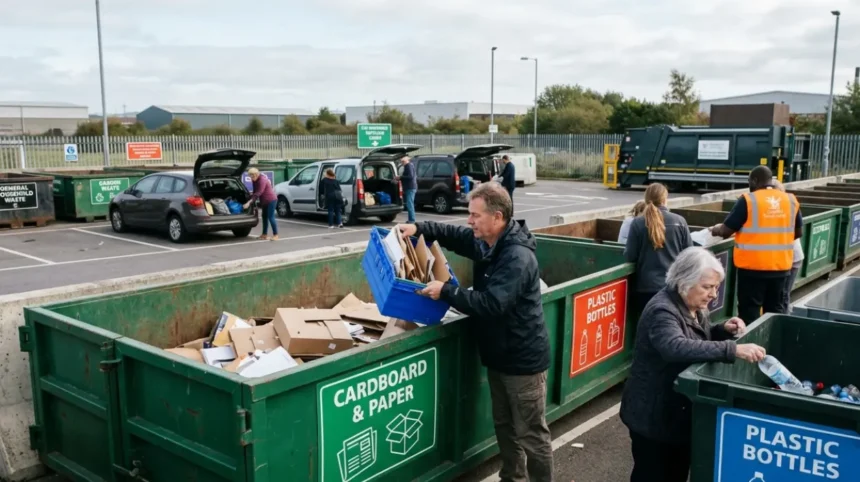
Municipal solid waste management forms a cornerstone of urban environmental policy in modern metropolitan frameworks. For inhabitants of the capital city of Wales, understanding infrastructure networks dictates everyday domestic compliance and regional environmental health. The Cardiff Council recycling centre located on Lamby Way within the Rumney electoral ward operates as a critical logistical hub. This specialized facility serves thousands of residential households every week, diverting domestic refuse away from disposal pathways and funneling materials into active circular economy pipelines.
- What Is the Exact Location and Accessibility Data for the Rumney Recycling Centre?
- Geographic Positioning and Infrastructure Access
- Operating Hours and Seasonal Schedules
- Structural Site Layout and Traffic Flow
- How Does the Cardiff Council Digital Booking System Function for Residents?
- What Specific Vehicle Restrictions and Asset Rules Apply at Lamby Way?
- Permitted Domestic Vehicle Categories
- Restricted Passenger Commercial Hybrids
- Prohibited Vehicle Configurations
- Which Waste Classifications Are Accepted or Prohibited at the Facility?
- Authorized Recyclable Waste Streams
- Restricted and Site-Specific Materials
- Prohibited Industrial Waste Classifications
- How Does the On-Site Sorting Policy and Pre-Sorting Directive Work?
- The Anti-Landfill Separation Policy
- On-Site Verification Actions
- Optimization Strategies for Residents
- What Industrial Processes Happen to Materials Post-Collection?
- The Materials Reclamation Facility Processing Sequence
- Advanced Sorting Technologies
- Downstream Value Chain and Remanufacturing
- What Legal Frameworks and Environmental Laws Govern the Site?
- Statutory Regulatory Frameworks
- Oversight by Natural Resources Wales
- Fly-Tipping Penalties and Enforcement Actions
- How Does the Site Support the Cardiff Circular Economy Strategy?
To maximize the efficiency of this civic infrastructure, users must navigate specific operational frameworks established by the local authority. This complete guide provides exact operational details, statutory legal guidelines, accepted material classifications, and systematic booking procedures required to utilize the premier recycling site in eastern Cardiff.
What Is the Exact Location and Accessibility Data for the Rumney Recycling Centre?
The Lamby Way Recycling Centre is located at Lamby Way Depot, Rumney, Cardiff, CF3 2EQ, operating seven days a week from 8:30 AM to 5:30 PM, closing only on Christmas Day, Boxing Day, and New Year’s Day.
Geographic Positioning and Infrastructure Access
The facility is positioned within the industrial and commercial zone of Rumney in eastern Cardiff. The geographic coordinates place the depot directly off the main arterial route of Wentloog Avenue, which links the eastern districts of the city to the A48 major trunk road network. This strategic positioning isolates high-volume public vehicular traffic away from dense residential streets, allowing heavy municipal transport vehicles and domestic automobiles to navigate the area safely.
Operating Hours and Seasonal Schedules
Cardiff Council enforces standardized operational hours across its primary waste management network. The Lamby Way facility operates on a fixed schedule throughout the entire calendar year. The site opens at 8:30 AM and terminates daily public access at 5:30 PM.
This seven-day operation guarantees full weekend availability for residents. The site ceases public operations strictly during three bank holidays: Christmas Day (December 25), Boxing Day (December 26), and New Year’s Day (January 1). Emergency operational closures due to extreme weather incidents or critical on-site maintenance are broadcast immediately via the official Cardiff Council digital communication channels.
Structural Site Layout and Traffic Flow
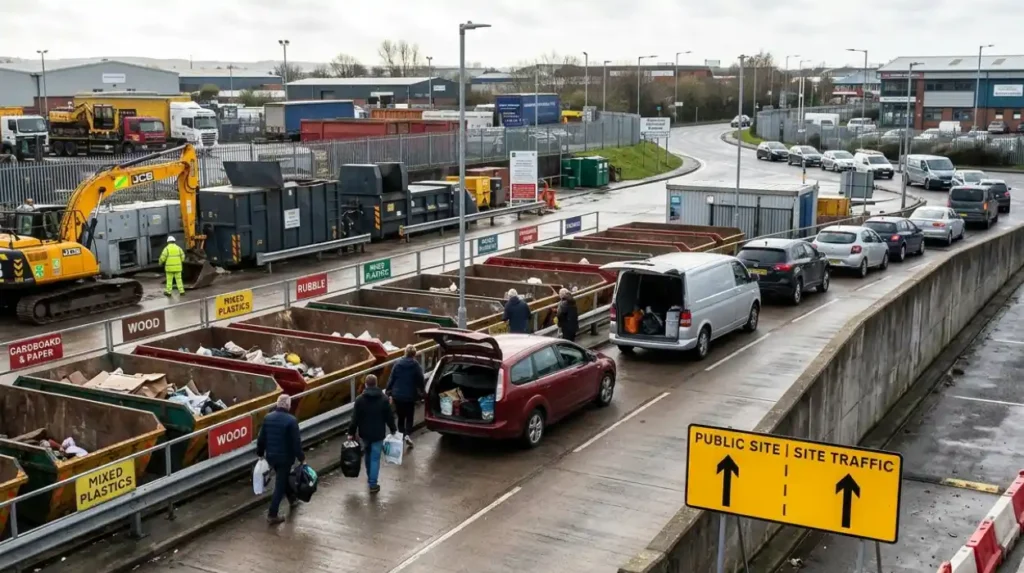
The site infrastructure utilizes a split-level design pattern engineered to maximize public safety during offloading procedures. Citizens drive up an elevated concrete ramp system to access a series of large, open-topped skips and industrial compactors. This structural arrangement removes the requirement for users to lift heavy items vertically above waist height.
The lower level remains strictly reserved for terminal staff operating heavy machinery, mechanical excavators, and commercial shunt vehicles. Clear color-coded signage stands at the entrance, dividing traffic lanes to prevent bottlenecks during peak utilization periods.
How Does the Cardiff Council Digital Booking System Function for Residents?
Residents must book a specific time slot online or via the Cardiff Gov mobile app before visiting the Lamby Way site, as unauthorized vehicles are strictly turned away by gate security personnel without exception.
Digital Reservation Framework
Cardiff Council implemented a digital booking system to regulate traffic volumes, reduce vehicular idling times, and track per-household waste allocations across the city. Residents must log into the portal via the official Cardiff Council website or utilize the native Cardiff Gov mobile application. The booking interface updates available slots continuously, permitting users to schedule appointments up to several weeks in advance or secure same-day slots if local demand permits.
Household Allocation Limits
To stop illegal commercial operators from exploiting free civic amenities, the local authority enforces strict caps on site utilization. Households possess an annual allocation of 26 site visits per calendar year. On any single operational day, a household can secure a maximum of three individual booking slots. The vehicle registration number entered during the digital registration process must match the vehicle arriving at the security gatehouse.
Entry Requirements and Arrival Verification
Upon arrival at the Rumney facility, drivers must halt at the check-in point for verification. Staff members utilize handheld digital scanners to read confirmation codes or verify vehicle registrations against the active daily manifest. Drivers must present two distinct forms of documentation to gain entry to the offloading platform:
- Booking Confirmation: A physical printout or digital display of the reservation pass containing the unique quick response code.
- Proof of Local Residency: A valid photo driving licence, a current Council Tax demand notice, or a utility statement dated within the preceding three calendar months, confirming a residential address within the borders of the City and County of Cardiff.
What Specific Vehicle Restrictions and Asset Rules Apply at Lamby Way?
Only standard domestic motorcars, sports utility vehicles, and adapted accessibility transport options are permitted onto the main household offloading platform, while commercial vehicles face immediate exclusion.
Permitted Domestic Vehicle Categories
The physical geometry of the elevated offloading platform dictates strict limitations on vehicle dimensions. Standard passenger automobiles containing rear windows are permitted unrestricted access, provided a valid digital booking exists. Sports utility vehicles, estate cars, and multi-purpose vehicles containing a maximum of seven passenger seats are authorized.
Vehicles modified specifically for disabled accessibility are granted full entry privileges, provided the gross vehicle weight stays within designated limits.
Restricted Passenger Commercial Hybrids
Small domestic vans, campervans, combi-vans, and lifestyle open-back pickup trucks face specialized scrutiny. The council classifies these vehicles as commercial hybrids. Owners of these specific vehicle types can access the Lamby Way site only if they hold a specialized permit confirming the transport contains household waste exclusively.
These vehicles must undergo visual inspections by gate staff before receiving permission to ascend the offloading ramp.
Prohibited Vehicle Configurations
To safeguard civic infrastructure and eliminate corporate tax evasion regarding commercial tipping fees, several vehicle configurations are permanently barred from entering the public household recycling area:
- Commercial cargo transport units exceeding a gross weight profile of 3.5 tonnes.
- Sign-written commercial transport trucks, corporate vans, or vehicles bearing third-party business logos.
- Mechanical tipper vehicles, heavy-duty industrial box vans, and multi-axle commercial trailers.
- Any vehicle towing an independent trailer on the main residential ramp at the Lamby Way site.
Which Waste Classifications Are Accepted or Prohibited at the Facility?
The Rumney recycling facility processes diverse domestic streams including electronic goods, white goods, timber, metals, and green garden matter, while strictly rejecting hazardous industrial chemicals and mixed commercial waste fractions.
Authorized Recyclable Waste Streams
The site functions primarily to process sorted consumer waste fractions. Materials must be segregated by the user before arrival to ensure rapid offloading into specialized industrial containers. The site manages standard sorted components efficiently:
- Consumer Electronic Assets: Desktop computers, cellular smartphones, television displays, and domestic small appliances.
- Large Domestic White Goods: Laundry washing machines, kitchen refrigeration units, dishwashers, and clothes dryers.
- Organic Green Garden Waste: Lawn grass clippings, hedge trimmings, tree branches, and organic root material.
- Structural Building Elements: Untreated scrap timber, structural lumber, ferrous iron beams, and non-ferrous aluminum extrusions.
Restricted and Site-Specific Materials
Certain challenging consumer materials require unique processing techniques and are confined to specific drop-off bays. Automotive lead-acid batteries, domestic household alkaline batteries, spent fluorescent lighting tubes, and used engine oils must be handed directly to site technicians.
The Lamby Way depot accepts specific complex consumer elements that are rejected at smaller regional hubs: unplasticized polyvinyl chloride window frames and end-of-life automotive rubber tyres are accepted only at the Rumney site under strict quantity limitations.
Prohibited Industrial Waste Classifications
The public household recycling sector cannot process high-risk or commercial-grade materials. Staff will intervene and halt offloading if any forbidden compounds are detected during visual spot-checks.
Prohibited categories include:
- Mixed commercial waste fractions originating from corporate operations, retail outlets, or paid trade specialists.
- Liquid chemical solvents, industrial paint stocks, and volatile hydrocarbon fuels.
- Unexploded gas canisters, pressurized industrial cylinders, and commercial explosive compounds.
- Raw asbestos insulation panels, clinical biological hazardous waste, and un-bagged toxic particulate matter.
How Does the On-Site Sorting Policy and Pre-Sorting Directive Work?
Users must pre-sort all household waste materials prior to entering the facility borders, because mixed general refuse bags are prohibited from immediate disposal without systematic individual visual verification.
The Anti-Landfill Separation Policy
Cardiff Council operates under statutory national targets set by the Welsh Government, which mandate high municipal recycling performance indicators. To meet these targets, the Rumney site strictly enforces an anti-landfill separation policy.
Visitors cannot simply toss black plastic refuse sacks filled with mixed, unsorted items into general waste skips. The facility demands that every material stream goes into its matching recycling bin.
On-Site Verification Actions
If a resident brings sealed plastic bags containing un-segregated trash to the site, operational staff will direct the user to a designated sorting table. The resident must open the containers and separate recyclable items before discarding any residue.
Staff members oversee this process to capture paper, cardboard, plastics, and metals that would otherwise contaminate landfill or energy-from-waste streams.
Optimization Strategies for Residents
To streamline the drop-off process and minimize time spent on the elevated platform, residents should follow three optimization protocols:
- Load Vehicles Chronologically: Place general non-recyclable residual waste deep inside the vehicle boot first, and stack highly recyclable sorted streams near the doors for immediate initial extraction.
- Dismantle Complex Assemblies: Break down mixed-material items at home; strip metallic brackets off large timber wardrobes and pull apart plastic components from composite furniture pieces.
- Utilize Dedicated Containers: Transport loose items like glass bottles or loose green waste inside reusable heavy-duty plastic tubs, which can be emptied rapidly into corresponding skips and returned to the vehicle.
What Industrial Processes Happen to Materials Post-Collection?
Collected consumer waste streams pass directly into the integrated Materials Reclamation Facility at Lamby Way, where automated mechanical screening and manual picking lines isolate high-purity commodities for remanufacturing.
The Materials Reclamation Facility Processing Sequence
The Rumney site is more than just a public drop-off station; it houses a massive, industrial-scale Materials Reclamation Facility. Once the public deposits items into the designated skips, terminal teams use heavy machinery to transfer these bulk volumes into processing lines.
Mechanical trommels (large rotating cylindrical sieves) sort the incoming matter by physical dimension, separating small organic residues from large structural objects.
Advanced Sorting Technologies
The processing lines utilize modern automated sorting mechanisms to isolate specific commodities with high chemical purity:
- Magnetic Separation Fields: Powerful overhead electromagnets pull ferrous metals like steel food cans and structural iron brackets from conveyor belts.
- Eddy Current Separators: Specialized induction fields repel non-ferrous metals, launching aluminum beverage containers and copper components into distinct collection bays.
- Optical Sorting Spectrometers: Near-infrared light sensors scan moving plastic lines, instantly identifying the polymer signatures of polyethylene terephthalate and high-density polyethylene, using precise air jets to blast target polymers into sorted channels.
Downstream Value Chain and Remanufacturing
Once separated, materials are compressed by industrial hydraulic systems into high-density transport bales. These uniform blocks of commodities are sold directly to verified UK reprocessing plants, keeping carbon footprints low by avoiding overseas shipping.
Clean timber elements are shredded into chipboard components or processed into biomass fuel blocks. Metals enter foundry furnaces to be cast into fresh structural components, while sorted plastics are pelletized to create new consumer packaging items.
What Legal Frameworks and Environmental Laws Govern the Site?
The Rumney facility operates under strict environmental permits issued and audited by Natural Resources Wales, complying with national statutory targets dictated by the Environmental Protection Act 1990.
Statutory Regulatory Frameworks
The management of the Lamby Way complex is governed by the Environmental Protection Act 1990. This legislation places a strict legal “duty of care” on both Cardiff Council and the citizens utilizing the site.
The local authority must ensure that waste material does not escape into the surrounding environment, while residents must dispose of their items through these lawful, authorized channels.
Oversight by Natural Resources Wales
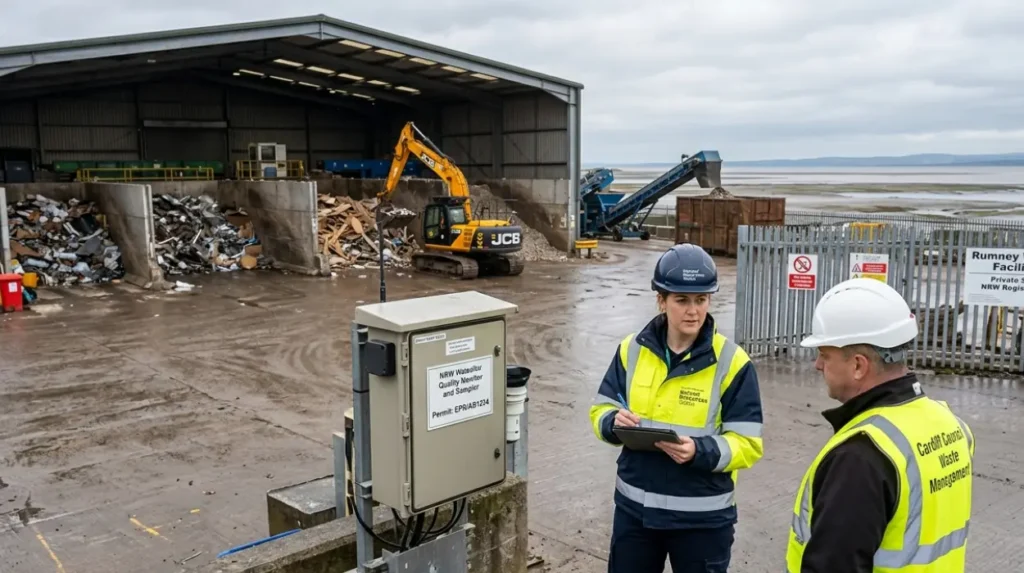
Natural Resources Wales monitors operations at the Rumney site. The body issues the environmental permits required to store, sort, and process waste materials adjacent to the sensitive coastal environment of the Severn Estuary.
Regular unannounced inspections check that dust emissions, noise pollution, and surface water runoff match strict environmental safety levels.
Fly-Tipping Penalties and Enforcement Actions
Abandoning household waste items outside the security perimeter gates, along Wentloog Avenue, or anywhere within the surrounding Rumney district constitutes a serious environmental crime under Section 33 of the Environmental Protection Act 1990.
Cardiff Council operates high-definition closed-circuit television networks across the area to identify offenders. Individuals caught fly-tipping face fixed penalty notices starting at £400, while severe or repetitive corporate violations can trigger prosecution in Magistrate Courts, resulting in unlimited financial penalties or imprisonment.
How Does the Site Support the Cardiff Circular Economy Strategy?
The facility acts as a key operational center for the Towards Zero Waste national strategy, aiming to phase out landfill disposal completely by driving municipal recycling rates past 70 percent.
The Towards Zero Waste National Blueprint
The Welsh Government established an ambitious environmental blueprint titled Towards Zero Waste. This statutory framework positions Wales as an international leader in resource sustainability.
The Rumney recycling hub provides the physical infrastructure required to hit these targets at a local level. By capturing consumer assets before they enter mixed waste streams, the city preserves the embedded energy of these commodities.
Carbon Minimization and Resource Recovery
Diverting domestic furniture, appliances, and organic garden waste away from traditional landfill sites prevents the formation of methane gases, a potent greenhouse gas driver.
Extracting structural metals and clean polymers at the Lamby Way complex reduces the need to mine raw materials, lowering global industrial carbon emissions.
Future Infrastructure Upgrades
As part of the Cardiff One Planet environmental strategy, the local authority plans to integrate more advanced automated sorting technologies at the Rumney depot.
Planned upgrades focus on specialized sorting lines for flexible multi-layer plastic packaging and textiles, helping Cardiff stay aligned with evolving international environmental standards and expanding resource reclamation efforts.
What is the Rumney Recycling Centre?
The Rumney recycling facility is the Lamby Way Recycling Centre, a major household waste and recycling site operated by Cardiff Council.