Cardiff’s youngest electoral wards are urban administrative areas defined by an exceptionally low median age, high student density, and large private rented housing sectors. These wards are geographically clustered around major higher education institutions and central commercial corridors.
- Which specific wards constitute the youngest areas in Cardiff?
- How do education institutions influence the age metrics of these wards?
- What role does housing tenure and HMO licensing play in young ward density?
- Houses in Multiple Occupation (HMO) Concentration
- Planning Controls and Article 4 Directions
- Growth of Purpose-Built Student Accommodation (PBSA)
- What are the socio-economic characteristics of Cardiff’s young ward populations?
- Income Levels and Economic Activity Data
- Diversity and Migration Profile
- Transport Usage and Car Ownership Patterns
- How do municipal services adapt to the needs of young wards?
- Waste Management and Cleansing Strategies
- Regulatory Enforcement via Shared Regulatory Services
- Public Health and Electoral Registration Challenges
- What are the long-term demographic and urban planning implications for Cardiff?
The Office for National Statistics (ONS) identifies Cardiff as the local authority with the lowest median age in Wales, recorded at 34 years in the 2021 Census. Within this local authority, specific inner-city electoral divisions lower the regional age metric significantly. The primary young wards in the city comprise Cathays, Plasnewydd, Gabalfa, Adamsdown, and Grangetown.
These administrative units differ structurally from the suburban outer ring of the city, such as Rhiwbina, Lisvane, and Cyncoed, which skew older. The concentration of young populations within these specific areas stems directly from higher education expansion, urban transport infrastructure, and the private rented sector (PRS) housing model.
Historical Development of Inner-City Student Wards
The demographic skew of inner Cardiff originated during the late nineteenth and early twentieth centuries. Rapid industrial expansion tied to the Coal Exchange and Cardiff Docks transformed agricultural land into high-density Victorian terraced housing. The construction of these street layouts created the physical infrastructure that currently houses young adults.
Following the expansion of Higher Education institutions after the Further and Higher Education Act 1992, universities in Cardiff expanded their student intakes rapidly. Private residential properties in Cathays and Plasnewydd transitioned from family homes into Houses in Multiple Occupation (HMOs). The Housing Act 2004 introduced mandatory HMO licensing, formally defining these high-density student living areas in municipal law.
Core Demographic Data Framework
The ONS Census provides the primary data standard for measuring age distribution across Wales. The lower layer super output areas (LSOAs) within Cathays North and Cathays South maintain median ages below 22 years. Plasnewydd maintains a median age below 28 years, while Gabalfa, Adamsdown, and Grangetown maintain median ages ranging between 28 and 34 years.
The primary age cohort across these wards is the 18-to-24-year-old bracket. This population distribution creates an inverted population pyramid, where the working-age young adult population drastically outnumbers both dependents under the age of 16 and adults over the age of 65.
Which specific wards constitute the youngest areas in Cardiff?
Cathays, Plasnewydd, Gabalfa, Adamsdown, and Grangetown constitute the five youngest electoral wards in the county borough of Cardiff. These five distinct administrative divisions house the highest concentrations of residents aged 18 to 34 across the entire municipality.
Cathays Ward
Cathays is the absolute youngest electoral division in Wales. The ward encompasses the primary main campus of Cardiff University, the Cathays railway station, and the Student Union facility.
- Age Profile: Over 68 percent of the ward’s population is between 18 and 24 years old. The median age stands at approximately 21.2 years.
- Housing Tenure: Over 80 percent of residences operate as licensed HMOs or purpose-built student accommodation (PBSA) blocks.
- Economic Activity: Non-economically active full-time students make up the dominant economic category.
Plasnewydd Ward
Plasnewydd covers the vibrant Roath area, extending from City Road and Albany Road to Richmond Road. It represents a transition zone between undergraduate student housing and young professional rentals.
- Age Profile: The median age of Plasnewydd is approximately 26.5 years. It holds a dense concentration of residents aged 22 to 34.
- Housing Tenure: High density of terraced conversions, private rental flats, and selective HMO developments.
- Economic Activity: Mix of postgraduate students, retail sector employees, healthcare practitioners, and creative sector professionals.
Gabalfa Ward
Gabalfa borders Cathays to the north and contains key transport nodes alongside university residential halls, such as the University Hall complex and student accommodation sites near the A48 Interchange.
- Age Profile: The median age in Gabalfa is approximately 27.8 years.
- Housing Tenure: Mix of local authority housing developments, student halls, and private sector rentals.
- Economic Activity: High proportion of full-time undergraduate students, healthcare workers employed at the nearby University Hospital of Wales, and service industry staff.
Adamsdown Ward
Adamsdown sits directly east of the city centre, extending from Newport Road down to the mainline railway infrastructure. It serves as a major hub for young working-class populations, international migrants, and students attending the University of South Wales Cardiff Campus.
- Age Profile: The median age of Adamsdown is approximately 30.1 years.
- Housing Tenure: High-density Victorian terraces, social housing flats, and recent multi-storey private apartment developments.
- Economic Activity: Young professional services, hospitality workers, light industry workers, and full-time students.
Grangetown Ward
Grangetown is located south-west of the city centre across the River Taff. It is one of Cardiff’s largest and most ethnically diverse wards, experiencing rapid population growth among young families and young working adults.
- Age Profile: The median age of Grangetown is approximately 34.3 years.
- Housing Tenure: Predominantly Victorian terraced homes, newly built waterside apartment developments, and social housing estates.
- Economic Activity: Highly diverse workforce spanning transport, logistics, healthcare, professional services, and local entrepreneurship.
How do education institutions influence the age metrics of these wards?
Higher education institutions directly dictate the low median age metrics of Cardiff’s inner wards by drawing tens of thousands of young adults into specific geographical locations annually. This institutional pipeline introduces an ongoing influx of residents aged 18 to 22, systematically offsetting natural population ageing.
Institutional Footprint and Enrolment Dynamics
Four primary higher education institutions operate campuses within the municipal boundaries of Cardiff:
- Cardiff University: Holds an enrolment of over 33,000 students across its Cathays Campus and Heath Park Campus.
- Cardiff Metropolitan University: Houses approximately 16,000 students across its Llandaff and Cyncoed campuses, generating heavy rental demand in Gabalfa and Plasnewydd.
- University of South Wales (USW): Operates its Atrium Campus in Adamsdown, specializing in creative industries and hosting over 3,500 students.
- Royal Welsh College of Music & Drama (RWCMD): Situated adjacent to Cathays, adding over 800 arts students to the immediate catchment zone.
Academic Calendar Cycles and Population Transience
The demographic structure of these young wards fluctuates according to the higher education academic calendar. The population peaks between September and June.
During the summer period from July to August, a significant percentage of full-time student residents temporarily leave the wards. However, the physical housing stock remains designated for young adult occupation, ensuring that census measures and annual population estimates permanently record these wards as low-age zones.
What role does housing tenure and HMO licensing play in young ward density?
Housing tenure structure and Houses in Multiple Occupation licensing directly concentrate young populations into Cathays, Plasnewydd, and Adamsdown by maximizing bedroom density per residential building. Private rented housing and high-density HMO conversions dominate the property markets within these young wards.
Houses in Multiple Occupation (HMO) Concentration
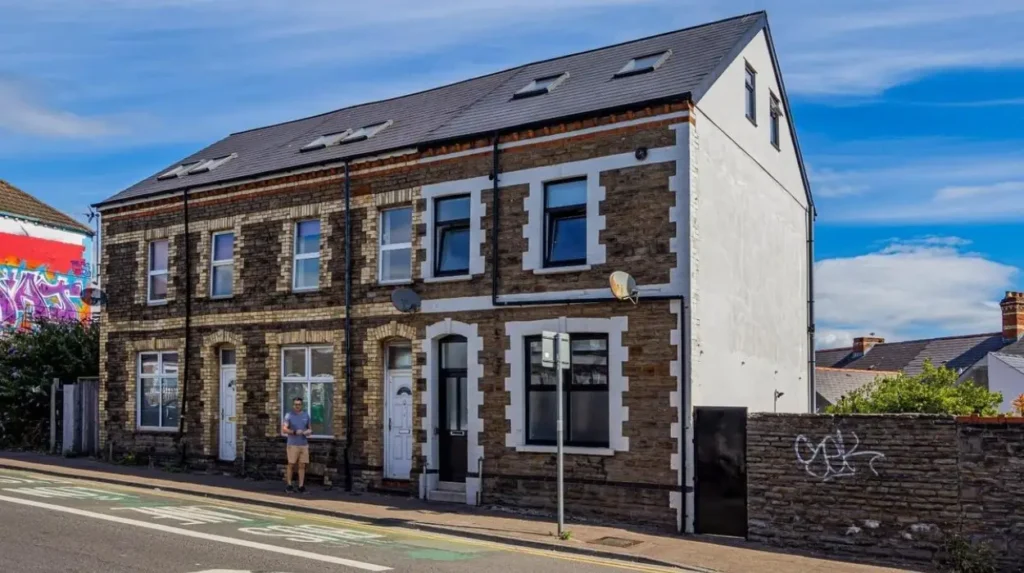
An HMO is legally defined under the Housing Act 2004 as a property rented by at least three people who are not from one ‘household’ (e.g., a family) but share facilities like the bathroom and kitchen. In Cathays and Plasnewydd, HMOs account for a massive share of the total housing stock.
Cardiff Council implemented the Cathays Additional Licensing Scheme and the Plasnewydd Additional Licensing Scheme under Part 2 of the Housing Act 2004. These legal frameworks mandate safety, space, and management standards for all let properties containing two or more unrelated occupants.
Planning Controls and Article 4 Directions
To manage the over-concentration of HMOs, Cardiff Council adopted the Managing HMOs Supplementary Planning Guidance (SPG) along with an Article 4 Direction.
- Threshold Policy: The SPG sets a threshold limit. In Cathays, if more than 20 percent of properties within a 50-metre radius are already registered HMOs, new planning applications for HMO conversions are automatically refused. In other wards (like Plasnewydd and Adamsdown), the threshold is set at 10 percent.
- Article 4 Direction: This legal mechanism removes Permitted Development Rights, requiring property owners to apply for full planning permission (Class C4) to convert a standard Class C3 residential dwelling into a small HMO.
Growth of Purpose-Built Student Accommodation (PBSA)
Over the past decade, urban planning policy in Cardiff shifted toward high-density Purpose-Built Student Accommodation (PBSA). Multi-storey private accommodation developments have concentrated in Cathays South, Adamsdown, and the central business district.
These facilities offer self-contained studio units or cluster flats with shared living spaces. Examples include:
- Zenith (Herbert Street, Adamsdown)
- The Crown Works (Cathays)
- Bridge Street Exchange (Adamsdown/Central)
PBSAs shift student populations out of traditional terraced streets into concentrated vertical units, freeing up terraced housing for young professional conversions.
Explore more Area Guide
Willows High School Cardiff: Complete Guide to Admissions, Curriculum and Facilities
Fitzalan High School Facilities: Sports, Learning, Community Access Cardiff
What are the socio-economic characteristics of Cardiff’s young ward populations?
The socio-economic characteristics of Cardiff’s youngest wards feature low immediate household incomes, high qualifications potential, elevated international migration rates, and reliance on active urban transport. These communities possess distinct economic signatures compared to suburban residential zones.
Income Levels and Economic Activity Data
The economic profile of young wards exhibits a statistical paradox known as the “student income effect.”
- Recorded Household Income: Wards like Cathays and Plasnewydd register low median household incomes in ONS data tables, often falling below £24,000 per annum. This metric occurs because full-time student stipends, loans, and parental support are not classified as standard earned income.
- Labor Force Participation: Employment in these wards is overwhelmingly concentrated in part-time services, retail, hospitality, administrative support, and gig-economy logistics.
- Human Capital Index: Despite low current income statistics, these wards contain the highest concentration of level 4 (degree level) qualifications or higher in Wales.
Diversity and Migration Profile
Cardiff’s youngest wards display high ethnic and national diversity. The 2021 Census confirms that inner-city Cardiff acts as the primary settlement area for international students and newly arrived migrant workers.
- Adamsdown and Grangetown: Feature long-standing multicultural communities alongside recent arrivals, with significant Somali, Pakistani, Bangladeshi, and Arab populations.
- Cathays and Plasnewydd: Host large international student cohorts, particularly from China, India, Nigeria, and European Union nations.
Transport Usage and Car Ownership Patterns
Younger populations in Cardiff rely heavily on active travel and public transit networks.
- Car Ownership: According to census metrics, over 55 percent of households in Cathays and Adamsdown do not own a motor vehicle, compared to under 15 percent in suburban Cyncoed.
- Active Travel Infrastructure: These wards feature heavy cycle infrastructure usage. The Cardiff Council Nextbike hire scheme (and subsequent transport initiatives) recorded its highest journey origin-destination points within Cathays, Plasnewydd, and the city centre.
- Rail and Bus Networks: Cathays station and Queen Street station serve as vital local transit nodes for these demographics.
How do municipal services adapt to the needs of young wards?
Municipal services adapt to young wards by deploying targeted waste management schedules, enforcing private sector housing regulations, and designing active travel transport infrastructure. The rapid turnover of short-term residents requires specific public service interventions from Cardiff Council.
Waste Management and Cleansing Strategies
High population density and annual tenancy turn-overs create severe waste management challenges in Cathays and Plasnewydd.
- End-of-Tenancy Waste Collections: During late June and early July, tenancy agreements expire simultaneously. Cardiff Council operates targeted waste clearance operations, known historically as “Operation Move Out,” to prevent refuse accumulation on streets.
- Collection Infrastructure: The council relies on specific bin allocation policies for HMO properties, replacing standard wheelie bins with high-capacity communal bins or controlled bag schemes where pavements are too narrow for physical storage.
Regulatory Enforcement via Shared Regulatory Services
Cardiff Council coordinates with the Shared Regulatory Services (SRS)—a partnership between Cardiff, the Vale of Glamorgan, and Bridgend—to regulate private rented housing in young wards.
- Rent Smart Wales: Headquartered in Cardiff, this organisation enforces mandatory licensing for all landlords and letting agents operating across Wales under the Housing (Wales) Act 2014.
- Proactive Inspections: Environmental health officers conduct regular inspections of private rental properties in Cathays, Plasnewydd, and Adamsdown to verify fire safety, damp mitigation, and minimum space compliance.
Public Health and Electoral Registration Challenges
- Electoral Registration Gaps: Young, highly mobile populations create low voter registration numbers. Cardiff Council’s electoral team conducts annual door-to-door canvassing in Cathays and Plasnewydd every autumn to capture newly arrived students on the electoral roll.
- Healthcare Distribution: Primary care facilities, such as GP surgeries in Cathays (e.g., Central Surgery, Park Place) and Roath, focus heavily on mental health services, sexual health screenings, and acute minor ailment treatments rather than chronic disease management for elderly populations.
What are the long-term demographic and urban planning implications for Cardiff?
The long-term demographic and urban planning implications for Cardiff include increased demand for purpose-built student housing, shifting commercial development patterns, and evolving electoral ward boundaries. As young populations grow, municipal policy must continually reconcile student housing needs with long-term community cohesion.

Local Development Plan (LDP) Strategies
Cardiff Council’s Replacement Local Development Plan (RLDP) outlines future growth strategies. The plan accounts for the constant presence of a large, non-permanent young population.
- Housing Target Distribution: Planning policy directs new residential developments toward brownfield sites in Adamsdown, Butetown, and the city center. This approach prevents the over-development of existing terraced housing stocks in established communities.
- Commercial Adaptive Reuse: Retail corridors in young wards—such as City Road in Plasnewydd and Salisbury Road in Cathays—have adapted away from traditional high-street retail toward late-night food services, coffee shops, independent gyms, and co-working spaces catering directly to younger consumers.
Transport Infrastructure Investment
The demographic reality of non-car-owning young wards shapes major capital investment decisions by Transport for Wales (TfW) and Cardiff Council.
What is the average age of residents in Cardiff?
According to the 2021 ONS Census, the median age of residents in Cardiff is 34 years. This makes Cardiff the youngest local authority area in Wales.