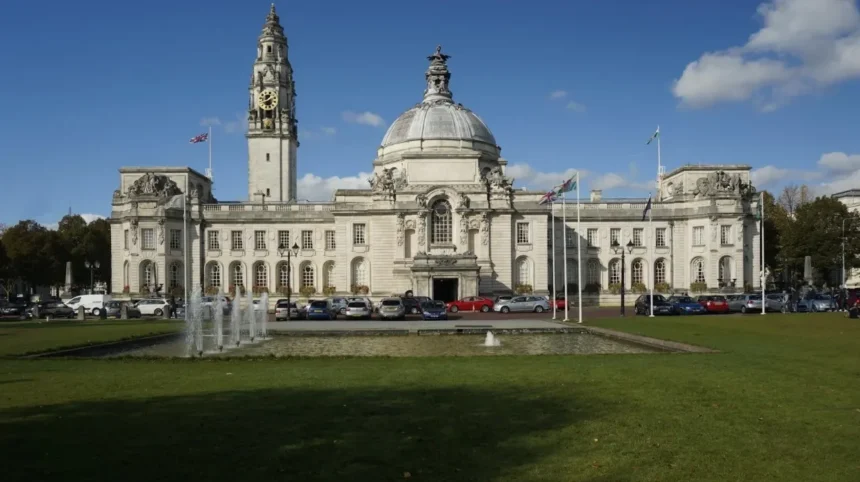
Cardiff’s civic buildings form one of the most important architectural groups in the Welsh capital. They represent local government, national culture, education, law, public health, science and civic identity. The strongest concentration sits around Cathays Park, where Cardiff’s Civic Centre developed as the city expanded rapidly during the late 19th and early 20th centuries.
- What are Cardiff’s civic buildings?
- Why was Cathays Park chosen for Cardiff’s civic centre?
- When did Cardiff’s main civic buildings develop?
- What is Cardiff City Hall used for?
- What makes National Museum Cardiff a civic building?
- What is the Temple of Peace and Health?
- How are Cardiff’s civic buildings protected?
- Which architectural styles appear in Cardiff’s Civic Centre?
- How do the civic buildings work together as an urban district?
- Why are Cardiff’s civic buildings important to Welsh history?
- How can visitors explore Cardiff’s civic buildings?
- How does heritage protection affect the future of Cardiff’s civic buildings?
- What do Cardiff’s civic buildings reveal about the city today?
The term civic building describes a public building created for government, administration, justice, education, culture or another community-wide function. In Cardiff, this includes City Hall, National Museum Cardiff, the Law Courts, Cardiff University buildings, the Temple of Peace and Health, and associated public spaces.
Cardiff’s Civic Centre remains significant because its buildings operate as a connected urban ensemble rather than as isolated landmarks. The area combines monumental architecture, landscaped gardens, institutional buildings and important public routes. Cardiff Council identifies the Civic Centre and Cathays Park as a major part of the city’s central urban structure.
What are Cardiff’s civic buildings?
Cardiff’s civic buildings are major public institutions and government-related structures that support administration, justice, education, culture and community life. Most historic examples are concentrated in Cathays Park and the wider Civic Centre, creating Cardiff’s principal civic architectural district.
Civic buildings differ from ordinary commercial or residential buildings because their functions serve wider public purposes. A city hall provides local government facilities. A court building supports the justice system. A national museum preserves and displays collections. A university building provides education and research.
Cardiff’s civic architecture reflects the city’s transformation from an industrial town into the capital of Wales. The development of coal exports, population growth, municipal government and national institutions created demand for larger and more formal public buildings.
The Civic Centre became the clearest physical expression of that development. Its buildings were planned alongside gardens, roads and open spaces. This created a coherent civic landscape rather than a collection of unrelated structures.
The area continues to have practical functions. Cardiff Council uses City Hall as a major civic and administrative venue, while nearby institutions continue to support education, culture, justice and public life.
Why was Cathays Park chosen for Cardiff’s civic centre?
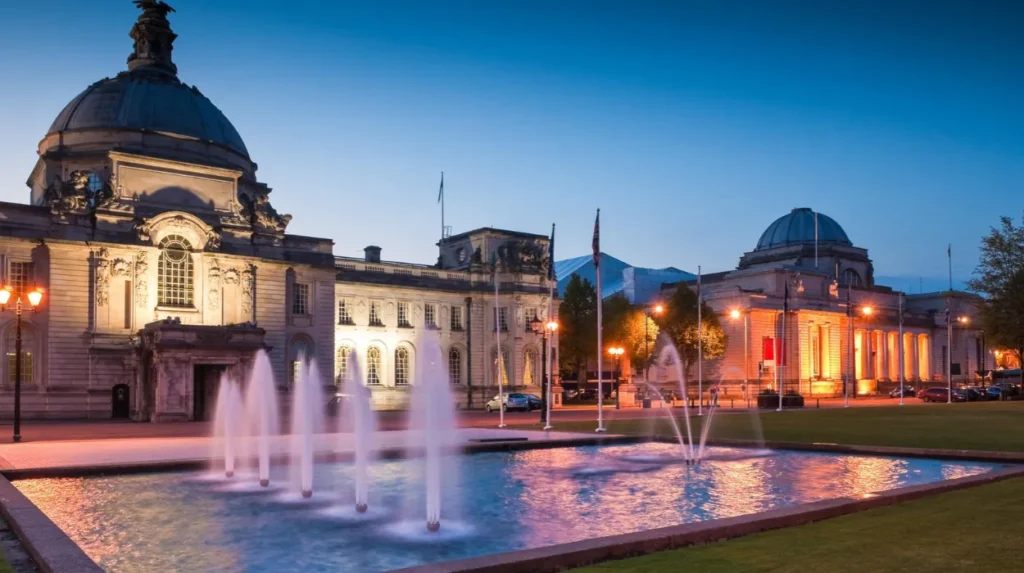
Cathays Park became Cardiff’s civic centre because the city needed space for major public institutions during rapid expansion. Its large planned development provided room for monumental buildings, landscaped spaces and formal roads close to the historic city centre.
Cardiff expanded dramatically during the 19th century as the South Wales coal industry grew. The port became a major international coal-export centre, increasing Cardiff’s population, wealth and administrative importance.
The development of Cathays Park provided an opportunity to establish a prestigious institutional district. Instead of placing every new public building within the older commercial core, the city developed a planned area with generous streets and open spaces.
This planning approach is important to understanding Cardiff’s civic architecture. The buildings were designed to work within a larger composition. City Hall, the museum and other institutions occupy prominent positions around landscaped areas and formal avenues.
The result is an urban district where architecture and public space are closely connected. Modern Cardiff Council documents continue to describe the Civic Centre and Cathays Park as an important part of the central city, with routes such as Kingsway connecting the civic area with Cardiff’s commercial centre.
The location also benefits from proximity to Cardiff city centre and public transport. National Museum Cardiff, for example, is around five minutes’ walk from Cathays railway station and about 20 minutes on foot from Cardiff Central station.
When did Cardiff’s main civic buildings develop?
Cardiff’s principal civic buildings developed mainly during the late 19th and early 20th centuries, with later additions extending the Civic Centre into the post-war period. This development reflects Cardiff’s growth as an industrial city and its emergence as Wales’s capital.
The most important phase occurred around the turn of the 20th century. Cardiff had acquired substantial economic importance through coal exports and needed public institutions appropriate to its growing status.
City Hall became one of the defining buildings of the Civic Centre. Its architecture established a formal civic character that was reinforced by neighbouring institutions.
National Museum Cardiff also belongs to this wider development. The museum now forms part of the Civic Centre and contains Wales’s national art, geology and natural history collections.
The development continued beyond the Edwardian period. The Temple of Peace and Health introduced an important interwar civic and institutional building. Later, post-war architecture added another layer to Cardiff’s civic landscape.
St David’s Hall represents a much later phase. Cadw records that the concert hall opened in 1983 and was built between 1978 and 1982. Its development was connected to Cardiff’s post-war redevelopment and its role as the capital city of Wales.
This long development period means Cardiff’s civic architecture cannot be understood as a single architectural style. It represents several generations of public architecture.
What is Cardiff City Hall used for?
Cardiff City Hall is the principal historic civic building in Cathays Park and an important centre for local government and formal civic activity. The Grade I listed building also contains significant architectural interiors, public rooms and historic works of art.
City Hall is one of Cardiff’s most recognisable civic landmarks. Its prominent position within the Civic Centre reflects the importance attached to municipal government during Cardiff’s period of rapid growth.
The building is protected as a Grade I listed building. Grade I is the highest category of listed-building protection in Wales and applies to buildings of exceptional interest. Cadw confirms that Cardiff City Hall has Grade I status.
The building contains formal civic spaces associated with public administration and ceremonial activity. Its architecture uses a monumental composition suited to a major municipal institution.
The surrounding public realm is equally significant. City Hall faces landscaped gardens and formal avenues, allowing the building to be viewed within its original civic setting.
City Hall also forms part of Cardiff’s working government infrastructure. Cardiff Council lists City Hall, Cardiff, CF10 3ND as an official council address for civic and administrative functions.
Its role therefore combines historic significance with continuing public use.
What makes National Museum Cardiff a civic building?
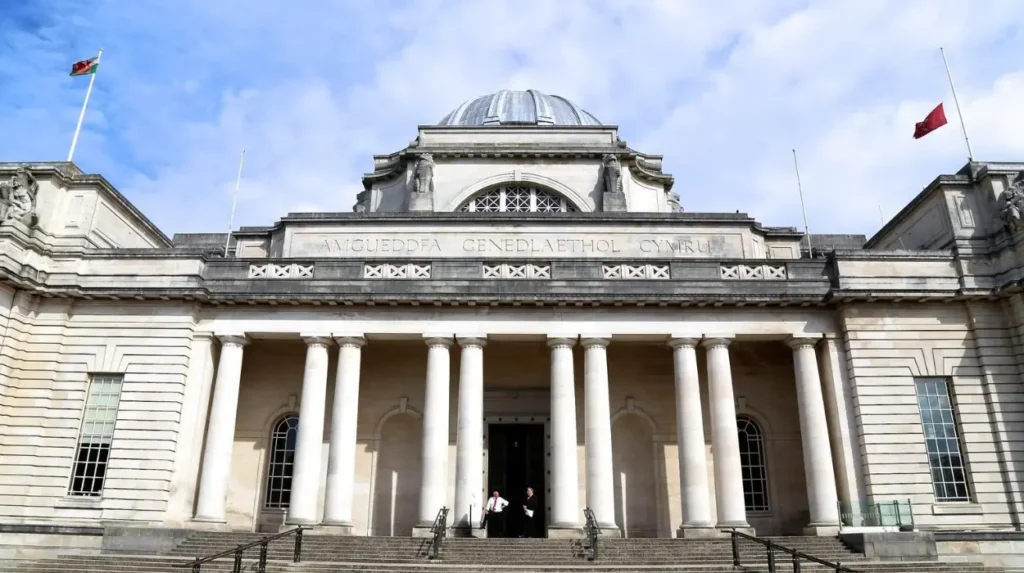
National Museum Cardiff is a civic and national cultural institution because it preserves, researches and displays collections representing Wales’s natural and cultural heritage. Located in Cathays Park, it forms a major part of Cardiff’s historic Civic Centre.
National Museum Cardiff is operated by Amgueddfa Cymru – Museum Wales, Wales’s national museum organisation. The Cardiff museum contains national collections covering art, geology and natural history.
The museum’s collections give the building a role extending beyond Cardiff. It is a Cardiff landmark, but its institutional purpose is national.
Its art collection covers approximately 500 years of paintings, drawings, sculpture, silver and ceramics. The museum also has significant Impressionist holdings and extensive natural history collections.
The museum’s natural history galleries explain the development of life and the natural environment. Its geology and palaeontology displays provide additional scientific context.
The building also supports temporary exhibitions, education and public programmes. Current museum information describes a programme of exhibitions and events alongside its permanent collections.
Its position within the Civic Centre demonstrates how Cardiff’s civic landscape combines government institutions with cultural institutions.
What is the Temple of Peace and Health?
The Temple of Peace and Health is a major Cardiff civic building associated with public health, peace and international cooperation. Designed by architect Sir Percy Thomas, it forms an important part of Cardiff’s interwar civic architecture and remains a listed historic building.
The Temple of Peace and Health was designed by Sir Percy Thomas, one of Wales’s important 20th-century architects. Its classical design uses symmetry, a prominent entrance and monumental proportions.
Cadw’s research on post-war architecture records the Temple of Peace and Health as a Grade II building and identifies it as an architectural award winner in 1946.
The building is particularly distinctive because its civic purpose is broader than municipal administration. It became associated with public health organisations and peace-related activities.
Its architectural treatment reflects this institutional role. The formal entrance and symmetrical composition create a strong public identity.
Cadw’s accessibility guidance uses the Temple of Peace as an example of how modern access improvements can be incorporated into historic buildings. The building’s elevated classical entrance has been adapted with symmetrical ramps while retaining its architectural character.
This illustrates an important principle in modern heritage management: historic civic buildings remain functional places rather than static monuments.
How are Cardiff’s civic buildings protected?
Historic civic buildings in Cardiff are protected through the Welsh listed-building system, local planning controls and heritage management. Cadw administers the national listing system, while Cardiff Council applies planning controls and considers the impact of development.
The main national legislation is the Historic Environment (Wales) Act 2023. It provides the legal framework for listing buildings of special architectural or historic interest and managing changes to listed buildings.
Wales has more than 30,000 listed buildings. Cadw classifies them into three grades: Grade I, Grade II* and Grade II. Grade I buildings have exceptional interest, Grade II* buildings have more than special interest, and Grade II buildings have special interest that justifies preservation efforts.
Listing does not mean that a building can never change. Instead, significant changes are controlled through listed building consent.
Listed building consent is a planning mechanism used to manage proposed alterations to protected buildings. The system considers the building’s architectural and historic significance before changes are approved.
Cadw states that listing covers the building as a whole, including relevant interiors and certain structures within its historic curtilage.
Cardiff Council also provides design guidance for development and public spaces. Its city-design work aims to ensure that new development contributes positively to Cardiff’s built environment.
Which architectural styles appear in Cardiff’s Civic Centre?
Cardiff’s Civic Centre combines several architectural approaches, including Edwardian civic architecture, classical design, monumental institutional architecture and later modernism. The buildings share formal planning and public functions while displaying different architectural responses to their periods.
The dominant historic character of Cathays Park comes from monumental early-20th-century architecture. Buildings use symmetry, stonework, columns, formal entrances, domes and carefully designed elevations.
Classical architectural language was particularly suitable for civic institutions because it communicated permanence, authority and institutional importance.
The Temple of Peace provides a strong example of classical architecture. Cadw describes its design as rigorously symmetrical, with a raised podium and central portico.
Later buildings demonstrate a different approach. St David’s Hall represents late-20th-century architecture and uses a distinctive polygonal form with seating arranged in terraces around the stage. Cadw identifies its architecture as significant within the history of post-war concert-hall design.
The architectural diversity demonstrates how Cardiff’s civic identity developed over more than a century.
How do the civic buildings work together as an urban district?
Cardiff’s civic buildings work together through planned streets, gardens, institutional plots and pedestrian connections. City Hall, the museum, courts, university buildings and other institutions form a civic landscape where individual buildings contribute to a larger architectural and public-space composition.
The Civic Centre is important because its significance extends beyond individual buildings.
Formal avenues establish views between major institutions. Open spaces provide separation between large structures. Gardens soften the monumental architecture while providing public areas within the central city.
This planning approach also creates a recognisable transition between Cardiff’s commercial centre and institutional district.
Kingsway provides one of the key connections. Cardiff Council describes Kingsway as a central route linking the city centre with the Civic Centre. Current public-realm proposals focus on improving pedestrian, cycling and public-space connections between these areas.
The civic district therefore functions as an urban system.
Its buildings have different purposes, but their location, scale and public spaces create a unified civic environment.
Why are Cardiff’s civic buildings important to Welsh history?
Cardiff’s civic buildings document the city’s transformation from an industrial coal-exporting centre into the capital of Wales. They also record the growth of municipal government, national cultural institutions, public health organisations, education and post-war cultural development.
Cardiff’s civic architecture reflects major changes in Welsh society.
The city’s economic expansion generated greater municipal responsibilities. Public institutions became more substantial as Cardiff’s population and administrative importance increased.
The creation of national cultural institutions added another layer. National Museum Cardiff became a place for preserving and presenting collections associated with Wales and the wider world.
The Temple of Peace represents the development of public-health and peace-related civic institutions.
The university buildings reflect the growth of higher education and research.
Later cultural buildings such as St David’s Hall demonstrate Cardiff’s continuing development as a capital city with national cultural responsibilities. Cadw specifically connects the hall’s historic significance with Cardiff’s post-war redevelopment and status as the capital of Wales.
Together, these buildings provide physical evidence of Cardiff’s changing civic role.
How can visitors explore Cardiff’s civic buildings?
Visitors can explore Cardiff’s civic architecture through the Civic Centre, Cathays Park, surrounding gardens and nearby cultural institutions. National Museum Cardiff provides public access to major collections, while exterior views of City Hall and other civic buildings reveal the area’s architectural character.
Cathays Park is particularly suitable for understanding Cardiff’s civic architecture because several major institutions are concentrated within a relatively compact area.
National Museum Cardiff is open to visitors and currently provides free admission, although some exhibitions, events and activities can carry charges. The museum’s standard visiting information lists its location as Cathays Park, Cardiff, CF10 3NP.
The museum is accessible by public transport. Cathays railway station is approximately five minutes’ walk away, while Cardiff Central is approximately 20 minutes on foot.
Visitors can also explore the surrounding streets and gardens to understand the relationship between buildings and public space.
City Hall’s exterior is an important architectural landmark, although access to working government areas depends on official arrangements and events.
The Civic Centre can therefore be experienced as both a cultural destination and an architectural district.
Explore More Area Guide
Public Notice Boards That Keep Cardiff Communities Connected
Local Post Offices Serving Communities Across Cardiff
How does heritage protection affect the future of Cardiff’s civic buildings?
Heritage protection ensures that Cardiff’s historic civic buildings can adapt to modern requirements while retaining important architectural and historic characteristics. Future changes must balance accessibility, energy performance, public use, planning requirements and conservation significance.
Historic buildings face practical requirements that did not exist when they were constructed.
Modern public buildings require accessible entrances, improved energy performance, updated services, fire safety measures and facilities suitable for contemporary users.
Heritage protection does not automatically prevent these changes. Cadw’s guidance specifically recognises the need to improve accessibility within listed buildings while respecting their architectural character. The Temple of Peace demonstrates this approach through its adapted entrance ramps.
Energy efficiency presents another challenge. Cardiff Council’s city-design guidance identifies sustainable design, efficient buildings and reduced construction impacts as important considerations in contemporary development.
Future conservation therefore involves active management rather than simple preservation.
The objective is to retain significant historic fabric while allowing buildings to continue serving public purposes.
What do Cardiff’s civic buildings reveal about the city today?
Cardiff’s civic buildings show that the capital’s identity is built around government, culture, education, justice, science and public institutions. Their continued use connects Cardiff’s industrial history and national development with the needs of a modern Welsh capital.
The Civic Centre remains an active part of Cardiff rather than a preserved historic quarter with no contemporary function.
City Hall continues its civic role. National Museum Cardiff continues to provide cultural and educational services. Universities continue to operate in and around the Civic Centre. Courts continue to support the justice system. The Temple of Peace continues its institutional legacy.
The buildings also contribute to Cardiff’s visitor economy and architectural identity.
National Museum Cardiff attracts visitors through art, natural history, geology, exhibitions and educational activities. Its collections provide a direct connection between the city’s civic landscape and Wales’s national cultural heritage.
The continued presence of these institutions makes the Civic Centre an important part of Cardiff’s urban structure.
Cardiff’s civic buildings are therefore best understood as working heritage. Their importance comes from the combination of architecture, history, institutional function, public space and continuing use.
The Civic Centre’s long development also demonstrates the changing ambitions of Cardiff. Its early municipal architecture reflected industrial prosperity and local government expansion. Its national institutions reflected the growing importance of Wales’s capital. Its later buildings reflected post-war cultural development and modern architectural thinking.
For visitors, the Civic Centre offers a concentrated introduction to Cardiff’s architectural history. For residents, it remains part of the city’s everyday institutional landscape. For heritage management, it provides a continuing example of how historic public buildings can remain useful while their architectural significance is protected.
Cardiff’s civic buildings consequently form one of the clearest physical records of the city’s development from industrial powerhouse to modern Welsh capital.
What are Cardiff’s civic buildings?
Cardiff’s civic buildings are public and institutional buildings connected with government, justice, education, culture, public health and community services. Many historic examples are concentrated in Cathays Park and Cardiff’s Civic Centre.