If you own or rent a property in Surrey Heath, understanding your council tax for 2026 is essential for household budgeting and financial planning. Surrey Heath Borough Council, together with Surrey County Council, the Police and Crime Commissioner, and local parish councils, sets annual council tax rates through a formal setting process each February. For the 2026/27 financial year, residents in Surrey Heath face modest but clearly defined increases, with each band’s total bill reflecting shared responsibilities between district, county, police, and parish authorities. This evergreen guide explains the 2026 council tax bands, rate levels, how bills are split, and how to estimate your own payment, all tailored for a Cardiff based audience interested in accurate, research‑backed UK‑local information.
- What is Surrey Heath Council Tax?
- How Surrey Heath Borough Council Sets 2026 Council Tax
- 2026 Council Tax Bands and Amounts in Surrey Heath
- How Much Do Different Bands Pay in 2026?
- How the 2026 Bill Is Split Between Councils
- Why Surrey Heath’s 2026 Rates Have Increased
- How to Check Your Surrey Heath Band and Bill
- Special Circumstances and Discounts in 2026
- How Surrey Heath 2026 Rates Compare to Nearby Areas
- Planning Ahead: Budgeting for Surrey Heath 2026 Council Tax
What is Surrey Heath Council Tax?
Surrey Heath is a borough in north‑west Surrey, England, governed by Surrey Heath Borough Council from Camberley. The council is a district‑level authority, meaning it raises council tax alongside Surrey County Council and local parish councils to fund different tiers of local services such as housing, waste collection, street cleansing, planning, libraries, police, fire, and local amenities. Council tax is a domestic property tax levied on most residential properties in England, with the amount largely decided by the property’s “valuation band” assigned by the Valuation Office Agency (VOA) in 1991. Those bands, which run from Band A to Band H, are fixed at 1991 values and are not updated to reflect current market prices, so a property’s band can stay the same for decades even if its sale price changes significantly.
Residents living in Surrey Heath pay a unified council tax bill that combines demands from Surrey Heath Borough Council, Surrey County Council, Surrey Police and Crime Commissioner’s police element, and, where applicable, parish or town councils. When the council sets the 2026/27 rates, it agrees separate percentage increases for each authority’s share, but the final figure you see on your bill is the total annual amount for your band.
How Surrey Heath Borough Council Sets 2026 Council Tax
Each year, Surrey Heath Borough Council meets in February to agree its share of residents’ council tax bills for the coming financial year. For 2026/27, the council confirmed that its own portion of the Band D bill will rise by £7.65 per year, which equates to roughly 15p per week and an increase of 2.99% on its share. This means that the council’s retained element for an average Band D property in Surrey Heath will sit at about £263 per year.
The total Band D bill across all authorities (excluding parish demands) is set to increase by 4.7% from £2,439.20 in 2025/26 to £2,553.93 in 2026/27. County and police elements typically account for the lion’s share: around 74% of the total collected goes to Surrey County Council and Surrey Fire and Rescue, about 13% to the Police and Crime Commissioner, roughly 10% to Surrey Heath Borough Council, and about 3% to parish councils where they exist. Because the borough’s own increase is only around 3%, and because Surrey County Council and the police set their own rates independently, the overall 4.7% rise reflects combined decisions across the local authority network.
2026 Council Tax Bands and Amounts in Surrey Heath
Surrey Heath’s 2026/27 council tax amounts are set separately for each area within the borough, since the parish share can differ between wards. The official Surrey Heath Borough Council page “Council Tax bands and amounts” lists exact 2026/27 figures by band for each locality, including Bisley, Chobham, Camberley/Frimley/Frimley Green/Mytchett/Deepcut, West End, and Windlesham/Lightwater/Bagshot. These figures are already inclusive of the Surrey Heath Borough Council increase and the wider county and police uplifts agreed for 2026.
Below is a representative snapshot of the 2026/27 full‑year council tax amounts for each band in one of the main areas (Camberley, Frimley, Frimley Green, Mytchett, and Deepcut). These figures are expressed in pounds sterling and are for the entire year unless you arrange alternative payment terms with the council.
- Band A: £1,708.00 per year
- Band B: £1,992.67 per year
- Band C: £2,277.34 per year
- Band D: £2,562.00 per year
- Band E: £3,131.33 per year
- Band F: £3,700.67 per year
- Band G: £4,270.00 per year
- Band H: £5,123.99 per year
These figures show that the 2026/27 Band D base in this area is slightly below the borough‑wide “average” Band D total of £2,553.93 quoted elsewhere, because the latter figure excludes parish demands and is an across‑borough average. Other areas, such as Bisley and West End, show Band D totals of £2,626.59 and £2,650.66 respectively, reflecting higher parish contributions in those wards. Across all localities, the 2026/27 increases typically sit in the 4.6%–5.6% range compared with 2025/26, with West End experiencing the largest percentage rise at 5.64%.
How Much Do Different Bands Pay in 2026?
Council tax bands are designed so that higher‑value properties (using 1991 values) pay more, but the increases are applied proportionally across bands. In practice, this means that if Band D rises by 4.69% in a particular area, Band A will rise by roughly the same percentage, resulting in a similar proportional increase across the board. The 2026/27 figures for Camberley, Frimley, Frimley Green, Mytchett, and Deepcut show that a Band A household pays about £1,708 per year, while a Band H household pays over £5,000, reflecting the seven‑fold step‑up in the banding structure.
Because Surrey Heath uses the standard A–H band system, it is straightforward to estimate your own 2026 payment if you know your band and area. For example, if your home is in Camberley and in Band C, you would pay approximately £2,277.34 per year, or about £189.78 per month if you spread the bill over 12 calendar months. Similarly, a Band F property in West End would face a 2026/27 total of £3,828.74, which breaks down to roughly £319 per month if paid in equal instalments. These monthly figures are useful for Cardiff‑based readers who may be comparing council‑tax‑style costs across different UK local authority areas, since they offer a clear monthly‑cash‑flow perspective.
How the 2026 Bill Is Split Between Councils
To understand what you are actually paying for in 2026, it helps to split the Surrey Heath Band D total into its constituent parts. Although the exact share varies slightly by area, the proportions remain broadly consistent across the borough. For the 2026/27 average Band D home, roughly £1,846 of the total will go to Surrey County Council and Surrey Fire and Rescue, about £338 to the Police and Crime Commissioner for Surrey Police, about £263 to Surrey Heath Borough Council itself, and the remaining balance (around 3%) to parish councils where they apply.
This split means that the majority of your council tax fund services that are not directly visible at the district level, such as major highways, adult social care, children’s services, fire and rescue, and large‑scale policing, while the borough portion supports more local services like waste collection, street cleaning, housing management, planning, parks, and leisure facilities. Parish councils, where they exist, use their share for hyper‑local matters such as village halls, small community projects, local events, and minor maintenance. For Cardiff‑based readers who may be researching the structure of local government finance in England, this breakdown illustrates how council tax operates as a multi‑tiered funding mechanism rather than a single central levy.
Why Surrey Heath’s 2026 Rates Have Increased
Surrey Heath Council has cited several key reasons for the modest 2026 tax increases. One of the main drivers is ongoing financial pressure from inherited financial issues, including past property‑investment decisions and the need to catch‑up on several years of unaudited accounts, which has constrained the council’s reserves. At the same time, heightened interest‑rate costs and reduced central‑government funding have made it harder to maintain services without passing on some of the burden through council tax.
The council has also emphasised that the 2026 increase is relatively small in everyday terms, with the borough’s own share rising by only about £7.65 per year for a Band D property, or roughly 15p per week. This is intended to help balance the need to protect essential services—such as refuse collection, street cleaning, planning, and community safety—while still trying to keep rises within what many residents might consider manageable. In addition, the council has frozen councillor allowances to avoid further increases and has committed to trying to keep local increases as low as possible over the medium term.
How to Check Your Surrey Heath Band and Bill
Each Surrey Heath property is already assigned a band by the Valuation Office Agency based on its 1991 value, and this band is visible on your council tax bill and on the GOV.UK “Check your Council Tax band” service. If you are unsure of your band or think it may be incorrect, you can review your property’s band on GOV.UK and, where appropriate, appeal to the VOA if major changes have occurred such as structural alterations or a change in the property’s use.
Once you know your band and area, the Surrey Heath Borough Council “Council Tax bands and amounts” page provides the exact 2026/27 annual figure for your combination of locality and band. If you are a tenant, your landlord may pay the council tax directly, but it is still important to know your band and the amount, especially if you are budgeting for a move or comparing rents in different parts of Surrey Heath. Many residents choose to pay by direct debit in 10 or 12 monthly instalments, and the council’s website usually offers an online calculator or payment planner to help you see your monthly payment based on the annual figure.
Special Circumstances and Discounts in 2026
Surrey Heath, like all English local authorities, offers several council tax reductions and reliefs that can significantly lower what you pay in 2026. These are crucial for readers in Cardiff who may be scouting relocation options and want to understand how factors such as household composition affect real‑world costs. Common reliefs include the 25% single‑person discount for properties occupied by just one adult, council tax support for low‑income households, and exemptions or discounts for people who are severely mentally impaired, students, or in certain types of care.
If you live alone, you may be entitled to a 25% reduction on your 2026 bill, which for a Band D property in Camberley would mean paying around £1,921.50 instead of £2,562.00. Households with no adults at all (for example, properties occupied only by full‑time students) may be entirely exempt from council tax, though the rules can be complex and depend on the specific circumstances. Surrey Heath Borough Council’s website includes a dedicated “Council Tax reductions and benefits” section where residents can apply for discounts, check eligibility, and upload supporting documents online.
How Surrey Heath 2026 Rates Compare to Nearby Areas
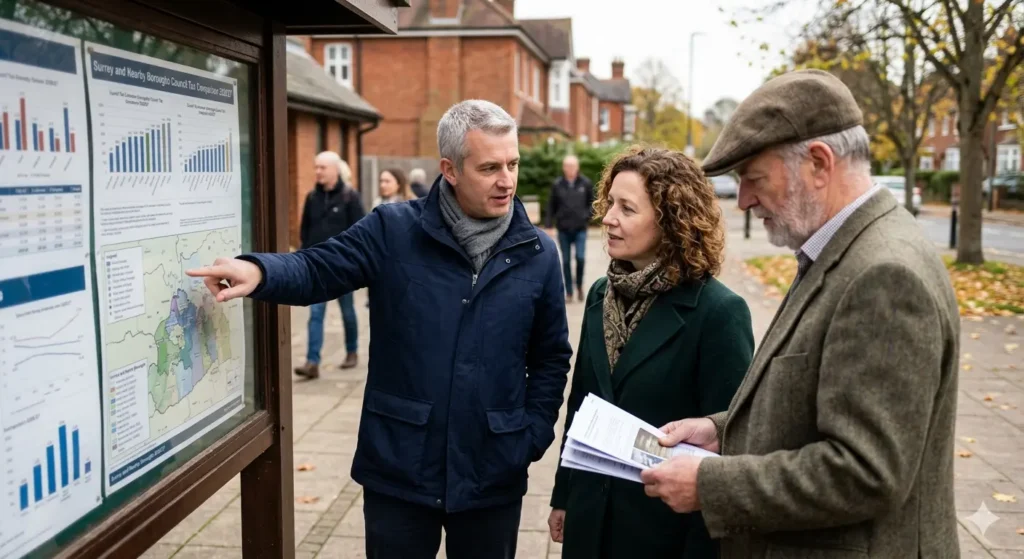
For context, Surrey Heath’s 2026/27 Band D totals are broadly in line with other non‑London boroughs in Surrey, though they remain high compared to many parts of Wales and the UK north. For example, neighbouring boroughs such as Spelthorne have also raised their 2026/27 Band D bills in the mid‑ £2,000 range, with similar percentage increases, reflecting the shared pressures from county and police cost‑setting. Because Surrey is generally a high‑value property area, council tax bands tend to produce higher absolute bills than in many other English counties, even where percentage increases are controlled.
Readers in Cardiff may find this useful when comparing the cost of living across regions. For instance, a typical Band D property in Surrey Heath could face an annual bill well above £2,500, whereas comparable UK areas outside the south‑east may see Band D totals closer to the national average or even lower. However, these differences are shaped by local spending priorities, property values, and the specific services delivered by each council, so the headline number should be considered alongside the quality of local infrastructure and amenities.
Planning Ahead: Budgeting for Surrey Heath 2026 Council Tax
For anyone either living in or considering a move to Surrey Heath, building the 2026 council tax into your annual budget is an important step. If you know your band and area, you can use the published figures to calculate your monthly payment and factor it into your housing costs alongside rent or mortgage, utilities, and service charges. It is also wise to keep an eye on any future council tax announcements in February each year, since even small percentage increases can accumulate over time.
If you are relocating from Cardiff or another part of the UK, it can help to compare the 2026 Surrey Heath Band D total with your current local authority’s Band D figure to see how much extra you might be paying. This kind of comparison can inform decisions about whether to move to a lower‑band property, apply for eligible discounts, or negotiate rent or purchase‑price expectations to offset higher council tax. By understanding both the 2026 rates and the factors that drive them, Cardiff‑linked readers can make more informed choices about housing and local authority costs in Surrey Heath.
What is the Council Tax in Surrey Heath for 2026?
Council Tax in Surrey Heath for 2026 varies by property band, with Band D used as the standard reference for setting rates.