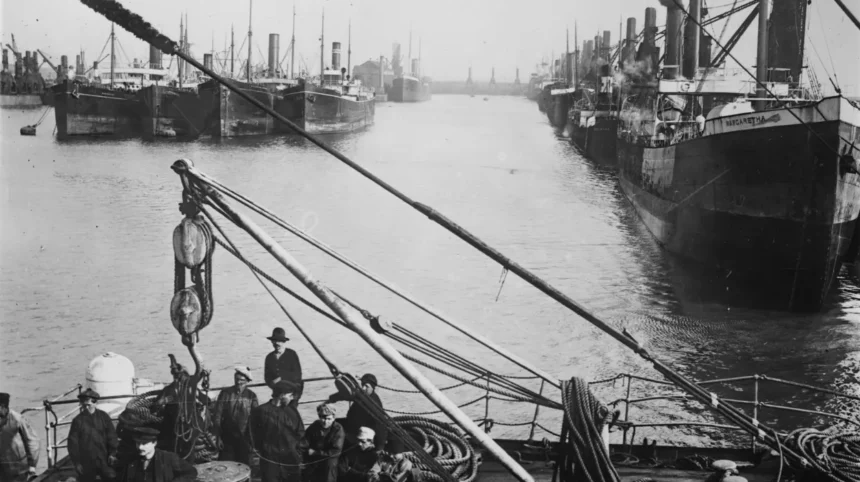
Cardiff Docks transformed Cardiff from a small Welsh port into one of the world’s leading coal-exporting centres during the Industrial Revolution. Developed from the nineteenth century onwards, the docks connected the South Wales coalfield with international markets, attracted workers from around the world and shaped the growth of Butetown, Tiger Bay and modern Cardiff Bay.
- What were Cardiff Docks and why were they important?
- How did Cardiff develop as a port before the Industrial Revolution?
- Why was the Bute West Dock built in 1839?
- How did the Bute East Dock expand Cardiff’s maritime trade?
- Which docks were built after the Bute West and East docks?
- How did the South Wales coal industry make Cardiff a global port?
- When did Cardiff’s coal exports reach their peak?
- How did railways connect the coalfield to the docks?
- How did Cardiff Docks shape Tiger Bay and Butetown?
- What happened to Cardiff Docks during the twentieth century?
- How did the decline of coal exports affect Cardiff?
- How did the docks operate during the Second World War?
- How did Cardiff Bay regeneration transform the former docks?
- Which historic Cardiff Dock sites can visitors still explore?
- What can visitors learn at the former West Bute Dock?
- What remains of East Bute Dock?
- Why is the Pierhead building significant?
- What is the lasting significance of Cardiff Docks today?
Their history includes the construction of the Bute docks, the expansion of railway transport, the rise of the global coal trade, the development of a multicultural dockland community and the decline of coal exports during the twentieth century. Regeneration projects later transformed much of the former industrial waterfront into a destination for housing, culture, tourism and recreation.
What were Cardiff Docks and why were they important?
Cardiff Docks were a network of enclosed docks, quays and shipping facilities developed to export coal and iron from South Wales. They connected the industrial valleys with international markets, supported Cardiff’s population growth and established the city as a major maritime centre.
Cardiff Docks developed along the southern edge of the city, close to the Bristol Channel. The term refers to the historic dock complex built around the Bute docks, Roath docks and Queen Alexandra Dock. These facilities provided protected water, loading areas, warehouses and access for merchant vessels.
Before the nineteenth century, Cardiff operated as a comparatively small port. Its commercial importance increased as iron production and coal mining expanded in the South Wales valleys. Industrial centres such as Merthyr Tydfil required reliable transport routes to move their products to overseas customers.
The docks addressed this need by providing larger ships with dedicated loading facilities. They also encouraged railway construction, warehouse development and investment in industrial infrastructure.
According to the UK Parliament’s historical account, Cardiff’s maritime trade expanded significantly during the nineteenth century as the coal and iron industries developed.
Cardiff Docks consequently became more than a transport facility. They influenced urban development, employment, migration, international commerce and the physical landscape of the modern city.
How did Cardiff develop as a port before the Industrial Revolution?
Cardiff’s port existed centuries before its famous docks opened in 1839. Early maritime commerce remained relatively limited, while the Glamorganshire Canal, authorised in 1791, improved transport between Cardiff and the iron-producing communities of South Wales.
Cardiff occupied a useful position near the mouth of the River Taff, where inland routes connected with coastal shipping. Historical records identify a quay at Cardiff in the sixteenth century, although maritime activity in the area began earlier.
During the seventeenth and eighteenth centuries, Cardiff remained less commercially significant than Swansea. Swansea benefited from its established metalworking industries and mineral trade, while Cardiff’s growth accelerated as the coal and iron resources of the valleys became increasingly important.
How did the Glamorganshire Canal support Cardiff’s early trade?
The Glamorganshire Canal was an artificial waterway built to transport industrial materials between the Merthyr Tydfil area and Cardiff. Authorised by an Act of Parliament in 1791, it improved the movement of iron and other goods towards the coast.
Before the canal, moving heavy materials by road was expensive and slow. Water transport offered industrial producers a more efficient route to market.
The canal supported the growth of ironworks and collieries in the upper valleys. However, increasing industrial output eventually exceeded the capacity of the existing transport and port infrastructure.
The limitations of the canal helped create the economic case for larger docks and improved rail connections.
This early transport network established the foundations for Cardiff’s later development as a major coal-exporting port.
Why was the Bute West Dock built in 1839?
The Bute West Dock was built to improve Cardiff’s capacity to handle industrial exports from South Wales. Financed by the second Marquess of Bute, it opened in October 1839 and provided dedicated dock facilities for the expanding coal and iron trade.
John Crichton-Stuart, the second Marquess of Bute, played a central role in the creation of the modern Cardiff docks. His family controlled extensive land and mineral interests, giving him a financial incentive to improve access between the coalfield and overseas markets.
Plans for a new dock developed during the 1820s. Canal engineer James Green prepared proposals, and Thomas Telford subsequently revised the scheme. The Bute Ship Canal Act received Royal Assent in July 1830, providing the legal foundation for the project.
Construction began in December 1834. The completed West Bute Dock opened on 9 October 1839, an event celebrated in Cardiff.
What facilities did the first dock provide?
The West Bute Dock offered a long, enclosed stretch of water designed to accommodate shipping more effectively than the older harbour facilities.
Its infrastructure included quays for loading and unloading, space for warehouses and an entrance connection to the sea. The dock’s layout supported the separation of export activity from other commercial operations.
The Taff Vale Railway Company began serving the dock in 1841. Railway connections linked Cardiff with Merthyr Tydfil and other industrial communities, improving the movement of coal and iron to ships.
The combination of railways and enclosed docks increased the efficiency of the port. However, growing demand soon placed pressure on the available capacity.
Why did the West Bute Dock become insufficient?
Industrial output expanded rapidly after the dock opened. More coal reached Cardiff, and larger volumes of goods required storage, handling and shipping facilities.
Historical records show that Cardiff’s total dock trade reached approximately 1.33 million tons in 1854. The increase demonstrated the commercial success of the port while exposing the limitations of its original infrastructure.
The growing volume of shipping encouraged the construction of a second major dock.
How did the Bute East Dock expand Cardiff’s maritime trade?
The Bute East Dock expanded Cardiff’s shipping capacity through staged construction between 1855 and 1859. Its additional water space, long quays and coal-loading facilities accommodated increasing exports and strengthened Cardiff’s position within the South Wales coal trade.
Construction of the East Bute Dock began in the early 1850s under the Bute estate. The first stage opened in June 1855, followed by further extensions during the late 1850s.
The dock’s expansion reflected the growing scale of industrial production in the valleys. Larger volumes of coal required more berths, loading equipment and space for vessels waiting to load.
According to the Glamorgan-Gwent Archaeological Trust’s historic environment records, the East Bute Dock eventually included more than 9,000 feet of quayage and numerous coal-loading facilities.
How did coal-loading equipment improve port operations?
Coal staithes were structures used to transfer coal into ships. They allowed railway wagons to deliver coal to elevated loading points, from which the material moved into vessels.
The East Bute Dock developed extensive coal-loading infrastructure. Historical records document 15 coal staithes initially, with the number later increasing to 22 in one account. These facilities enabled large volumes of coal to pass through the dock.
The dock also supported other activities, including warehousing, timber handling, engineering and ship maintenance. This combination made the facility an important industrial complex rather than a coal-only loading point.
The expansion of East Bute helped Cardiff compete with other South Wales ports and prepared the harbour for further development during the second half of the nineteenth century.
Which docks were built after the Bute West and East docks?
Cardiff’s later dock development included Roath Basin, Roath Dock and Queen Alexandra Dock. Opened in 1874, 1887 and 1907 respectively, these facilities expanded the port’s capacity and accommodated the continuing growth of industrial shipping.
The expansion of Cardiff Docks occurred in stages. Each new facility responded to increasing demand, changes in vessel requirements and competition from other ports.
What was Roath Basin?
Roath Basin was developed to the east of the original Bute docks. Construction began in 1868, and the basin opened for trade in July 1874.
A dock basin is an area of water connected to a larger dock or harbour system. It provides additional space for vessels and supports the movement of cargo through the port.
Roath Basin formed part of a broader expansion programme intended to relieve congestion. Its construction demonstrated that the original Bute facilities were no longer sufficient for the scale of Cardiff’s maritime economy.
What role did Roath Dock play?
Roath Dock opened in August 1887. It added another major facility to the growing network of enclosed docks and supported Cardiff’s expanding export trade.
The new dock improved the port’s ability to manage increasing traffic. Its development took place during a period when coal was central to industrial production, railway transport and international maritime commerce.
Why was Queen Alexandra Dock important?
Queen Alexandra Dock opened in 1907 and represented the final major dock expansion in Cardiff’s historic Bute dock system.
The facility required extensive engineering and land reclamation. Parliamentary records describe the dock as an exceptional masonry construction, reflecting the scale of investment committed to Cardiff’s maritime infrastructure.
By the early twentieth century, Cardiff had developed a substantial network of docks, railways, warehouses and industrial facilities. This infrastructure helped the city handle the large volumes of coal moving from South Wales to international markets.
How did the South Wales coal industry make Cardiff a global port?
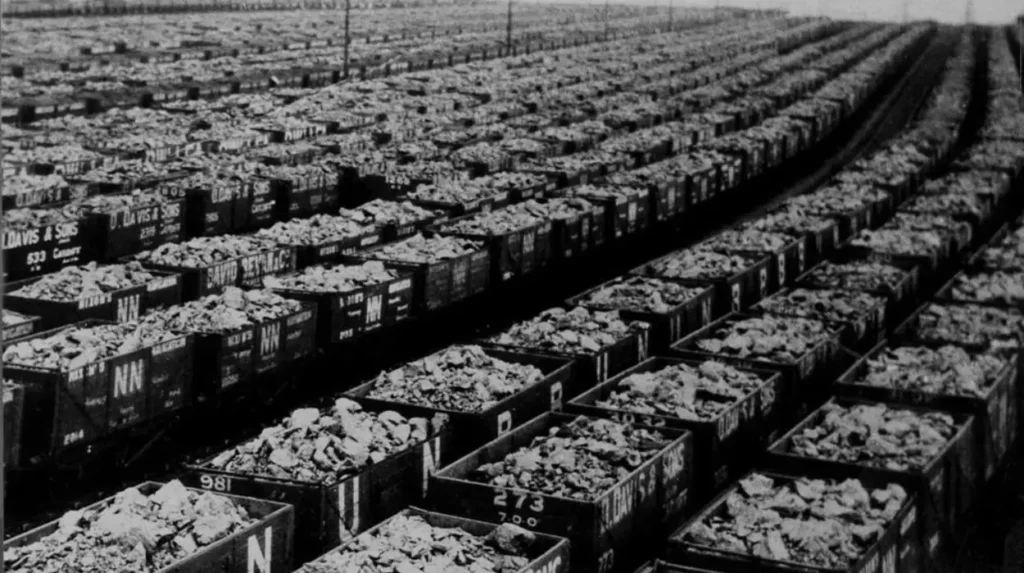
The South Wales coalfield supplied the fuel that drove Cardiff’s maritime expansion. Coal from valleys such as the Rhondda, Cynon and Rhymney travelled by railway to the docks, where it was loaded onto ships supplying industrial economies across the world.
Coal powered steam engines, industrial machinery, ships and factories during the Industrial Revolution. South Wales produced coal valued for its suitability for several industrial and maritime uses.
Cardiff’s position near the coalfield and its access to the Bristol Channel made it an important export centre. Railway connections linked inland mines to the port, creating an integrated transport system.
The port’s growth also depended on international demand. Industrialising economies required reliable supplies of fuel, while shipping companies needed ports capable of handling large cargo volumes efficiently.
When did Cardiff’s coal exports reach their peak?
Cardiff’s coal exports reached their historic peak in the years immediately before the First World War. Figures published in historical accounts place exports at more than 13 million tonnes in 1913.
This volume illustrates the scale of the port’s influence on international trade. Cardiff was not simply exporting local fuel; it was part of a global supply network supporting shipping, manufacturing and heavy industry.
The Cardiff Coal Exchange became a central institution in this trade. Located in the dockland commercial district, it brought together coal owners, merchants and buyers to negotiate contracts.
In 1901, a transaction worth £1 million was recorded at the Coal Exchange. The deal is widely recognised as the first million-pound business transaction of its kind, reflecting Cardiff’s international commercial significance.
How did railways connect the coalfield to the docks?
Railways transported coal from mining communities to Cardiff’s loading facilities. The Taff Vale Railway, which began operating in the nineteenth century, was particularly important in connecting the industrial valleys with the port.
Rail transport reduced dependence on slower road movement and allowed greater quantities of coal to reach the docks. The relationship between railways and dock infrastructure supported industrial expansion across the region.
This transport system also influenced settlement patterns. Workers moved towards industrial centres, businesses developed around railway connections and Cardiff’s population increased as the port attracted employment.
The docks therefore formed part of a much larger industrial network connecting mines, ironworks, railways, merchants and international customers.
How did Cardiff Docks shape Tiger Bay and Butetown?
Cardiff Docks encouraged the growth of Butetown, a dockland district associated with the multicultural community popularly known as Tiger Bay. Seafarers, dockworkers and traders from many countries settled in the area, shaping its social life and cultural identity.
The expansion of the docks created demand for workers in cargo handling, shipping, engineering, transport, hospitality and commerce. Cardiff attracted people from across Wales, other parts of Britain and overseas.
Butetown developed alongside the dock system. Housing, shops, religious institutions and community organisations served the needs of people whose livelihoods depended on maritime trade.
Tiger Bay became a familiar name for the wider dockland community. The district developed an international character through its connections with global shipping routes.
Which communities contributed to Tiger Bay?
Historical accounts describe residents with connections to more than 50 nationalities. Communities included people of Somali, Yemeni, Greek, Norwegian, Caribbean and other backgrounds, alongside Welsh and other British residents. Cardiff Harbour Authority+1
These communities contributed to the port’s labour force and established businesses, places of worship and social networks. Their presence reflected the movement of people that accompanied international shipping.
Cardiff’s docklands were therefore significant not only for their economic output but also for the development of multicultural urban life in Wales.
What happened to dockland housing?
Housing in Butetown reflected changing patterns of employment and investment. Some areas initially accommodated managers and skilled workers, while other streets became closely associated with dockers, sailors and their families.
Over time, parts of the district experienced deteriorating buildings and economic hardship as the docks declined. During the 1960s, redevelopment and clearance changed sections of Butetown, although the community remained an important part of Cardiff’s identity.
The historic street layout, surviving buildings and remaining dock structures provide evidence of the area’s industrial past.
Understanding Tiger Bay’s history requires recognising both the prosperity generated by the docks and the social challenges experienced by the communities that depended on them.
What happened to Cardiff Docks during the twentieth century?
Cardiff Docks experienced a prolonged decline as demand for South Wales coal weakened, international energy markets changed and competing ports expanded. The loss of traditional export business reduced employment, weakened dockland commerce and created pressure for large-scale urban regeneration.
The First World War marked a major turning point in the history of the coal trade. Although demand continued in some markets, the conditions that had supported Cardiff’s rapid expansion began to change.
During the interwar period, industrial restructuring, international competition and changes in energy consumption placed pressure on the coal industry. The Great Depression added further difficulties for industrial communities and export businesses.
The docks remained active, but their earlier dominance became increasingly difficult to sustain.
How did the decline of coal exports affect Cardiff?
Coal exports weakened as industrial demand and international trade patterns changed. Other energy sources, including oil, gained importance, while changing shipping practices and competition affected established coal-exporting ports.
By the 1960s, coal exports through Cardiff had fallen dramatically, and the port’s traditional economic model had largely collapsed.
The consequences extended beyond shipping. Dockworkers and related businesses lost employment, while warehouses, loading facilities and industrial sites became underused.
The wider dockland area faced economic challenges as businesses moved or closed. Communities that had grown around maritime work had to adapt to a different economic environment.
How did the docks operate during the Second World War?
Cardiff’s maritime infrastructure remained strategically important during the Second World War because shipping and industrial supply networks supported Britain’s wartime economy.
The docklands and surrounding areas experienced bombing. Historical records describe substantial wartime damage to parts of Butetown, although the extent of destruction varied across the district. Coflein+1
The war demonstrated the continuing importance of ports to national infrastructure, even as the economic conditions supporting Cardiff’s traditional coal trade were changing.
After the war, industrial decline continued, making the long-term redevelopment of the docklands an increasingly significant issue for Cardiff.
How did Cardiff Bay regeneration transform the former docks?
Cardiff Bay regeneration transformed large areas of former industrial dockland into a mixed-use waterfront. The Cardiff Bay Development Corporation, established in 1987, coordinated major redevelopment, including housing, public spaces, infrastructure and the Cardiff Bay Barrage.
By the late twentieth century, large parts of the old docklands required a new economic purpose. Former industrial land presented opportunities for redevelopment, but the scale of the area required coordinated planning and investment.
The Cardiff Bay Development Corporation was established in 1987 as part of a government programme addressing urban decline. Its work included transport improvements, housing development, open spaces and waterfront infrastructure.
What was the purpose of the Cardiff Bay Barrage?
The Cardiff Bay Barrage is a major engineering structure across the estuary of the River Taff and River Ely. Completed in 2000, it created a freshwater environment in Cardiff Bay by controlling the tidal movement of water.
The barrage measures approximately 1.1 kilometres and incorporates sluice gates, a fish pass and locks for vessel movements. It forms a key part of the modern waterfront’s physical infrastructure.
The creation of the freshwater bay changed the area’s landscape and supported new uses for the waterfront, including recreation, leisure boating and public access.
The barrage also introduced environmental considerations involving water quality, fish movement and the management of a changed estuarine ecosystem.
How did regeneration change the waterfront economy?
Regeneration encouraged investment in residential property, offices, hospitality, cultural facilities and tourism. Former industrial areas became places for living, working and leisure.
The modern waterfront includes cultural and civic destinations such as the Wales Millennium Centre, the Senedd and the historic Pierhead building. These institutions give Cardiff Bay a role in Welsh cultural life and government as well as tourism.
The redevelopment also improved connections between the waterfront and the wider city. Public spaces and walking routes allow visitors and residents to experience areas once dominated by industrial infrastructure.
However, regeneration did not erase the docklands’ earlier history. Surviving buildings, dock remains, street patterns and heritage displays continue to connect the modern bay with its industrial origins.
Which historic Cardiff Dock sites can visitors still explore?
Visitors can explore several locations that explain Cardiff’s maritime history, including the remaining East Bute Dock water, the Roald Dahl Plass area, the Pierhead building and Butetown’s historic streets. These places reveal different aspects of the city’s industrial and social development.
The former docklands contain a mixture of preserved structures, redeveloped sites and public spaces. Each location offers a different perspective on the evolution of the port.
What can visitors learn at the former West Bute Dock?
The original West Bute Dock has been filled in and redeveloped. Its entrance basin is associated with Roald Dahl Plass, a public space in the modern Cardiff Bay district.
Although the original dock water is no longer present, the location helps visitors understand the geography of the earliest major dock built by the Bute estate.
What remains of East Bute Dock?
Sections of East Bute Dock survive as water and historic dockland features. The area provides evidence of the infrastructure that supported coal handling, shipping and warehouse operations.
Historic environment records also document the surviving Bute Warehouse and archaeological remains associated with the former dock. These features demonstrate the continuing heritage value of former industrial sites, even when their original commercial use has disappeared.
Why is the Pierhead building significant?
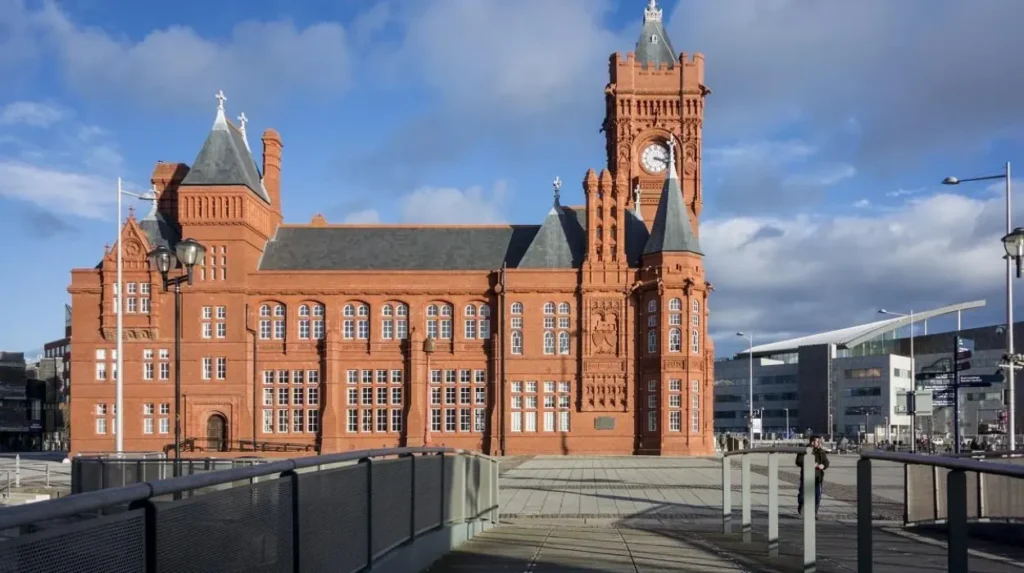
The Pierhead building is a prominent historic landmark in Cardiff Bay. Its connection with the dockland commercial district makes it an important part of the waterfront’s heritage.
Alongside the nearby Senedd and Wales Millennium Centre, it illustrates how Cardiff Bay combines historic architecture with modern civic and cultural development.
Visitors interested in the docks can use these landmarks as starting points for understanding the relationship between the former port, Butetown and the redeveloped waterfront.
Explore More Area Guide
The History of Cardiff Bay: From Coal Port to Waterfront Landmark
Cardiff’s Lost Villages and Settlements: Hidden History
What is the lasting significance of Cardiff Docks today?
Cardiff Docks remain central to understanding the city’s economic, social and cultural development. Their legacy survives in historic buildings, dock remains, railway routes, community identity and Cardiff Bay’s regeneration, connecting modern waterfront life with Wales’s industrial maritime past.
The docks helped establish Cardiff as an international trading centre. Their expansion supported the growth of the coal industry, strengthened railway networks and attracted workers from across the world.
Their influence extended into the city’s urban form. Butetown and the surrounding docklands developed in response to maritime employment, while commercial buildings reflected the wealth generated by international trade.
The decline of the coal economy created major challenges, but it also led to a new phase of urban development. Cardiff Bay now supports residential communities, tourism, public institutions and cultural activities.
How does Cardiff’s dock history contribute to Welsh heritage?
The history of Cardiff Docks forms part of Wales’s wider industrial heritage. It demonstrates the relationship between natural resources, transport infrastructure, international markets and urban growth.
The docks also preserve evidence of migration and multicultural settlement. Tiger Bay’s history shows how a port connected local communities with people and cultures across the world.
Industrial heritage sites help explain these developments through surviving buildings, archaeological remains, historical documents and museum collections.
Why does Cardiff Docks history remain relevant?
The docks offer a useful historical perspective on economic change. Cardiff’s experience shows how a city built around one major industry can face significant challenges when markets and technologies change.
The transition from coal exports to a diversified waterfront also demonstrates the importance of infrastructure, public investment, environmental management and cultural heritage in urban regeneration.
Today, Cardiff Bay is part of the city’s identity, but its modern landscape makes more sense when understood through the history of the docks that came before it.
The story of Cardiff Docks is therefore not limited to the rise and fall of the coal trade. It is also the history of Cardiff’s transformation into a major Welsh city and the continuing relationship between its industrial past and its future.
When were Cardiff Docks first established?
Cardiff’s major modern dock system began with the opening of Bute West Dock on 9 October 1839. The port existed before this date, but the new dock significantly increased its capacity to handle industrial exports.