
Finding suitable student accommodation in Cardiff requires careful planning around rent, university location, transport, tenancy agreements and living costs. Cardiff offers several housing options, including university halls, private student residences, shared houses, private flats and purpose-built student accommodation. The right choice depends on a student’s budget, course location, preferred living environment and length of stay.
- What Types of Student Accommodation Are Available in Cardiff?
- University-Owned Halls of Residence
- Private Purpose-Built Student Accommodation
- Shared Student Houses and Flats
- Private Flats and Studio Apartments
- Which Areas Are Best for Student Accommodation in Cardiff?
- How Much Does Student Accommodation Cost in Cardiff?
- Average Private Accommodation Costs
- University Accommodation Costs
- What Additional Accommodation Expenses Should Students Budget For?
- When Should Students Book Accommodation in Cardiff?
- Which Universities Should Students Consider When Choosing Accommodation in Cardiff?
- Cardiff University
- Cardiff Metropolitan University
- University of South Wales
- Why Does Campus Location Matter?
- What Should Students Check Before Signing a Cardiff Tenancy Agreement?
- Understand the Occupation Contract
- Check Rent Smart Wales Registration
- Understand Deposit Protection
- Check House Conditions
- Check Fire Safety
- What Is the Difference Between University Halls and Private Student Accommodation?
- How Can Students Travel Between Accommodation and Universities in Cardiff?
- How Can International Students Find Suitable Accommodation in Cardiff?
- Apply for University Accommodation Early
- Consider Private Student Residences
- Arrange Payments and Guarantor Requirements
- Check Accommodation Before Travelling
- What Should Students Consider When Choosing Accessible Accommodation in Cardiff?
- Wheelchair-Accessible Rooms
- Accommodation for Sensory Requirements
- Quiet Living Environments
- Support During the Application Process
- What Should Students Expect When Moving Into Cardiff Student Accommodation?
- Prepare Important Documents
- Organise Essential Household Items
- Complete the Property Inventory
- Understand Building Rules
- How Can Students Save Money on Cardiff Accommodation?
- Compare Shared Accommodation
- Avoid Unnecessary Facilities
- Check Whether Bills Are Included
- Choose a Practical Location
- Understand Council Tax Exemptions
- What Are the Most Important Accommodation Mistakes Students Should Avoid?
- Paying Money Before Verifying the Property
- Ignoring Contract Duration
- Overlooking Household Responsibilities
- Choosing Accommodation Without Visiting
- Ignoring Licensing and Safety
- How Can Students Get Housing Advice in Cardiff?
- Cardiff Students’ Union
- Cardiff University Accommodation Services
- Rent Smart Wales
- Cardiff Council and Shared Regulatory Services
- Finding the Right Student Accommodation in Cardiff
Cardiff is a major higher education destination in Wales. Its universities attract undergraduate students, postgraduate researchers and international students who need accommodation close to teaching facilities, libraries, transport connections and everyday services. Popular student neighbourhoods include Cathays, Roath, Plasnewydd, Cardiff City Centre and areas surrounding Heath Park.
This guide explains the main types of Cardiff student accommodation, the most practical neighbourhoods, average rental costs, booking procedures and legal responsibilities. It also covers the essential checks students should complete before signing a tenancy agreement.
What Types of Student Accommodation Are Available in Cardiff?
Cardiff students can choose university-owned halls, private student accommodation, shared houses, private flats and studio apartments. Each option provides different levels of privacy, facilities, rental flexibility and included services, allowing students to select housing according to their budget, university location and lifestyle requirements.
Cardiff has an established student housing market serving students from several higher education institutions. Accommodation providers operate across the city, particularly around Cathays, the city centre, Roath and university campuses.
The main accommodation categories offer different arrangements.
University-Owned Halls of Residence
University-owned halls are residential buildings managed directly by a university. They provide designated student rooms, shared facilities and accommodation contracts designed around academic requirements.
Cardiff University operates several residences for undergraduate and postgraduate students. Options include en-suite bedrooms, shared-bathroom accommodation, studios and part-catered residences.
Some residences are particularly convenient for students attending Cathays Park campus, while others provide access to Heath Park campus. The university’s accommodation directory lists properties such as Talybont, Aberconway Hall, Senghennydd Court, University Hall and Clodien House.
University halls generally provide a structured residential environment. Students share communal facilities and benefit from accommodation management and university support services.
Private Purpose-Built Student Accommodation
Private purpose-built student accommodation, commonly called PBSA, refers to residential buildings specifically developed for students.
Private student residences operate independently of universities. Their facilities vary by provider and building.
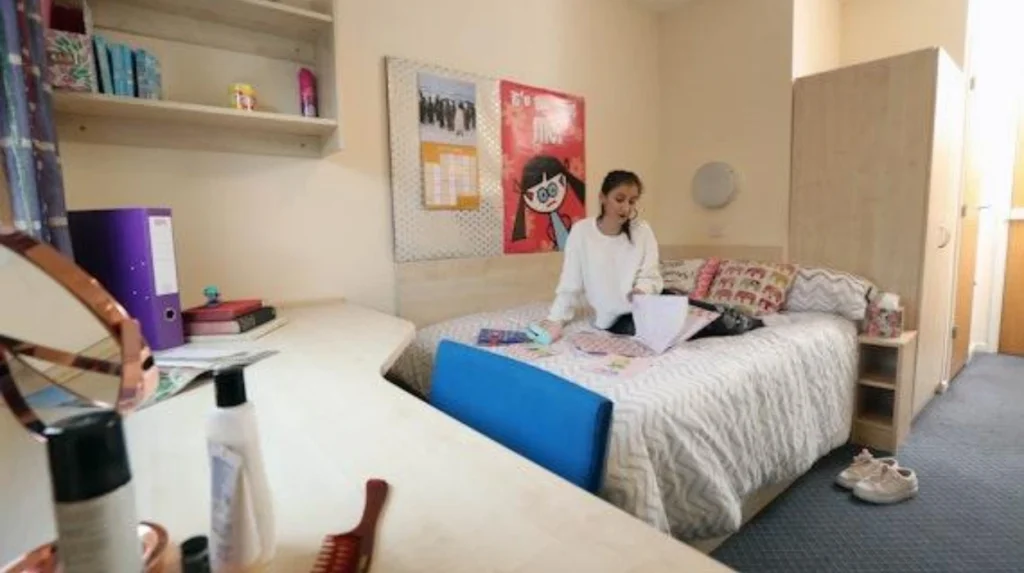
Common facilities include furnished bedrooms, en-suite bathrooms, shared kitchens, study areas, laundry rooms and communal lounges. Some developments also provide gyms, cinema rooms, social spaces and secure bicycle storage.
Private halls are particularly relevant to students who want managed accommodation without organising a shared private tenancy.
Cardiff Students’ Union provides housing advice and information about accommodation options. Students should check whether a private provider meets recognised accreditation standards before making a payment.
Shared Student Houses and Flats
Shared student housing involves renting a property with other students. Each resident usually has a private bedroom and shares facilities such as the kitchen, bathroom and living room.
Cathays and Roath have established student rental markets, with traditional terraced houses and converted residential properties.
Shared accommodation generally offers more control over household arrangements. Students choose their housemates, organise household responsibilities and manage their own domestic routines.
However, tenants must understand whether their agreement creates individual or joint responsibility for rent and other contractual obligations.
Private Flats and Studio Apartments
Private flats and studios provide greater independence than shared houses. A studio usually combines sleeping, living and kitchen facilities in one private space, while a separate flat generally includes distinct rooms.
These options suit postgraduate students, couples and students who prioritise privacy. Their rental costs are generally higher than those of a bedroom in shared housing.
Students should compare the total cost of accommodation rather than rent alone. Electricity, heating, water, broadband and other household expenses affect affordability.
Which Areas Are Best for Student Accommodation in Cardiff?
Cathays, Roath, Plasnewydd, Cardiff City Centre and Heath are important student accommodation areas in Cardiff. Their suitability depends on university location, rental budget, transport access and local facilities, including supermarkets, libraries, restaurants and public transport connections.
Cardiff’s student neighbourhoods have different residential characteristics. Some provide walking access to university buildings, while others offer more residential surroundings and connections to the city centre.
Cathays
Cathays is one of Cardiff’s best-known student residential neighbourhoods. It sits close to Cardiff University and the Cathays Park campus.
The area contains traditional terraced houses, shared student properties, private halls and converted residential buildings. Its location makes it particularly convenient for students attending lectures and using university facilities.
Cathays also has everyday services, including convenience shops, supermarkets, cafés, takeaway restaurants and laundrettes. Students can reach Cardiff city centre on foot.
The neighbourhood has a substantial student population, especially around the university’s academic buildings and residential streets.
Cathays is particularly suitable for:
- Cardiff University undergraduate students.
- Students looking for shared houses near campus.
- International students who prefer a central residential location.
- Students who want to reduce daily commuting.
Students should check the condition of older rental properties carefully. Heating, insulation, damp, window quality and bathroom facilities require particular attention in traditional terraced housing.
Roath
Roath is an established residential district east of Cardiff city centre. It attracts students because of its housing choices, local shopping streets and access to central Cardiff.
Albany Road and Wellfield Road are important local shopping areas. They contain supermarkets, independent retailers, restaurants, cafés and other everyday services.
Roath also provides access to Roath Park, a large public green space with a lake, gardens and recreational facilities.
Students living in Roath generally use walking, cycling and local bus services to reach university buildings. Actual journey times depend on the property’s location and the destination campus.
The area suits students who want a residential neighbourhood with access to shops and outdoor spaces.
Plasnewydd
Plasnewydd is an inner-city Cardiff neighbourhood that includes parts of the wider Roath area. It contains shared student houses, private rental properties and residential streets close to local shopping facilities.
Its position provides access to Cardiff city centre and Cardiff University. Students also benefit from nearby services along Albany Road and surrounding commercial streets.
Plasnewydd is relevant to students comparing shared housing with accommodation closer to the city centre.
The local housing stock includes traditional terraced properties and converted buildings. Students should inspect bedrooms, communal facilities, fire safety arrangements and heating systems before accepting a tenancy.
Cardiff City Centre
Cardiff City Centre provides access to shopping, entertainment, transport and several private student accommodation developments.
The area includes Cardiff Central railway station, Queen Street railway station, the main shopping district and major bus connections.
Students living centrally can access restaurants, supermarkets, cultural venues and leisure facilities. Cardiff University’s Cathays Park campus is also accessible from the city centre.
City-centre accommodation includes private halls, modern apartment buildings and studio flats. Some developments offer furnished rooms, communal study areas and managed facilities.
Students should compare rental prices carefully because central locations and additional building facilities can increase accommodation costs.
Heath
Heath is an important residential location for students studying healthcare and medical subjects at Cardiff University’s Heath Park campus.
The campus includes the university’s School of Medicine facilities and is associated with University Hospital of Wales.
Clodien House is one of the university accommodation options particularly convenient for Heath Park students. Cardiff University lists its walking distance to the Heath Park campus as approximately five minutes.
Students attending healthcare placements and campus-based teaching should prioritise reliable access to Heath Park.
Cathays, Roath and other central neighbourhoods also provide access to the campus, but students should calculate their daily commuting costs and travel times before signing a contract.
Which Neighbourhood Should Students Choose?
The most suitable neighbourhood depends on the student’s main requirements.
Cathays is particularly practical for students attending Cathays Park campus. Heath is convenient for students studying at Heath Park. Roath and Plasnewydd provide residential surroundings with access to local shopping streets, while Cardiff City Centre offers extensive transport and entertainment connections.
A property located closest to campus is not automatically the cheapest option. Students should compare rent, bills, transport expenses and contract duration together.
How Much Does Student Accommodation Cost in Cardiff?
Student accommodation costs in Cardiff depend on property type, location, facilities and tenancy length. Cardiff University’s May 2026 estimates place average shared-house rent at £500 monthly excluding bills, with estimated utilities adding £88 monthly.
Accommodation is usually one of the largest expenses in a student’s budget. Cardiff University publishes living-cost estimates to help students compare university residences with private rental accommodation.
Average Private Accommodation Costs
According to Cardiff University’s living-cost calculator, the estimated cost of renting a room in a four-bedroom shared house is £500 per month, excluding bills.
The university estimates the following additional household expenses:
- Rent: £500 per month.
- Utilities, including gas, electricity, water and broadband: £88 per month.
- Food, toiletries and laundry: approximately £293.19 per month.
- Study materials: £20 per month.
- Socialising and leisure: approximately £165.97 per month.
- Clothing: £40 per month.
- Mobile phone and television licence allocation: £18.75 per month.
The university calculates an estimated total living cost of £1,125.91 per month for this private accommodation budget.
These are university estimates based on research available in May 2026, not guaranteed rental quotations. Individual spending varies according to property, household arrangements and personal circumstances.
University Accommodation Costs
University residence prices depend on room type, building, catering arrangements and contract length.
Cardiff University’s published 2026 accommodation listings include examples such as:
These are starting prices published in the university’s accommodation listings, not universal rates for every room or contract.
The advertised total contract price is important because university residences operate different contract periods. Students should compare the full accommodation cost rather than assuming every weekly price covers the same number of weeks.
What Additional Accommodation Expenses Should Students Budget For?
Students should calculate the complete cost of living in a property before signing a tenancy agreement.
Additional expenses include:
Utility bills: Gas, electricity and water charges depend on the property, household consumption and billing arrangements.
Internet: Broadband costs depend on the provider and package. Students should confirm whether internet access is included in the rent.
Laundry: Some residences include communal laundry facilities that operate through paid machines. Private houses generally require students to organise their own laundry arrangements.
Transport: Students living outside walking distance of campus should account for bus, rail or cycling expenses.
Contents insurance: Personal belongings insurance provides protection for eligible possessions against specified risks.
Deposits: Landlords normally require a tenancy deposit before the occupation begins. The amount and legal protection arrangements must be checked.
A realistic budget includes both regular payments and initial moving expenses.
When Should Students Book Accommodation in Cardiff?
Students should begin researching Cardiff accommodation several months before their course starts. Cardiff Students’ Union reports that private rental properties for the following academic year commonly appear from late October and early November, with some students signing contracts well in advance.
Accommodation demand changes throughout the academic year. Students arriving in September should begin comparing properties before the busiest rental period.
Booking University Halls
University accommodation follows an application process established by the relevant institution.
Cardiff University provides an online accommodation application system. Students should check eligibility, application deadlines, room availability and contract conditions.
The university’s accommodation information explains that first-year undergraduate students and eligible international postgraduate students receive accommodation support subject to the applicable guarantee conditions and deadlines.
UK postgraduate students should not assume they automatically receive guaranteed university accommodation. Availability and eligibility differ between student categories.
Students should accept their accommodation offer before the stated deadline and retain confirmation of their booking.
Booking Private Student Halls
Private student residences usually accept applications directly through their accommodation providers.
Students should compare:
- Room types and available facilities.
- Weekly rent and total contract price.
- Deposit and payment requirements.
- Contract start and end dates.
- Cancellation and replacement-tenant policies.
- Included utility bills and internet services.
Some private providers request a booking payment or advance rent. Students should establish the legal purpose of every payment before transferring money.
Finding Shared Student Housing
Students searching for private houses can use established letting agents and accommodation advertising platforms.
Cardiff Students’ Union identifies Woodville Road, Mundy Place and Albany Road as locations where students can find letting agents.
The private rental market often advertises accommodation for the following academic year from late October and early November.
Students should avoid signing a contract simply because other prospective tenants are interested in the same property. A complete viewing and contract review are more important than securing a room immediately.
Which Universities Should Students Consider When Choosing Accommodation in Cardiff?
Cardiff has several higher education institutions, including Cardiff University, Cardiff Metropolitan University and the University of South Wales. Students should select accommodation according to their actual teaching campus because university buildings and facilities are distributed across different parts of the city.
Cardiff’s higher education sector attracts students studying business, engineering, medicine, creative subjects, education, social sciences and other disciplines.
Cardiff University
Cardiff University is a major research university located in Cardiff. Its academic facilities include Cathays Park and Heath Park campuses.
The university recorded 38,455 enrolled students during the 2024/25 academic year, according to its annual monitoring report using Higher Education Statistics Agency data.
Its student residences include accommodation near Cathays Park, Cardiff city centre and Heath Park.
Students should identify their main teaching building before choosing a property. A student attending the School of Medicine has different commuting requirements from someone studying at the Cathays Park campus.
Cardiff Metropolitan University
Cardiff Metropolitan University operates campuses in Cardiff, including Llandaff and Cyncoed.
The Llandaff campus serves students across several academic disciplines, while Cyncoed provides additional teaching and sporting facilities.
Students attending Cardiff Metropolitan University should investigate accommodation in neighbourhoods with practical connections to their campus.
Cathays, Roath and central Cardiff provide potential residential options, but journey times depend on the precise address and transport arrangements.
University of South Wales
University of South Wales has a Cardiff campus associated with its creative, cultural and professional courses.
The Cardiff campus is located in the city centre, making central accommodation relevant to students attending teaching sessions there.
USW also operates campuses outside Cardiff, including Pontypridd and Newport. Students should confirm their course location rather than selecting accommodation based only on the university’s name.
USW provides information about private halls in Cardiff and university-owned accommodation at its other locations.
Why Does Campus Location Matter?
Campus location affects more than commuting time. It also determines access to university libraries, laboratories, student support facilities, societies and teaching buildings.
A student who chooses housing near Cathays Park but attends regular teaching sessions at Llandaff needs to consider the additional journey.
Before booking, students should check their course timetable, campus address and transport connections.

What Should Students Check Before Signing a Cardiff Tenancy Agreement?
Students should inspect the property, verify the landlord or letting agent, review the occupation contract, check deposit protection and confirm rent arrangements before signing. These checks reduce financial risks and help students understand their housing rights and responsibilities.
A tenancy agreement establishes the contractual relationship between a landlord and a tenant. In Wales, residential renting is governed by the Renting Homes (Wales) Act 2016, which introduced the occupation contract system.
Students should understand the legal arrangements before committing to a property.
Understand the Occupation Contract
The Renting Homes (Wales) Act 2016 changed the framework for renting residential accommodation in Wales.
Most private student renters occupy properties under standard occupation contracts. These contracts set out the landlord’s and contract-holder’s responsibilities.
Students should review the following details:
- Monthly or weekly rent.
- Contract commencement and termination dates.
- Payment deadlines.
- Deposit arrangements.
- Responsibility for utility bills.
- Repair and maintenance obligations.
- Rules concerning guests and pets.
- Notice and termination provisions.
The written statement of the occupation contract should explain the key terms and conditions.
Students renting with friends should establish whether they are signing one joint contract or separate individual contracts. This distinction affects their financial responsibilities.
Check Rent Smart Wales Registration
Rent Smart Wales regulates landlord and letting-agent registration and licensing requirements under the Housing (Wales) Act 2014.
Landlords who let or manage properties in Wales must comply with the applicable registration and licensing requirements.
Students should check the landlord’s registration and establish whether a letting agent holds the necessary licence when carrying out regulated letting or management activities.
Rent Smart Wales provides an online register that helps tenants check relevant landlord and agent details.
Understand Deposit Protection
A rental deposit provides financial security against certain contractual losses, such as unpaid rent or damage beyond fair wear and tear.
For relevant occupation contracts, landlords must protect deposits through an authorised deposit scheme and provide the required information within the statutory period.
Students should request written confirmation of the deposit amount and protection arrangements.
In England and Wales, the three government-authorised tenancy deposit protection providers are:
- Deposit Protection Service.
- MyDeposits.
- Tenancy Deposit Scheme.
Students should keep the deposit receipt, protection certificate and inventory documents.
Check House Conditions
A property viewing should include a careful inspection of its condition.
Students should examine:
Damp and mould: Check ceilings, window frames, bathroom walls and external-facing rooms for moisture damage.
Heating: Confirm that radiators, boilers and other heating equipment work properly.
Windows and doors: Check locks, draughts and ventilation.
Water supply: Test taps, showers and toilet facilities.
Electrical safety: Check visible sockets, lighting and the condition of electrical installations.
Kitchen facilities: Confirm that cooking appliances, refrigerators and washing facilities are suitable for the number of occupants.
Students should photograph existing damage and request an inventory before moving in.
Check Fire Safety
Fire safety is particularly important in shared student housing because several occupants use the same building.
Students should check that the property has suitable smoke alarms, appropriate fire precautions and clear escape routes.
Houses in Multiple Occupation have additional regulatory requirements.
A House in Multiple Occupation, or HMO, is generally a property occupied by at least three people forming more than one household who share facilities such as a kitchen or bathroom.
Cardiff has additional HMO licensing requirements in certain neighbourhoods. The Shared Regulatory Services guidance identifies Cathays and Plasnewydd as areas where additional licensing applies to relevant HMOs that are not already subject to mandatory licensing.
Mandatory licensing also applies to qualifying HMOs with five or more occupants from at least two households in properties of three or more storeys across the relevant council areas.
Students renting a shared house should ask the landlord or agent about applicable licensing requirements before signing.
What Is the Difference Between University Halls and Private Student Accommodation?
University halls are managed by educational institutions, while private student accommodation is operated by independent housing providers. Both offer student-focused residential facilities, but their application procedures, contract conditions, prices, management arrangements and available services differ.
The decision between university halls and private residences depends on the student’s priorities.
Management and Support
University halls are connected to the university’s accommodation services. Students can access relevant residence-management and student-support arrangements.
Private student residences operate through independent companies. Their customer support, maintenance procedures and building management depend on the provider.
Students should identify the organisation responsible for maintenance, security and complaints.
Facilities and Services
University residences provide different combinations of shared bathrooms, en-suite bedrooms, communal kitchens and catering arrangements.
Private residences often advertise additional facilities, such as gyms, cinema rooms, study areas and social lounges.
However, facilities vary between buildings. Students should inspect the exact accommodation rather than relying entirely on promotional photographs.
Contract Length
University accommodation commonly uses academic-year contracts or other specified residential periods.
Private student housing contracts can also cover an academic year, but some providers require longer commitments.
Private shared houses often operate on 12-month contracts. Cardiff University’s May 2026 living-cost guidance uses a 12-month private housing contract for its cost comparison.
Students who return home during summer should check whether rent remains payable throughout the holiday period.
Included Bills
Many private student halls advertise rent that includes utilities and internet. University residences also provide different billing arrangements depending on the building and contract.
Shared private houses can require tenants to organise and pay household bills separately.
Students should confirm precisely which services are included before comparing prices.
How Can Students Travel Between Accommodation and Universities in Cardiff?
Cardiff provides bus, rail, cycling and walking connections between student neighbourhoods and university campuses. Students should select accommodation based on their regular teaching destination, available transport services and total commuting costs rather than distance alone.
Cardiff has a connected urban transport network serving the city centre and surrounding residential districts.
Walking to University
Walking is practical for students living near their teaching buildings.
Cathays offers convenient access to Cardiff University’s Cathays Park campus, while accommodation near Heath Park is particularly useful for healthcare students.
Walking also reduces regular transport expenditure and provides direct access to nearby shops and university facilities.
Students should check actual walking routes rather than relying only on straight-line distances.
Cardiff Bus Services
Cardiff Bus provides local bus services across Cardiff and neighbouring areas.
Bus services connect residential districts with the city centre and university locations. Students living in Roath, Heath, Llandaff and other outer neighbourhoods should investigate routes serving their campus.
Bus frequency, service hours and journey times differ between routes. Students should check current timetables before committing to accommodation.
Rail Connections
Cardiff has several railway stations, including Cardiff Central and Cardiff Queen Street.
Rail connections are useful for students travelling between Cardiff and other Welsh or UK destinations. Local rail services also connect some surrounding areas with the city.
Students living farther from campus should compare railway access with bus services and walking connections.
Cycling Around Cardiff
Cycling offers another commuting option for students. Cardiff has established cycling routes and active travel infrastructure.
Students should check secure bicycle storage at their accommodation and identify suitable routes to their campus.
A bicycle also provides access to local shopping facilities, libraries and recreational areas.
Transport Budgeting
Students should calculate commuting expenses alongside rent.
A cheaper property outside the main student neighbourhoods does not always produce lower overall costs if it requires frequent paid transport.
A practical comparison includes weekly journeys, evening travel, weekend services and the distance to supermarkets.
How Can International Students Find Suitable Accommodation in Cardiff?
International students can secure Cardiff accommodation through university residence applications, private student halls and shared rental properties. They should confirm their university’s accommodation eligibility rules, understand payment requirements, arrange suitable tenancy documentation and secure housing before travelling to the UK.
International students often need to arrange accommodation before arriving in Cardiff. This requires additional preparation because they cannot always inspect properties in person.
Apply for University Accommodation Early
Cardiff University provides accommodation information and application facilities for eligible international students.
International postgraduate students starting in September can qualify for university accommodation arrangements, subject to the relevant offer conditions and acceptance deadlines.
Students should read their accommodation offer carefully and confirm the contract period.
Students attending Cardiff Metropolitan University or the University of South Wales should consult their respective accommodation teams for available university-linked and private housing arrangements.
Consider Private Student Residences
Private halls provide an alternative when university accommodation is unavailable or unsuitable.
International students should check whether the provider accepts international applicants and whether the accommodation offers the required contract length.
A furnished room with included bills can simplify initial arrangements for students arriving from overseas.
Students should request a written booking confirmation and verify the provider’s contact details before transferring money.
Arrange Payments and Guarantor Requirements
Some landlords and letting agents request a UK-based guarantor when assessing a prospective tenant.
A guarantor is a person who agrees to meet specified financial obligations if the tenant fails to fulfil them.
International students without a UK-based guarantor should ask about alternative arrangements. These include approved guarantor services or advance rent where legally permitted and contractually agreed.
Cardiff University Students’ Union provides housing advice and identifies a university guarantor scheme for eligible registered students.
Students should never pay an unexplained fee or transfer money to an unverified individual.
Check Accommodation Before Travelling
International students should obtain written confirmation of:
- Property address and room number.
- Contract start date.
- Total rent and payment schedule.
- Deposit arrangements.
- Included utility bills.
- Internet availability.
- Check-in instructions.
- Emergency contact details.
Students booking remotely should request a live video viewing and a copy of the written occupation contract.
What Should Students Consider When Choosing Accessible Accommodation in Cardiff?
Accessible student accommodation provides facilities that support students with mobility, sensory or other accessibility requirements. Students should discuss individual needs with university accommodation teams and private providers before booking to confirm suitable rooms, facilities and access arrangements.
Accessibility is an important part of accommodation planning. Students should identify the facilities required to use their accommodation safely and independently.
Wheelchair-Accessible Rooms
Some student residences provide wheelchair-accessible accommodation.
Cardiff University’s accommodation search allows students to filter options according to accessibility requirements, including wheelchair access.
Students should confirm the precise room specification rather than assuming that a general accessible-room description covers every requirement.
Relevant features include:
- Step-free building entrances.
- Suitable bedroom door widths.
- Accessible bathrooms.
- Appropriate kitchen facilities.
- Lift access where required.
- Accessible communal spaces.
Accommodation for Sensory Requirements
Students with hearing or visual impairments should ask about suitable facilities.
Examples include accessible alarm systems, visual fire alerts, suitable lighting and clear building navigation.
The university accommodation team can explain available facilities and discuss specific requirements during the application process.
Quiet Living Environments
Some students require quieter residential arrangements to support studying, sleep and daily routines.
Cardiff University lists quiet-living accommodation among its available residential preferences.
Students should check the location of communal areas, social spaces and shared facilities before selecting a room.
Support During the Application Process
Students should contact their university’s disability or student-support services when accommodation requirements affect their housing choices.
Early communication gives accommodation teams more time to identify suitable rooms and discuss necessary adjustments.
Private providers should also receive clear information about any essential accessibility requirements before a contract is signed.
What Should Students Expect When Moving Into Cardiff Student Accommodation?
Moving into student accommodation involves confirming the booking, preparing identification documents, arranging payments, completing check-in procedures and inspecting the property. Students should organise these tasks before arrival to reduce administrative problems and ensure their accommodation is ready.
Moving into a new property requires more than collecting keys. Students should prepare essential documents and understand the building’s residential arrangements.
Prepare Important Documents
Students should keep copies of their accommodation confirmation, occupation contract and payment receipts.
University residents should follow the check-in instructions provided by their accommodation office.
Private renters should retain landlord and letting-agent contact details, deposit protection information and the property inventory.
International students should also keep their university enrolment and identification documents accessible.
Organise Essential Household Items
The items required depend on whether the accommodation is furnished or unfurnished.
Typical essentials include bedding, towels, toiletries, cleaning products, kitchen equipment and suitable clothing.
Students living in university halls should check the room inventory before purchasing additional furniture or appliances.
Some residences provide basic kitchen facilities, while others require residents to supply their own cooking equipment.
Complete the Property Inventory
A property inventory records the condition and contents of accommodation at the beginning of a tenancy.
Students should check bedroom furniture, appliances, walls, windows, flooring and communal areas.
Existing damage should be reported to the landlord or accommodation manager in writing.
Photographs provide useful evidence of the property’s initial condition and help prevent disagreements when the tenancy ends.
Understand Building Rules
Every accommodation provider has its own residential procedures.
Students should establish:
- How to report maintenance problems.
- What to do during emergencies.
- How to access communal facilities.
- Whether visitors are permitted.
- How waste and recycling are organised.
- Where bicycles can be stored.
- How to contact building management.
Understanding these arrangements helps students manage their accommodation throughout the academic year.
How Can Students Save Money on Cardiff Accommodation?
Students can reduce accommodation expenses by comparing shared housing, selecting properties near their campus, checking included bills and avoiding unnecessary facilities. Reviewing contract length, transport costs and household responsibilities also helps students calculate the actual cost of living.
Accommodation choices affect a student’s financial position throughout the academic year.
Compare Shared Accommodation
Sharing a house distributes certain household expenses between residents.
For example, four students renting a shared house can divide eligible utility and broadband costs, subject to their agreement.
However, students should understand their individual rent responsibilities and the terms of a joint occupation contract.
Avoid Unnecessary Facilities
Private student residences sometimes advertise gyms, cinemas, social lounges and other additional facilities.
These features can be useful, but they should not replace essential considerations such as affordability, location, room quality and security.
Students should compare the total contract cost against the facilities they actually intend to use.
Check Whether Bills Are Included
A room advertised at a lower weekly rent does not always represent the cheapest option.
Students should calculate rent plus electricity, gas, water, broadband and other household expenses.
An accommodation provider offering inclusive bills can simplify budgeting, but students should check whether usage limits or additional charges apply.
Choose a Practical Location
Living close to a university campus can reduce daily transport costs.
Cathays is particularly practical for Cardiff University students attending Cathays Park, while Heath provides access to the university’s medical campus.
Students should compare the combined cost of accommodation and commuting before choosing a cheaper property farther away.
Understand Council Tax Exemptions
Most qualifying full-time students are exempt from Council Tax when they meet the applicable requirements.
Cardiff University explains that full-time undergraduate and postgraduate students generally qualify when their courses meet the relevant duration and eligibility conditions.
Part-time students do not automatically receive the same exemption.
Households containing both students and non-students have different Council Tax arrangements. Students should check their circumstances with Cardiff Council and obtain the appropriate student-status documentation.
What Are the Most Important Accommodation Mistakes Students Should Avoid?
Students should avoid paying deposits before verifying properties, signing contracts without reading conditions, ignoring additional bills and choosing accommodation without checking transport access. Careful property inspections and written confirmation of payments help prevent common student housing problems.
Accommodation problems often begin when students make decisions without checking the relevant documents or property conditions.
Paying Money Before Verifying the Property
Students should confirm that a property exists and that the person advertising it has authority to rent it.
They should verify the landlord or letting agent through appropriate registration records.
Payments should use traceable methods with written receipts.
Ignoring Contract Duration
A student might need accommodation for an academic year but sign a contract covering a longer period.
This creates additional rent obligations during holidays or after completing a course.
Students should check the termination date and any replacement-tenant arrangements before committing.
Overlooking Household Responsibilities
Shared housing requires residents to understand their responsibilities for cleaning, bills, maintenance reporting and communal facilities.
Students should discuss household arrangements before signing a joint contract.
They should also establish how rent and bills are divided between occupants.
Choosing Accommodation Without Visiting
Photographs do not always represent the property’s current condition.
Students should arrange an in-person inspection whenever possible.
International students who cannot visit should request a live video tour, detailed photographs and written confirmation of the accommodation’s facilities.
Ignoring Licensing and Safety
Students should check whether the property requires an HMO licence.
They should also examine fire safety arrangements, locks, heating and general maintenance.
If a property appears unsafe or a landlord fails to address serious problems, students should seek advice from their university housing team or the relevant local authority.
Explore More Area Guide
Best Student Areas in Cardiff: Cathays, Roath and Heath
Moving to Cardiff as a Student: Accommodation, Costs and University Life
How Can Students Get Housing Advice in Cardiff?
Cardiff students can obtain accommodation guidance from university residence teams, Cardiff Students’ Union, Rent Smart Wales and local housing authorities. These organisations provide information about applications, rental agreements, landlord requirements, deposits and housing-related problems.
Students do not need to manage every accommodation issue independently.
Cardiff Students’ Union
Cardiff Students’ Union provides specialist housing advice for Cardiff University students.
Its Student Advice team helps students understand tenancy agreements, landlord responsibilities and housing conditions.
The team also provides contract-checking support for private accommodation.
Contact details published by Cardiff University include:
- Email: [email protected]
- Telephone: +44 (0)29 2078 1410
Students should use the official university website to confirm current contact arrangements.
Cardiff University Accommodation Services
Cardiff University’s accommodation service provides information about residence applications, room availability, accommodation types and eligibility.
Students can compare accommodation through the university’s online residence directory.
The directory includes information about accessibility, room facilities, catering and residence locations.
Rent Smart Wales
Rent Smart Wales provides landlord and letting-agent registration and licensing information.
Its register helps students check relevant housing-provider details.
It also provides guidance about legal responsibilities for landlords and letting agents operating in Wales.
Cardiff Council and Shared Regulatory Services
Cardiff Council and Shared Regulatory Services provide information about housing standards, HMO licensing and relevant environmental health matters.
Students concerned about unsafe housing or licensing requirements should seek advice through the appropriate local authority service.
Finding the Right Student Accommodation in Cardiff
Cardiff offers a wide range of student accommodation, from university-owned halls and private residences to shared houses and independent flats. Cathays, Roath, Plasnewydd, Cardiff City Centre and Heath provide different residential options for students attending universities across the city.
The best accommodation choice depends on the student’s university campus, financial position, preferred facilities and tenancy requirements.
Cardiff University’s May 2026 living-cost estimates provide a useful starting point for budgeting, with average shared-house rent estimated at £500 per month excluding bills. Students should use this figure as a benchmark rather than a guaranteed market price.
Planning ahead, inspecting properties, checking occupation contracts and verifying landlords help students make informed housing decisions. With suitable preparation, students can find accommodation that supports their academic commitments and everyday life in Cardiff
What is the best area for student accommodation in Cardiff?
Cathays is one of the most popular areas for students attending Cardiff University because of its proximity to the Cathays Park campus. Roath, Plasnewydd, Heath and Cardiff City Centre are also suitable options depending on university location and budget.