
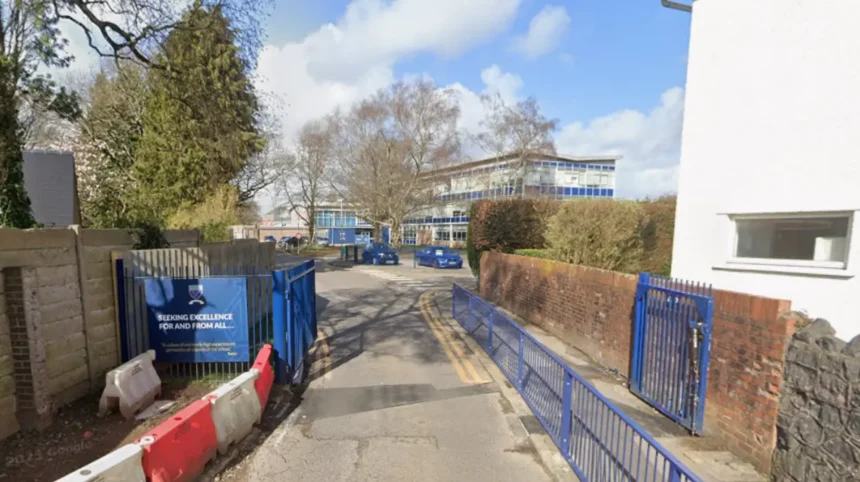
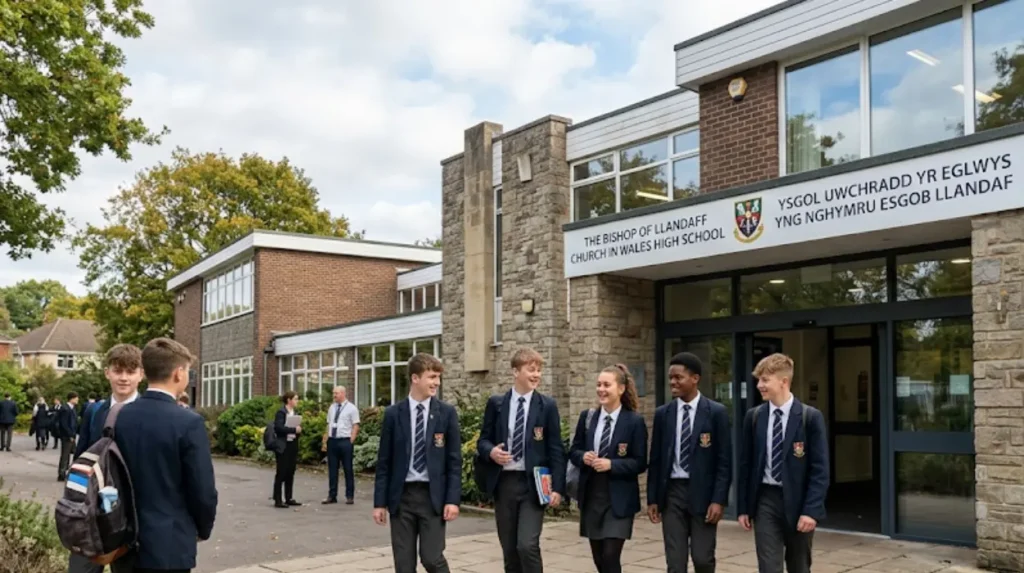
The Bishop of Llandaff Church in Wales High School is an 11–18 co-educational voluntary aided comprehensive school in Llandaff, Cardiff, serving students from Cardiff, the Vale of Glamorgan, Rhondda Cynon Taf, and Bridgend.
- What is the Bishop of Llandaff School?
- Where is the Bishop of Llandaff School located and who does it serve?
- What is the history and background of the Bishop of Llandaff School?
- What type of school is the Bishop of Llandaff in the Welsh education system?
- What curriculum and subjects does the Bishop of Llandaff School offer?
- How does admissions work at the Bishop of Llandaff School?
- What are the sixth form entry requirements and pathways?
- What are the school’s core values and ethos?
- How does the Bishop of Llandaff School perform in inspections and outcomes?
- What facilities and extracurricular opportunities does the school provide?
- Who should consider the Bishop of Llandaff School for secondary education?
What is the Bishop of Llandaff School?
The Bishop of Llandaff is a Church in Wales, Christian faith comprehensive secondary school for ages 11 to 18, located in Llandaff, Cardiff, with approximately 1,300 students.
The school operates as a voluntary aided comprehensive, meaning it is state-funded but maintained in partnership with the Church in Wales. It admits students of all abilities from a wide catchment that includes Cardiff and surrounding local authorities. The school’s ethos is explicitly Anglican, yet it serves both Christian and non-Christian communities across the region.
The full name is Bishop of Llandaff Church in Wales High School (Welsh: Ysgol Uwchradd yr Eglwys yng Nghymru Esgob Llandaf). It was established in 1961 and is situated on Rookwood Close, Llandaff, Cardiff, CF5 2NR. The current head teacher is Mr Marc Belli.
Where is the Bishop of Llandaff School located and who does it serve?
The school is located at Rookwood Close, Llandaff, Cardiff, CF5 2NR, and serves students aged 11 to 18 from Cardiff, the Vale of Glamorgan, Rhondda Cynon Taf, Caerphilly, and Bridgend.
Llandaff is a historic cathedral city within Cardiff, giving the school a central yet community-focused position. The catchment extends beyond Cardiff into multiple local authorities, reflecting its role as a regional Church in Wales secondary school. Families from both urban Cardiff and more rural parts of the Vale and valleys apply to the school.
The age range is 11 to 18, covering Key Stage 3 (Years 7–9), Key Stage 4 (Years 10–11), and Key Stage 5 (Sixth Form). The school’s DFEE number is 4608, and it is listed on Cardiff Council’s school directory as The Bishop Of Llandaff C.W High School.
What is the history and background of the Bishop of Llandaff School?
The Bishop of Llandaff High School was established in 1961 as a Church in Wales voluntary aided comprehensive school in Llandaff, Cardiff, and has grown to serve around 1,300 students.
The school was founded during the post-war expansion of secondary education in Wales, when many new comprehensive schools were created to replace or supplement the selective system. Its Church in Wales foundation reflects the historical role of the Anglican Church in Welsh education, particularly in and around the Diocese of Llandaff.
Over time, the school has maintained its religious character while operating as a fully inclusive comprehensive. It admits students of all faiths and none, in line with its mission to serve both Christian and non-Christian communities. The school’s continuity since 1961 has made it a stable institution in Cardiff’s secondary education landscape.
In recent years, the school has been recognized for high performance. Estyn, the education and training inspectorate for Wales, rated the school “excellent” in all five inspection categories, the highest possible rating. This places it among the top-performing secondary schools in Wales.
What type of school is the Bishop of Llandaff in the Welsh education system?
The Bishop of Llandaff is a voluntary aided comprehensive school under the Church in Wales, providing state-funded secondary education for ages 11 to 18 within the Welsh curriculum framework.
In Wales, voluntary aided schools are maintained by the local authority but have a foundation, usually religious, that contributes to capital costs and appoints some governors. The Church in Wales foundation shapes the school’s ethos, religious education, and collective worship, while the curriculum follows national Welsh requirements.
As a comprehensive school, it does not select by academic ability. It admits students across the full ability range and provides differentiated pathways through Key Stages 3, 4, and 5. The school’s designation as an 11–18 institution means it includes a sixth form, offering post-16 academic and vocational routes.
The school operates under Curriculum for Wales, which emphasizes broad, balanced learning and the development of skills for life beyond school. This national curriculum framework applies across all key stages, with specific adaptations for each phase.
What curriculum and subjects does the Bishop of Llandaff School offer?
The school delivers the Curriculum for Wales across Key Stages 3, 4, and 5, with core subjects including English, Welsh, mathematics, science, and religious education, plus a wide range of academic and vocational options.
In Lower School (Years 7–9, Key Stage 3), the curriculum includes core subjects: English, Welsh, mathematics, science, and religious education. Non-core subjects include modern foreign languages, design technology, ICT, history, geography, art, music, drama, physical education, PSE (including sex education), and careers and the world of work. This broad mix ensures exposure to humanities, arts, sciences, and practical skills.
In Upper School (Years 10–11, Key Stage 4), compulsory subjects are English language and literature, Welsh second language, mathematics (numeracy and mathematics), science, religious education, physical education, and the Welsh Baccalaureate. Students also study PSE (including Relationships and Sexuality Education) and careers and the world of work. On top of this, they choose from a range of academic and vocational courses leading to external qualifications, based on demand and student interest.
In Senior School (Sixth Form, Key Stage 5), students follow a broad range of A-level and vocational courses. All students complete the Advanced Skills Baccalaureate (Wales) qualification, which is a compulsory element of the sixth form curriculum except in rare cases such as elite sport participation. This qualification integrates skills development, community engagement, and broader learning alongside subject study.
How does admissions work at the Bishop of Llandaff School?
Admissions follow Cardiff Council and Church in Wales criteria for Years 7–11, with a structured sixth form application process, entry requirements by pathway, and priority for internal students who meet those requirements.
For entry into Year 7 and other year groups below sixth form, the school uses the standard local authority admissions framework for voluntary aided schools. This includes criteria such as looked-after children, siblings, distance, and church attendance, as set out by Cardiff Council and the school’s own admissions policy. Exact weighting and distance tie-breaks are defined in the published policy each year.
Sixth form admissions operate on a separate cycle. The school usually admits up to 160 places into Year 12. Current students receive priority for admission if they meet the entry requirements. External students from other local and wider-area schools also apply each year.
The sixth form application timeline includes an open evening for Year 11 students (internal and external) in November, with application forms available from that date and a deadline in mid-December. For September 2025 entry, the open evening is scheduled for Thursday 20 November 2025, with applications due by Monday 15 December 2025.
What are the sixth form entry requirements and pathways?
Sixth form entry is organized into three main routes based on GCSE grades, with Route One for 7+ A*–C including 5+ Bs, Route Two for 5+ A*–C including 3+ Bs, and Route Three for 5+ A*–C with a vocational emphasis.
Route One allows students to take 4 A levels plus the Advanced Skills Baccalaureate (AdvSBQ). This route is for students who expect to achieve seven or more A*–C grades in full-course GCSE subjects, including at least five B grades. Courses equivalent to GCSE do not count towards this requirement.
Route Two allows 3 A levels plus AdvSBQ. This is for students who expect to achieve five or more A*–C grades in full-course GCSE subjects, including at least three B grades. Again, GCSE-equivalent courses do not contribute to meeting this threshold.
Route Three also leads to 3 A levels plus AdvSBQ but is designed for students with five or more A*–C grades overall, where results are predominantly at C level or where GCSE-equivalent courses have been followed. Students on this route must take at least one BTEC subject if their results fall into this category, creating a more vocational combination.
Most AS/A-level subjects require at least a C grade at GCSE. Certain subjects, including A-level English, mathematics, economics, business studies, and science, require a minimum B grade. For mathematics, a B grade in Higher Tier Mathematics is also required. If actual GCSE results do not meet the chosen route’s requirements, students must re-consider options with the Head of Sixth Form.
What are the school’s core values and ethos?
The school’s ethos is built on four core gospel values: Love, Acceptance, Responsibility, and Forgiveness (LARF), which underpin behaviour, relationships, and the curriculum.
These values shape the school’s approach to pastoral care, discipline, and community life. They are explicitly referenced in the curriculum design, with the aim of helping every student become the “best version of themselves.” The ethos is Anglican in foundation but is applied in a way that includes students of all faiths and none.
The school states that its formal and informal curriculum is designed so that all students, regardless of background or ability, can develop attitudes and qualities that prepare them to achieve high academic standards, gain life skills, and live good lives. This links the LARF values directly to both personal development and academic expectations.
Collective worship, religious education, and the general life of the school reflect its Church in Wales identity. At the same time, the school emphasizes service to both Christian and non-Christian communities, reinforcing an inclusive interpretation of its religious foundation.
Explore More Area Guide
Cardiff High School Admissions Guide for Parents in Cardiff Today
Whitchurch High School Guide for Cardiff Parents, Pupils, and Sixth Form
How does the Bishop of Llandaff School perform in inspections and outcomes?
Estyn rated the Bishop of Llandaff Church in Wales High School “excellent” in all five inspection categories, the highest possible rating, indicating strong performance across teaching, leadership, and student outcomes.
Estyn inspects schools in Wales on several key areas, including standards, wellbeing, teaching and learning experiences, care and support, and leadership. An “excellent” rating in all five measures places the school in the top tier of Welsh secondary schools. This rating signals consistent strength rather than isolated excellence in one area.
The school’s performance is also reflected in its ability to attract sixth form students from beyond its immediate catchment. Up to 160 Year 12 places are offered annually, with both internal and external applicants. Sustained demand for sixth form places typically correlates with strong post-16 results and progression routes.
While detailed exam statistics vary year by year, the combination of an “excellent” Estyn rating, a broad curriculum, and structured sixth form pathways indicates a school that performs well across academic and personal development measures. Families and professionals use these indicators when assessing the school’s overall effectiveness.
What facilities and extracurricular opportunities does the school provide?
The school provides a full secondary school facility set for an 11–18 comprehensive, supporting a broad curriculum, sixth form study, and a range of extracurricular activities including sports, arts, and academic clubs.
As a large secondary school with around 1,300 students, the Bishop of Llandaff maintains specialist spaces for sciences, design technology, ICT, arts, music, drama, and physical education. These facilities support the wide subject offer described in the curriculum overview, from GCSE and BTEC options to A-level sciences and humanities.
Extracurricular provision includes activities linked to the curriculum and wider enrichment. Examples include modern languages debates, where Year 12 students have participated in spontaneous debating in Spanish and French at external venues such as Cathedral School. This illustrates the school’s emphasis on language confidence and real-world application.
The Advanced Skills Baccalaureate (Wales) further extends learning beyond the classroom through community engagement, employability skills, and personal projects. This compulsory sixth form element ensures that all students, regardless of route, participate in structured enrichment alongside their academic or vocational courses.

Who should consider the Bishop of Llandaff School for secondary education?
The school suits families in Cardiff and surrounding areas seeking a Church in Wales comprehensive with strong inspection ratings, a broad curriculum, and a structured sixth form with clear academic and vocational pathways.
It is particularly relevant for students who want a faith-based ethos without selective entry, and who value a curriculum that balances core academics with personal development. The LARF values and Anglican foundation may appeal to churchgoing families, while the inclusive admissions policy and diverse catchment make it accessible to non-religious households as well.
The school is a strong option for students planning to continue into sixth form locally. Its three defined routes, clear GCSE requirements, and compulsory Advanced Skills Baccalaureate provide structure for both high-achieving academic students and those who benefit from more vocational combinations. The “excellent” Estyn rating adds confidence for parents weighing secondary choices in Cardiff and the wider region.
For families in Llandaff, central Cardiff, the Vale of Glamorgan, Rhondda Cynon Taf, Caerphilly, and Bridgend, the Bishop of Llandaff Church in Wales High School offers a well-established, high-performing, and values-driven secondary education option within the Welsh state system.