Cardiff has a remarkable concentration of historic churches within a relatively compact urban area. Walking between them reveals how the city developed from a medieval settlement beside Cardiff Castle into a major industrial port and the capital of Wales.
- Why are Cardiff’s historic churches important to the city’s history?
- Which historic churches can you visit in central Cardiff?
- How can you walk between Cardiff’s central historic churches?
- What makes Llandaff Cathedral essential on a Cardiff church walk?
- Which architectural details should you look for inside Cardiff’s historic churches?
- How did Cardiff’s churches change during the Industrial Revolution?
- How did war and restoration affect Cardiff’s historic churches?
- How should you plan a self-guided historic church walk in Cardiff?
- What does Cardiff’s historic church heritage reveal about the city today?
The churches also record major changes in Welsh religious life. Medieval parish churches, Norman foundations, Victorian Anglican buildings and Roman Catholic architecture all reflect different periods of Cardiff’s development.
A self-guided church walk provides a practical way to connect architecture with the city’s wider history. The route can include St John the Baptist Church, St Mary the Virgin in Butetown, Cardiff Metropolitan Cathedral of St David and Llandaff Cathedral.
The most important historic buildings require different amounts of walking and viewing time. The central churches fit naturally into a city-centre walking route. Llandaff Cathedral works as a longer extension, linking the modern city with one of Cardiff’s oldest Christian sites.
Visitors should remember that churches remain places of worship. Opening arrangements, services and private events affect access. Quiet behaviour, appropriate clothing and respect for worshippers are essential when exploring historic churches in Cardiff.
Why are Cardiff’s historic churches important to the city’s history?
Cardiff’s historic churches document more than eight centuries of religious, architectural and urban development, from medieval parish foundations and Norman influences to Victorian expansion, industrial growth, wartime destruction and modern conservation. Their buildings connect Cardiff’s present streets with earlier communities and institutions.
Cardiff began as a Roman fort and later developed around Cardiff Castle and the medieval town. Religious buildings formed an important part of this settlement. Parish churches served local communities while monastic institutions connected Cardiff with wider ecclesiastical networks.
The medieval town included the former Priory Church of St Mary, established in connection with a Benedictine priory in the 12th century. Historical records place the priory’s foundation in 1147. The church stood close to the River Taff and became closely associated with the southern part of medieval Cardiff.
The River Taff later caused serious problems for St Mary’s. A major flood in 1607 damaged the church and surrounding area. The medieval building eventually disappeared, leaving the present Victorian St Mary the Virgin in Butetown as a later successor.
Cardiff’s religious architecture changed significantly during the Industrial Revolution. Population growth created demand for new churches and chapels. The development of the docks attracted workers and migrants, including a large Irish Catholic population. This growth contributed directly to the construction of new Anglican and Catholic churches during the 19th century.
The city’s churches therefore provide evidence for several major historical processes. These include medieval urban development, the Reformation, religious change, industrialisation, migration, Victorian architecture, the Cardiff Blitz and post-war reconstruction.
Cardiff Council currently records around 1,000 listed buildings across the city. Listed status recognises buildings with special architectural or historic interest and provides additional protection through the planning system.
A walking tour makes these connections easier to understand because the buildings remain embedded within the streets where Cardiff developed.
Which historic churches can you visit in central Cardiff?
Central Cardiff contains several important historic churches within practical walking distance, including St John the Baptist Church, St Mary the Virgin in Butetown and Cardiff Metropolitan Cathedral of St David. Together, they represent medieval, Victorian Anglican and Victorian Roman Catholic traditions.
St John the Baptist Church
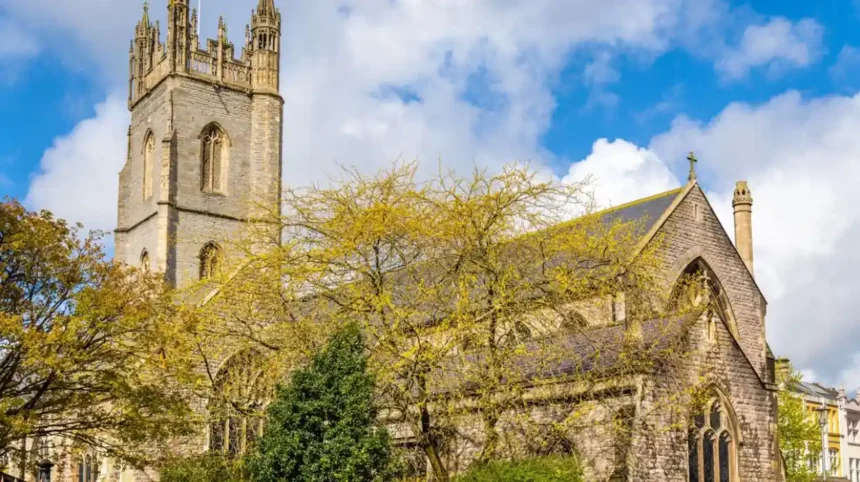
St John the Baptist Church stands in St John’s Square, immediately beside Cardiff’s central shopping streets and close to Cardiff Castle. It is one of the most important surviving medieval buildings in central Cardiff.
Coflein, the historic environment record maintained by the Royal Commission on the Ancient and Historical Monuments of Wales, identifies the church as one of Cardiff’s few buildings with surviving medieval fabric. The nave and chancel are probably medieval in origin, with the church probably dating from the 14th century. Its exterior underwent significant alteration around 1865.
The church is particularly useful for understanding medieval Cardiff because its position remains closely connected to the historic town centre. The building survived while much of the surrounding medieval fabric disappeared during later urban redevelopment.
Its tower provides an important architectural landmark. The church’s present appearance combines medieval elements with later restoration and rebuilding.
When visiting, examine the relationship between the church and St John’s Square. The surrounding streets demonstrate how a medieval religious building became integrated into a modern commercial city centre.
St Mary the Virgin, Butetown
St Mary the Virgin stands on Bute Street near Cardiff’s southern city centre. The present church was built between 1841 and 1843 after the earlier medieval St Mary’s Church was damaged by flooding and eventually abandoned.
The building was constructed on land associated with the Marquess of Bute. The architect was John Thomas Foster, an architect from Liverpool. Church Heritage Cymru records the construction period as 1841–1843 and identifies the church as a Grade II listed building.
The present church replaced the former Priory Church of St Mary, which had stood near the River Taff. The medieval church had become increasingly vulnerable to flooding. The 1607 flood was particularly destructive.
St Mary’s therefore represents two periods of Cardiff history at the same location: medieval Cardiff and the industrial Victorian city.
Its location is also significant because Butetown developed alongside Cardiff’s docks. The church stands within one of the city’s historically multicultural communities. Its story connects religion with industrial expansion, migration and population growth.
Cardiff Metropolitan Cathedral of St David
Cardiff Metropolitan Cathedral of St David is the principal Roman Catholic cathedral in Cardiff and the seat of the Archbishop of Cardiff. It stands on Charles Street, east of the central shopping district.
The cathedral was designed by Pugin & Pugin and constructed between 1884 and 1887. It replaced an earlier Catholic church built in 1842. The building became a cathedral in 1916.
The cathedral demonstrates the growth of Roman Catholicism in 19th-century Cardiff. The Catholic population increased substantially as Irish migrants arrived to work in the expanding docks and industrial economy.
The building also records the impact of the Second World War. It was damaged during the Cardiff Blitz in 1941 and underwent restoration between 1952 and 1959 under Bates, Son & Price.
Inside, visitors can identify religious and artistic features connected with Cardiff’s Catholic history, including the chapel dedicated to the Cardiff martyrs St Philip Evans and St John Lloyd.
How can you walk between Cardiff’s central historic churches?
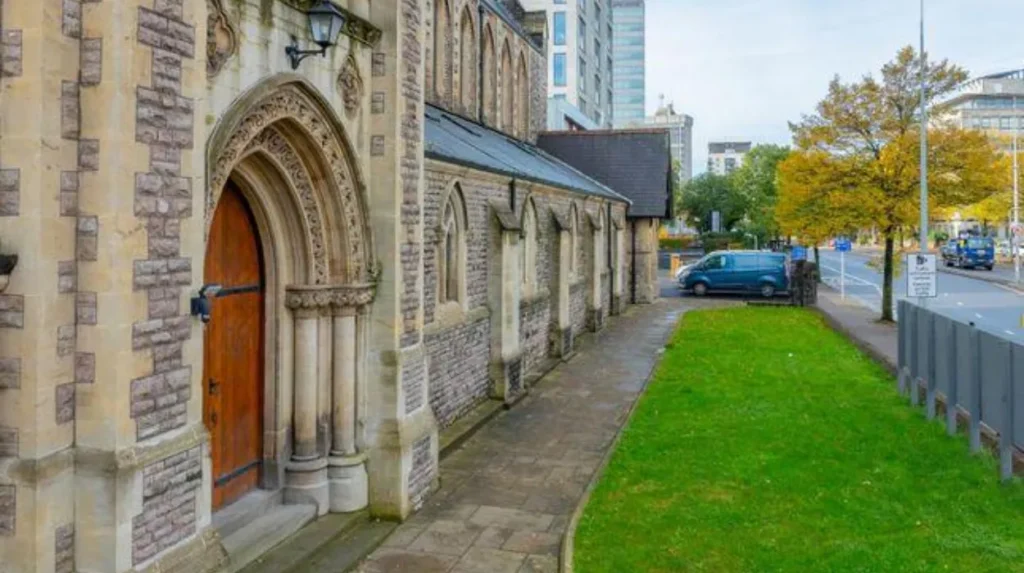
A central Cardiff church walk works best as a flexible route linking St John the Baptist with St David’s Cathedral and St Mary the Virgin. The route crosses the historic commercial centre and continues south towards Butetown and Cardiff’s docklands.
Start at St John the Baptist Church in St John’s Square. Its location beside the main pedestrianised shopping area makes it a convenient starting point.
From the church, walk towards Cardiff Castle and the civic centre before continuing through the central streets towards Charles Street. This section provides opportunities to see how medieval Cardiff was progressively surrounded by Victorian and modern development.
Continue towards Cardiff Metropolitan Cathedral of St David on Charles Street. The journey passes through the eastern part of the city centre and illustrates the expansion of Cardiff beyond its medieval walls.
After visiting the cathedral, continue south-west towards St Mary the Virgin in Butetown. The route leads towards the area historically associated with Cardiff’s docks and maritime economy.
The distance between individual buildings depends on the precise streets selected. A complete central route requires several kilometres of walking when additional heritage sites are included.
The walk works particularly well during daylight hours because several historic buildings require exterior viewing when their interiors are unavailable.
Cardiff’s street network also allows visitors to combine church architecture with other heritage sites. Cardiff Castle, the arcades, the Old Library, Cardiff Market and the civic centre all sit within the wider historic landscape.
The route should therefore be treated as a heritage walk rather than simply a sequence of religious buildings.
What makes Llandaff Cathedral essential on a Cardiff church walk?
Llandaff Cathedral is essential for understanding Cardiff’s earliest Christian history because Christian activity on the site dates from at least the 6th century. The present cathedral developed from Norman construction beginning around 1120 and contains medieval, Victorian and post-war architectural evidence.
Llandaff Cathedral provides the strongest connection between modern Cardiff and early medieval Christianity.
The cathedral’s own historical record places Christian activity at the site from at least the 6th century. The early Christian tradition is associated with St Dyfrig and St Teilo, important figures in the early ecclesiastical history of south-east Wales.
The present cathedral developed during the Norman period. Bishop Urban began a major rebuilding programme around 1120. Later medieval bishops expanded the building with additional architectural elements, including the Chapter House and Lady Chapel.
The Lady Chapel dates from approximately 1280. It contains medieval and later artistic features, including a restored 15th-century carved screen. The chapel also contains the tomb of William de Braose, Bishop of Llandaff from 1266 to 1287.
Llandaff Cathedral also contains medieval monuments associated with bishops and other figures. These include effigial monuments dating from the 13th to 16th centuries.
The building experienced major damage during the Cardiff Blitz on 2 January 1941. A German parachute mine damaged the cathedral, destroying sections of the roof, south aisle and chancel. The building was subsequently restored after the war.
Architect George Pace played a major role in the post-war reconstruction. His work incorporated modern design alongside surviving medieval fabric, producing the distinctive combination visible inside the cathedral today.
The cathedral is approximately two miles from Cardiff city centre. It can be reached by public transport and then explored on foot through the historic village of Llandaff.
Which architectural details should you look for inside Cardiff’s historic churches?
Historic churches in Cardiff contain architectural evidence from different periods, including medieval masonry, Gothic revival design, stained glass, carved monuments, towers, chapels, memorials and post-war reconstruction. Comparing these details helps visitors identify changes in religious architecture across several centuries.
Architecture provides the clearest visual method for comparing Cardiff’s churches.
At St John the Baptist Church, focus on the medieval character of the nave, chancel and tower. Later alterations demonstrate how Victorian restoration changed historic buildings while retaining older structural elements. Coflein records the church’s medieval origins alongside substantial 19th-century exterior work.
At St Mary the Virgin, examine the Victorian Gothic composition. The church uses dark sandstone with Bath stone dressings and includes twin towers, a rose window, aisles and an apse. These details reflect the architectural ambitions of the 19th-century rebuilding.
At Cardiff Metropolitan Cathedral of St David, the Early English architectural character reflects the 19th-century Gothic tradition. The building’s sandstone exterior and later restoration demonstrate the relationship between Victorian Catholic architecture and post-war repair.
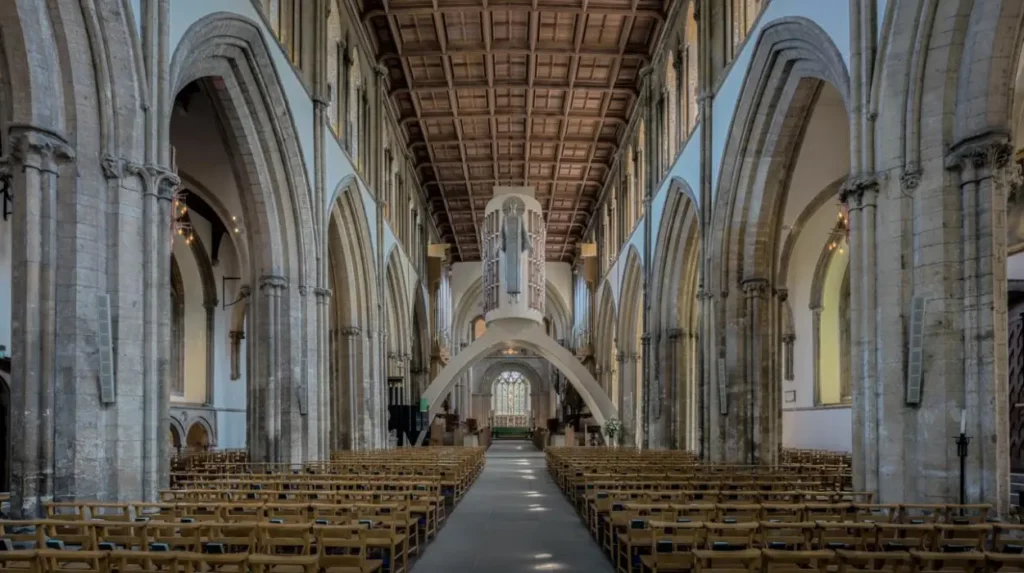
Llandaff Cathedral provides the widest chronological range. Visitors can identify Norman work, medieval Gothic elements, Victorian restoration and 20th-century reconstruction within one building.
The cathedral’s Norman sanctuary arch is especially significant. Later work includes the west front, nave, Chapter House and Lady Chapel. The 19th-century restoration introduced another major architectural layer under John Prichard and John Pollard Seddon.
The post-war cathedral introduces another architectural period. George Pace’s work incorporated contemporary design with surviving medieval features. Jacob Epstein’s Majestas, created for the cathedral’s post-war reconstruction, forms part of this distinctive modern intervention.
Stained glass provides another useful comparison. Llandaff Cathedral contains glass from several periods, while its chapels include works associated with artists and designers including William Morris and Ford Madox Brown.
Visitors should also examine memorials, fonts, screens, floor stones, tombs and inscriptions. These smaller features often reveal information about local families, clergy, military history and parish communities.
How did Cardiff’s churches change during the Industrial Revolution?
Cardiff’s churches expanded and changed rapidly during the Industrial Revolution because population growth, dock development, migration and rising urban wealth created new religious communities. Victorian churches therefore record the transformation from a small market town into a major industrial and maritime city.
Cardiff’s population and economy changed dramatically during the 19th century.
The development of the Glamorgan Canal in 1794 improved the movement of coal, iron and other industrial goods. The Taff Vale Railway followed in 1840, allowing larger quantities of material to reach Cardiff. The docks then expanded the city’s maritime capacity.
Religious buildings followed this urban expansion.
St Mary the Virgin in Butetown is a direct example. The church was rebuilt between 1841 and 1843 as Cardiff’s population expanded. Its construction responded to the needs of a growing community associated with the developing docks.
The Roman Catholic Cathedral of St David provides another example. Catholic numbers increased substantially during the 19th century, particularly because of Irish immigration connected with dock and industrial employment. The cathedral replaced an earlier Catholic church and became the diocesan cathedral in 1916.
Church architecture therefore reflects demographic change as well as religious history.
The same period also produced numerous chapels and parish churches throughout Cardiff. Some survive as active places of worship, while others have been converted, incorporated into other buildings or demolished.
This change is visible in Cardiff’s built environment. Modern streets frequently contain fragments of earlier religious buildings or buildings that retain architectural features from former chapels.
The former Bethany Baptist Chapel is an example of adaptive urban change. Coflein records that the chapel was later incorporated into the former Howells department store, with original features retained inside the larger building.
This type of survival demonstrates why a walking tour should include both active churches and surviving architectural fragments.
How did war and restoration affect Cardiff’s historic churches?
War, flooding, structural failure and Victorian rebuilding transformed several historic Cardiff churches. St Mary’s suffered major flooding, Llandaff Cathedral suffered severe wartime damage, and St David’s Cathedral underwent post-war restoration. These events explain why historic churches contain several architectural periods.
Historic buildings rarely survive unchanged.
St Mary’s medieval church was damaged by flooding from the River Taff. The severe flood of 1607 contributed to the building’s decline and eventual abandonment. The present St Mary the Virgin in Butetown was constructed centuries later.
Llandaff Cathedral experienced another major disruption during the Second World War.
On 2 January 1941, Cardiff suffered its heaviest wartime air raid. Llandaff Cathedral was struck by a parachute mine. The explosion damaged the Chapter House and destroyed major sections of the nave roof, south aisle and chancel.
The cathedral remained usable in restricted areas during the wartime period. Full restoration waited until after the war because building materials and labour were limited.
George Pace later led the post-war reconstruction. His work preserved historic elements while introducing new architectural features. This approach created a building in which medieval, Victorian and 20th-century design can be read together.
Cardiff Metropolitan Cathedral of St David also suffered wartime damage. An incendiary bomb affected the cathedral during the 1941 Cardiff Blitz. Restoration took place from 1952 to 1959.
These examples demonstrate why restoration history is essential when reading historic architecture. A church that appears medieval from the outside can contain substantial Victorian or post-war reconstruction.
The survival of historic churches depends on continuing conservation. Cardiff Council currently identifies around 1,000 listed buildings and 31 scheduled monuments within the city. Listed buildings receive statutory protection through the planning system.
Visitors contribute to this conservation environment by treating buildings carefully, following access arrangements and supporting legitimate church or heritage activities.
Explore More Area Guide
Self-Guided Heritage Walk Around Llandaff Cathedral, Cardiff
Cardiff’s Oldest Community Centres: Butetown, Cathays & Grangetown
How should you plan a self-guided historic church walk in Cardiff?
A successful Cardiff church walk combines central churches with a separate Llandaff extension, allowing time for architecture, history, worship and surrounding streets. Plan around opening times, services, walking distances, weather, accessibility and the need for quiet behaviour inside active churches.
Begin with the central churches if you have limited time.
St John the Baptist provides the strongest starting point for medieval Cardiff. Cardiff Metropolitan Cathedral of St David then introduces the city’s Victorian Catholic history. St Mary the Virgin extends the route towards Butetown and the former docklands.
Allow additional time for Llandaff Cathedral. The cathedral is not part of the compact central route, but it provides the earliest Christian historical context.
Llandaff Cathedral currently provides wheelchair access at its east and west ends. Its official visitor information also provides public transport guidance and information about guided tours.
Guided tours typically last between 45 minutes and one hour, although longer tours can be arranged. The cathedral’s tour material covers its Celtic, Norman, medieval and later history.
Check current opening arrangements before travelling. Churches can close for private functions, services, maintenance or special events.
Photography should also follow each church’s rules. Flash photography, tripods and photography during services can be restricted.
The best approach is to treat each building as both a heritage site and an active religious institution.
Walking shoes are appropriate because the route combines pedestrianised streets, historic urban areas and longer connections between central Cardiff and Llandaff.
Public transport provides useful alternatives for the longer section. Llandaff Cathedral’s visitor information states that Fairwater is approximately a 10-minute train journey from Cardiff Central, followed by a 10–15-minute walk. Bus routes from central Cardiff also serve the Llandaff area.
The result is a flexible heritage experience rather than a fixed tour timetable.
What does Cardiff’s historic church heritage reveal about the city today?
Cardiff’s historic churches show how the city evolved through medieval settlement, religious reform, industrialisation, migration, wartime destruction and modern conservation. Walking between them reveals that Cardiff’s history is preserved not in one building but across interconnected streets, communities and architectural layers.
The churches provide a chronological framework for understanding Cardiff.
St John the Baptist represents the surviving medieval urban core. St Mary the Virgin records the replacement of a medieval parish church after flooding and the growth of Victorian Cardiff. St David’s Cathedral represents the expansion of Roman Catholic life during the industrial period.
Llandaff Cathedral reaches further back. Its Christian history extends to at least the 6th century, while its present building began major Norman development around 1120.
Together, these buildings show how Cardiff expanded geographically and socially.
The city’s historic churches also demonstrate the importance of conservation. Cardiff Council’s current heritage framework covers conservation areas, listed buildings, scheduled monuments and historic parks and gardens. Cardiff has 27 designated conservation areas and around 1,000 listed buildings.
Churches remain part of this wider historic environment.
Their value extends beyond architecture. Churchyards preserve memorials and burial evidence. Interiors preserve inscriptions, monuments, stained glass and religious artwork. Locations reveal how communities were organised around medieval parishes, Victorian neighbourhoods and industrial districts.
A walking route therefore provides more than a sightseeing itinerary. It creates a direct method for understanding Cardiff’s physical development.
For visitors, the central churches offer an accessible introduction to the city’s religious and architectural history. For residents, the route provides a way to examine familiar streets through their historical layers.
The combination of medieval fabric, Victorian rebuilding and 20th-century restoration is particularly important. It explains why Cardiff’s historic churches do not belong to a single architectural period.
They are records of continuous urban change.
Exploring Cardiff’s historic churches on foot is consequently one of the most direct ways to connect the city’s medieval origins, industrial expansion, multicultural development and modern heritage conservation.
What is the best historic church to visit in Cardiff?
St John the Baptist Church is one of the best starting points for exploring Cardiff’s historic churches because it stands in the city centre and retains important medieval fabric. Llandaff Cathedral provides the city’s strongest early Christian and medieval heritage experience.