Cardiff’s lost cinemas form an important part of the city’s entertainment, architectural and social history. From early electric theatres on Queen Street to large suburban picture palaces, Cardiff developed a substantial cinema culture during the first half of the twentieth century. Many of these venues later closed, were demolished or changed into entirely different buildings.
- What were Cardiff’s lost cinemas?
- When did Cardiff’s cinema boom begin?
- Why was the Capitol Cinema important to Cardiff?
- What happened to Cardiff’s Plaza Cinema?
- Which early Cardiff cinemas stood on Queen Street?
- How did Cardiff’s neighbourhood cinemas develop?
- What was cinema-going like in historic Cardiff?
- Why did Cardiff’s historic cinemas close?
- What happened to Cardiff’s lost cinemas after they closed?
- Where can people research Cardiff’s lost cinema history today?
- Why do Cardiff’s lost cinemas still matter?
The story of Cardiff’s lost cinemas begins before the era of modern multiplexes. Early film exhibitions took place inside theatres, halls and other entertainment venues before dedicated cinemas appeared. By the early 1910s, purpose-built and converted picture houses were becoming established across the city.
Several important former cinemas stood around Queen Street, The Hayes, Cathays, Roath, Gabalfa and other neighbourhoods. The Capitol, Plaza, Central Cinema, Electric Theatre, Gaiety and Coronet were among the venues that shaped local cinema-going.
Historic records preserved by Cardiff Central Library, the Royal Commission on the Ancient and Historical Monuments of Wales (RCAHMW), People’s Collection Wales and local history organisations provide evidence of these buildings and their changing uses. People’s Collection Wales preserves historic photographs of Cardiff’s Empire Theatre and other entertainment venues, while RCAHMW records surviving architectural evidence.
What were Cardiff’s lost cinemas?
Cardiff’s lost cinemas were former film venues that closed permanently and were demolished, redeveloped or converted to another use. They included large city-centre picture palaces, neighbourhood cinemas and early electric theatres operating from the early twentieth century onward.
The term “lost cinema” describes a former cinema that no longer operates as a cinema at its original location. The building itself does not always have to disappear. Some former cinemas survived through conversion into shops, pubs, offices, entertainment venues or other uses.
Cardiff’s cinema history includes several different building types. Early venues were often adapted from existing halls or entertainment buildings. Later picture palaces were purpose-built with large auditoriums, balconies, projection rooms, restaurants and other facilities.
The development of dedicated cinemas followed the rapid spread of motion pictures across Britain. Early film programmes were frequently presented as part of mixed entertainment. Dedicated electric theatres then developed as audiences became accustomed to regular film screenings.
Cardiff became an important centre for this growth because of its expanding population, commercial importance and transport connections. The city’s expanding suburbs supported neighbourhood cinemas, while Queen Street and the central shopping district supported major entertainment venues.
The historic record also shows that cinema-going was not restricted to major central venues. Neighbourhood cinemas served communities in areas such as Cathays, Roath and Gabalfa.
When did Cardiff’s cinema boom begin?
Cardiff’s permanent cinema expansion accelerated during the early twentieth century, particularly between 1909 and the 1930s. Early venues included the Electric Theatre and Central Cinema, followed by purpose-built picture palaces such as the Capitol and Plaza.
The Electric Theatre on Queen Street opened on 27 September 1909. It presented Bioscope pictures and was one of Cardiff’s earliest venues devoted specifically to film. The building was later removed, and the site was incorporated into the Dominion’s Arcade development by 1921.
The word “Bioscope” was widely used during the early cinema period to describe motion-picture projection. Cardiff’s Electric Theatre therefore belongs to the period when film exhibition was developing from novelty entertainment into a permanent commercial industry.
The Central Cinema at The Hayes followed another development pattern. The building originally operated as a roller-skating rink from 1909 and was used occasionally for films before becoming a full-time cinema on 7 March 1911. Historical cinema records give the venue a capacity of approximately 1,500 seats, including a balcony.
These early venues demonstrate how Cardiff’s cinema infrastructure developed through both new construction and adaptation of existing entertainment buildings.
The cinema boom accelerated during the 1920s. Larger venues offered extensive seating and increasingly elaborate interiors. The Capitol opened in 1921, while the Plaza opened in 1928.
The growth reflected a wider transformation in British entertainment. Cinema became a regular leisure activity rather than an occasional attraction. Cardiff’s picture houses provided scheduled programmes, children’s matinees and increasingly sophisticated sound and projection systems.
Why was the Capitol Cinema important to Cardiff?
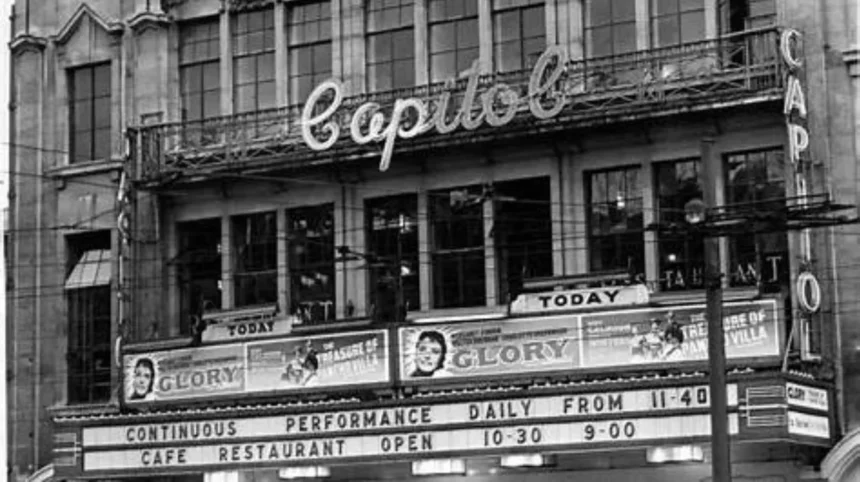
The Capitol Cinema was one of Cardiff’s largest historic picture houses. It opened on Queen Street in December 1921 with more than 3,000 seats and included restaurants, a ballroom and other entertainment facilities before closing in 1978 and later being demolished.
The Capitol occupied a prominent position on Queen Street. Construction took place between 1919 and 1921, and the venue opened on 24 December 1921.
Historical records describe an auditorium with capacity for 3,158 people. The building also contained a ballroom, three restaurants, a bar, banqueting facilities and a games area.
The scale of the Capitol reflected the architectural ambitions of the interwar picture-palace era. A cinema was not simply a room containing a screen. Large venues incorporated social and leisure facilities designed to attract audiences for extended visits.
The Capitol was originally developed by Tilney Kinema Company. Paramount later leased the building from 1931, demonstrating the increasing involvement of major cinema companies in Cardiff.
The venue also hosted live entertainment. Its stage and auditorium allowed the building to operate beyond conventional film exhibition.
The cinema eventually closed on 21 January 1978. The building remained an important local landmark after closure, but its future became increasingly uncertain.
A 26 June 1981 South Wales Echo article preserved by People’s Collection Wales reported proposals for demolition of the Capitol and nearby Cory Hall. The article recorded concerns about the condition of the buildings and the difficulty of saving them.
The Capitol was ultimately demolished in 1983. Its disappearance removed one of Cardiff’s largest historic cinema buildings from Queen Street.
The former cinema site remains part of the modern city centre landscape, while the name survives in local historical references and the Central Bar, which takes its name from the Capitol cinema that once occupied part of the site.
What happened to Cardiff’s Plaza Cinema?
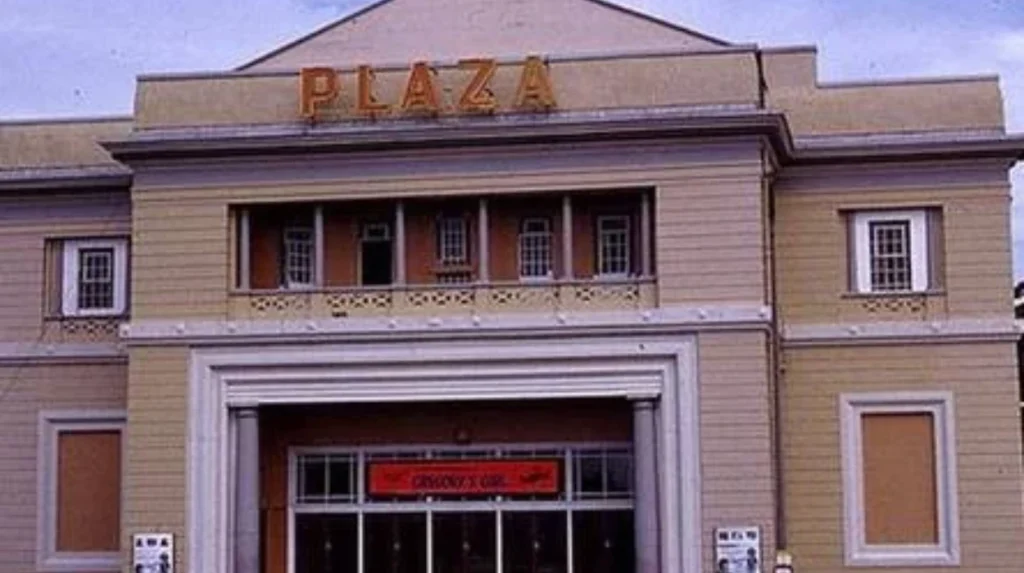
The Plaza Cinema opened on North Road in Gabalfa in 1928 with approximately 1,500 seats. It operated through several ownership changes before closing in 1981. The building was subsequently demolished, removing a major suburban picture palace from Cardiff’s cinema landscape.
The Plaza Cinema opened on 12 March 1928 on North Road, Gabalfa. Architect Howard Williams designed the building in a Greek Revival style, giving the cinema a distinctive architectural identity.
The venue contained approximately 1,500 seats. Its location made it accessible to residents across northern Cardiff and surrounding districts.
The Plaza initially operated independently before becoming associated with the Cardiff Cinema Circuit. It later passed to Jackson Withers and then to the Rank Organisation in 1976.
The cinema closed on 17 October 1981. Its final programme included Alien and The Fog, films associated with the late 1970s and early 1980s horror and science-fiction cinema market.
The Plaza’s decline illustrates the relationship between cinema economics and changes to the surrounding urban environment. North Road underwent major road changes during the late 1960s. Local historical accounts associate the opening of the Gabalfa flyover with reduced parking and increased road noise around the cinema.
Cinema attendance was also affected by broader changes in leisure patterns, television ownership and the restructuring of the British cinema industry.
The Plaza therefore represents more than a demolished building. It demonstrates how suburban cinemas depended on local accessibility, parking, transport patterns and regular neighbourhood audiences.
Which early Cardiff cinemas stood on Queen Street?
Queen Street contained several important early entertainment venues, including the Electric Theatre, Picture Palace, Picture Show and Empire Theatre. These buildings established the street as an important centre for Cardiff’s early cinema and popular entertainment before later redevelopment.
Queen Street played a central role in Cardiff’s early cinema history. The Electric Theatre opened in 1909 and provided a dedicated venue for film programmes. Its later redevelopment illustrates how rapidly the commercial centre changed during the early twentieth century.
The Central Bar’s historical account also identifies the Picture Palace and Picture Show as early Queen Street cinemas operating before the First World War. The Palace later became the Queen’s and showed Cardiff’s first sound films.
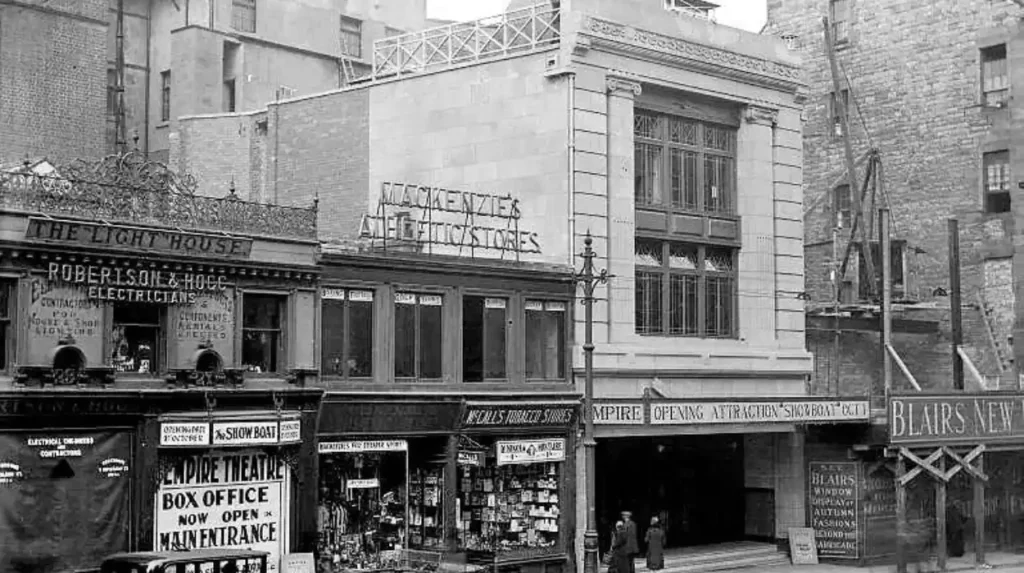
The Empire Theatre was another major Queen Street entertainment building. It was not originally a cinema. The venue opened in the nineteenth century and underwent rebuilding following a serious fire.
A historic photograph held by Cardiff Central Library and published through People’s Collection Wales shows Empire Theatre staff outside the building around the turn of the twentieth century. The venue reopened in 1900 following a fire and underwent another reconstruction in 1915. In 1933 it was converted into a cinema.
The Empire demonstrates how cinema became integrated into buildings that originally served other entertainment purposes.
The transformation also shows why Cardiff’s lost cinema history cannot be limited to purpose-built picture houses. The city’s cinema network included theatres, halls and other buildings that adapted to changing entertainment technology.
How did Cardiff’s neighbourhood cinemas develop?
Cardiff’s neighbourhood cinemas expanded beyond the city centre during the early twentieth century. Venues in Cathays, Roath, Gabalfa and other districts provided local film programmes, children’s matinees and regular entertainment without requiring audiences to travel into central Cardiff.
The suburban cinema network formed an important part of everyday leisure in Cardiff.
The Coronet Cinema in Cathays provides a documented example. The Coronet Electric Theatre was built in 1913 on Woodville Road. It was later known as the Cosy Coronet Cinema and then the New Coronet Cinema. The venue eventually closed and was demolished.
The Coronet had a relatively small capacity compared with the Capitol and Plaza. Its auditorium held approximately 600 people. Its family-run character illustrates the range of cinema businesses that operated alongside larger national circuits.
Roath also developed its own cinema culture. The Gaiety Grand Cinema opened in City Road for the Splott (Cardiff) Cinema Company. By 1913 it was known as the Gaiety Electric Theatre. Historical research records the operation of cinema programmes across the chain, including regular film changes and Saturday morning children’s screenings.
These neighbourhood venues created local cinema identities. Residents could attend regular screenings close to home, while children’s matinees became an established part of weekend entertainment.
The suburban cinema network also reveals the importance of independent operators. Cardiff’s cinema industry included local companies alongside larger organisations such as Paramount and Rank.
What was cinema-going like in historic Cardiff?
Historic Cardiff cinema-going involved scheduled film programmes, live musical accompaniment, children’s matinees and continuous admission practices. Audiences experienced ornate interiors, balconies and large communal auditoriums before television and multiplexes transformed entertainment habits.
Early cinema was different from modern screening practices.
Silent films required musical accompaniment. Pianists and other musicians performed alongside screenings, creating an integrated sound environment before synchronised dialogue became standard.
Local historical research records memories of Cardiff’s Splott Cinema during the silent-film era. Accounts describe piano and violin accompaniment and Saturday afternoon children’s screenings.
Children’s matinees became particularly important. Saturday morning screenings provided regular entertainment for younger audiences and helped establish cinema as a routine part of local life.
Admission practices also differed. Historical research on Cardiff’s Gaiety Cinema records that audiences could enter during a film and remain through a later screening. This created a continuous programme structure rather than the fixed start times common in modern cinemas.
Sound cinema changed this model. Cardiff’s early venues gradually installed sound equipment as talking pictures became commercially dominant.
The Palace, later known as the Queen’s, is recorded as the venue that showed Cardiff’s first sound films.
The transition from silent films to sound films required investment in projection and audio technology. Cinema operators therefore faced technical changes alongside shifts in audience expectations.
Why did Cardiff’s historic cinemas close?
Cardiff’s historic cinemas closed because of changing audience patterns, competition from television and new entertainment formats, changing transport conditions, ownership restructuring, building condition and the growing preference for smaller modern screens and multiplex-style venues.
Cinema closures rarely resulted from a single cause.
Television changed domestic entertainment after the Second World War. More households gained access to television, reducing the need to visit cinemas for regular moving-picture entertainment.
Cinema operators also faced changing expectations. Large single-screen picture palaces required substantial maintenance and operating costs. Their vast auditoriums were difficult to fill consistently when audiences became more fragmented.
Urban transport changes also affected some venues. The Plaza’s history provides a specific example. Changes around North Road affected parking and the road environment, while the cinema struggled to maintain attendance.
Ownership changes also shaped the industry. The Plaza passed through independent and larger corporate operators before its closure. The Capitol was leased to Paramount during part of its operating history.
Building condition became another issue. The 1981 South Wales Echo report about the Capitol and Cory Hall documented concerns about deterioration and demolition.
Redevelopment pressures were especially strong in city centres. Large sites offered opportunities for commercial redevelopment at a time when historic entertainment buildings were not always protected.
The result was a substantial reduction in Cardiff’s historic cinema stock during the second half of the twentieth century.
What happened to Cardiff’s lost cinemas after they closed?
Former Cardiff cinemas followed different post-closure paths. Some were demolished for redevelopment, while others changed into pubs, shops or other commercial premises. Their histories survive through photographs, architectural records, newspaper reports and local historical research.
Demolition was the final stage for several major venues.
The Capitol was demolished in 1983 after closing in 1978. Its large Queen Street building therefore disappeared from Cardiff’s physical landscape within five years of its final screening.
The Plaza also disappeared after its closure. Its former North Road site no longer contains the original picture palace.
Other entertainment buildings survived through adaptation. The Prince of Wales Theatre provides an example of a former performance venue that continued in another use. The building originated as the Theatre Royal in 1878, was later renamed the Prince of Wales Theatre and was converted into a pub in 1999.
Although the Prince of Wales was primarily a theatre rather than a dedicated cinema, its history demonstrates the wider pattern affecting Cardiff’s historic entertainment buildings.
The survival of photographic evidence is particularly important. People’s Collection Wales preserves images of the Empire Theatre and other historic Welsh cinemas and theatres. The collection brings together material from institutions including Cardiff Central Library, Amgueddfa Cymru and RCAHMW.
These records allow researchers to reconstruct the appearance, location and function of buildings that no longer exist.
Explore More Area Guide
Hidden Canals Beneath Cardiff: Glamorganshire Canal History
Cardiff During the Industrial Revolution: Coal, Docks and Railways
Where can people research Cardiff’s lost cinema history today?
Cardiff’s lost cinema history can be researched through Cardiff Central Library collections, People’s Collection Wales, RCAHMW records, local history societies, historic newspapers and specialist cinema archives. These sources preserve photographs, architectural information, newspapers and personal recollections.
Cardiff Central Library is an important source for historic photographs and local records. The Empire Theatre collection, for example, identifies Cardiff Central Library as the owner of the historic photograph published through People’s Collection Wales.
People’s Collection Wales provides a searchable digital collection covering Welsh history and heritage. Its cinema and theatre collection includes photographs and records relating to Cardiff and other Welsh communities.
The Royal Commission on the Ancient and Historical Monuments of Wales maintains national records of historic buildings and archaeological sites. Its collections provide architectural evidence that helps document Cardiff’s former entertainment buildings.
Local history organisations also contribute valuable research. The Roath Local History Society has documented the history of the Gaiety Cinema and its development as part of Cardiff’s early suburban cinema network.
Specialist cinema databases provide additional information about individual venues, including opening dates, capacities, architects, operators and closure dates. These records are particularly useful for identifying buildings that disappeared before extensive digital photography became common.
Historic newspapers provide another layer of evidence. Reports about closures, demolition proposals and redevelopment can reveal contemporary attitudes toward cinema buildings.
Combining these sources is important because no single archive contains the complete history of every Cardiff cinema.
Why do Cardiff’s lost cinemas still matter?
Cardiff’s lost cinemas document major changes in entertainment, architecture, technology, transport and urban development. Their history explains how film became a mass leisure activity and why twentieth-century picture palaces eventually disappeared from the city’s streets.
The former cinemas provide evidence of Cardiff’s social history.
The Capitol demonstrates the scale of interwar entertainment architecture. Its auditorium, restaurants, ballroom and other facilities show how cinema buildings combined film with wider leisure activities.
The Electric Theatre demonstrates the earliest dedicated phase of cinema development. Its 1909 opening placed Cardiff within the rapid national expansion of permanent film venues.
The Central Cinema illustrates adaptation. A former roller-skating rink became a permanent cinema in 1911, showing how existing entertainment infrastructure could be repurposed for moving pictures.
The Plaza demonstrates the importance of suburban cinema and transport conditions. Its location in Gabalfa connected cinema-going with neighbourhood growth, road access and changing car ownership.
The Coronet and Gaiety show that cinema culture was not limited to large city-centre picture palaces. Smaller venues served local communities and developed their own audiences.
These buildings also reveal the technological development of entertainment. Cardiff moved from Bioscope exhibitions and silent films with live accompaniment to sound cinema and later forms of modern film exhibition.
Their disappearance reflects the restructuring of British urban entertainment. Television, changing leisure habits, transport redevelopment, commercial pressures and new cinema formats all altered the economics of large single-screen venues.
For modern Cardiff, the surviving records provide a connection to a cityscape that has changed substantially. Photographs, maps, newspapers and architectural records allow former cinemas to be located and understood even when their buildings no longer survive.
Cardiff’s lost cinemas are therefore part of the city’s wider heritage. They connect Queen Street, The Hayes, Cathays, Roath and Gabalfa with a period when cinema became one of the defining forms of twentieth-century popular entertainment.
The physical buildings have largely disappeared, but their histories remain accessible through archives and historical research. Their records provide a detailed account of how Cardiff watched films, built entertainment spaces and transformed its urban landscape across more than a century.
What were Cardiff’s lost cinemas?
Cardiff’s lost cinemas were former picture houses that closed permanently and were demolished, redeveloped or converted to other uses. They included the Capitol, Plaza, Electric Theatre, Central Cinema, Gaiety and Coronet.