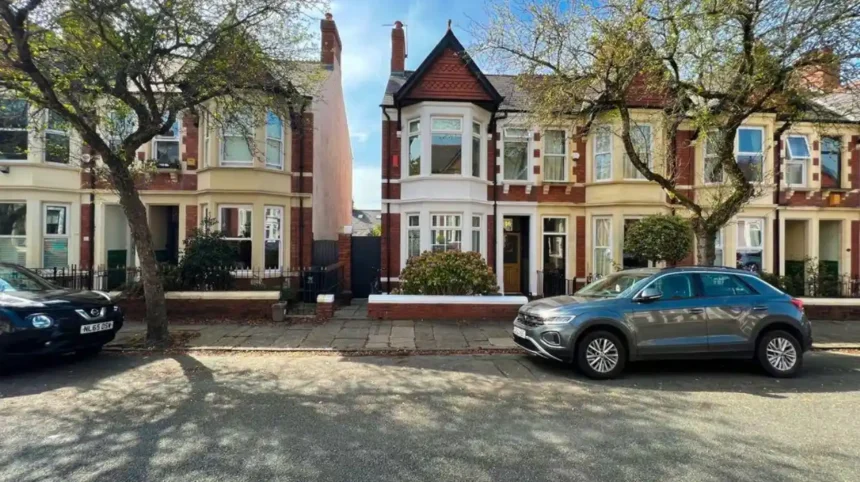
Penylan is an established residential district in east Cardiff, Wales, recognised for its historic housing, mature streets, parks and connections with the wider Roath area. Its Edwardian houses form part of a broader phase of suburban expansion that transformed Cardiff between the late nineteenth and early twentieth centuries.
- What are Edwardian houses in Penylan?
- Why did Penylan develop as a residential suburb?
- What architectural features define Edwardian houses in Penylan?
- How is Penylan’s Edwardian housing connected to Roath Park?
- Which historic features should homeowners preserve in Edwardian Penylan houses?
- Are Edwardian houses in Penylan protected by conservation rules?
- How should an Edwardian house in Penylan be renovated?
- What makes Edwardian houses in Penylan historically important today?
- How can people identify an authentic Edwardian house in Penylan?
- What is the future relevance of Edwardian houses in Penylan?
The term Edwardian house generally describes a property associated with the reign of King Edward VII, from 1901 to 1910, although architectural historians often use “Edwardian” more broadly for houses built in the early twentieth century, including properties constructed before the First World War. In Penylan, this architectural character sits alongside late-Victorian housing and later interwar development.
Penylan’s residential landscape developed alongside Cardiff’s rapid growth as an industrial, commercial and port city. The opening of Roath Park in 1894 strengthened the appeal of east Cardiff for suburban development. Historic records also show that villas and other substantial homes appeared around Penylan and Roath as former agricultural land was converted for residential use.
The result is a neighbourhood where architectural character is closely connected to street layout, gardens, mature trees, parks and the historic expansion of Cardiff. Several parts of Penylan are covered by conservation-area designations, including Roath Park, Roath Park Lake and Gardens, and Roath Mill Gardens.
What are Edwardian houses in Penylan?
Edwardian houses in Penylan are early twentieth-century homes shaped by Cardiff’s suburban expansion, typically combining spacious layouts, larger windows, decorative brickwork, generous gardens and period architectural details with established tree-lined residential streets.
Edwardian housing developed during a period when British towns and cities experienced substantial population growth. Cardiff expanded rapidly during the industrial era because of its coal-exporting economy, docks, railway connections and commercial activity.
Penylan formed part of the wider Roath landscape. Historical research records that the area was once dominated by farms, open land and country houses. By the late nineteenth century, suburban development was replacing much of this rural landscape.
The architectural identity of Penylan therefore reflects a transition from rural estate land to planned residential suburb.
Edwardian houses are not defined by one universal design. They include detached villas, semi-detached houses and terraces. In Penylan, the larger suburban house became particularly important because available plots allowed builders to provide front gardens, rear gardens and wider road setbacks.
The Edwardian period also introduced changes in domestic expectations. Houses increasingly incorporated larger windows, improved daylight, more practical circulation and less rigidly formal room arrangements than many earlier Victorian properties.
Period houses in Penylan also need to be understood within their wider streetscape. The character of a historic street comes from the relationship between buildings, gardens, boundaries, roads, trees and open spaces rather than from individual houses alone. Cadw identifies these collective elements as important when assessing conservation areas.
Why did Penylan develop as a residential suburb?
Penylan developed as a residential suburb because Cardiff expanded rapidly during the late nineteenth and early twentieth centuries, while new roads, public parks, transport links and available estate land created conditions for substantial suburban housebuilding.
The development of Penylan followed Cardiff’s wider urban expansion. Roath was historically a large estate containing farms, houses and agricultural land. Penylan itself remained relatively rural during much of the nineteenth century.
Historical mapping provides evidence of this transformation. A map of 1886 shows Penylan before extensive residential development, while later decades saw substantial building activity.
Roath Park was an important factor in the area’s development. Cardiff’s first publicly owned public park opened on 20 June 1894. The park incorporated a 30-acre artificial lake and formed part of a larger 121-acre recreational landscape. Construction began in the early 1890s, with roads, paths, planting and water features established before the formal opening.
The park was not simply a recreational facility. Its landscape helped shape the development pattern of surrounding residential streets. Coflein, the Royal Commission on the Ancient and Historical Monuments of Wales’ national historic environment record, states that Roath Park retains its setting of surrounding villa residences built to take advantage of the park and particularly its lake.
This relationship explains why some Penylan houses have substantial plots and landscaped settings.
The growth of the area also reflected Cardiff’s increasing demand for middle-class suburban housing. Developers provided homes away from the industrial core while maintaining access to the city’s commercial districts.
Road names and surviving buildings provide further evidence of the area’s development history. Local historical research identifies roads and neighbourhood features connected with military campaigns and prominent landowners, while former farms and country estates were gradually absorbed into the expanding city.
Penylan therefore represents an important stage in Cardiff’s transition from an estate-based landscape to a modern urban suburb.
What architectural features define Edwardian houses in Penylan?
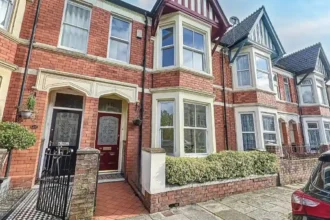
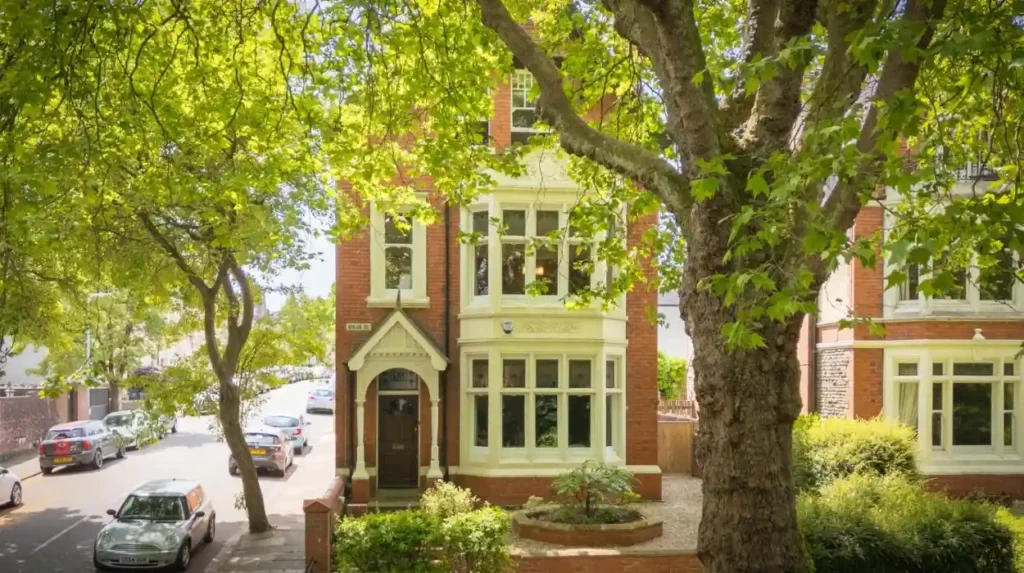
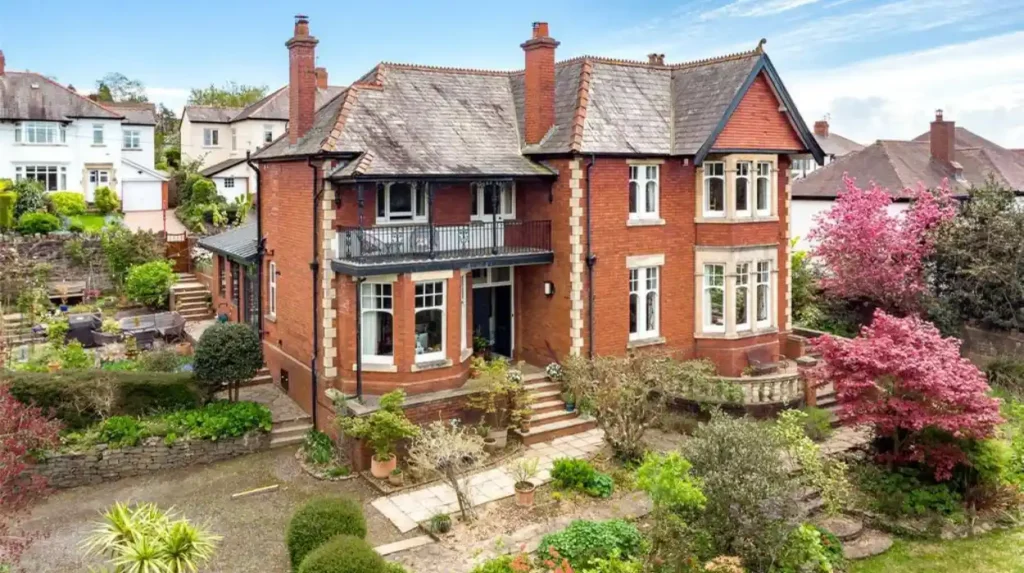
Edwardian houses in Penylan commonly feature broad frontages, large sash or casement windows, brick or rendered elevations, pitched roofs, decorative porches, bay windows, front gardens, rear gardens and traditional boundary treatments.
The architecture of Penylan reflects several design trends rather than one fixed style.
One defining characteristic is increased emphasis on natural light. Edwardian houses often have larger windows than earlier Victorian properties. Bay windows were frequently used to enlarge rooms and increase daylight.
Front doors are also important architectural features. Many period houses have recessed or projecting porches, timber doors, glazed panels and decorative surrounds.
Brickwork is another common feature. Edwardian suburban architecture frequently used red or brown brick, sometimes combined with painted render, stone details or contrasting bands. Decorative brickwork provided visual variation without requiring the elaborate ornamentation associated with some earlier Victorian buildings.
Roof design also changed. Edwardian houses often have broad pitched roofs with prominent gables, projecting eaves and sometimes decorative timberwork. Roofs were commonly finished with clay tiles or slate, depending on the building and local materials.
Internally, the original layout of a substantial Edwardian house often separated formal and service areas. A typical property included an entrance hall, reception rooms, dining room, kitchen, bedrooms and ancillary spaces. Larger houses frequently included servants’ accommodation or service circulation.
Fireplaces formed important elements of period interiors. Original fireplaces, tiled surrounds, timber surrounds and decorative plasterwork provide evidence of the home’s construction period.
Boundary features are equally significant. Low brick walls, stone walls, timber gates, iron railings and planted front gardens contribute to the streetscape. Their combined effect creates the spacious suburban character associated with many historic Cardiff neighbourhoods.
Not every house retains every original feature. Replacement windows, modern doors, extensions, roof alterations and rendered elevations have changed individual properties over time.
This distinction is important. A house does not need to retain every original component to demonstrate Edwardian character. Architectural significance is assessed through the surviving combination of form, materials, detailing, setting and historic context.
How is Penylan’s Edwardian housing connected to Roath Park?
Penylan’s Edwardian housing is closely connected to Roath Park because residential development expanded around the park after its creation, producing villa streets whose gardens, views, mature trees and spacious plots formed part of the park’s historic setting.
Roath Park is central to understanding Penylan’s residential history.
The park was designed during the late Victorian period and opened in 1894. Its creation introduced a major public landscape into east Cardiff at a time when Cardiff’s population and built-up area were expanding.
The park’s lake, gardens, paths and planting created an attractive setting for nearby residential development.
Coflein describes Roath Park as an extensive late-Victorian public park laid out between 1887 and 1894 by William Harpur and planted by William Pettigrew. It retains much of its original framework and continues to serve recreational functions associated with its original design.
The surrounding houses therefore form part of a larger historic landscape.
This is especially important when examining properties near Roath Park Lake and the streets leading towards Penylan. The visual relationship between houses and open space contributes to the area’s character.
The scale of properties also reflects the land available during the suburban expansion period. Instead of tightly packed urban terraces, some streets around Penylan and Roath developed with larger houses separated by gardens and boundary walls.
The park also influenced the identity of the neighbourhood. Public recreation, greenery and residential development became interconnected elements of east Cardiff’s urban structure.
The continued importance of this relationship is reflected in Cardiff’s conservation framework. Cardiff Council identifies Roath Park, Roath Park Lake and Gardens, and Roath Mill Gardens among the conservation areas associated with Penylan.
These designations recognise that historic character exists at area level. The significance is not limited to one landmark or one house.
Which historic features should homeowners preserve in Edwardian Penylan houses?
Homeowners should give particular attention to original windows, doors, roofs, brickwork, render, porches, fireplaces, staircases, decorative plasterwork, boundary walls, railings, gardens and other features that contribute to an Edwardian property’s historic character.
Historic features provide evidence of how Penylan houses were designed and occupied.
Windows are particularly important. Original timber sash or casement windows contribute to the proportions and appearance of period elevations. Replacing them with visually incompatible modern units can change the architectural character of a property.
Doors also contribute strongly to the street-facing appearance. Edwardian timber doors often contain glazing, moulded panels or decorative joinery.
Rooflines are another important element. Changes to roof form, dormers, chimneys and materials can affect the appearance of an entire terrace or street.
Chimneys deserve attention because they provide vertical accents across historic roofscapes. Even when fireplaces have been removed internally, surviving chimney stacks can retain architectural value.
Front gardens also have a practical heritage role. Historic houses were designed as part of a relationship between private gardens and public streets. Removing front gardens entirely and replacing them with hardstanding changes this relationship.
Boundary walls and railings similarly define the transition between private and public space.
Inside the property, staircases, fireplaces, timber flooring, doors, cornices, ceiling details and room proportions can reveal the original design.
Cadw states that listed-building significance can include form, layout, construction details, historical materials, finishes, fixtures and fittings. It also stresses that the absence of a feature from a list description does not automatically mean that feature lacks historic interest.
This principle is relevant when assessing older houses even when they are not individually listed.
Owners should establish the planning status of a property before carrying out substantial external or structural work. Cardiff Council provides conservation-area information and maps showing designated areas across the city.
Are Edwardian houses in Penylan protected by conservation rules?
Some Edwardian houses in Penylan are located within designated conservation areas, where planning controls protect the character and appearance of the wider historic environment; individual properties can also have separate listed-building status requiring additional consent.
Conservation-area designation and listed-building designation are different forms of heritage protection.
A conservation area protects the character of a defined area. Cadw explains that conservation areas focus on the collective historic environment, including settlement patterns, building plots, routes, architectural styles, materials and detailing.
Cardiff currently identifies 27 conservation areas across the city. Its published information lists several areas associated with Penylan, including Roath Park, Roath Park Lake and Gardens and Roath Mill Gardens.
Being inside a conservation area does not automatically mean that every house is listed.
A listed building is individually recognised for special architectural or historic interest. Cadw states that listing is a legal designation under the Historic Environment (Wales) Act 2023. Changes affecting the special character of a listed building generally require listed building consent.
Conservation areas can also impose additional controls. Cadw explains that conservation-area legislation includes controls relating to demolition of unlisted buildings and protection of trees, while Article 4 Directions can restrict certain permitted development rights.
For a Penylan property, the correct process therefore begins with checking the exact address against Cardiff Council’s planning and conservation information.
This is particularly important before replacing windows, altering doors, changing roof materials, removing boundary features, constructing extensions or carrying out other external alterations.
Cadw recommends early discussion with the local planning authority when historic assets are affected. Heritage impact assessment provides a structured method for understanding the significance of a building or area and assessing proposed changes.
How should an Edwardian house in Penylan be renovated?
An Edwardian house in Penylan should be renovated through repair-first methods that retain historic fabric, preserve important proportions and details, improve performance sensitively, and comply with applicable planning, conservation-area or listed-building requirements.
Renovating an Edwardian house requires a different approach from renovating a modern property.
The first stage is a building survey. The survey should identify structural movement, damp, roof defects, timber decay, defective drainage and alterations from previous renovations.
Repair should normally precede replacement. Historic timber windows, doors and decorative elements can often be repaired rather than removed.
Traditional materials are also important. Old brickwork, lime-based finishes, natural slate and traditional timber components can perform differently from modern materials. Compatibility is therefore a significant consideration.
Energy efficiency can be improved without removing historic character. Measures include draught reduction, appropriate insulation, improved heating controls and carefully selected secondary glazing where appropriate.
Modern extensions can also be designed without overwhelming the original building. The distinction between historic and new construction should be clear while maintaining appropriate scale, materials and proportions.
For listed buildings, Cadw emphasises that changes affecting special architectural or historic interest require careful management. Listed building consent can apply to relatively minor alterations, including certain work involving windows, doors, cleaning and painting.
Heritage impact assessment is particularly important for significant alterations. Cadw describes it as a process that identifies the significance of a historic asset and evaluates the effect of proposed change.
For conservation-area properties, homeowners should also examine Cardiff Council’s relevant conservation-area appraisal and planning guidance before finalising designs.
A good renovation therefore balances three requirements: maintaining architectural character, improving the building’s practical performance and meeting current planning requirements.
What makes Edwardian houses in Penylan historically important today?
Edwardian houses in Penylan document Cardiff’s transformation from a nineteenth-century industrial city into a twentieth-century suburban city, preserving evidence of changing housing standards, urban planning, architecture, recreation, landscape design and middle-class residential expansion.
The importance of Penylan’s Edwardian housing extends beyond individual properties.
These houses represent a particular stage in Cardiff’s urban development. They show how residential neighbourhoods expanded beyond the dense central city and incorporated larger gardens, wider streets and access to public open space.
The relationship with Roath Park is especially significant. The park was created as a major public recreational landscape and remains an important component of Cardiff’s historic environment.
Penylan’s housing also demonstrates changing domestic architecture. Victorian houses often relied on elaborate ornament, while Edwardian designs increasingly emphasised light, space, practicality and simpler decorative treatments.
The neighbourhood provides evidence of how architectural trends were adapted to local circumstances. Cardiff’s builders worked with available materials, plot sizes, roads, parks and local development patterns.
Some historic houses have disappeared. Local historical research records the demolition of substantial former villas such as Bronwydd and Oldwell, demonstrating how redevelopment has changed the area over time.
This makes surviving Edwardian housing more significant as evidence of the neighbourhood’s earlier form.
Historic records also show that Penylan’s landscape contained large private houses before much of the modern housing stock appeared. The conversion of former estate and agricultural land into streets and residential plots created the urban structure visible today.
The survival of period architecture alongside later buildings allows the evolution of Penylan to be understood through the built environment itself.
Explore More Area Guide
Cardiff Income Levels and Salary Trends Explained Cardiff 2026
Cardiff Migration Trends and Population Growth Cardiff 2026
How can people identify an authentic Edwardian house in Penylan?
An authentic Edwardian house in Penylan is identified through its construction date, architectural form, original materials, surviving period details, historic maps, planning records and relationship with neighbouring properties rather than through appearance alone.
Visual appearance provides an initial indication but does not establish a property’s construction date.
A reliable assessment combines several sources.
Historic maps can show when a building first appeared. Ordnance Survey mapping is particularly useful for comparing the area’s development at different dates.
Property deeds and conveyance records can provide additional evidence about ownership and construction.
Planning records can identify extensions, alterations and redevelopment.
Architectural features also provide evidence. Original brickwork, windows, doors, fireplaces, roof structures and room layouts can help establish a building’s age and subsequent changes.
The surrounding streetscape is another important clue. A house constructed as part of a coordinated Edwardian development often shares plot dimensions, setbacks, materials and architectural details with neighbouring properties.
The existence of a conservation-area designation can provide additional historic context but does not itself prove that an individual property is Edwardian.
Cadw’s Cof Cymru system provides records for nationally designated historic assets, while Cardiff Council provides information about conservation areas and local heritage protection.
Professional building historians, conservation specialists and experienced surveyors can also assess architectural fabric where the construction date is uncertain.
This approach avoids a common mistake: assuming that every early twentieth-century house is automatically Edwardian. The term must be supported by chronology and architectural evidence.
What is the future relevance of Edwardian houses in Penylan?
Edwardian houses in Penylan remain relevant because they form a substantial part of Cardiff’s historic residential environment, support local architectural identity, contribute to conservation-area character and provide adaptable housing within an established urban neighbourhood.
The future of Penylan’s historic housing depends on informed maintenance and carefully managed adaptation.
Older houses require ongoing investment. Roofs, rainwater goods, windows, masonry, render, timber and drainage all require inspection and repair.
Energy performance is also an important issue. Many historic homes were constructed before modern insulation and heating standards. Sensitive improvements can reduce energy consumption while retaining significant architectural features.
Population and housing pressures also create demand for extensions, conversions and internal reconfiguration. These changes require careful design where historic character is important.
Cadw’s conservation approach recognises that historic buildings require continued use and managed change. The objective is not to freeze buildings in one historical condition. Instead, conservation seeks to understand significance and manage alterations so that important historic qualities survive.
This approach is particularly relevant to Penylan because the area remains a functioning residential neighbourhood rather than a museum landscape.
The wider streetscape also matters. Historic houses, gardens, trees, roads and public spaces work together to establish local character. Conservation-area management therefore considers more than individual façades.
Cardiff Council’s conservation framework provides a mechanism for managing this historic environment. Its conservation-area programme includes several designated areas within Penylan and the surrounding Roath Park landscape.
Edwardian houses in Penylan therefore remain important as both homes and historic evidence.
Their continued survival connects modern Cardiff with the city’s rapid suburban expansion more than a century ago. Careful maintenance, accurate historical research and proportionate planning controls provide the foundation for retaining that connection while allowing homes to meet contemporary needs.
What are Edwardian houses in Penylan?
Edwardian houses in Penylan are early twentieth-century homes built during or around the reign of King Edward VII, from 1901 to 1910. The term also covers some homes built before the First World War that display Edwardian architectural characteristics.