Cardiff Bay is one of the most significant waterfront residential areas in the Welsh capital. The district combines modern apartment buildings with historic dockland architecture, public waterfront spaces, cultural venues, restaurants, employment areas and transport connections. Its residential character is strongly linked to the regeneration of the former Cardiff docks.
- What are flats around Cardiff Bay?
- How did Cardiff Bay become a major residential area?
- Which areas have the main concentration of flats around Cardiff Bay?
- What types of flats can you find around Cardiff Bay?
- What are Cardiff Bay flats like for buyers?
- How much do flats around Cardiff Bay cost?
- What are the main costs of owning a Cardiff Bay flat?
- What are Cardiff Bay flats like for renters?
- How well connected are flats around Cardiff Bay?
- What amenities are close to flats around Cardiff Bay?
- What should buyers check before purchasing a flat around Cardiff Bay?
- What should renters check before choosing a Cardiff Bay flat?
- How is new residential development changing Cardiff Bay?
- What is the future relevance of flats around Cardiff Bay?
- Why are flats around Cardiff Bay important to Cardiff’s housing market?
The modern Cardiff Bay residential market developed alongside one of the largest urban regeneration programmes in the United Kingdom. The Cardiff Bay Development Corporation was established in 1987 to regenerate around 1,100 hectares of derelict docklands in Cardiff and Penarth. The programme delivered new housing, infrastructure, commercial space and public amenities.
For people searching for flats around Cardiff Bay, the area includes several distinct residential settings. These include the Inner Harbour around Mermaid Quay, Atlantic Wharf, Butetown, Lloyd George Avenue, the International Sports Village and neighbouring parts of Grangetown and Penarth.
The housing stock includes purpose-built apartment blocks, converted commercial buildings and newer residential schemes. The choice ranges from compact one-bedroom apartments to larger family-oriented homes.
Cardiff’s wider housing data also demonstrate the importance of flats to the local market. The Office for National Statistics reported an average Cardiff house price of £273,000 in May 2026. Flats and maisonettes averaged £162,000, while the average private rent for flats and maisonettes was £984 per month in June 2026. These figures cover the whole Cardiff local authority rather than Cardiff Bay specifically, so individual Bay properties differ according to location, size, tenure, condition and building facilities.
What are flats around Cardiff Bay?
Flats around Cardiff Bay are apartments located within Cardiff’s regenerated waterfront districts, including Butetown, Atlantic Wharf, Lloyd George Avenue and the International Sports Village. They include modern developments, converted buildings and residential schemes with varied sizes, tenure and facilities.
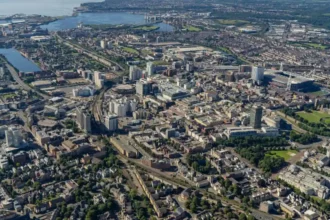
Cardiff Bay’s apartment market is closely connected to the area’s transformation from an industrial dockland into a mixed-use waterfront district. The regeneration programme combined housing with employment, leisure, transport infrastructure and public spaces.
The Cardiff Bay Development Corporation reported significant housing delivery before it was formally wound up in March 2000. Cardiff Harbour Authority records 4,800 new housing units as one of the regeneration programme’s major achievements. The same programme generated 16,750 new jobs and 327 hectares of land reclamation.
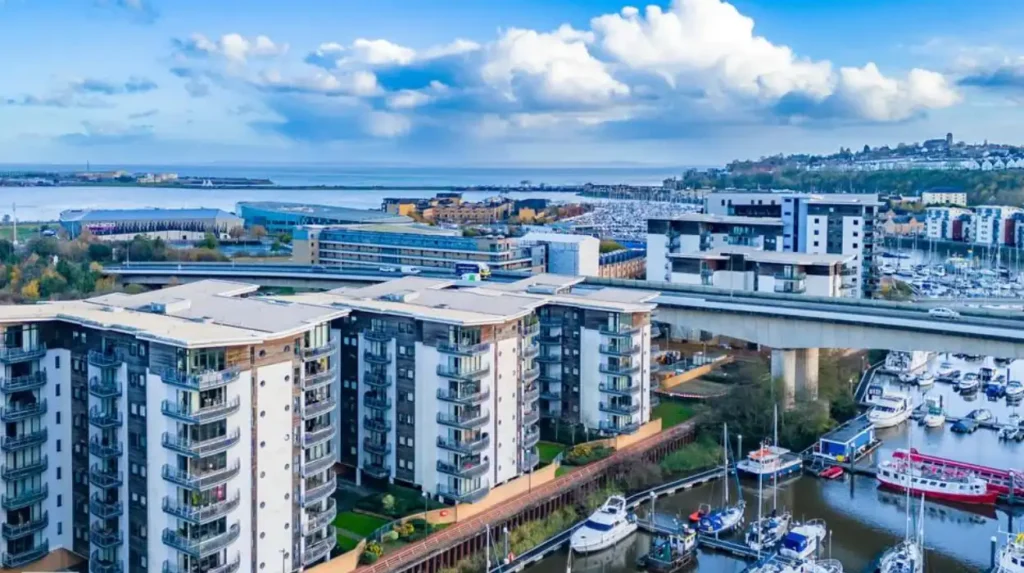
The result is a residential environment dominated by apartments in several parts of the Bay. Buildings differ substantially in age and architectural character.
Some flats occupy contemporary apartment blocks with balconies, communal entrances and underground or allocated parking. Other properties form part of mixed-use buildings close to commercial premises.
The term “Cardiff Bay flat” therefore covers a broad property category rather than one standard type of home.
How did Cardiff Bay become a major residential area?
Cardiff Bay became a major residential area through dockland regeneration that began formally in 1987, followed by large-scale infrastructure, new housing and waterfront investment. The 1999 Barrage transformed the tidal environment and helped establish the modern Bay.
Cardiff developed as an international coal-exporting port during the Industrial Revolution. Cardiff Docks connected coal-producing communities in the South Wales Valleys with international markets.
Coal exports reached more than 13 million tonnes in 1913, shortly before the First World War. After the post-war period, demand declined. By the 1960s, coal exports had virtually ceased, leaving the docklands with declining economic activity.
The decline affected surrounding communities and land use. By the early 1980s, Cardiff Bay contained extensive derelict dockland and faced significant economic and social challenges.
The Cardiff Bay Development Corporation was established in April 1987. Its regeneration programme covered approximately 1,100 hectares of old docklands in Cardiff and Penarth. Housing construction formed a central part of the programme.
The Cardiff Bay Barrage became a defining infrastructure project. Construction began in 1994, and the 1.1-kilometre structure was completed in 1999. Cardiff Harbour Authority states that the project created a 200-hectare freshwater lake and helped catalyse approximately £2 billion of regeneration investment.
The waterfront environment created by this transformation supported further residential, commercial and leisure development.
Today, the area’s apartment buildings form part of a much broader regeneration legacy. The housing market therefore reflects more than individual developments. It represents decades of planning, infrastructure investment and redevelopment.
Which areas have the main concentration of flats around Cardiff Bay?
The main concentrations of flats around Cardiff Bay include Butetown, the Inner Harbour, Atlantic Wharf, Lloyd George Avenue and the International Sports Village, with additional apartment stock extending into Grangetown and neighbouring Penarth.
Butetown
Butetown is one of Cardiff Bay’s historic communities. It developed around the docks and became closely associated with Cardiff’s international maritime trade and multicultural population.
Modern residential development sits alongside historic buildings and landmarks. The area provides access to the waterfront, cultural venues and city-centre transport routes.
Apartment buildings in and around Butetown include both established developments and newer schemes.
Inner Harbour
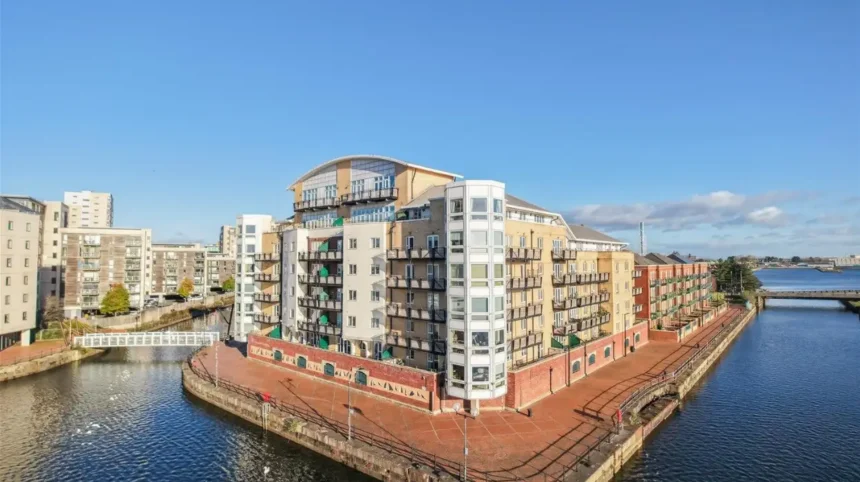
The Inner Harbour is the most recognisable waterfront residential setting. It is close to Mermaid Quay, the Wales Millennium Centre, the Senedd and Cardiff Bay’s public spaces.
Apartments in this location often benefit from proximity to restaurants, cultural attractions and waterfront promenades. Properties directly facing the water have a different setting from apartments further inland.
Atlantic Wharf
Atlantic Wharf occupies a major regeneration zone between Cardiff city centre and the Bay. It contains residential, leisure, commercial and infrastructure uses.
The area has remained central to Cardiff’s regeneration strategy. Cardiff Council has identified Atlantic Wharf as a major component of continuing Cardiff Bay regeneration, including proposals involving the wider Inner Harbour area.
Lloyd George Avenue
Lloyd George Avenue provides an important connection between the city centre and Cardiff Bay. Residential development along and around this corridor includes modern apartment buildings and mixed-use schemes.
The location is particularly relevant for residents who want access to both the city centre and waterfront.
International Sports Village
The International Sports Village is located in the wider Cardiff Bay area. Residential development here includes modern apartment schemes positioned near sports, leisure and waterfront facilities.
The area has a more contemporary master-planned character than some of the historic dockland districts.
What types of flats can you find around Cardiff Bay?
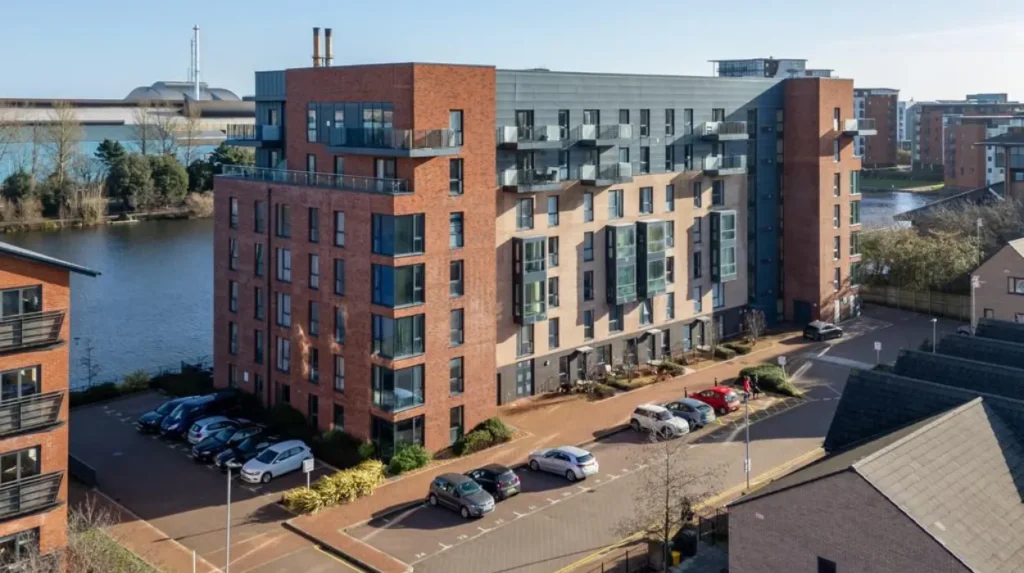
Flats around Cardiff Bay include one-bedroom apartments, two-bedroom homes, three-bedroom apartments, larger family-oriented units and converted buildings. Properties also differ by floor level, outlook, parking, balconies, tenure, building age and communal facilities.
One-bedroom flats are common in urban apartment markets. They typically suit single occupants, couples and some investors seeking smaller residential units.
Two-bedroom flats provide additional flexibility. They are used by couples, small families, professionals and households requiring a separate office or guest room.
Three-bedroom and larger apartments form a smaller but important part of the market. Cardiff Council’s 2026 completion of the Scott Harbour redevelopment demonstrates this family-oriented segment. The completed scheme contains 78 council apartments across one-, two-, three- and four-bedroom layouts.
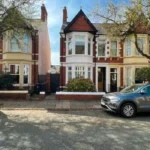
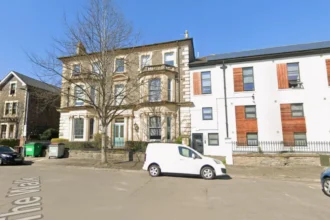
Converted flats form another category. Older commercial or residential buildings can be subdivided into individual apartments subject to planning and building regulations.
Modern purpose-built developments often include communal entrances, lifts, shared landscaped areas and designated parking. Individual buildings vary considerably, so buyers and renters need to assess the specification of each property rather than relying only on the location.
Waterfront orientation is another important distinction. A flat overlooking the Bay, Roath Basin or a public waterfront has a different outlook from one facing an internal courtyard or neighbouring building.
Floor level also affects the character of an apartment. Higher floors can provide wider views, while lower floors provide easier access and different privacy conditions.
What are Cardiff Bay flats like for buyers?
Cardiff Bay flats provide buyers with a broad choice of apartment sizes and locations within a major regeneration district. Cardiff-wide data show flats remain substantially below average house prices, although individual Bay properties vary according to building, tenure and specification.
The Office for National Statistics recorded Cardiff’s average house price at £273,000 in May 2026. The average price for flats and maisonettes was £162,000. The ONS data also showed that flat prices in Cardiff stayed around the same level over the year to May 2026.
These figures are useful for understanding the wider market but do not represent a Cardiff Bay-specific average. Cardiff Bay contains properties with significant differences in age, size, waterfront position and facilities.
Buyers should therefore examine individual comparable sales rather than applying the citywide flat average directly to a specific apartment.
Leasehold arrangements also require close attention. Buyers should review the remaining lease term, service charge, ground rent provisions where applicable, building insurance arrangements and planned major works.
The condition of communal areas is another important consideration. A well-maintained entrance, lift system, roof, external envelope and shared spaces affect ongoing ownership costs.
Newer buildings require different checks from older conversions. A modern apartment requires assessment of warranties, service charges and management arrangements. A converted building requires particular attention to construction quality, fire safety arrangements, sound insulation and the history of alterations.
How much do flats around Cardiff Bay cost?
There is no single Cardiff Bay flat price because values vary by location, size, building, outlook and tenure. Cardiff-wide ONS data for May 2026 recorded £162,000 for flats and maisonettes, providing a useful benchmark rather than a Bay-specific valuation.
Cardiff’s wider housing market provides the strongest reliable statistical benchmark for residential pricing.
In May 2026, the ONS reported an average Cardiff house price of £273,000. The average for flats and maisonettes was £162,000. The average for terraced properties was £262,000, while semi-detached properties averaged £325,000.
Rental data provide another useful benchmark. In June 2026, the average private rent in Cardiff was £1,162 per month. Flats and maisonettes averaged £984 per month. Average rents were £897 for one-bedroom properties, £1,073 for two-bedroom properties, £1,194 for three-bedroom properties and £1,685 for properties with four or more bedrooms.
These figures cover Cardiff as a whole. They do not establish the rental value of a particular Cardiff Bay development.
Location within the Bay is a major differentiating factor. Waterfront outlook, proximity to cultural venues, building quality, parking and floor area all affect the comparison between properties.
Service charges also affect the effective cost of apartment ownership. Buildings with lifts, communal gardens, concierge facilities or extensive external maintenance require ongoing management and maintenance expenditure.
For this reason, a buyer should assess the total annual housing cost rather than the purchase price alone.
What are the main costs of owning a Cardiff Bay flat?
The main ownership costs include the purchase price, mortgage payments, service charges, building-related expenses, council tax, insurance arrangements and maintenance. Leasehold documents determine many recurring costs for individual apartments.
Service charges are particularly important for apartment owners. They fund shared building services and maintenance. Typical categories include communal cleaning, lift maintenance, building management, external repairs, lighting and insurance where included within the service structure.
The amount varies significantly between buildings.
A building with several lifts and extensive communal areas has different management requirements from a small low-rise development.
Lease length is another major consideration. A buyer should obtain the lease documentation and understand the remaining term before committing to a purchase.
Major works are also relevant. Leaseholders can face additional contributions when significant repairs are required to communal structures or systems.
Council tax applies to residential properties according to their valuation band. The exact charge depends on the property’s band and Cardiff’s applicable council tax rates.
Mortgage costs depend on the loan amount, deposit, interest rate, mortgage term and lender conditions.
Owners should also budget for internal maintenance. Appliances, heating systems, decoration and fixtures remain separate from many communal service-charge responsibilities.
What are Cardiff Bay flats like for renters?
Cardiff Bay offers rental apartments ranging from compact one-bedroom homes to larger family flats. Cardiff-wide ONS data recorded average private rent of £984 for flats and maisonettes in June 2026, with individual Bay rents determined by property characteristics.
Rental demand in Cardiff Bay is connected to its proximity to employment, cultural venues, transport links and the city centre.
The area attracts different household types. Professionals often prioritise access to employment districts and public transport. Couples frequently seek one- or two-bedroom apartments. Families require larger floor plans and convenient access to schools and community facilities.
The condition of the apartment is important for renters. Tenants should inspect heating, windows, ventilation, appliances, water pressure and communal areas before signing a tenancy.
The tenancy agreement should clearly establish rent, deposit arrangements, responsibilities for utilities and repair procedures.
Renters should also establish whether parking is included. A private parking space is not automatically included with every apartment.
The ONS reported that Cardiff private rents increased 3.4% annually to June 2026, while rents for flats and maisonettes increased 2.6%.
These figures describe the wider Cardiff rental market and should not be treated as a precise Cardiff Bay rental index.
How well connected are flats around Cardiff Bay?
Cardiff Bay has strong public transport connections to central Cardiff, including Cardiff Bus services linking the Bay with the city centre. The area’s road, pedestrian and cycling infrastructure also connects residential districts with waterfront destinations and employment areas.
Cardiff Bus operates several services through Cardiff Bay. Its current network includes service 6, the Baycar, providing a direct connection between Cardiff city centre and Cardiff Bay, alongside services such as routes 1, 2 and 8.
The Baycar connects the city centre with key destinations including the Wales Millennium Centre and the Senedd area.
Lloyd George Avenue is an important transport corridor between the Bay and central Cardiff. Its location also supports walking and cycling connections.
Transport accessibility varies by development. Residents should assess the actual walking distance to their preferred bus stop, station or workplace rather than relying on the general Cardiff Bay label.
Car access also differs between buildings. Some developments have allocated parking, while others rely more heavily on public parking and street arrangements.
Cardiff Council uses formal parking standards and controlled parking principles across the city. Parking availability should therefore be checked at individual developments.
What amenities are close to flats around Cardiff Bay?
Cardiff Bay flats are close to major cultural, leisure, dining and public destinations, including Mermaid Quay, the Wales Millennium Centre, the Senedd, the Barrage and waterfront promenades. Amenities differ according to the precise residential location.
Mermaid Quay is one of Cardiff Bay’s principal commercial and leisure destinations. It contains restaurants, cafés, shops and waterfront facilities.
The Wales Millennium Centre is a major performing arts venue. Its presence gives the Inner Harbour a strong cultural function.
The Senedd is the home of the Welsh Parliament. The Pierhead is another important historic and civic building in the Bay.
Techniquest is a science discovery centre located in the waterfront area. The Red Dragon Centre provides additional leisure and entertainment facilities.
The Cardiff Bay Barrage provides a major public open-space route. Cardiff Harbour Authority describes the Barrage as 1.1 kilometres long, extending from Cardiff docks towards Penarth. It includes locks, bridges, sluice gates and a fish pass.
These facilities contribute to the area’s mixed-use character. Residents are not separated from commercial and cultural activity because the residential environment developed as part of a wider regeneration programme.
The exact amenity profile depends on the apartment’s position. Inner Harbour residents have different immediate facilities from people living farther south around the International Sports Village.
What should buyers check before purchasing a flat around Cardiff Bay?
Buyers should check tenure, lease length, service charges, major works, building insurance, parking rights, planning history, property condition and flood-related information before purchasing. Cardiff Council provides online access to planning applications and decisions.
Leasehold documentation should be reviewed carefully. Buyers should understand the length of the lease and the responsibilities assigned to the leaseholder and building owner.
Service-charge accounts provide information about ongoing costs. Buyers should also examine whether major works have been proposed.
Planning history is relevant when a property has been extended, converted or substantially altered. Cardiff Council provides an online planning system where users can view planning applications and decisions.
Building condition requires professional assessment where appropriate. Common inspection areas include the roof, external walls, windows, balconies, communal entrances, lifts and internal plumbing.
Parking rights require documentary confirmation. A listing that states “parking available” does not replace confirmation of the legal right to use a specific space.
Flood risk deserves particular attention in waterfront areas. Cardiff Council states that the city uses multiple flood-prevention measures, including the Cardiff Bay Barrage. The council also directs residents to Natural Resources Wales for flood warnings and river, sea and internal drainage information.
Buyers should therefore use property-specific flood information alongside broader neighbourhood information.
What should renters check before choosing a Cardiff Bay flat?
Renters should check the tenancy agreement, monthly rent, deposit, energy costs, parking, broadband, heating, furnishings, communal maintenance and transport access before moving into a Cardiff Bay apartment. The exact building determines the practical living conditions.
The advertised rent is only one component of the monthly housing cost.
Tenants should confirm which utilities are included and identify the expected costs for electricity, gas, water and broadband.
Heating efficiency is especially relevant in larger apartments. Residents should understand the heating system and check the property’s Energy Performance Certificate where applicable.
Parking should be confirmed in writing if it is important to the tenancy.
Noise is another practical consideration. Apartments near restaurants, entertainment venues, busy roads or waterfront attractions have different surroundings from quieter residential buildings.
The condition of communal areas provides useful information about building management. Clean entrances, functioning lifts and well-maintained shared spaces indicate the standard of ongoing property management.
Tenants should also establish the procedure for reporting repairs.
The precise location determines convenience. A flat advertised as being “near Cardiff Bay” can be several minutes or significantly farther from the Inner Harbour, city-centre transport and waterfront amenities.
How is new residential development changing Cardiff Bay?
New development continues to shape Cardiff Bay through housing, regeneration, mixed-use schemes and infrastructure investment. Cardiff Council’s planning framework emphasises coordinated development, transport, green space, community facilities and sustainable urban design.
Cardiff Council identifies major development activity through its Local Development Plan framework. Strategic development planning considers housing alongside transport corridors, schools, community facilities and green spaces.
The council’s Liveable Design Guide sets out principles for quality of life, identity, public space, transport and sustainability in large-scale development. Its tall-building guidance specifically addresses tall buildings in Cardiff’s city centre and Bay areas.
Recent housing delivery also demonstrates the continued evolution of Cardiff Bay’s residential stock.
Scott Harbour is a notable example. In February 2026, Cardiff Council announced completion of the final phase of its redevelopment, delivering 78 council apartments. The scheme transformed a former office building and includes one-, two-, three- and four-bedroom homes.
The example shows that Cardiff Bay housing development is not limited to constructing entirely new blocks. Regeneration also involves converting existing commercial buildings into residential accommodation.
Cardiff’s wider regeneration agenda remains active. In March 2026, Welsh Government announced funding for placemaking plans covering Adamsdown, Splott, Butetown and Cardiff Bay.
This continued planning activity gives Cardiff Bay long-term relevance as a residential district.
Explore More Area Guide
Languages Spoken in Cardiff: Welsh & English Guide Cardiff 2026
Demographics of Cardiff’s Youngest Wards: Complete Population Guide Cardiff 2026
What is the future relevance of flats around Cardiff Bay?
Flats around Cardiff Bay remain central to the area’s future because residential development forms part of a wider regeneration model combining housing, employment, leisure, transport and public space. Planning policy continues to influence the district’s long-term residential character.
The area’s future residential identity is closely connected to regeneration policy.
Cardiff Council continues to manage planning applications, development activity, design standards and infrastructure considerations across the city. Its residential design guidance addresses housing layout and development quality, while tall-building guidance covers relevant city-centre and Bay locations.
The Bay’s established infrastructure provides a foundation for continued residential use. The Barrage, waterfront public spaces, cultural venues, roads and public transport services support a mixed-use district rather than a standalone housing estate.
Housing delivery also remains relevant to Cardiff’s wider need for additional homes. Cardiff Council’s housing development programme includes large-scale schemes intended to increase housing supply and improve neighbourhoods.
The most important future factors for individual flats include building quality, management, transport access, housing demand, planning decisions and local regeneration.
For buyers and renters, the Cardiff Bay label should therefore be treated as a starting point. The precise building, street, tenure, floor plan and management arrangements determine the practical value of each property.
Why are flats around Cardiff Bay important to Cardiff’s housing market?
Flats around Cardiff Bay represent the residential legacy of Cardiff’s dockland regeneration. They provide housing within a mixed-use waterfront district where historic infrastructure, modern apartments, employment, culture, transport and public spaces operate together.
Cardiff Bay demonstrates how a former industrial dockland can become a major residential and mixed-use urban district.
The transformation began with the decline of the coal-export economy and the establishment of the Cardiff Bay Development Corporation in 1987. The regeneration programme delivered thousands of homes alongside major infrastructure and commercial investment.
The Barrage became the physical centrepiece of the transformation. Its completion created the modern freshwater Bay and supported the development of a new waterfront environment.
Today, flats occupy an important position within that regenerated landscape.
The residential market contains different building types, tenure arrangements, apartment sizes and price points. Cardiff-wide ONS data provide a useful statistical context, with flats and maisonettes averaging £162,000 in May 2026 and £984 per month in private rent in June 2026.
For anyone assessing flats around Cardiff Bay, the most reliable approach is property-specific research. Location, lease terms, service charges, parking, building condition, transport and planning history all influence the practical characteristics of an apartment.
Cardiff Bay remains an important part of Cardiff’s housing geography because residential development is integrated with the city’s wider regeneration, transport and economic objectives.
What are flats around Cardiff Bay?
Flats around Cardiff Bay are apartments located in waterfront and nearby neighbourhoods such as Butetown, Atlantic Wharf, Lloyd George Avenue and the International Sports Village. They include modern developments, converted buildings and council housing schemes.