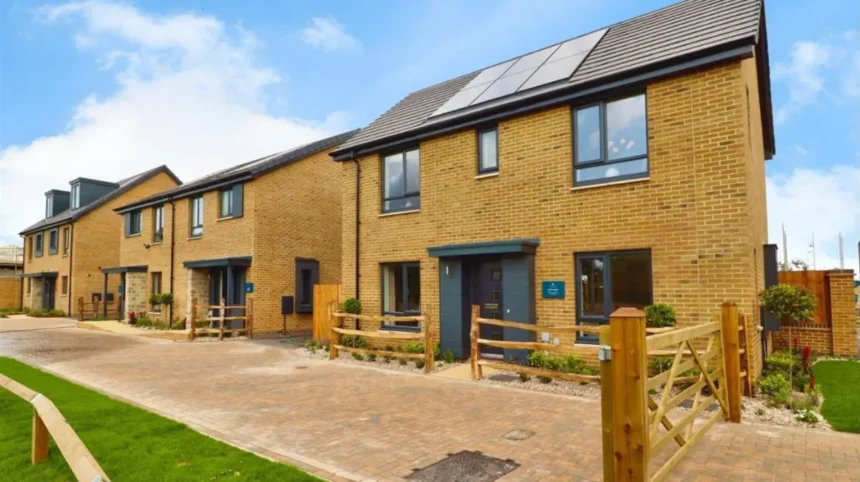
New build estates in St Mellons form an important part of Cardiff’s expanding eastern residential area. The suburb contains modern family housing, affordable homes, council developments and specialist community-living accommodation. Recent schemes include Kings Drive, Silvervale Park, Ffos y Faendre, Sant Silian in Old St Mellons and Llys Y Goetre.
- What are new build estates in St Mellons?
- How did St Mellons develop into a modern residential area?
- Which new build estates and developments are associated with St Mellons?
- What types of homes are available on new build estates in St Mellons?
- How does planning control new build estates in St Mellons?
- How important are transport and connectivity for St Mellons new builds?
- What infrastructure is required alongside new housing in St Mellons?
- How energy efficient are new build homes in St Mellons?
- How does affordable housing fit into St Mellons new build estates?
- What should buyers check when considering a new build estate in St Mellons?
- What does the future of new build estates in St Mellons look like?
- Why are new build estates important to St Mellons and Cardiff?
St Mellons is distinct from Old St Mellons. Old St Mellons is the historic village, while the modern St Mellons residential area developed extensively during the late twentieth and early twenty-first centuries. Cardiff Council planning documents identify housing delivery, transport, community facilities and green infrastructure as important elements of major development across the eastern side of Cardiff.
For buyers, tenants and residents, understanding the development pattern is important. New-build estates are not simply collections of newly constructed houses. They are planned residential environments shaped by Welsh planning policy, Cardiff Council’s Local Development Plan, infrastructure requirements, affordable-housing policies, active-travel objectives and environmental standards.
What are new build estates in St Mellons?
New build estates in St Mellons are planned residential developments containing newly constructed homes, supporting infrastructure and landscaped areas, with examples including Kings Drive, Silvervale Park and Ffos y Faendre. They serve private buyers, council tenants, affordable-housing residents and specialist housing needs.
A new build estate is a residential development where homes are constructed as part of a coordinated scheme rather than as isolated individual properties. The development normally has an approved layout covering houses, roads, parking, gardens, landscaping, drainage and access.
St Mellons has a mixture of established modern estates and newer developments. Kings Drive is one of the clearest current examples. Cardiff Living describes Kings Drive as a development near St Mellons offering two-, three- and four-bedroom family homes for private sale and council rent.
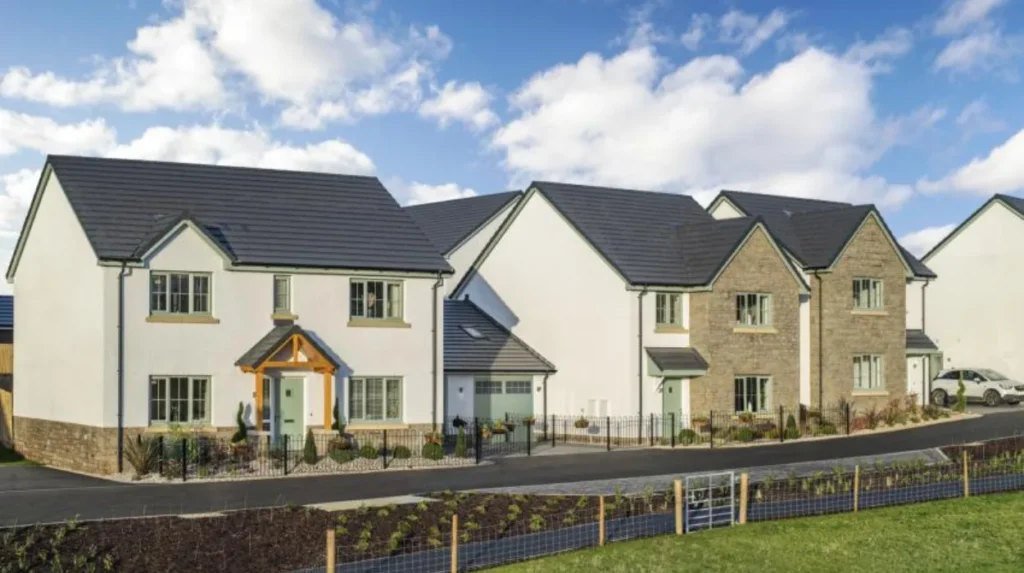
Silvervale Park is another example of contemporary residential development in St Mellons. Cardiff Living identifies the development as a modern housing scheme off Willowbrook Drive, with four-bedroom homes and private front and rear gardens.
The area also contains publicly funded housing. Ffos y Faendre delivered 13 council homes on the former enterprise-centre site at Wakehurst Place. Cardiff Council stated that the scheme consists of two-, three- and four-bedroom family houses and was completed in 2023.
The wider definition also includes specialist developments. Llys Y Goetre in St Mellons provides 60 one- and two-bedroom apartments for older residents, with communal facilities, landscaped gardens, solar panels, lounges, activity rooms and a health suite. The scheme was completed in January 2026.
How did St Mellons develop into a modern residential area?
St Mellons changed from a rural village and historic parish into a substantial Cardiff suburb through twentieth-century urban expansion, with large-scale housing development surrounding the historic settlement and creating the modern residential landscape seen today.
The historic settlement of St Mellons has much older origins. Historical records describe St Mellons as a parish in Monmouthshire before its incorporation into Cardiff’s administrative area. A nineteenth-century gazetteer recorded a parish covering 2,574 acres, with 688 residents and 137 houses in 1870–72.
The village was historically associated with agriculture and travel. Its position on the route between Cardiff and Newport gave it a transport and commercial function. Cardiff Council’s conservation-area appraisal records churches, historic cottages, former public houses and other buildings that demonstrate the village’s earlier development.
The twentieth century produced a major change in land use. Fields surrounding the historic village were progressively developed for housing. Cardiff Council’s historical appraisal states that large-scale development during the latter half of the twentieth century transformed the rural setting and enveloped the historic village with housing estates.
The administrative geography also changed. In 1974, St Mellons became part of the Cardiff district following local-government reorganisation. In 1996, the former St Mellons community was divided, with Old St Mellons established from the eastern part and the remaining area becoming associated with Pontprennau.
This history explains the distinction between Old St Mellons and modern St Mellons. The historic village retains older buildings and heritage features. The newer residential area contains predominantly modern housing and estate infrastructure.
Which new build estates and developments are associated with St Mellons?
Important new-build developments associated with St Mellons include Kings Drive, Silvervale Park, Ffos y Faendre, Sant Silian in Old St Mellons and Llys Y Goetre. These schemes demonstrate the area’s mix of family housing, affordable homes, council accommodation and specialist community living.
Kings Drive is a significant example of current residential development. Cardiff Living, the partnership between Cardiff Council and Wates Residential, states that the wider programme is intended to deliver 1,700 new homes across Cardiff over ten years. Kings Drive provides two-, three- and four-bedroom family homes near St Mellons.
The housing range at Kings Drive includes named house types such as Water-lily, Hawthorn, Honeysuckle and Violet. Cardiff Living’s development information records two-bedroom, three-bedroom and four-bedroom designs within the scheme.
Silvervale Park provides another example of contemporary family housing. Its published development information identifies four-bedroom houses and private front and rear gardens, with the development located off Willowbrook Drive.
Ffos y Faendre has a different purpose. It was developed specifically as council housing. The 13 homes consist of two-, three- and four-bedroom properties designed for households on Cardiff’s housing waiting list.
Sant Silian is located in Old St Mellons rather than the modern St Mellons estate area. Cardiff Community Housing Association states that the development provides 36 new homes through a Section 106 planning agreement with Dandara Wales & West Ltd. Construction began in summer 2023 and completion is scheduled for 2026.
Llys Y Goetre represents specialist housing. The development provides 60 sustainable one- and two-bedroom apartments for older residents. Its design incorporates communal areas and facilities intended to support independent living.
What types of homes are available on new build estates in St Mellons?
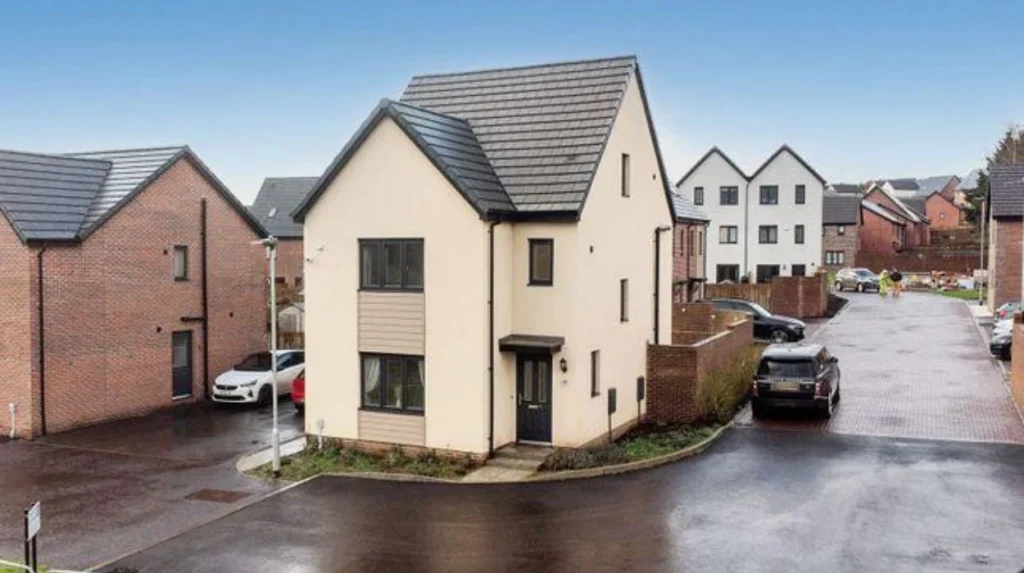
New build estates in St Mellons contain several housing formats, including two-bedroom apartments, three-bedroom semi-detached houses, four-bedroom detached houses and specialist one- and two-bedroom apartments, providing different options for families, first-time buyers, tenants and older residents.
Family houses form a major component of St Mellons’ new-build market. Kings Drive includes two-, three- and four-bedroom properties, while individual house designs include detached and semi-detached formats.
Three-bedroom houses provide a substantial family-housing category. Current listings for Kings Drive have included three-bedroom detached and semi-detached homes, with examples such as the Hawthorn and Dahlia designs. Property availability changes as individual plots are sold or reserved.
Four-bedroom properties provide larger family accommodation. Cardiff Living’s Honeysuckle design, for example, has four bedrooms, two bathrooms, a garage and two parking spaces. The published floorplan also includes an open-plan kitchen and dining area.
Specialist apartments form another category. Llys Y Goetre contains 60 one- and two-bedroom apartments designed for older residents. These homes are part of Cardiff Council’s broader programme for purpose-built accommodation supporting independent living.
Affordable and social housing is also integrated into the area’s development pattern. Kings Drive includes homes available for council rent, while Ffos y Faendre provides council housing and Sant Silian includes affordable homes delivered through Section 106 arrangements.
How does planning control new build estates in St Mellons?
New build estates in St Mellons are controlled through Welsh planning policy and Cardiff’s development plan, which assess housing need, design, transport, infrastructure, environmental effects, affordable housing, drainage and community requirements before development proceeds.
Planning in Wales operates under a different national policy framework from England. Planning Policy Wales, Edition 12, provides the national planning policy context for housing and sustainable development.
Planning Policy Wales states that planning authorities must understand local housing markets and plan for a supply of housing that meets identified needs. It also requires new housing development to include an appropriate mix of market and affordable house types, tenures and sizes.
Cardiff Council’s Local Development Plan provides the local strategic framework. The council identifies strategic development sites and uses masterplanning to coordinate housing with infrastructure. Its major-development monitoring system records planning histories, construction activity, housing completions and infrastructure delivered through planning obligations.
This approach means a large estate is assessed as a place rather than only as a collection of houses. Roads, schools, transport corridors, community facilities, green spaces and drainage all form part of the planning assessment.
Planning obligations are also important. A Section 106 agreement is a legal agreement connected to planning permission that secures contributions or works required to mitigate the effects of development. Sant Silian, for example, is being delivered through a Section 106 agreement involving Cardiff Community Housing Association and Dandara Wales & West Ltd.
How important are transport and connectivity for St Mellons new builds?
Transport is a central component of St Mellons development because new housing must connect residents with employment, education, shops and public services through roads, buses, walking routes and cycling infrastructure across eastern Cardiff.
St Mellons benefits from its position within eastern Cardiff and its proximity to major transport corridors. The wider eastern development area has experienced sustained residential growth, increasing the importance of coordinated transport planning.
Cardiff Council’s strategic-development monitoring states that transport and highway improvements are being provided alongside major developments to give residents alternatives to private cars.
Active travel is also part of Cardiff’s transport strategy. Cardiff Council’s cycleway programme includes Cycleway 2, connecting the city centre with Adamsdown, Newport Road retail areas, Rumney, Llanrumney and St Mellons Business Park.
For residents of new estates, connectivity involves more than commuting. Walking and cycling routes provide access to shops, schools, community facilities and public transport. Estate layouts therefore influence daily travel patterns.
Public transport access is also relevant to specialist accommodation. Cardiff Council’s information about Llys Y Goetre identifies convenient Cardiff Bus access alongside proximity to local shops, amenities and St Mellons Hub.
What infrastructure is required alongside new housing in St Mellons?
New housing requires supporting infrastructure because additional residents increase demand for roads, public transport, schools, drainage, utilities, green space, community facilities and health-related services across the surrounding neighbourhood and wider Cardiff area.
Infrastructure planning is a fundamental part of Cardiff’s strategic housing programme. Cardiff Council states that strategic sites are masterplanned so supporting infrastructure, including sustainable transport corridors, schools, community facilities and green spaces, forms part of development delivery.
Green infrastructure is also significant. Planning Policy Wales places strong emphasis on sustainable places, environmental protection, biodiversity and green infrastructure. New developments therefore require consideration of landscape, ecology, trees, open space and environmental resilience.
Drainage is particularly important in new housing. Sustainable drainage systems manage surface-water runoff and form part of the technical assessment of development. Their role becomes increasingly important where large areas of previously permeable land are replaced by roofs, roads and paved surfaces.
Community infrastructure has a direct relationship with housing design. Llys Y Goetre demonstrates this through communal lounges, activity rooms, landscaped gardens and health-related facilities integrated into the residential scheme.
How energy efficient are new build homes in St Mellons?
Modern St Mellons developments incorporate energy-efficiency measures through contemporary construction standards, efficient building systems and renewable-energy technologies, with examples including solar panels at Llys Y Goetre and EPC A-rated homes at Sant Silian.
Energy efficiency is increasingly integrated into Welsh housing policy and new-build construction. Modern homes are assessed against building standards covering energy performance, insulation, ventilation and heating systems.
Sant Silian provides a clear local example. Cardiff Community Housing Association states that its 36 homes include solar panels and are built to EPC A ratings.
Llys Y Goetre also incorporates solar panels. Cardiff Council describes the 60-apartment development as sustainable accommodation designed to support independent living.
Energy-efficient construction affects household running costs through improved thermal performance and more efficient energy systems. It also contributes to wider decarbonisation objectives.
For prospective residents, energy performance should be assessed through the property’s Energy Performance Certificate, construction specification and heating system. A new-build property does not automatically have identical energy performance to every other new-build property. The actual specification remains important.
How does affordable housing fit into St Mellons new build estates?
Affordable housing forms part of St Mellons’ broader residential supply through council housing, social housing and Section 106 homes, with examples including Ffos y Faendre, Kings Drive council-rent properties and Sant Silian affordable homes.
Welsh planning policy requires authorities to understand housing requirements across different tenures and household groups. Planning Policy Wales states that new housing should incorporate a mix of market and affordable homes where evidence identifies those needs.
Cardiff Living provides a direct example through Kings Drive, where homes are available for both private sale and council rent.
Ffos y Faendre represents direct council-house delivery. Cardiff Council handed over 13 new homes in 2023 for allocation to families on the housing waiting list.
Sant Silian represents a Section 106 affordable-housing model. The development is being delivered through a planning agreement connected to the wider development and provides 36 homes managed by Cardiff Community Housing Association.
This mixture gives St Mellons a broader housing profile than a conventional private estate. The area contains market homes, council-rented homes, affordable homes and specialist accommodation.
What should buyers check when considering a new build estate in St Mellons?
Buyers should check tenure, service charges, estate management, planning conditions, property specifications, energy performance, parking, transport, broadband, drainage, warranties, completion arrangements and the long-term maintenance responsibilities attached to the development.
The first consideration is tenure. A property can be freehold, leasehold, shared ownership, council-rented or another affordable-housing arrangement. Buyers should establish the legal tenure before committing to a purchase.
The second consideration is the specification. Buyers should examine the property’s floor area, number of bedrooms, parking arrangements, garden provision, storage, heating system, glazing, insulation and energy rating.
The third consideration is estate management. Some developments contain communal landscaping, private roads, shared facilities or management arrangements. The relevant legal documents should identify maintenance responsibilities and associated charges.
The fourth consideration is planning. Large estates are often delivered in phases. The appearance of an established phase does not necessarily represent the final layout. Buyers should examine approved plans and the development’s remaining phases when relevant.
The fifth consideration is transport. Residents should assess actual walking distances to bus stops, shops, schools and employment areas rather than relying solely on a development’s advertised location.
The sixth consideration is construction quality and warranty protection. Buyers should obtain the relevant new-home warranty documentation and understand the process for reporting defects.
Explore More Area Guide
Victorian Homes History & Architecture Roath Cardiff 2026
Average Income Trends Reveal Cardiff Earnings 2026
What does the future of new build estates in St Mellons look like?
The future of new build estates in St Mellons is linked to Cardiff’s continuing housing requirements, strategic development, affordable-housing delivery, active travel, sustainable construction and specialist accommodation for changing household needs.
Cardiff’s wider eastern development programme remains significant. The council identifies North East Cardiff as a strategic development area containing approximately 4,500 homes with employment and community uses, while the East of Pontprennau Link Road area is identified for approximately 1,300 homes with associated community uses.
These figures demonstrate the scale of housing growth around the eastern side of Cardiff. They also show why St Mellons should be understood as part of a wider development geography rather than as an isolated housing market.
The future housing mix is also becoming more diverse. Cardiff’s programme for older residents includes substantial investment in specialist accommodation. The council states that more than £220 million is being invested to build at least 620 new apartments for older residents across Cardiff.
Llys Y Goetre in St Mellons forms part of this programme. Its 60 apartments demonstrate how future development is addressing changing household structures and the need for housing that supports independent living.
Environmental standards will remain important. Planning Policy Wales places sustainable development, biodiversity, green infrastructure and energy efficiency within the planning framework for new development.
The future of St Mellons housing therefore involves more than additional house numbers. Development planning increasingly connects housing with transport, environmental performance, community facilities and demographic needs.
Why are new build estates important to St Mellons and Cardiff?
New build estates are important because they increase housing supply, provide affordable and specialist accommodation, support population growth and create planned neighbourhoods with transport, green infrastructure and community facilities within Cardiff’s expanding eastern urban area.
St Mellons demonstrates the transformation of Cardiff’s eastern edge from a historically rural landscape into a substantial residential environment. The contrast between historic Old St Mellons and modern St Mellons illustrates how urban expansion reshaped the area during the twentieth and twenty-first centuries.
Current development adds another layer to this transformation. Kings Drive provides family housing through the Cardiff Living partnership. Ffos y Faendre provides council homes. Sant Silian adds affordable housing in Old St Mellons. Llys Y Goetre provides specialist accommodation for older residents.
The result is a housing environment containing different property sizes, tenures and development models.
For Cardiff, the strategic importance is broader. Housing delivery must respond to demographic change while supporting sustainable transport, infrastructure and environmental objectives. Cardiff Council’s strategic-site programme explicitly connects housing development with schools, community facilities, green spaces and transport improvements.
For residents, the key issue is the quality and completeness of the neighbourhood. A successful new-build estate requires functional homes, safe streets, usable open spaces, reliable services and practical connections to the wider city.
St Mellons’ continuing development reflects these principles. Its new-build estates form part of Cardiff’s wider housing strategy while retaining a direct connection with the area’s long history as a settlement on the eastern side of the city.
What are the main new build estates in St Mellons?
Key new-build developments include Kings Drive, Silvervale Park and Ffos y Faendre. Nearby Old St Mellons also has developments such as Sant Silian, while Llys Y Goetre provides specialist accommodation for older residents.