
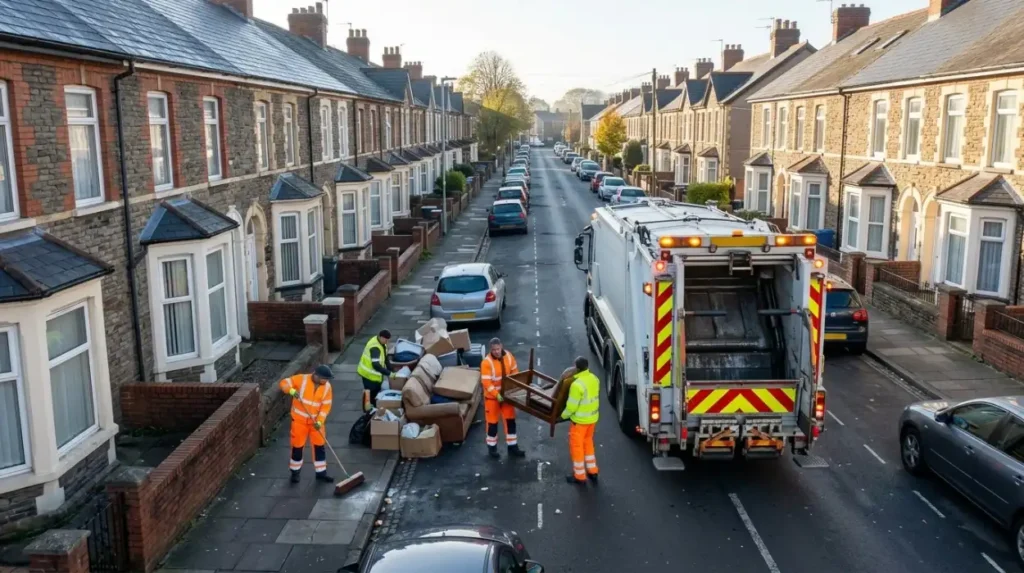
Fly-tipping is the illegal disposal of waste on land without the permission required for lawful disposal. In Cardiff, it includes dumped furniture, household rubbish, construction debris and abandoned commercial waste on streets, pavements, open spaces and other locations.
- How Can You Report Fly-Tipping to Cardiff Council?
- What Information Should You Include in a Fly-Tipping Report?
- Where Should You Report Fly-Tipping in Cardiff?
- Should You Report Fly-Tipping on Roads and Pavements?
- What Should You Do About Waste in Rivers or on Natural Resources Wales Land?
- Who Is Responsible for Fly-Tipping on Private Land?
- What Should You Do If You Witness Fly-Tipping in Progress?
- What Happens After You Report Fly-Tipping in Cardiff?
- How Can the Council Identify Those Responsible?
- How Long Does Cardiff Council Take to Remove Fly-Tipped Waste?
- What Are the Penalties for Fly-Tipping in Cardiff?
- How Can You Prevent Fly-Tipping in Cardiff?
- What Should You Do If Cardiff Council Has Not Removed Reported Waste?
- How Does Fly-Tipping Affect Cardiff Communities and the Environment?
- How Can You Dispose of Household Waste Legally in Cardiff?
- What Is the Best Way to Report Fly-Tipping in Cardiff?
Fly-tipping is an environmental offence that affects public spaces, private land, residential streets and commercial areas. The waste is deposited outside the proper waste collection and disposal system. Unlike authorised household collections or licensed waste facilities, fly-tipping involves unlawful dumping.
Cardiff is the capital of Wales and contains residential neighbourhoods, retail districts, industrial estates, parks, public highways and countryside on its outskirts. These different environments create different challenges for waste management. Dumped rubbish on a pavement obstructs pedestrians, while construction waste on rural land creates additional environmental and land-management concerns.
Common examples of fly-tipping include:
- Household furniture, such as sofas, mattresses and wardrobes, abandoned beside a road.
- Black bags containing domestic rubbish dumped in an alley.
- Builders’ rubble, plasterboard and broken fixtures left on public or private land.
- Commercial waste abandoned outside shops or industrial premises.
- Electrical appliances, such as washing machines and refrigerators, left in unauthorised locations.
- Large quantities of garden waste dumped beside a footpath or in a green space.
Fly-tipping is different from a missed bin collection. A missed collection involves waste presented for an authorised service but not collected as scheduled. Fly-tipping involves waste deposited unlawfully. Reporting the correct issue helps Cardiff Council direct the complaint to the appropriate service.
The offence also differs from littering. Littering generally involves smaller items discarded in public places, such as wrappers, cans or cigarette packets. Fly-tipping usually concerns the unlawful deposit of waste, including larger or substantial quantities. The precise legal classification depends on the circumstances.
Illegal dumping transfers the costs of waste removal to landowners, local authorities and, ultimately, the public. It also damages the appearance of neighbourhoods and creates additional work for council cleansing teams.
How Can You Report Fly-Tipping to Cardiff Council?
Residents can report fly-tipping through Cardiff Council’s official website or the Cardiff Gov app. Provide the exact location, a description of the waste, when it was discovered and photographs when available. The council directs reports to its waste enforcement team.
The Cardiff Gov app supports location-based reporting. Users can place a map pin at the affected site and attach up to three images, alongside additional information. These details help the relevant team identify the precise location and understand the reported problem.
A useful report identifies the location clearly. A street name alone is insufficient when a dumping site sits behind buildings, beside a footpath or along an access road. Include a nearby landmark, house number, postcode or map location where possible.
Residents should report each distinct dumping site separately when the locations are far apart. Separate reports help the council distinguish between incidents and identify the individual places requiring investigation.
What Information Should You Include in a Fly-Tipping Report?
A useful fly-tipping report identifies the location, approximate discovery time, waste type, estimated quantity and any immediate hazards. Photographs provide additional evidence. Witness descriptions, vehicle details and registration numbers also assist investigations when recorded safely and accurately.
Cardiff Council investigates reports to try to identify those responsible. Clear information helps officers understand the incident and determine appropriate action.
Before submitting a report, record the following details where available:
- Exact location: Record the street, postcode, nearby property, footpath entrance or map pin.
- Discovery date and time: State when you first noticed the waste. If you witnessed the dumping, record the time it happened.
- Waste description: Identify the material, such as household bags, mattresses, tyres, furniture, rubble or electrical equipment.
- Approximate quantity: Describe the number of bags, objects or piles. Estimate the dimensions of a larger heap.
- Photographic evidence: Take photographs from a safe position without touching or moving the waste.
- Witness information: Record relevant observations about a vehicle, person or activity you directly witnessed.
- Potential hazards: Explain whether the waste blocks a pavement, sits near a drain or contains suspicious containers.
A report does not require the identity of the offender. Residents should not delay reporting an incident because they did not witness the dumping or cannot identify who left the rubbish.
How Should You Take Photographs of Dumped Waste?
Photographs should show the overall site and the type of material deposited. A wide photograph establishes the location and scale, while a closer photograph shows the waste itself. Take images from public areas or other places where you have permission to stand.
Avoid opening bags, containers or packages to search for identifying documents. Waste contains potentially dangerous substances, sharp objects and contaminated materials. Leave the evidence undisturbed for the relevant authorities.
If a vehicle is involved, record its registration number only when you can do so safely. Do not follow the vehicle, block its path or approach its occupants.
Where Should You Report Fly-Tipping in Cardiff?
Report ordinary fly-tipping on Cardiff streets, public spaces and other council-managed land to Cardiff Council. Report dumping on Natural Resources Wales-managed land or in a main river to Natural Resources Wales. The responsible organisation depends on the location and circumstances.
Should You Report Fly-Tipping on Roads and Pavements?
Cardiff Council is the appropriate starting point for waste dumped on ordinary public streets, pavements, lay-bys and council-managed land. Natural Resources Wales identifies local authorities as responsible for dealing with fly-tipping on publicly owned land, including roads and lay-bys.
A report should explain whether the waste blocks pedestrian access, obstructs a road or creates a hazard for road users. This information helps the authority understand the immediate impact.
What Should You Do About Waste in Rivers or on Natural Resources Wales Land?
Natural Resources Wales (NRW) is the Welsh environmental regulator responsible for environmental protection and regulation within its remit. It accepts reports about incidents on its managed land and fly-tipping in a main river, such as the River Taff.
Use the Natural Resources Wales incident reporting service when the incident falls within its responsibility. The service requests information about what happened, where and when it occurred, whether it is continuing and any available photographs or videos. NRW also provides a 24-hour incident line on 0300 065 3000.
Who Is Responsible for Fly-Tipping on Private Land?
Private land includes gardens, driveways, private access roads and fields. Natural Resources Wales states that landowners are generally responsible for paying to remove waste dumped on their property. Landowners should report the incident before arranging removal.
Cardiff Council’s waste enforcement officers can help private landowners investigate an incident. The council requires permission to search and investigate the waste on the landowner’s behalf. Removal arranged by the council can incur a charge to the landowner.
Landowners should preserve photographs, record disposal costs and keep invoices. These records document the incident and the financial impact of the dumping.
What Should You Do If You Witness Fly-Tipping in Progress?
Do not confront people who are dumping waste or attempt to stop their vehicle. Move to a safe location, record relevant details without putting yourself at risk and contact the police on 101 when witnessing fly-tipping in progress.
Witnessing an offence provides information that an investigation can use. However, personal safety takes priority over gathering evidence.
If you see someone unloading rubbish, note the time, location, type of waste and direction of travel. Record a vehicle registration number only when it is safe and practical to do so. Do not trespass onto private property or approach a moving vehicle.
Natural Resources Wales advises members of the public to contact the police on 101 when they witness fly-tipping in progress. It also identifies Crimestoppers on 0800 555 111 as an option for providing information anonymously.
Call 999 when there is an immediate threat to life or an emergency requiring urgent police assistance. For an incident that has already happened and presents no immediate emergency, use the appropriate reporting service.
Do not touch suspicious drums, chemical containers, needles, asbestos-like materials or unidentified powders. Explain the suspected hazard in your report and leave the site undisturbed.
What Happens After You Report Fly-Tipping in Cardiff?
After receiving a fly-tipping report, Cardiff Council’s waste enforcement team investigates the incident to try to identify those responsible. Officers assess the available information and evidence, while the response depends on the circumstances, the site and the nature of the waste.
Reporting is the first step in the enforcement process. It does not automatically establish who dumped the waste or guarantee prosecution.
The investigation can involve reviewing photographs, checking the reported location, examining waste for evidence and assessing witness information. Officers determine whether the available material supports further enforcement action.
How Can the Council Identify Those Responsible?
Waste can contain documents, packaging or other identifying material that helps investigators establish a connection between the rubbish and a person or business. Vehicle descriptions and witness observations also provide useful leads.
In a documented Welsh case, Natural Resources Wales reported that identifying materials found among six bags of waste helped link the dumping to two individuals who were subsequently prosecuted. The incident occurred at Coed Moel Famau in November 2024 and resulted in court proceedings in May 2025. This illustrates how evidence from dumped waste can support an investigation.
The presence of a name or address in discarded material does not, by itself, prove that the named person committed the offence. Investigators must assess the evidence and circumstances.
How Long Does Cardiff Council Take to Remove Fly-Tipped Waste?
There is no single removal deadline that applies to every report. The response depends on factors such as the location, waste type, immediate danger, ownership of the land and the investigation required.
Waste that obstructs a pavement or creates an immediate hazard presents different concerns from a small pile of non-hazardous material on private land. Reports should clearly explain any risks so the authority can assess the incident appropriately.
Residents should not assume that submitting a report means the waste will be removed immediately. If the problem remains unresolved, retain the original report details and use Cardiff Council’s official contact channels to request an update.
What Are the Penalties for Fly-Tipping in Cardiff?
Fly-tipping is an offence under Section 33 of the Environmental Protection Act 1990. Cardiff Council states that the offence carries a maximum fine of £50,000, while very serious cases can result in imprisonment for up to five years and recovery of council clearance costs.
The Environmental Protection Act 1990 provides the legal framework for controlling the unauthorised deposit of waste. Section 33 prohibits the unlawful deposit, treatment or disposal of controlled waste in or on land, subject to the legislation’s provisions.
The penalty depends on the offence, the applicable legal provisions and the outcome of enforcement proceedings. The maximum penalty is not the automatic punishment for every incident.
Cardiff Council adopts a zero-tolerance approach to fly-tipping and investigates reports to try to identify offenders. Enforcement action can help deter illegal dumping and hold those responsible accountable.
Can Businesses and Householders Be Penalised for Waste Dumped by Someone Else?
A person or business that arranges waste removal has responsibilities for ensuring that waste is handled lawfully. Giving rubbish to an unregistered or unsuitable operator can create legal and financial problems if the waste is later dumped illegally.
Natural Resources Wales reported in March 2026 that 48,367 fly-tipping incidents were recorded across Wales between April 2024 and March 2025, a 14.7% increase on the preceding year. The figures also recorded more than 1,500 fixed penalty notices and 69 successful prosecutions. Cardiff recorded 20 successful prosecutions, the highest number among Welsh local authorities in that reporting period.
These figures demonstrate the scale of the problem across Wales and the importance of evidence-based enforcement. They are national reporting-period figures, not a count of all unreported incidents in Cardiff.
A householder who arranges a legitimate waste collection should check the operator’s registration and keep records of the transaction. The aim is to demonstrate that reasonable steps were taken to ensure lawful disposal.
How Can You Prevent Fly-Tipping in Cardiff?
Residents, landlords and businesses can help prevent fly-tipping by arranging authorised waste collections, checking waste carrier registration, securing private land and reporting illegal dumping promptly. Responsible disposal reduces the risk of rubbish entering public spaces and helps prevent waste-related enforcement problems.
Prevention starts with ensuring that unwanted items enter an authorised waste management system. Household rubbish, furniture, electrical appliances and building materials require appropriate disposal arrangements.
Cardiff Council provides information about recycling centres, bulky waste collections and recycling options through its recycling and waste services. Residents should check the relevant service requirements before transporting items or arranging collection.
How Can You Check a Waste Carrier?
A waste carrier is a person or business that transports waste as part of its activities and is subject to applicable registration requirements. Before paying someone to remove rubbish, check their registration through Natural Resources Wales.
Ask for written confirmation of the service, the price and the destination of the waste. Keep receipts, invoices and other relevant records. A low collection price does not establish that the operator disposes of waste legally.
How Can Landowners Reduce Repeat Dumping?
Landowners can improve security by installing suitable gates, barriers, lighting and signs. Natural Resources Wales also recommends keeping access gates closed and improving visibility where possible. Measures must not obstruct public rights of way.
Prompt reporting and lawful removal after evidence has been recorded can also help discourage additional dumping at an existing waste site.
What Should You Do If Cardiff Council Has Not Removed Reported Waste?
If reported fly-tipping remains in place, retain your original report details, document the current condition and contact Cardiff Council through its official channels for an update. Explain any continuing obstruction, safety hazard or environmental concern and provide the original location.
An unresolved report does not automatically mean that the council has ignored the incident. The authority might need further information, investigate ownership or assess the waste before deciding how to proceed.
When requesting an update, provide the date of your original report, its reference number if available and the precise location. Explain whether the quantity of waste has increased or whether the site has become more dangerous.
If the waste presents a new or immediate hazard, make that clear rather than relying solely on an earlier report. Use the appropriate emergency service when the circumstances require urgent intervention.
The Public Services Ombudsman for Wales published a Cardiff Council case on 12 June 2026 concerning fly-tipped waste near a resident’s allotment. The complaint involved concerns about rats, and the Ombudsman secured the council’s agreement to remove the waste within four weeks as part of an early resolution. This was an individual case, not a general removal deadline for all fly-tipping reports.
How Does Fly-Tipping Affect Cardiff Communities and the Environment?
Fly-tipping creates environmental, public health and financial problems by leaving waste in places not authorised to receive it. Dumped materials can obstruct public access, attract pests, damage natural habitats and require councils or landowners to pay for investigation and removal.
The impact depends on the material, the amount of waste and the location. A discarded mattress creates different risks from a leaking chemical container, while construction debris beside a watercourse raises concerns about pollution and habitat damage.
Waste can also affect local businesses and residents by obstructing access, reducing the usability of public spaces and creating additional cleaning costs. Repeated incidents place further pressure on environmental services.
Welsh Government statistics provide a wider picture of the problem. Between April 2024 and March 2025, local authorities recorded 48,367 fly-tipping incidents across Wales. The published figures show that reported incidents increased by approximately 15% compared with the previous year.
These statistics cover incidents reported to local authorities and do not capture every incident on private land or every unreported case. They nevertheless provide an important measure of the scale of illegal waste disposal.
Accurate public reporting supports the collection of evidence, targeted enforcement and identification of locations experiencing repeated dumping.
Explore More Area Guide
How to Report Problems to Cardiff Council | Full Guide
Cardiff Council Housing: Applications, Eligibility and Support
How Can You Dispose of Household Waste Legally in Cardiff?
Cardiff residents can use authorised household waste collections, suitable recycling services, booked recycling centre visits and legitimate bulky-item collection arrangements. Before handing waste to a private operator, verify the relevant registration requirements and confirm that the waste will reach an authorised destination.
Legal disposal prevents unwanted items from becoming an environmental problem elsewhere in Cardiff or Wales.
Residents can use Cardiff Council’s recycling and waste services to check collection arrangements, recycling centres and bulky-item services. The council also provides an online route for reporting waste problems and accessing disposal information.
Different materials require different disposal methods. Electrical equipment, building waste, chemicals and ordinary household rubbish should not be treated as interchangeable waste streams. Follow the council’s guidance for the particular material.
Businesses and landlords should also arrange suitable commercial waste services and retain relevant records. Proper waste management reduces the risk of illegal dumping and supports compliance with environmental requirements.
What Is the Best Way to Report Fly-Tipping in Cardiff?
The most direct way to report ordinary fly-tipping in Cardiff is through Cardiff Council’s official fly-tipping reporting page or Cardiff Gov app. Provide a precise location, describe the waste, attach safe photographs and report any immediate hazards or witnessed offences.
Reporting promptly gives the responsible authority information to assess the incident and investigate potential offenders.
Residents do not need to identify the offender before reporting dumped rubbish. The location, description, timing and available evidence provide a useful starting point for an investigation.
Prompt, accurate reports help Cardiff’s waste enforcement team assess illegal dumping, identify potential evidence and determine the appropriate response. Responsible waste disposal and public cooperation also help reduce repeat incidents and protect Cardiff’s streets, parks and surrounding environment.
How do I report fly-tipping in Cardiff?
You can report fly-tipping through the Cardiff Council official website. Provide the location, a description of the waste and photographs if available.