The history of temples around Cardiff spans thousands of years, beginning with prehistoric pagan structures, evolving through Roman polytheism, and modernizing into diverse multi-faith centers including Hindu, Buddhist, Sikh, and Jain places of worship across South Wales.
- What Hindu Temples Are Located In and Near Cardiff?
- What Buddhist Temples and Meditation Centers Exist Around Cardiff?
- What Sikh Gurudwaras and Jain Spaces Operate in the Cardiff Area?
- What Ancient and Historic Temple Sites Exist Near Cardiff?
- The Romano-British Temple at Caerwent (Venta Silurum)
- Prehistoric Sacred Sites in the Vale of Glamorgan
- Historical Reconstructions at St Fagans
- How Does Planning Permission and Conservation Law Apply to Temples in Cardiff?
- What Impact Do Temples Have on Cardiff’s Local Community and Economy?
- Socio-Economic Contributions
- Cultural Tourism and Economic Activity
- Educational Integration
- Interfaith Relations
- What Architectural Styles Characterize Temples Around Cardiff?
- How Will Sacred Spaces and Temples in Cardiff Evolve in the Future?
Cardiff and the surrounding Vale of Glamorgan contain evidence of religious and spiritual gathering spaces dating back to the Neolithic period. Early spiritual activity in the region centered on natural sites and megalithic monuments. During the Roman occupation of Britain between 48 AD and 410 AD, formal temple structures emerged across South Glamorgan. The Roman settlement of Venta Silurum (modern Caerwent), located 23 miles east of Cardiff, contains the excavated foundations of a 4th-century Romano-British temple dedicated to syncretic Romano-Celtic deities. Roman legionaries stationed at the Roman fort beneath Cardiff Castle also practiced religious rituals dedicated to Mithras, Jupiter, and local Celtic spirits.
Following the departure of the Roman Empire, Christianity became the dominant structural faith in Wales from the 5th century onward, transforming older sacred landscapes into Christian monastic enclosures (llans). For several centuries, non-Christian temple architecture remained non-existent in South Wales due to religious uniformity enforced by medieval state and ecclesiastical authority.
The revival of non-Christian temple architecture in Cardiff began in the late 19th and 20th centuries. The Industrial Revolution transformed Cardiff into a major global coal exporting port. The opening of the Bute West Dock in 1839 attracted international merchant sailors, laborers, and immigrants from South Asia, the Middle East, North Africa, and the Caribbean. This demographic shift created permanent diaspora communities in the Tiger Bay and Butetown districts.
By the mid-20th century, these established communities required dedicated, permanent structures for congregational worship and cultural practice. The Commonwealth Immigrants Act of 1962 and subsequent migration movements brought significant Hindu, Sikh, Buddhist, and Muslim populations to Cardiff. Initial worship spaces operated within converted residential terraced houses. Over subsequent decades, these communities acquired capital, secured local planning permissions, and constructed purpose-built temples or adapted landmark historic buildings to host formal non-Christian practices. Today, the temples surrounding Cardiff reflect the multicultural demography of modern South Wales, serving as centers for spiritual devotion, education, and social cohesion.
What Hindu Temples Are Located In and Near Cardiff?
Cardiff hosts several significant Hindu temples, most notably the Sanatan Dharma Mandal on Merthyr Road and the BAPS Shri Swaminarayan Mandir in Grangetown, serving as central hubs for religious rituals, festivals, and community education for Welsh Hindus.
Hinduism in Wales has a documented population exceeding 10,000 adherents according to official census data, with the largest concentration residing within the Cardiff local authority area. Hindu temples, known as mandirs, serve as the spiritual and cultural centers for this community.
The Sanatan Dharma Mandal and Hindu Temple, located on Merthyr Road in the Whitchurch area of Cardiff, is one of the oldest established Hindu temples in Wales. Established in its current dedicated capacity to serve the broader Sanatan Dharma (universal Hindu practice) community, the temple contains consecrated deities (murtis) including Radha-Krishna, Shiva, Rama, Sita, Hanuman, and Ganesha. The temple facility incorporates a primary prayer hall (mandap), a cultural center, and facilities for hosting daily aarti (light offerings) and bhajan (devotional singing) services.
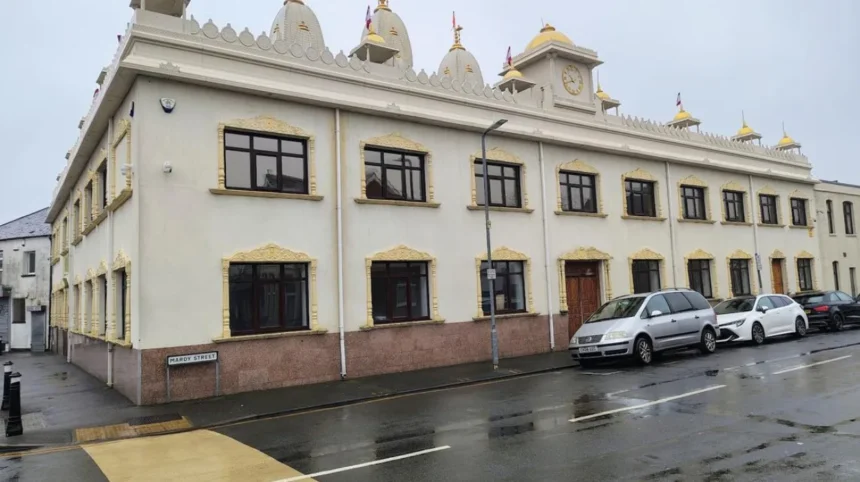
The BAPS Shri Swaminarayan Mandir, situated in Grangetown, Cardiff, represents the Bochasanwasi Akshar Purushottam Swaminarayan Sanstha tradition. This temple adheres to specific architectural guidelines derived from ancient Shilpa Shastras (traditional Hindu manuals of architecture). The center hosts structured spiritual assemblies (satsangs), language classes for Gujarati, and youth development programs.
Beyond the immediate city boundaries, the Hindu community in South Wales accesses regional sacred spaces and community mandirs in neighboring authorities such as Newport and Swansea. These temples perform critical religious ceremonies throughout the calendar year.
The primary operational functions of Hindu temples around Cardiff include:
- Pooja and Aarti: Daily ritual worship services performed at fixed solar times by resident priests (pujaaris).
- Samskaras: Rites of passage ceremonies, including namakarana (naming ceremonies), vivaha (weddings), and antyesti (commemorative funeral rites).
- Festivals: Major annual cultural events, including Diwali (Festival of Lights), Navratri (Nine Nights of the Goddess), Janmashtami (Birth of Krishna), and Holi (Festival of Colors).
- Education: Instruction in traditional languages (Sanskrit, Gujarati, Hindi, Tamil), classical music, dance, and philosophical texts such as the Bhagavad Gita and Upanishads.
What Buddhist Temples and Meditation Centers Exist Around Cardiff?
Buddhist sacred spaces around Cardiff include the Aro Ling Cardiff Buddhist Centre in Roath, the Kagyu Samye Dzong Cardiff in Canton, and regional Theravada and Zen meditation centers that offer traditional worship, teachings, and mindfulness practice.
Buddhism in South Wales encompasses various traditions, including Theravada, Mahayana, and Vajrayana (Tibetan Buddhism). Rather than relying solely on grand monumental architecture, Buddhist temples and centers around Cardiff emphasize functional spaces dedicated to meditation, textual study, and monastic teaching.
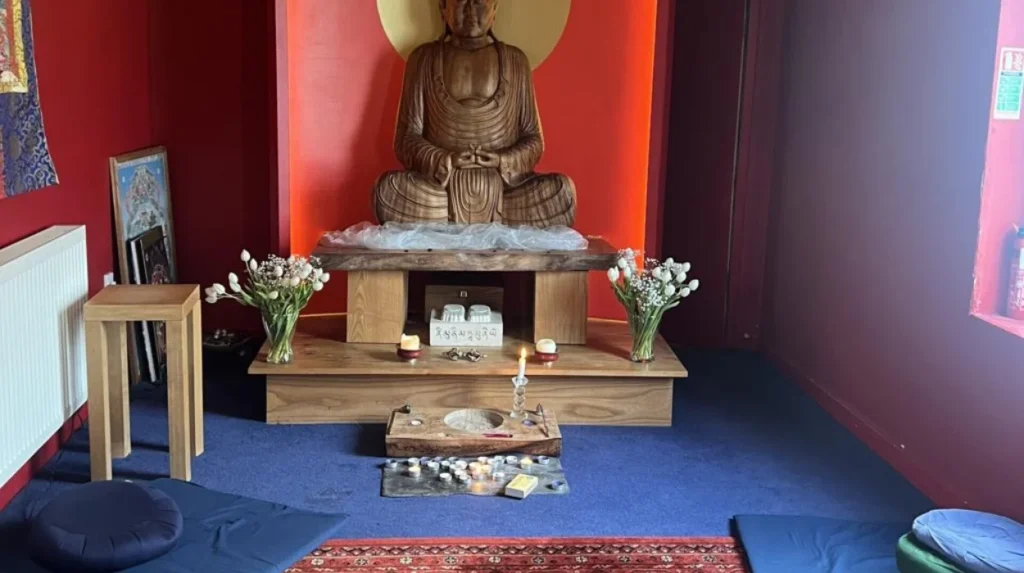
The Kagyu Samye Dzong Cardiff, located in the Canton district, is an official branch of Kagyu Samye Ling Monastery in Scotland, which belongs to the Karma Kagyu lineage of Tibetan Buddhism. The center features a traditionally decorated shrine room (gompa) housing sacred statues of the Buddha Shakyamuni, Chenrezig (the Bodhisattva of Compassion), and Guru Rinpoche, alongside traditional Tibetan textile banners (thangkas). The center provides scheduled sessions for shamatha (calm abiding) meditation, tonglen practice, and Tibetan language instruction.
The Aro Ling Cardiff Buddhist Centre, situated in Roath, represents the Aro gTér lineage, a non-monastic Nyingma tradition of Tibetan Buddhism. The center serves as a dedicated space for teaching dzogchen meditation, physical yogic exercises (s’ag ‘khor), and Buddhist philosophy applicable to householder life.
In addition to Tibetan centers, the Cardiff area hosts practitioners of Theravada Buddhism. The Welsh Buddhist Vihara tradition provides access to ordained monks (bhikkhus) who perform traditional chants, pujas, and retreats. Meditation groups aligned with the Triratna Buddhist Community and Western Zen lineages also maintain active, dedicated spaces within the city.
Buddhist temples around Cardiff fulfill specific spiritual functions:
- Uposatha Days: Observance of traditional lunar calendar days dedicated to intensified practice and adherence to precepts.
- Meditation Instruction: Regular public classes in mindfulness, breath awareness (anapanasati), and loving-kindness (metta bhavana).
- Festivals: Celebration of Vesak (Buddha Day, commemorating the birth, enlightenment, and death of Gautama Buddha), Kathina (robe-offering ceremony), and Losar (Tibetan New Year).
What Sikh Gurudwaras and Jain Spaces Operate in the Cardiff Area?
The Sikh community in Cardiff is served by major Gurudwaras including the Sri Dasmesh Singh Sabha Gurdwara in Roath, while Jain practitioners utilize local multi-faith facilities and regional centers for spiritual gatherings and vows.
Sikhism and Jainism represent two major dharmic traditions with an established presence in South Wales. While a Sikh place of worship is termed a Gurdwara (meaning “gateway to the Guru”), it functions structurally and spiritually as a temple housing the sacred scripture, the Guru Granth Sahib.
The Sri Dasmesh Singh Sabha Gurdwara, located on Bhatia Close in Roath, Cardiff, stands as one of the primary Sikh centers in Wales. The Gurdwara contains two main functional areas: the Darbar Sahib (main prayer hall) and the Langar Hall (community kitchen). In the Darbar Sahib, the Guru Granth Sahib is seated upon a raised, canopy-covered throne (Takt). Congregants engage in Kirtan (devotional singing of hymns), Paath (scriptural reading), and Ardas (formal prayer).
A secondary prominent Sikh institution in the area is the Bhatra Sikh Gurdwara on Millcent Street in Riverside, which represents one of the earliest established Sikh congregations in Wales, reflecting the mid-20th century settlement of Sikh traders in Cardiff.
Every Sikh Gurdwara in Cardiff maintains the tradition of Langar, a free communal vegetarian kitchen open to all individuals regardless of religion, ethnicity, or socioeconomic status. This practice enforces the core Sikh principles of Sewa (selfless service) and Vand Chhako (sharing resources).
Jainism, an ancient Indian religion emphasizing absolute non-violence (Ahimsa) and asceticism, maintains a smaller, highly organized population in Cardiff. Due to population size, dedicated purpose-built Jain temples (Derasars) are rare in Wales, with the nearest large-scale purpose-built Jain temples located in Leicester and London. However, Jain practitioners in Cardiff organize regular meetings, practice Svetambara and Digambara traditions, observe Paryushana (an eight-to-ten-day period of fasting and repentance), and utilize shared multi-faith spaces for communal prayers and lectures on Jain philosophy.
What Ancient and Historic Temple Sites Exist Near Cardiff?
Historic temple sites near Cardiff include the excavated 4th-century Romano-British Temple at Caerwent, the Pagan Celtic ritual sites across the Vale of Glamorgan, and the reconstructed ancient shrines at St Fagans National Museum of History.
The physical landscape surrounding Cardiff contains several archaeologically verified temple sites dating from the Iron Age, Roman, and early medieval epochs.
The Romano-British Temple at Caerwent (Venta Silurum)
Located 23 miles east of Cardiff city center, Caerwent represents the most complete excavated Roman town in Wales. In the northeastern quadrant of the ancient walled city lie the structural remains of a classic Romano-British temple constructed around 330 AD.
The temple layout features a square central sanctuary (cella) surrounded by an outer covered walkway (peristyle), with an apse on its northern wall. Archaeological excavations uncovered plaster fragments painted in vivid colors, structural columns, and votive altars. The temple was dedicated to a localized Romano-Celtic deity, combining classical Roman ritual forms with indigenous Silurian Celtic worship practices.
Prehistoric Sacred Sites in the Vale of Glamorgan
Prior to the Roman conquest, the Celtic Silures tribe inhabited the area surrounding modern Cardiff. The Silures did not build stone-roofed temples; instead, their sacred sites were nemetons—sacred groves, clearings, or water bodies where rituals were conducted by Druids.
Archaeological sites near Cardiff containing significant ritual and spiritual importance include:
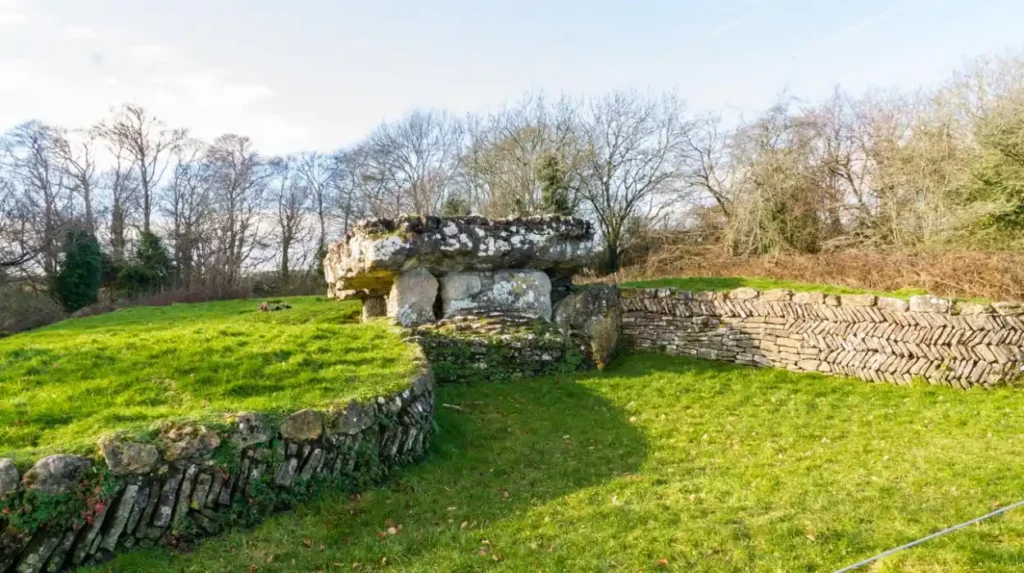
- Tinkinswood Burial Chamber: Located 6 miles west of Cardiff, this Neolithic chambered tomb dates to approximately 4000 BC. The site features a 40-ton capstone—one of the largest in Europe—and served as a focal point for ancestor worship and seasonal fertility rituals.
- St Lythans Burial Chamber: Situated 1 mile south of Tinkinswood, this portal dolmen dates to 3500 BC and functioned as a sacred megalithic site oriented toward the solstice sunrises.
- Llyn Cerrig Bach Connection: Although located further northwest, artifacts found in Glamorgan waterways show that local rivers such as the River Taff and River Ely were treated as sacred conduits where ritual votive offerings of weapons, cauldrons, and jewelry were deposited to appease aquatic deities.
Historical Reconstructions at St Fagans
Located within Cardiff’s city boundaries, St Fagans National Museum of History contains reconstructed historical buildings that demonstrate the evolution of sacred architecture in Wales over two millennia. The museum features a reconstructed Iron Age roundhouse complex based on archaeological evidence from South Wales, illustrating how ancient domestic and sacred spaces were aligned with astronomical events and spiritual symbolism.
How Does Planning Permission and Conservation Law Apply to Temples in Cardiff?
Temples in Cardiff are governed by UK land use planning classifications, specifically Class F1 (Learning and non-residential institutions), and must comply with CADW heritage regulations when converting listed historical buildings.
The establishment, expansion, or conversion of physical structures into temples within Cardiff is strictly regulated by Welsh planning policy and local government statutory controls.
Land Use Classifications
Under the Town and Country Planning (Use Classes) Order 1987 (and its subsequent amendments applicable in Wales), places of worship fall under Class F1(f) (Public worship or religious instruction).
To convert a commercial, industrial, or residential building into a functioning temple, an organization must submit a formal planning application to the Cardiff Council Planning Authority. Key considerations evaluated by the authority include:
- Highways and Traffic Impact: Assessment of vehicle movements during peak festival times, requiring adequate off-street parking or verified public transport accessibility plans.
- Noise Impact Assessments: Regulation of amplified sound, ritual bells, or large congregation gatherings, particularly within residential zones like Roath, Cathays, or Grangetown.
- Occupancy and Fire Safety: Strict limits on structural capacity under the Regulatory Reform (Fire Safety) Order 2005.
Listed Building Regulations and CADW
Many religious organizations in Cardiff acquire existing historic buildings—such as disused Victorian chapels, industrial halls, or municipal structures—to convert into temples. If the building is listed (Grade I, Grade II*, or Grade II), any modifications are overseen by CADW, the Welsh Government’s historic environment service.
Listed Building Consent is required for both internal and external alterations. This creates specific conservation requirements for temple communities:
- Preservation of Structural Integrity: Historic timberwork, stained glass, and masonry must be preserved.
- Integration of Sacred Elements: Installing Hindu garbhagrihas (inner sanctums), Sikh palkis (canopies), or Buddhist altars must be performed without permanently destroying the underlying historic fabric of the building.
- Accessibility Modifications: Installing ramps, lifts, or expanded sanitary facilities to comply with the Equality Act 2010 must meet strict architectural conservation standards.
What Impact Do Temples Have on Cardiff’s Local Community and Economy?
Temples around Cardiff generate significant socio-economic value by providing free charitable services, driving cultural tourism, hosting educational visits, and fostering interfaith collaboration across South Wales.
The temples and sacred spaces surrounding Cardiff operate as social, economic, and civic infrastructure alongside their primary religious functions.
Socio-Economic Contributions
Cardiff’s temples operate extensive charitable programs that support vulnerable populations regardless of faith background.
- Food Distribution: The Sikh principle of Langar delivers hundreds of free, hot vegetarian meals weekly to homeless individuals and low-income families in central Cardiff. Similarly, Hindu mandirs and Buddhist centers coordinate regular food bank donations.
- Crisis Response: During environmental emergencies, pandemics, or local economic disruptions, temple facilities act as emergency distribution centers for clothing, medical supplies, and shelter.
- Senior Care and Isolation Reduction: Temples offer daily social clubs, luncheon schemes, and health monitoring for elderly immigrants, reducing social isolation and easing pressure on local adult social care services.
Cultural Tourism and Economic Activity
Major religious festivals hosted by Cardiff’s temples attract thousands of visitors annually from across the United Kingdom, generating direct expenditure in local hospitality, retail, and transport sectors.
- Diwali Celebrations: The annual Festival of Lights organized by the Sanatan Dharma Mandal and BAPS Swaminarayan Mandir includes public processions, light displays, and cultural performances in Cardiff Castle and civic spaces, boosting evening economy footfall.
- Vaisakhi: The Sikh New Year festival involves the Nagar Kirtan (public procession) through the streets of Cardiff, drawing participants from across South Wales and the West of England.
Educational Integration
Cardiff temples play a direct role in supporting the Curriculum for Wales, specifically the Religion, Values and Ethics (RVE) mandatory element. Temples routinely host primary and secondary school visits from across the Cardiff, Vale of Glamorgan, and Rhondda Cynon Taf local education authorities. These visits provide students with direct access to living religious traditions, sacred artifacts, and interfaith dialogue, satisfying national educational mandates for spiritual and moral development.
Interfaith Relations
Cardiff temples actively participate in the Cardiff Interfaith Forum and work alongside the Welsh Government to promote social cohesion. These institutions advise policymakers on issues related to hate crime prevention, community integration, housing equality, and public health campaigns.
What Architectural Styles Characterize Temples Around Cardiff?
Temples around Cardiff feature a blend of repurposed Victorian Gothic architecture, adaptive modern civic design, and authentic traditional South Asian and East Asian sacred architectural forms.
The built environment of temples in South Wales reflects the historical evolution of immigrant communities—moving from functional adaptation to purpose-built, traditional architectural expression.
Adaptive Reuse of Historic Buildings
The majority of non-Christian temples in Cardiff operate within repurposed 19th-century and early 20th-century structures. Cardiff contains a high concentration of Victorian and Edwardian chapels built during the coal boom. As congregation sizes for traditional Christian chapels declined in the late 20th century, growing Hindu, Sikh, and Buddhist communities purchased these structures.
This adaptive reuse produces a unique architectural hybrid:
- Exterior: Traditional Welsh Pennant sandstone, Gothic pointed arches, slate roofing, and stained-glass window frames preserved in compliance with local conservation standards.
- Interior: Reconfigured internal spaces featuring open prayer halls, removed pews to allow floor seating, installed sanctums facing specific cardinal directions (such as East-facing altars in Hindu mandirs), and non-iconic decorative motifs.
Purpose-Built Sacred Architecture
In recent decades, religious organizations have secured funding to construct purpose-built facilities incorporating traditional authentic architectural elements:
| Religion | Architectural Element | Material/Design Feature | Symbolic Function |
|---|---|---|---|
| Hinduism | Shikhara / Vimana | Carved stone or white plaster spires | Represents the sacred mountain (Meru); connects earth to the divine |
| Hinduism | Garbhagriha | Enclosed windowless inner sanctuary | The “womb-chamber” hosting the primary consecrated deity |
| Sikhism | Gumbad | White onion-shaped domes | Symbolizes spiritual sovereignty and divine purity |
| Sikhism | Nishan Sahib | High flagpole bearing the Sikh emblem | Marks the presence of a Gurdwara offering shelter and food |
| Buddhism | Gompa Shrine | Carved wooden altars with gold leafing | Creates an environment conducive to deep concentration and meditation |
How Will Sacred Spaces and Temples in Cardiff Evolve in the Future?
Temples around Cardiff are evolving through green energy retrofitting, digital broadcast infrastructure, youth-focused community programs, and expanded interfaith regional networks across South Wales.
The future development of temples in the Cardiff capital region is shaped by demographic shifts, environmental sustainability mandates, and technological integration.
Sustainability and Environmental Initiatives
In alignment with the Welsh Government’s target of achieving a net-zero public sector and community infrastructure, temples across Cardiff are modernizing their physical assets. Initiatives include:
- Solar Panel Installation: Fitting photo-voltaic arrays on wide temple roof surfaces to generate clean electricity.
- Waste Reduction: Transitioning communal dining (Langar and Prasadam) entirely away from single-use plastics to biodegradable or stainless-steel reusable dinnerware.
- Energy Efficiency Retrofits: Installing heat pumps and improved thermal insulation within drafty historic Victorian structures to lower carbon footprints and operational heating costs.
Digital Expansion and Hybrid Worship
The integration of high-definition streaming technology allows Cardiff temples to broadcast daily aarti, kirtan, and meditation sessions to homebound adherents, elderly residents, and global diaspora networks. Virtual reality and digital archives are also being developed to preserve the history of early South Asian and East Asian settlers who established the first worship spaces in Cardiff’s docklands.
Demographic and Cultural Adaptation
As second- and third-generation British-born adherents become administrators of these sacred spaces, temple services increasingly incorporate English alongside traditional liturgical languages (Sanskrit, Punjabi, Tibetan, Gujarati). This linguistic transition ensures that philosophical concepts remain accessible to younger demographics while continuing to preserve traditional ritual purity and heritage.
Through architectural preservation, community service, and spiritual continuity, the temples surrounding Cardiff remain essential components of the social, cultural, and physical fabric of South Wales.