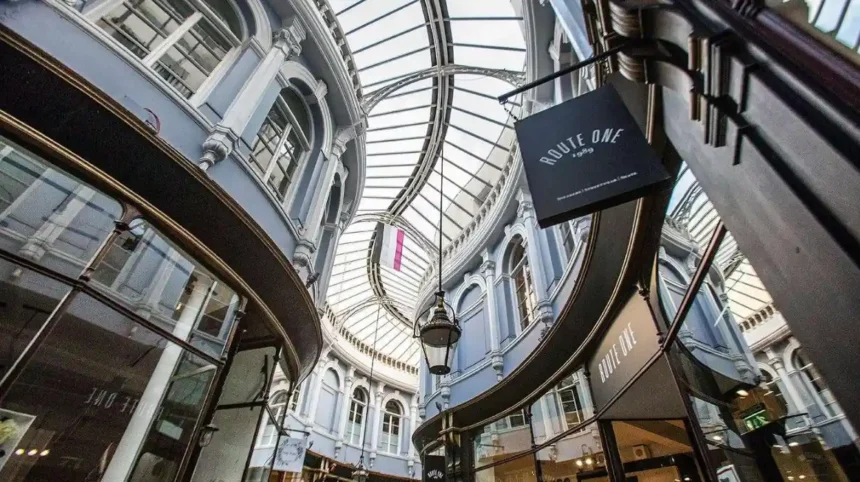
Cardiff is widely recognised as the City of Arcades, a distinction that reflects its exceptional collection of Victorian and Edwardian shopping arcades. Located in the heart of the Welsh capital, these historic covered passages connect major shopping streets through elegant architecture, independent businesses, traditional shopfronts and specialist retailers.
- What Are Victorian Arcades in Cardiff?
- How Did Cardiff’s Victorian Arcades Develop?
- Cardiff’s Industrial Growth During the Victorian Period
- The Opening of Royal Arcade in 1858
- Expansion During the 1880s and Early Twentieth Century
- Which Victorian and Edwardian Arcades Should You Visit in Cardiff?
- 1. Royal Arcade
- 2. Morgan Arcade
- 3. Castle Arcade
- 4. High Street Arcade
- 5. Duke Street Arcade
- 6. Wyndham Arcade
- 7. Dominions Arcade
- What Architectural Features Make Cardiff’s Victorian Arcades Special?
- Glazed Roofs and Natural Lighting
- Timber Galleries and Balconies
- Decorative Ironwork and Structural Details
- Traditional Shopfronts and Entrance Façades
- How Do Cardiff’s Victorian Arcades Connect the City Centre?
- The Castle Quarter Connection
- The Morgan Quarter Connection
- The Mill Lane and Queen Street Connections
- Why Are Cardiff’s Victorian Arcades Important to Local Businesses?
- Supporting Independent Retailers
- Supporting Food and Hospitality Businesses
- Contribution to Cardiff’s Tourism Industry
- How Are Cardiff’s Historic Arcades Protected and Preserved?
- Listed Building Protection
- Cardiff Council’s Conservation Guidance
- Balancing Modern Business Needs With Heritage Conservation
- What Is the Difference Between Victorian and Edwardian Arcades in Cardiff?
- How Can You Explore Cardiff’s Victorian Arcades on Foot?
- Start at Royal Arcade
- Continue Through Morgan Arcade
- Explore Wyndham Arcade
- Visit Castle Arcade
- Finish at High Street and Duke Street Arcades
- Practical Information for Visitors
- What Is the Future of Cardiff’s Victorian Arcades?
- Changing Shopping Habits
- Heritage-Led Regeneration
- Supporting Independent Businesses
- Preserving Cardiff’s Architectural Identity
- Why Should Victorian Arcades Be Part of Cardiff’s Heritage Experience?
The Victorian arcades in Cardiff represent an important part of the city’s commercial, architectural and social history. Developed during a period of rapid industrial expansion, they transformed the way people shopped, traded and moved through the city centre. Today, they remain an important attraction for residents, tourists, architecture enthusiasts and visitors exploring Cardiff’s historic streets.
Cardiff’s arcade network includes Royal Arcade, Morgan Arcade, Castle Arcade, High Street Arcade, Duke Street Arcade, Wyndham Arcade and Dominions Arcade. Together, these seven arcades preserve more than 150 years of retail history while accommodating modern shops, cafés, restaurants and independent businesses.
Their continued use demonstrates how historic commercial buildings contribute to contemporary urban life. Visitors experience traditional Victorian design alongside modern Welsh retail culture, all within a compact and walkable city centre.
What Are Victorian Arcades in Cardiff?
Victorian arcades in Cardiff are covered shopping passages developed mainly during the nineteenth century, connecting central streets through enclosed retail spaces. They feature traditional shopfronts, glazed roofs, decorative ironwork and historic architectural details, while continuing to accommodate independent retailers, cafés and specialist businesses.
A Victorian shopping arcade is a pedestrian shopping passage containing individual retail units arranged along an enclosed walkway. Unlike conventional shopping streets, arcades provide a protected indoor environment where businesses share a continuous architectural structure.
Cardiff’s arcades developed during the Victorian period, when the city experienced substantial population growth and commercial expansion. Their design created additional retail frontage within the relatively restricted historic city centre.
The arcades also introduced a distinctive shopping environment. Customers could move between different businesses without returning to the main streets. Glass roofs provided natural daylight, while decorative balconies, timber shopfronts and ornamental features created an identifiable architectural character.
Cardiff’s arcade network includes buildings from different historical periods. The earliest surviving example dates to 1858, while later developments continued into the twentieth century.
Why Is Cardiff Known as the City of Arcades?
Cardiff earned its reputation as the City of Arcades because it possesses an unusually concentrated collection of historic covered shopping passages. Visit Cardiff identifies seven principal Victorian and Edwardian arcades in the city centre.
These include:
- Royal Arcade
- Morgan Arcade
- Castle Arcade
- High Street Arcade
- Duke Street Arcade
- Wyndham Arcade
- Dominions Arcade
The arcades collectively provide more than 100 shops, cafés, bars and restaurants, according to Visit Cardiff.
Their significance extends beyond retail. They form an interconnected pedestrian environment that preserves historic architecture and supports independent businesses.
How Did Cardiff’s Victorian Arcades Develop?
Cardiff’s Victorian arcades developed during nineteenth-century industrial and commercial expansion. The opening of Royal Arcade in 1858 established the model, while growing retail demand encouraged further construction as Cardiff became an important international coal-exporting port.
Cardiff’s Industrial Growth During the Victorian Period
During the nineteenth century, Cardiff changed from a relatively small Welsh town into a major industrial and maritime centre. Its location near the South Wales coalfields supported the development of international coal exports.
The expansion of Cardiff Docks attracted merchants, shipping companies, industrial workers and investors. Population growth increased demand for commercial premises, accommodation and consumer services.
The historic town centre faced spatial restrictions. Much of its commercial activity remained concentrated within the boundaries of the medieval settlement. Developers needed additional retail space without relying entirely on large new streets.
Shopping arcades provided an effective solution. They created additional shopfronts through narrow plots and internal pedestrian routes.
Academic research published in Business History in 2022, titled Interinstitutional Shaping of Retail Innovation: The Nineteenth-Century Retail Arcade, examines how Cardiff’s economic growth encouraged arcade development. The research identifies Royal Arcade as an important early commercial investment that influenced subsequent projects.
By 1888, Cardiff’s port was handling exceptionally high volumes of maritime trade. Historical research cited in the study records that Cardiff cleared more outward-bound tonnage than Liverpool during that year.
This economic environment supported investment in the city’s commercial architecture.
The Opening of Royal Arcade in 1858
Royal Arcade established Cardiff’s first major Victorian shopping arcade. Its development introduced a new commercial format that connected different parts of the city centre through an enclosed shopping passage.
The project replaced an area previously occupied by overcrowded housing and narrow alleys. Its commercial success demonstrated the financial potential of covered retail developments.
Royal Arcade later became an important part of the Morgan Quarter, connecting St Mary Street with The Hayes.
Its historical importance comes from its position at the beginning of Cardiff’s major arcade development period. The building continues to accommodate independent shops, cafés and specialist retailers.
Expansion During the 1880s and Early Twentieth Century
The success of Royal Arcade encouraged further investment. High Street Arcade, Castle Arcade, Morgan Arcade and Wyndham Arcade contributed to the expansion of Cardiff’s covered retail network.
Developers recognised that arcades offered additional commercial frontage and attracted shoppers looking for convenient access to different businesses.
Construction continued into the early twentieth century. Duke Street Arcade and Dominions Arcade demonstrate how the original Victorian shopping concept developed during the Edwardian and post-Edwardian periods.
This timeline explains why Cardiff’s historic arcades represent more than one architectural generation.
Which Victorian and Edwardian Arcades Should You Visit in Cardiff?
Cardiff has seven principal historic shopping arcades: Royal, Morgan, Castle, High Street, Duke Street, Wyndham and Dominions. Each offers a different combination of architecture, independent retail, specialist shops, cafés and connections to the city’s commercial history.
1. Royal Arcade
Royal Arcade is Cardiff’s oldest surviving shopping arcade and an important landmark in the city’s retail history.
The arcade connects St Mary Street with The Hayes. Its central location makes it a convenient starting point for exploring Cardiff’s historic shopping passages.
Its traditional commercial environment includes independent retailers, cafés and specialist food businesses.
Notable businesses include Wally’s Delicatessen and Kaffeehaus, Sobeys vintage clothing and Uncommon Ground coffee.
The arcade also provides a connection to Morgan Arcade through a small passageway. This creates a continuous shopping route between two historically important developments.
Royal Arcade remains particularly significant because it demonstrates the beginning of Cardiff’s Victorian arcade tradition.
2. Morgan Arcade
Morgan Arcade forms part of the Morgan Quarter and connects St Mary Street with The Hayes.
Its architecture features a glazed roof, traditional shopfronts and decorative Victorian details. The passage accommodates a combination of established retailers, independent boutiques and specialist businesses.
One of its most recognisable businesses is Spillers Records. Spillers is widely recognised as the world’s oldest record shop, with its origins dating to 1894.
The arcade also contains specialist clothing retailers, jewellers, art businesses and cafés.
Morgan Arcade provides an important connection between Cardiff’s historic retail identity and its contemporary independent shopping scene.
3. Castle Arcade
Castle Arcade stands close to Cardiff Castle and forms part of the Castle Quarter.
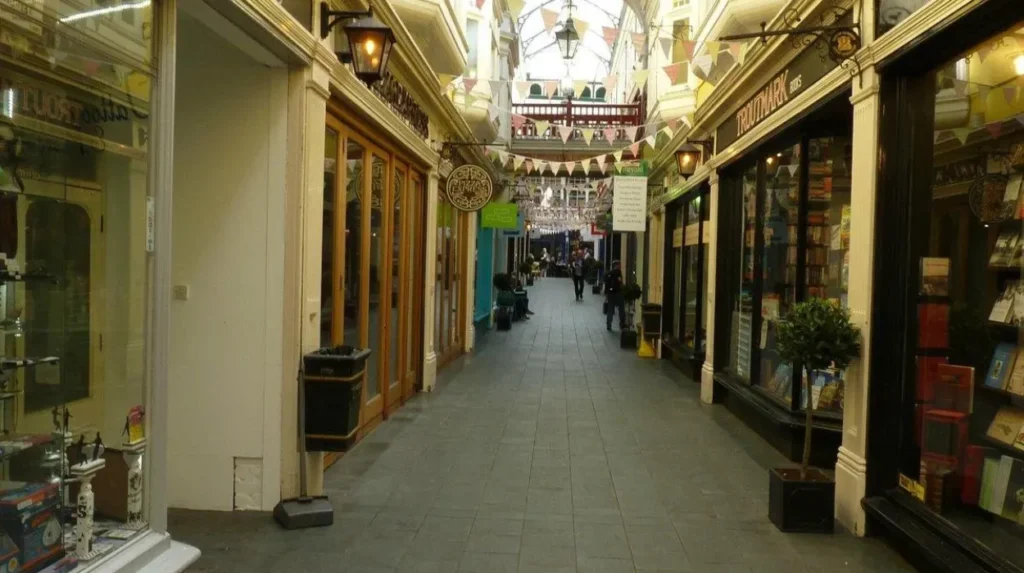
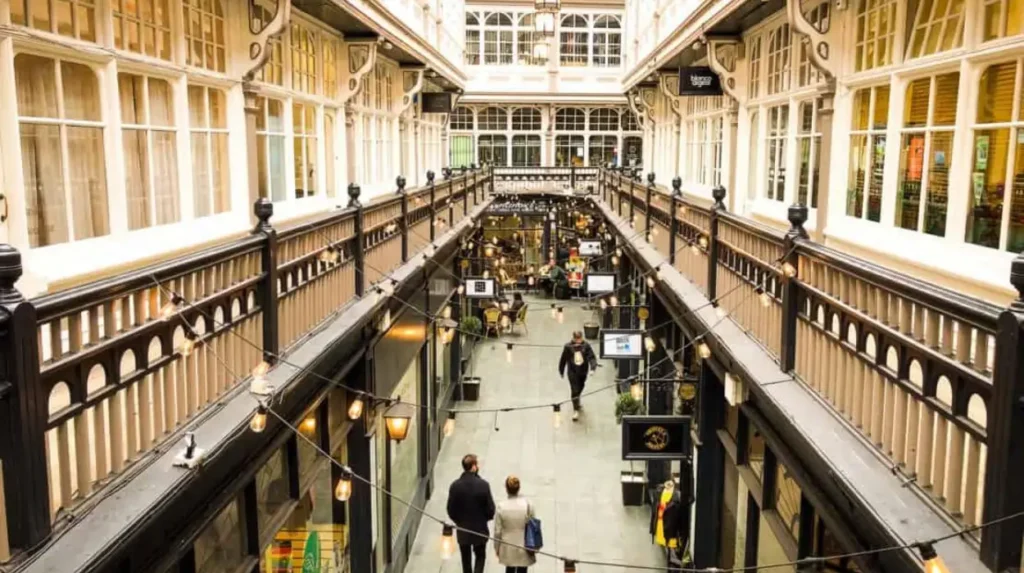
Its most distinctive architectural feature is its multi-level arrangement. Wooden balconies overlook the central shopping passage, creating additional retail space above the ground floor.
The building preserves traditional architectural features, including timber detailing, decorative ironwork and historic shopfronts.
Its specialist businesses include Cardiff Violins and Troutmark Books. The arcade also accommodates restaurants, cafés and independent retailers.
Castle Arcade is particularly relevant to visitors interested in Victorian commercial architecture because its internal galleries demonstrate how historic developers maximised retail space within a relatively narrow building footprint.
Its position opposite Cardiff Castle also makes it easy to include in a city-centre heritage walk.
4. High Street Arcade
High Street Arcade connects High Street with St John Street and forms part of the Castle Quarter.
The arcade opened in 1886 and retains important elements of its Victorian architectural character. Its entrance building combines Classical and Gothic influences with decorative architectural details.
Cadw, the Welsh government’s historic environment service, records the entrance building’s history as dating to 1885. Its arcade structure contains a glazed roof supported by triangular trusses.
The passage also connects internally with Duke Street Arcade.
Historically, High Street Arcade accommodated businesses including apothecaries and fortune tellers. Its commercial identity has since changed to include independent coffee shops, vintage clothing retailers, barbers and lifestyle businesses.
The building’s preserved features make it an important example of Cardiff’s historic shopping architecture.
5. Duke Street Arcade
Duke Street Arcade connects with High Street Arcade and extends towards Duke Street.
Although it belongs to the later development of Cardiff’s historic shopping network, its design maintains the character of traditional covered arcades.
One of its distinctive features is its painted floor. The curved passageway connecting it with High Street Arcade creates an unusual internal route.
The arcade accommodates independent businesses, specialist food outlets, beauty services and hospitality venues.
Examples include Swoon artisan gelato, New York Deli and specialist hair salons.
Its connection with High Street Arcade allows visitors to explore both buildings without returning to the main street.
6. Wyndham Arcade
Wyndham Arcade connects St Mary Street with Mill Lane, an established restaurant and nightlife district.
Its red-brick entrance arch is an identifiable feature of its Victorian architectural design.
The arcade contains specialist retailers, cafés, restaurants and businesses serving different customer groups.
Waterloo Tea is among the recognisable businesses associated with the arcade. Visitors also find restaurants and specialist retail outlets within the passage.
Its location near Mill Lane makes Wyndham Arcade particularly useful for combining daytime shopping with Cardiff’s evening food and entertainment options.
7. Dominions Arcade
Dominions Arcade is the newest of Cardiff’s seven principal historic arcades. Its construction in 1921 places it in the early twentieth century rather than the Victorian period.
The arcade is located near Queen Street and represents the continued development of Cardiff’s covered shopping tradition after the Victorian era.
Its surrounding commercial environment includes hospitality businesses and independent retail outlets.
Dominions Arcade is important to understanding the complete history of Cardiff’s arcade network because it demonstrates that the city’s covered shopping model continued beyond the reign of Queen Victoria.
What Architectural Features Make Cardiff’s Victorian Arcades Special?
Cardiff’s Victorian arcades combine glazed roofs, decorative ironwork, timber balconies, traditional shopfronts and detailed entrance façades. These features provide natural light, pedestrian circulation and additional retail frontage while preserving the architectural character of nineteenth-century commercial development.
Glazed Roofs and Natural Lighting
Glazed roofs are among the most recognisable features of traditional shopping arcades.
They allow daylight to enter enclosed passages while protecting shoppers from rain and wind. This arrangement creates an indoor shopping environment without completely separating the passage from natural light.
The roof structures also contribute to the visual identity of each arcade.
Cardiff’s historic arcades use different glazing arrangements and structural details, reflecting their individual construction periods.
Timber Galleries and Balconies
Some arcades contain upper-level galleries overlooking the central passage.
Castle Arcade provides a particularly clear example of this arrangement. Its wooden balconies create additional shopfronts and establish visual connections between different levels.
This design increases the commercial capacity of a restricted urban site.
Balconies also contribute to the traditional appearance of Victorian shopping interiors.
Decorative Ironwork and Structural Details
Victorian commercial architecture frequently incorporated ornamental metalwork.
Iron railings, supporting structures and decorative brackets contributed to both the practical and visual design of shopping arcades.
These details demonstrate the relationship between nineteenth-century engineering and architectural decoration.
Traditional Shopfronts and Entrance Façades
The street-facing entrances of Cardiff’s arcades form an important part of their architectural identity.
High Street Arcade, for example, features a decorative entrance façade with Gothic and Classical influences.
Traditional shopfronts also contribute to the character of the internal passages. Timber framing, recessed entrances and historically appropriate signage help preserve the appearance of the buildings.
Cardiff Council’s shopfront and signage guidance specifically addresses historic arcades. It recommends retaining original shopfronts and using sympathetic materials when replacement work becomes necessary.
How Do Cardiff’s Victorian Arcades Connect the City Centre?
Cardiff’s historic arcades form a connected pedestrian shopping network between St Mary Street, The Hayes, High Street, Castle Street, Duke Street, St John Street and Mill Lane. Their internal routes provide convenient access between retail districts and historic attractions.
The geographical arrangement of the arcades contributes significantly to their continued popularity.
Rather than operating as isolated attractions, the passages connect different parts of the city centre.
The Castle Quarter Connection
The Castle Quarter contains Castle Arcade, High Street Arcade and Duke Street Arcade.
These buildings are located close to Cardiff Castle and the surrounding historic streets.
Visitors can combine an arcade walk with a visit to the castle, Bute Park and nearby independent businesses.
The internal connection between High Street Arcade and Duke Street Arcade also makes movement between these shopping passages straightforward.
The Morgan Quarter Connection
The Morgan Quarter contains Royal Arcade and Morgan Arcade.
Both arcades connect St Mary Street with The Hayes and provide access to independent retailers, cafés and specialist shops.
Their shared pedestrian network creates a convenient shopping route through the southern part of Cardiff’s historic arcade district.
The Mill Lane and Queen Street Connections
Wyndham Arcade provides a route between St Mary Street and Mill Lane.
Dominions Arcade adds another historic shopping location near Queen Street.
These connections extend the arcade experience beyond the central Morgan and Castle Quarter areas.
The result is a compact network that visitors can explore on foot.
Why Are Cardiff’s Victorian Arcades Important to Local Businesses?
Cardiff’s Victorian arcades support independent retailers, specialist shops, hospitality businesses and local entrepreneurs. Their smaller commercial units provide opportunities for distinctive businesses, while their historic character attracts visitors seeking shopping experiences beyond conventional retail centres.
The arcades play an important role in Cardiff’s local economy. They provide commercial premises for businesses that contribute to the city’s independent retail identity.
Unlike large shopping centres dominated by national retailers, the historic arcades accommodate specialist businesses and smaller operators.
Examples include independent bookshops, record shops, vintage clothing retailers, jewellery businesses, coffee shops and specialist food outlets.
Supporting Independent Retailers
Independent retailers contribute to the diversity of Cardiff’s shopping environment.
Businesses such as Spillers Records and Troutmark Books demonstrate the importance of specialist retail within the arcade network.
These businesses attract customers with specific interests and provide products that are not always available in mainstream shopping centres.
The historic setting also helps businesses establish distinctive identities. Traditional shopfronts and architectural details create a recognisable commercial environment.
Supporting Food and Hospitality Businesses
Restaurants, cafés and specialist food retailers form another important part of the arcade economy.
Examples include Wally’s Delicatessen and Kaffeehaus in Royal Arcade, New York Deli in Duke Street Arcade and Waterloo Tea in Wyndham Arcade.
These businesses encourage visitors to spend more time exploring the city centre.
The combination of shopping and hospitality also extends the commercial value of the arcades beyond traditional retail hours.
Contribution to Cardiff’s Tourism Industry
The arcades attract visitors interested in architecture, shopping, local food and Welsh urban history.
Their central location makes them accessible from major visitor destinations.
Cardiff Castle, the Principality Stadium, Cardiff Market and the National Museum Cardiff are all within the wider city-centre visitor area.
This relationship allows the arcades to contribute to a broader cultural tourism experience.
How Are Cardiff’s Historic Arcades Protected and Preserved?
Cardiff’s historic arcades receive protection through heritage designation, planning controls and conservation guidance. Cadw listing records and Cardiff Council’s planning policies help safeguard significant architectural features, traditional shopfronts and the historic character of these commercial buildings.
The preservation of Victorian arcades requires cooperation between property owners, businesses, planning authorities and heritage specialists.
Historic commercial buildings experience regular changes because retailers update interiors, replace equipment and modify shopfronts to meet modern requirements.
Conservation policies help ensure these improvements respect the architectural significance of the buildings.
Listed Building Protection
Cadw is responsible for maintaining the statutory list of buildings of special architectural or historic interest in Wales.
Listed buildings receive legal protection under the planning system. Works affecting their special architectural or historic character generally require listed building consent.
Several Cardiff arcade buildings have listed status.
Castle Arcade is particularly notable for its architectural significance. Cadw’s listed building record identifies it as a Grade II* building and describes its historic galleries, timber balconies and decorative structural features.
High Street Arcade also has recognised heritage significance. Its entrance building and glazed internal passage contribute to the historic character of Cardiff city centre.
The designation of historic buildings helps prevent inappropriate alterations and supports the retention of important architectural details.
Cardiff Council’s Conservation Guidance
Cardiff Council provides guidance for shopfronts and signage within traditional shopping arcades.
Its planning guidance emphasises the importance of retaining original architectural features.
Important conservation considerations include:
- Retaining and refurbishing original shopfronts.
- Using materials and finishes appropriate to historic buildings.
- Preserving traditional doorways and recessed entrances.
- Avoiding inappropriate external security shutters.
- Preventing unsuitable illuminated advertising installations.
These principles help maintain architectural consistency throughout the arcade network.
Balancing Modern Business Needs With Heritage Conservation
Historic arcades must accommodate modern commercial requirements.
Retailers need suitable lighting, electrical installations, accessible entrances, security arrangements and contemporary shop interiors.
However, improvements must respect the architectural significance of the buildings.
For example, a business replacing its shopfront must consider the existing building materials, proportions and decorative details.
The challenge is to maintain functional commercial spaces without removing the historic features that make Cardiff’s arcades distinctive.
What Is the Difference Between Victorian and Edwardian Arcades in Cardiff?
Victorian arcades in Cardiff primarily developed during Queen Victoria’s reign from 1837 to 1901, while Edwardian-era developments followed during the early twentieth century. Royal, Morgan and High Street illustrate Victorian retail architecture, whereas later Dominions reflects subsequent development.
The distinction is important because Cardiff’s reputation as the City of Arcades includes buildings from different historical periods.
Victorian Arcades
The Victorian period produced the foundations of Cardiff’s historic shopping network.
Royal Arcade opened in 1858, followed by further developments during the city’s industrial expansion.
Victorian arcade architecture frequently features glazed roofs, timber galleries, decorative façades and traditional shopfronts.
Castle Arcade and High Street Arcade demonstrate these characteristics.
Edwardian and Later Arcades
Edwardian commercial architecture continued many Victorian design traditions while introducing different decorative approaches and construction details.
Duke Street Arcade, completed in 1902, belongs to the early twentieth-century development of the network.
Dominions Arcade, constructed in 1921, represents an even later stage.
These buildings demonstrate the continued commercial popularity of covered shopping passages after the Victorian period.
Understanding this distinction provides a more accurate historical picture of Cardiff’s architectural heritage.
How Can You Explore Cardiff’s Victorian Arcades on Foot?
Visitors can explore Cardiff’s historic arcades through a self-guided walking route connecting the Morgan Quarter, Castle Quarter, Mill Lane and Queen Street. The route combines historic architecture, independent shopping, cafés and nearby cultural attractions.
The compact city centre makes walking the most practical way to experience the arcades.
A self-guided visit allows enough time to appreciate architectural features and explore independent businesses.
Start at Royal Arcade
Begin at the St Mary Street entrance to Royal Arcade.
Explore the historic passage, traditional shopfronts and specialist food retailers.
The arcade’s connection with Morgan Arcade makes it a convenient starting point.
Continue Through Morgan Arcade
Walk through the connecting passage into Morgan Arcade.
Look for its glazed roof, decorative architectural features and independent businesses.
Spillers Records provides an additional point of interest for music enthusiasts.
Explore Wyndham Arcade
Continue towards Wyndham Arcade, which connects St Mary Street with Mill Lane.
Its red-brick entrance provides a distinctive architectural feature.
The surrounding Mill Lane district offers additional restaurants and hospitality venues.
Visit Castle Arcade
Walk towards Cardiff Castle and enter Castle Arcade.
Its upper galleries and wooden balconies are important features to examine.
The arcade also provides access to specialist retailers and independent food businesses.
Finish at High Street and Duke Street Arcades
Complete the route by exploring High Street Arcade and its connection with Duke Street Arcade.
These passages provide further examples of traditional arcade architecture.
Visitors can finish their walk near Cardiff Market and St John the Baptist Church.
Practical Information for Visitors
The arcades are generally accessible from surrounding public streets, although opening arrangements differ between individual buildings and businesses.
Visitors should consider the following points:
- Best time to visit: Weekday mornings and afternoons provide opportunities to explore shops and architectural details.
- Shopping hours: Individual retailers set their own opening and closing times.
- Photography: Interior architecture, shopfronts and glazed roofs provide useful photographic subjects. Ask permission before photographing inside individual businesses.
- Accessibility: Older buildings have different layouts and access arrangements. Check individual entrances and businesses before visiting if step-free access is essential.
- Transport: Cardiff Central railway station and Queen Street railway station provide access to the city centre.
The arcades also provide covered pedestrian routes during wet weather, although individual access arrangements and opening times should always be checked.
Explore More Area Guide
Cardiff Arcades Guide: Explore 7 Historic Shopping Arcades
Independent Businesses in Cardiff City Centre: A Local Guide
What Is the Future of Cardiff’s Victorian Arcades?
The future of Cardiff’s Victorian arcades depends on heritage conservation, independent business investment, visitor demand and adaptation to changing shopping habits. Continued maintenance and commercial activity will help preserve their architectural character and economic contribution.
Cardiff’s historic arcades remain relevant because they combine architectural heritage with active commercial spaces.
However, their long-term sustainability depends on several factors.
Changing Shopping Habits
Online shopping and large retail developments have changed how consumers use traditional shopping streets.
Historic arcades must offer experiences that distinguish them from conventional online retail.
Independent products, specialist services, local food and distinctive shopping environments provide important advantages.
Heritage-Led Regeneration
Heritage-led regeneration involves improving historic buildings while retaining their architectural and cultural significance.
For Cardiff’s arcades, this includes maintaining glazed roofs, repairing decorative features and supporting appropriate commercial improvements.
Investment in the surrounding streets also helps improve pedestrian access and the wider visitor experience.
Supporting Independent Businesses
Independent businesses remain central to the identity of Cardiff’s arcades.
Specialist retailers attract customers through unique products, personal services and established local reputations.
Supporting these businesses helps maintain the economic and cultural value of the buildings.
Preserving Cardiff’s Architectural Identity
The arcades contribute to Cardiff’s distinctive city-centre identity.
Their continued use demonstrates that historic commercial architecture can accommodate contemporary businesses without losing its original purpose.
Future conservation work, appropriate property management and investment in independent retail will remain important to protecting this heritage.
Cardiff’s Victorian arcades therefore represent both an important historical achievement and an active part of the city’s modern commercial environment.
Why Should Victorian Arcades Be Part of Cardiff’s Heritage Experience?
Cardiff’s Victorian arcades provide a direct connection between the city’s industrial past and its contemporary retail culture. Royal Arcade established the foundations of the network in 1858, while later developments created the distinctive collection of covered shopping passages recognised today.
Their architectural features, including glazed roofs, timber galleries, decorative ironwork and traditional shopfronts, preserve important examples of Victorian and Edwardian commercial design.
The arcades also support independent retailers, specialist businesses, cafés and restaurants. Their central locations connect major shopping streets and provide visitors with convenient access to Cardiff’s historic attractions.
For residents, they remain useful shopping destinations and important parts of the city’s architectural identity. For tourists, they offer opportunities to discover independent Welsh businesses and explore more than 150 years of commercial history.
Preserving these buildings while supporting modern businesses ensures that Cardiff’s reputation as the City of Arcades remains an important part of its cultural and economic future.
Why is Cardiff known as the City of Arcades?
Cardiff is known as the City of Arcades because it has seven historic Victorian and Edwardian shopping arcades. These covered passages connect central streets and contain independent shops, cafés, restaurants and specialist retailers.