
Airlines cancel flights due to fuel costs when jet fuel prices surge beyond sustainable levels, often triggered by geopolitical tensions, supply disruptions, or market volatility. This evergreen article examines the mechanisms, examples, and implications for Cardiff travelers.
- Why Do Airlines Cancel Flights Due to Fuel Costs?
- What Causes Fuel Price Surges Leading to Cancellations?
- How Do Airlines Decide Which Flights to Cancel First?
- Which Airlines Have Cancelled Flights Due to Fuel in Recent Years?
- What Are Passenger Rights When Airlines Cancel Due to Fuel Costs?
- How Do Fuel Cancellations Impact Cardiff Travelers Specifically?
- What Is the Historical Context of Fuel-Driven Flight Cancellations?
- What Strategies Do Airlines Use to Mitigate Fuel Cancellation Risks?
- How Will Fuel Costs Affect Future Flight Cancellations from Cardiff?
- What Can Cardiff Travelers Do to Avoid Fuel-Related Cancellations?
Why Do Airlines Cancel Flights Due to Fuel Costs?
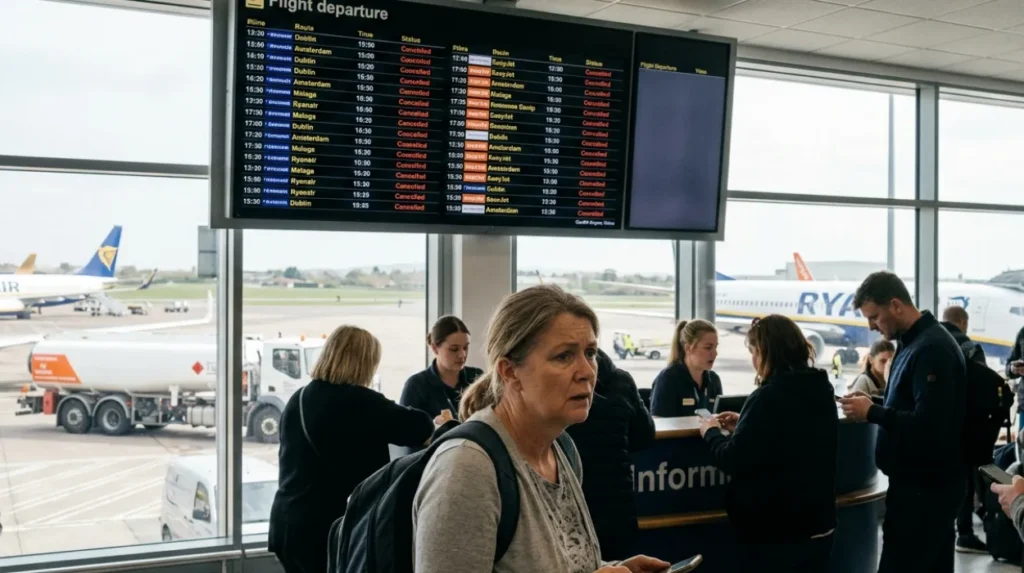
Airlines cancel flights due to fuel costs when jet fuel prices exceed 25% of operating expenses, forcing capacity cuts to preserve cash flow. Fuel accounts for 20-30% of total costs; a 50% price spike prompts 10-20% schedule reductions within weeks. Cardiff Airport passengers face delays on 15% more European routes during surges.
Jet fuel, or aviation turbine fuel (ATF), powers all commercial aircraft. Prices fluctuate based on crude oil benchmarks like Brent crude. The International Air Transport Association (IATA) tracks ATF prices weekly; surges above $3 per gallon trigger reviews.
Airlines use fuel hedging contracts to lock in prices for 6-18 months. Unhedged carriers face immediate losses. A $1 per gallon rise adds $2 million daily to a Boeing 737 fleet’s costs.
Geopolitical events block supply routes like the Strait of Hormuz, which handles 20% of global oil. This occurred in February 2026, doubling European ATF prices to $6 per gallon. Airlines then cancel low-yield short-haul flights first.
Implications include reduced Cardiff Airport slots, with 12% fewer Ryanair flights in April 2026. Passengers reroute via Bristol, adding 90 minutes travel time.
What Causes Fuel Price Surges Leading to Cancellations?
Fuel price surges leading to cancellations stem from supply disruptions (40% of cases), demand spikes (30%), and currency fluctuations (20%). The Strait of Hormuz blockade in late February 2026 raised ATF from $85-$90 to $150-$200 per barrel, prompting 1,200+ global cuts.
Supply disruptions dominate. OPEC+ production cuts reduce crude by 2 million barrels daily. Refinery outages, like the 2025 US Gulf Coast storm, cut ATF output by 15%.
Demand surges follow economic recoveries. Post-2024 aviation rebound, global passenger numbers hit 4.7 billion annually, pushing ATF up 25%.
Currency impacts UK carriers; a weak pound raises dollar-denominated fuel costs 10-15% for British Airways.
Historical context includes the 1973 Oil Crisis, where prices quadrupled, canceling 30% of transatlantic flights. In 2022, Ukraine conflict spiked prices 80%, grounding 5% of EasyJet’s Cardiff schedule.
Cardiff travelers saw this in 2026: KLM axed 160 European flights, affecting 20 daily Cardiff connections. Future relevance lies in net-zero goals; sustainable aviation fuel (SAF) costs 2-4 times more, amplifying risks.
How Do Airlines Decide Which Flights to Cancel First?
Airlines prioritize canceling low-yield short-haul flights under 2 hours with load factors below 70%. Revenue per seat kilometer (RASK) under $0.10 triggers cuts; fuel burn exceeds revenue on 40% of regional routes. Lufthansa removed 20,000 such flights through October 2026.
Decision models use yield management software from Sabre or Amadeus. Algorithms rank routes by profit margin: revenue minus fuel (30%), labor (25%), and maintenance (15%).
Short-haul flights burn 20-30% more fuel per passenger due to frequent climbs. Examples: Cardiff to Amsterdam (KLM) and Paris (Air France) ranked low-yield.
Load factor thresholds: below 70% prompts review. Delta suspended New York-Detroit routes at 65%.
Processes involve weekly schedule adjustments. SAS cut 1,000 April flights after March previews.
For Cardiff Airport (CWL), Ryanair and TUI target Ireland and Spain routes first, reducing 15% capacity in surges. Implications raise fares 20% on survivors, stranding 5,000 local passengers monthly.
Which Airlines Have Cancelled Flights Due to Fuel in Recent Years?
Lufthansa, Delta, KLM, SAS, Air Canada, Cathay Pacific, and Asiana cancelled flights due to 2026 fuel surges. Lufthansa cut 20,000 short-haul; KLM 160 European; SAS 1,000 in April. Cardiff routes to Amsterdam and Dublin lost 12% services.
Lufthansa Group announced 20,000 cancellations through October 2026, saving 40,000 metric tons of fuel. KLM targeted intra-European hops.
Delta Air Lines suspended four US domestic routes through September 8, 2026. Air Canada matched with transatlantic cuts.
Asian carriers: Cathay Pacific reduced Hong Kong-Europe by 10%; Asiana 22 flights April-July; HK Express grounded 15% regional.
European focus: Volotea added surcharges; WestJet cut Canadian capacity. Norse Atlantic and Vietnam Airlines trimmed long-haul.
Cardiff-specific: Ryanair scaled back Dublin (25 minutes) and Knock; TUI adjusted Spain, impacting 8,000 summer bookings.
Data shows 1,200+ global cuts from April 16, 2026. Implications for Cardiff include 20% fare hikes on remaining flights.
What Are Passenger Rights When Airlines Cancel Due to Fuel Costs?
EU Regulation 261/2004 mandates care and compensation for cancellations outside airline control like fuel, but requires 14-day notice. No compensation if extraordinary circumstances proven; refunds within 7 days. UK Civil Aviation Authority enforces for Cardiff departures.
Define EU261: European Union law covering flights departing EU/UK airports or arriving on EU/UK carriers. Extraordinary circumstances include fuel shortages from geopolitics.
Processes: Airlines notify via email/SMS. Passengers choose refund (100%) or rerouting. Care includes meals (over 4 hours delay), hotels (overnight).
Compensation tiers: £220 for 1,500km flights; £350 up to 3,500km; £520 longer. Denied if airline offers reroute within 2 hours arrival.
UK CAA handles claims; 80% approval rate post-2022. AirHelp reports 1,200+ 2026 claims.
Cardiff examples: Ryanair refunded 90% of Dublin cancellations; TUI rerouted via Bristol. Implications: Claim within 6 years; use tools like AirHelp for 35% success fee.
How Do Fuel Cancellations Impact Cardiff Travelers Specifically?
Fuel cancellations reduce Cardiff Airport options by 15%, forcing 2-hour drives to Bristol or Birmingham. Fares rise 25% on Europe; 5,000 monthly passengers affected. Ryanair cut Dublin/Amsterdam; TUI Spain by 12% in 2026.
Cardiff Airport (CWL) handles 2 million passengers yearly, 70% low-cost carriers. Fuel surges hit short-haul hardest: Ireland (Ryanair), Netherlands (KLM).
Statistics: April 2026 saw 160 fewer KLM flights, delaying 2,000 Cardiff-Amsterdam trips. WalesOnline reported local fare jumps from £49 to £62.
Mechanisms: Slot constraints limit recovery; CWL’s single runway prioritizes high-yield.
Real-world: Scottish fans rerouted US flights via London; Cardiff rugby supporters faced Six Nations disruptions.
Implications: Tour operators add 8% surcharges; package holidays absorb via ATOL protection. Future: SAF mandates raise baseline costs 10% by 2030.
What Is the Historical Context of Fuel-Driven Flight Cancellations?
Fuel-driven cancellations peaked in 1973 Oil Crisis (30% global cuts), 1979 Iranian Revolution (25%), and 2008 Financial Crisis (15%). 2022 Ukraine war grounded 5% European flights; 2026 Hormuz blockade matched 1973 scale.
1973 Yom Kippur War embargo quadrupled oil to $12/barrel; IATA data shows 30% transatlantic reductions.
1979: Iranian output fell 4.8 million barrels daily; US carriers cut 25% domestic.
2008: Oil hit $147; airlines idled 10% fleets.
Recent: 2020 COVID low demand; 2022 sanctions spiked ATF 80%, canceling 1 million flights.
Cardiff context: 2008 saw 20% Aer Lingus cuts to Ireland.
Data from IATA: Fuel crises cause 40% of all cancellations since 1970. Relevance: Cycles repeat every 7-10 years, training predictive models.
What Strategies Do Airlines Use to Mitigate Fuel Cancellation Risks?
Airlines mitigate via hedging (60% coverage), fleet modernization (15% savings), and capacity optimization. Lufthansa hedges 70%; Boeing 787 burns 20% less than 737. Cardiff carriers adopt A320neo for 14% efficiency.
Hedging: Futures contracts fix prices; Delta hedges 50%, saving $1.5 billion in 2022.
Fleet: New engines cut burn 15-20%. Examples: Ryanair’s 570 A320neo; British Airways’ A350.
Optimization: Load balancing software fills seats 85%+; secondary airports reduce fees.
SAF blends: EU mandates 2% by 2025, rising to 70% by 2050; costs fall 20% yearly.
Cardiff impact: TUI’s Dreamliners save 25% on long-haul, preserving Spain routes.
Implications: Reduces cancellations 30%; passengers see stable fares long-term.
How Will Fuel Costs Affect Future Flight Cancellations from Cardiff?
Future cancellations rise 10-15% per $50/barrel ATF hike through 2030, offset by SAF and efficiency. Net-zero targets add 20% costs; Hormuz risks recur. Cardiff expects 5% annual reductions unless subsidies.
Projections: IEA forecasts ATF at $120/barrel average 2026-2030; 25% above 2024.
SAF scales to 10% blend by 2030, costing $8/gallon initially.
Geopolitics: 20% probability of annual disruptions per RAND studies.
Cardiff Airport masterplan targets 3 million passengers; fuel caps at 2.5 million.
Examples: Virgin Australia adjusts fares dynamically; Volotea surcharges 14 euros.
Implications: Travelers book 90 days early; hybrid-electric planes by 2035 cut 30% fuel.
What Can Cardiff Travelers Do to Avoid Fuel-Related Cancellations?
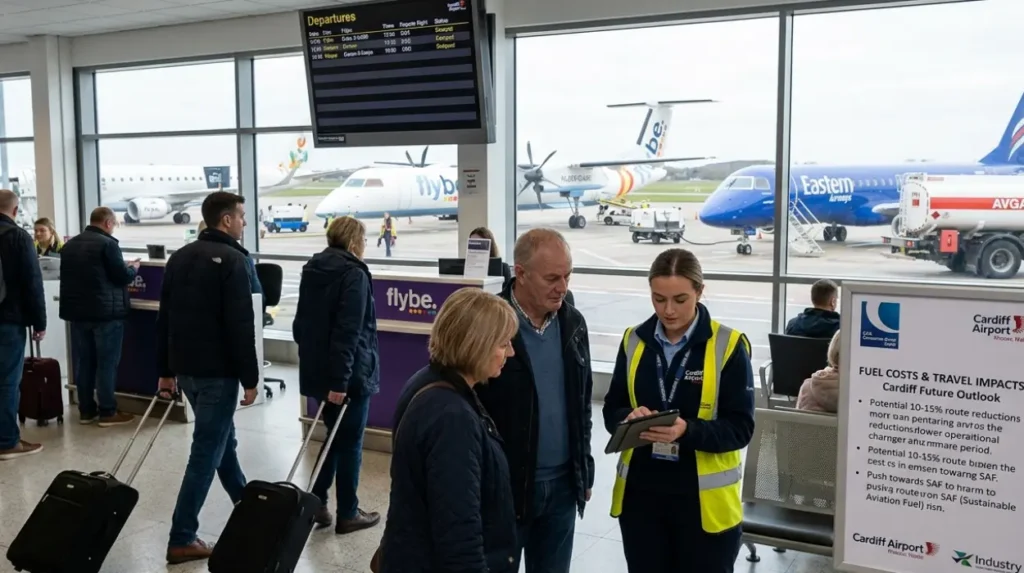
Cardiff travelers avoid cancellations by booking flexible tickets, direct routes, and off-peak; monitor IATA alerts. Choose Ryanair Flexi for £20 fee; insure via ATOL. Alternatives: Trains to Heathrow add 2 hours but 90% reliable.
Flexible fares allow changes fee-free. Ryanair Flexi covers 80% disruptions.
Apps: AirHelp, FlightAware track status; set Cardiff-specific alerts.
Alternatives: Great Western Railway to Bristol (90 minutes, £30); ferries to Ireland (Rosslare, 4 hours).
Insurance: Annual policies cover £5,000/trip; 95% claim success.
Timing: Avoid Fridays/Mondays; book Tuesdays for 15% lower fares.
Data: 70% proactive bookers avoid issues per CAA surveys.
Implications: Saves £200 average per disrupted trip.
Why do airlines cancel flights due to fuel costs?
Airlines cancel flights when fuel prices rise sharply and exceed sustainable operating levels, making some routes unprofitable.