Llandaff Palace, also known as the Bishop’s Palace, Llandaff Castle, Bishop’s Castle, or the Old Bishop’s Palace, is one of Cardiff’s most important surviving medieval monuments. The ruined palace stands close to Llandaff Cathedral in the historic suburb of Llandaff, northwest of Cardiff city centre.
- What is Llandaff Palace and where is it located?
- When was Llandaff Palace built?
- What was Llandaff Palace used for?
- What did the medieval Llandaff Palace look like?
- How did Owain Glyndŵr affect Llandaff Palace?
- When did Llandaff Palace become a ruin?
- What remains of Llandaff Palace today?
- Why is Llandaff Palace important to Cardiff’s history?
- How large was the medieval Llandaff Palace complex?
- What happened to Llandaff Palace after the medieval period?
- How is Llandaff Palace preserved today?
- Why does Llandaff Palace remain important for Cardiff today?
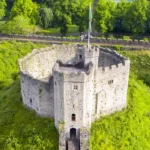
The site was the fortified medieval residence of the Bishops of Llandaff. Its principal surviving structure is the impressive twin-towered gatehouse, supported by sections of medieval curtain wall and other archaeological remains. The palace was constructed during the late 13th century and was associated with Bishop William de Braose, who served as Bishop of Llandaff from 1266 to 1287.
The palace was more than a residence. It functioned as an administrative centre for the medieval Diocese of Llandaff. Its fortified design reflected the political and military conditions of medieval south Wales. Damage during the Owain Glyndŵr rebellion in 1404 contributed to the abandonment of the palace as the bishops’ main residence. The complex remained substantially intact for centuries before probably being dismantled during the English Civil War.
Today, Llandaff Palace forms part of a protected historic landscape beside Llandaff Cathedral. Its ruins provide evidence of medieval episcopal authority, architecture, administration, conflict, and changing patterns of settlement in Cardiff.
What is Llandaff Palace and where is it located?
Llandaff Palace is the medieval residence of the Bishops of Llandaff beside Llandaff Cathedral in Cardiff. Its surviving ruins represent centuries of ecclesiastical, architectural, political, and religious history, and the site remains one of Cardiff’s important medieval heritage landscapes today.
Llandaff Palace is located in Llandaff, a historic community now incorporated into Cardiff. The ruins stand south of Llandaff Cathedral, within the historic Cathedral Green area. The location placed the bishop’s residence directly within the centre of medieval ecclesiastical life.
The name “palace” refers to an episcopal residence rather than a royal palace. An episcopal palace was a substantial residence used by a bishop for accommodation, administration, hospitality, and official activities. The Bishop of Llandaff required such a building because the Diocese of Llandaff covered a large territory and required continuous administration.
The site is also called Llandaff Castle because of its fortified appearance. Medieval bishops sometimes required defensive residences because political instability and armed conflict affected Wales during the medieval period.
The palace is protected as a historic monument and its surviving ruins have exceptional architectural and historical importance. The gatehouse provides the clearest surviving evidence of the original fortified complex.
When was Llandaff Palace built?
The palace developed beside Llandaff Cathedral because medieval bishops required a residence close to their cathedral, administrative centre, and religious community. Construction expanded across centuries, producing a complex combining residential rooms, service buildings, defensive features, gardens, and diocesan administration.
The principal medieval palace dates from the second half of the 13th century. Bishop William de Braose is generally associated with its construction between 1266 and 1287, during his episcopate at Llandaff.
William de Braose belonged to an influential Anglo-Norman family. His period as bishop coincided with major castle-building activity in south Wales. Caerphilly Castle, one of the largest medieval fortifications in Wales, was constructed during the same broad period.
The design of Llandaff Palace reflects this wider architectural environment. Its gatehouse had a strongly defensive character, while the enclosure provided a protected space for residential and administrative buildings.
The palace therefore represents the combination of religious authority and secular power that characterised medieval bishoprics. A medieval bishop was not solely a religious figure. Bishops also administered property, controlled revenues, supervised clergy, received important visitors, and participated in political affairs.
The location beside the cathedral was particularly significant. The cathedral represented the religious centre of the diocese, while the palace provided the bishop’s residential and administrative base.
What was Llandaff Palace used for?
Medieval Llandaff Palace served the Bishops of Llandaff as a residence and administrative centre. Bishops governed a diocese, managed church property, supervised clergy, received visitors, conducted official business, and maintained households, so the palace supported religious responsibilities and secular administration.
The primary function of Llandaff Palace was episcopal residence. The Bishop of Llandaff required accommodation when conducting business at the cathedral and managing diocesan affairs.
The palace also provided administrative space. A medieval diocese required organised management of land, income, appointments, correspondence, legal matters, and religious institutions. The bishop’s household and officials therefore formed an important part of the palace’s operation.
The complex also provided accommodation for visitors. Medieval bishops received clergy, political figures, landowners, messengers, and other guests. A substantial residence enabled the bishop to maintain the hospitality expected from an important ecclesiastical office.
The fortified character of the building had practical significance. Llandaff occupied an important position near the River Taff and within a politically contested region. The palace’s walls, towers, and gatehouse provided additional security.
The building also demonstrated episcopal authority. Its scale and fortified architecture communicated the status of the Bishop of Llandaff. The palace therefore combined religious, administrative, residential, and defensive functions within one complex.
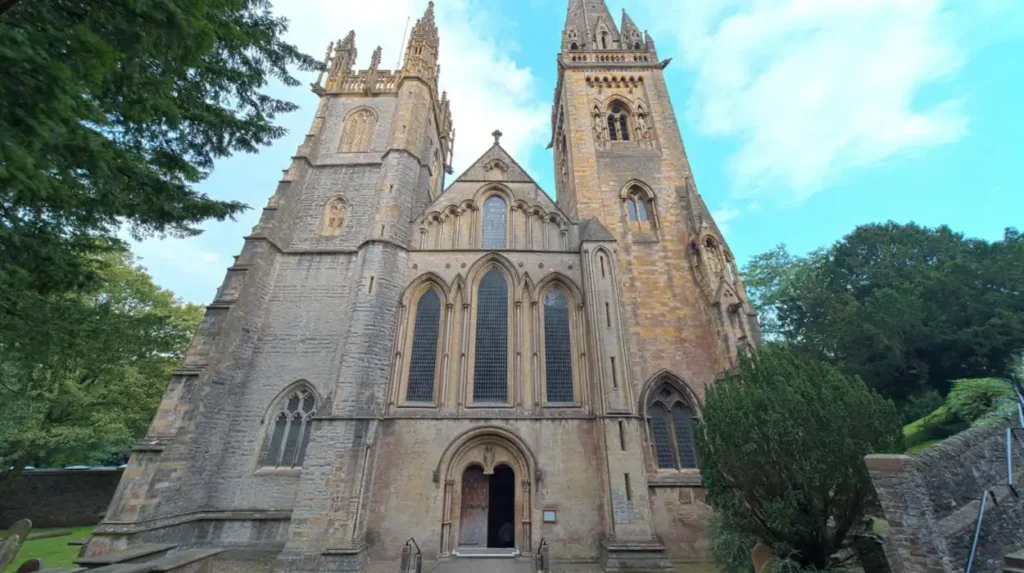
What did the medieval Llandaff Palace look like?
The surviving ruins display architectural evidence from different periods, including medieval masonry, walls, openings, and remains associated with the residential complex. Later alterations changed the buildings, while archaeological evidence helps identify rooms, boundaries, circulation routes, and relationships between palace and cathedral.
The medieval palace occupied a roughly rectangular or sub-rectangular enclosure measuring approximately 52 metres by 40 metres. Curtain walls enclosed the site, while towers strengthened important corners.
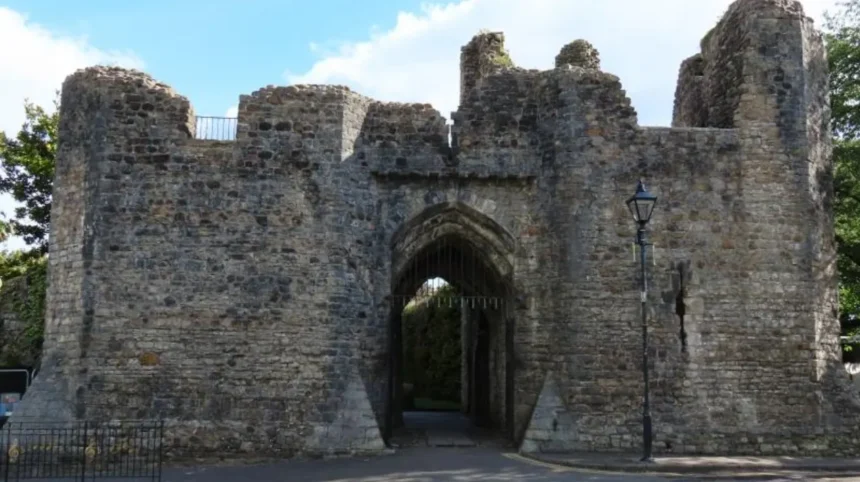
The gatehouse stood at the western corner facing the approach from Llandaff Cathedral. Its twin towers remain the most recognisable part of the palace today.
The gatehouse originally contained a vaulted passage and multiple levels. Defensive features included a portcullis arrangement and substantial timber doors reinforced with iron fittings. These features demonstrate the building’s defensive purpose.
The enclosure also contained residential and service buildings. Archaeological investigations identified evidence associated with a hall and solar. A medieval hall provided a major communal and ceremonial space, while a solar generally served as a more private residential area for senior members of the household.
The surviving walls also demonstrate how the palace was organised. Circulation routes connected the gatehouse, defensive walls, residential structures, and other areas of the enclosure.
Much of the original interior architecture has disappeared. The surviving masonry therefore represents only part of the original complex. Archaeological evidence remains important for reconstructing its medieval arrangement.
How did Owain Glyndŵr affect Llandaff Palace?
Llandaff Palace was damaged during the Owain Glyndŵr rebellion in 1404, when conflict affected the building and wider region. The surviving remains reflect this destructive period and earlier construction, while later abandonment left the medieval complex substantially ruinous.
Owain Glyndŵr led a major Welsh rebellion against English rule between 1400 and the early 15th century. The uprising affected settlements, castles, religious institutions, and administrative centres across Wales.
Llandaff Palace was attacked and damaged during the rebellion in 1404. The damage changed the building’s role as an episcopal residence.
After the attack, the bishops increasingly relied on Mathern Palace in Monmouthshire as their principal residence. Mathern provided a more secure episcopal base away from the damaged Llandaff complex.
The change demonstrates how military conflict influenced the use of medieval religious buildings. A palace could retain administrative or symbolic importance even after becoming unsuitable as a permanent residence.
The gatehouse remained usable after the main residential functions declined. Later alterations included changes to openings, demonstrating that parts of the complex continued to have practical value.
The abandonment of the palace as the bishop’s principal home did not immediately turn the entire site into a ruin. Historical evidence shows that substantial parts of the complex survived for several centuries.
When did Llandaff Palace become a ruin?
The palace became increasingly ruinous after seventeenth-century damage and changing patterns of episcopal residence. Its functions shifted away from the medieval complex, while later buildings altered the setting. The surviving remains therefore represent a historic monument rather than an intact working bishop’s residence.
The decline of Llandaff Palace occurred gradually rather than through one single event. The palace had already lost its primary residential role after the damage associated with the Owain Glyndŵr rebellion.
The complex remained substantially intact into the early modern period. A plan produced by John Speed in 1610 depicts the palace as a complete fortified enclosure, showing that significant walls and towers still survived at that time.
The English Civil War began in 1642 and created widespread destruction across Britain. Wales was involved in the conflict, with military forces occupying and attacking strategic buildings.
Llandaff Palace was probably dismantled or severely damaged during this period. This process is often described as slighting, meaning the deliberate reduction of a fortified building so that it could no longer function effectively for defence.
The destruction explains the major difference between the documented 17th-century complex and the surviving ruins. The gatehouse and fragments of the enclosure remained, while most residential structures disappeared.
The palace consequently became a historic ruin rather than a functioning episcopal residence.
What remains of Llandaff Palace today?
Llandaff Palace stands within a wider historic landscape that includes Llandaff Cathedral, the River Taff, medieval streets, church buildings, and later urban development. Together, these features explain Llandaff’s importance as an ecclesiastical centre and connect the palace to Cardiff’s development.
The twin-towered gatehouse is the most prominent surviving part of Llandaff Palace. Its stone construction, arched entrance, defensive details, and surviving wall sections provide a clear impression of the medieval enclosure.
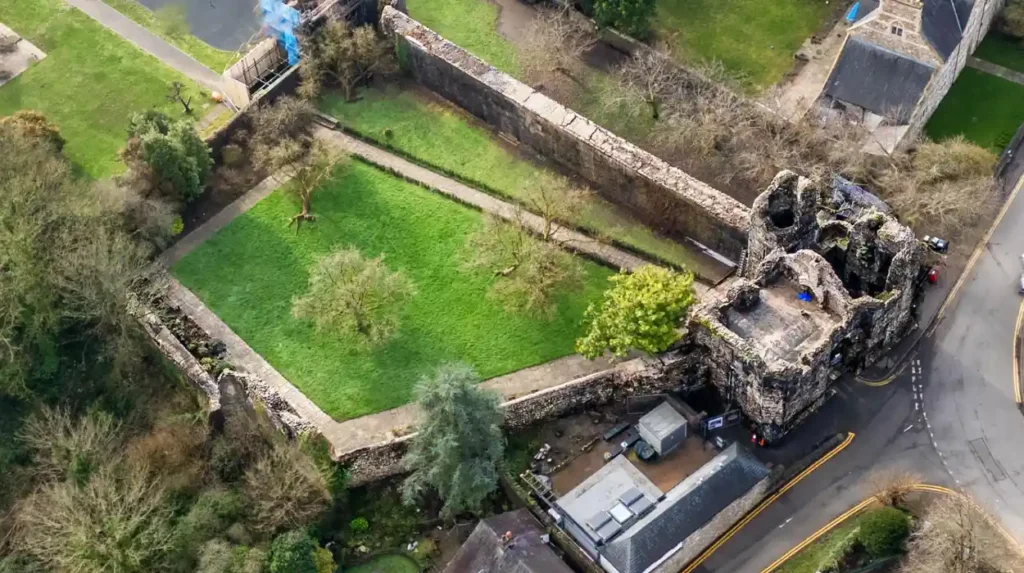
Sections of curtain wall also survive. Curtain walls were defensive walls connecting towers and enclosing a protected area. At Llandaff, these walls formed the boundary of the medieval palace.
Archaeological remains provide additional evidence of the former buildings. Traces associated with the hall and solar demonstrate that the palace contained substantial residential accommodation beyond the surviving gatehouse.
The original palace also contained towers that have largely disappeared. The surviving remains therefore represent only a fraction of the original medieval complex.
The site is now incorporated into a public garden and historic landscape. Its open setting allows visitors to understand the relationship between the palace ruins and Llandaff Cathedral.
The preservation of the gatehouse is particularly important because it provides visible architectural evidence of the palace’s fortified character.
Why is Llandaff Palace important to Cardiff’s history?
Llandaff Palace matters to Cardiff because it preserves physical evidence of the city’s medieval religious landscape. The ruins connect Cardiff with the medieval Diocese of Llandaff, demonstrate episcopal authority, and provide architectural evidence for understanding how Llandaff developed before becoming part of modern Cardiff.
Llandaff has a much older history than modern Cardiff. The area developed as an important Christian centre around Llandaff Cathedral and the seat of the Bishop of Llandaff.
The palace formed part of this ecclesiastical settlement. Its existence demonstrates that Llandaff was not simply a religious site but also an administrative centre with substantial institutional infrastructure.
The Diocese of Llandaff was an important medieval ecclesiastical jurisdiction. Its bishop controlled church property and exercised authority over clergy and religious institutions within the diocese.
The palace therefore provides physical evidence of how religious authority operated on the ground. Its walls, gatehouse, and former residential buildings demonstrate the material resources required to maintain episcopal government.
The site also helps explain Cardiff’s historical expansion. Modern Cardiff incorporates many communities that developed independently before becoming part of the growing urban area. Llandaff retained its distinctive medieval character while becoming integrated into Cardiff.
The palace remains one of the clearest surviving medieval secular structures in the Llandaff area.
How large was the medieval Llandaff Palace complex?
The medieval palace occupied an enclosure approximately 52 metres by 40 metres, surrounded by defensive masonry and strengthened by towers. Its gatehouse controlled the main entrance, while residential and administrative buildings occupied the protected interior courtyard.
The measured enclosure demonstrates that Llandaff Palace was a substantial complex rather than a single residential building.
An enclosure of approximately 52 metres by 40 metres provided space for several functions. The outer walls created security, while buildings inside the enclosure accommodated the bishop and household.
The gatehouse formed the principal controlled entrance. Its twin towers strengthened the entrance and provided a commanding architectural statement.
The curtain walls connected defensive structures around the enclosure. Towers provided additional protection and strengthened vulnerable points along the perimeter.
The interior included a hall and solar. The hall was an important medieval room used for communal activities, official functions, meals, and ceremonial occasions. The solar provided more private accommodation.
Service areas would have supported the household. Medieval elite residences required spaces for food preparation, storage, servants, maintenance, and other domestic functions.
Although most internal buildings have disappeared, archaeological evidence confirms that the palace contained a more complex arrangement than the surviving gatehouse alone suggests.
What happened to Llandaff Palace after the medieval period?
The palace ceased to function as the bishops’ principal residence after medieval conflict, while the surviving gatehouse remained in use. The complex later deteriorated, suffered probable Civil War dismantling, and eventually became a protected historic site and public garden.
The post-medieval history of Llandaff Palace demonstrates how historic buildings can change function over time.
After the 1404 damage, the bishops relied on Mathern Palace. The Llandaff site therefore lost its status as the main episcopal residence.
The gatehouse remained in use. Evidence of Tudor-period modification to an upper-level window indicates continued occupation or practical use after the medieval period.
The palace was still sufficiently complete to appear on John Speed’s 1610 plan. This is significant because it establishes that the complex survived far longer than the date traditionally associated with its abandonment as a residence.
The English Civil War then transformed the site. The palace was probably dismantled during the conflict, leaving the gatehouse and sections of the walls as the principal surviving structures.
In the 19th century, the ruins formed part of the wider episcopal landscape. The bishops returned to live near Llandaff Cathedral in 1850, using a residence that later became associated with Cathedral School.
The old palace was eventually separated from private episcopal use. Cardiff acquired the site in 1971, followed by repair and conversion into a public garden in 1972.
How is Llandaff Palace preserved today?
The palace ruins support historical and archaeological study because surviving masonry records construction methods, building phases, spatial organisation, and patterns of destruction. Researchers compare physical evidence with documentary records to reconstruct how episcopal buildings changed across medieval and post-medieval periods.
Llandaff Palace has protected heritage status because its remains have exceptional historical and architectural importance.
The monument is a Scheduled Monument, which recognises the archaeological importance of the site. The surviving ruins are also Grade I listed, reflecting their exceptional architectural and historical significance.
Conservation focuses on protecting surviving masonry and preventing further structural deterioration. Historic ruins require careful management because weather, vegetation, water penetration, erosion, and uncontrolled alterations can damage medieval stonework.
Archaeological research provides another form of preservation. Excavation and building analysis can identify lost structures, construction phases, changes to rooms, and evidence of later occupation.
The 1960s archaeological investigations contributed to understanding the surviving remains, including evidence associated with the hall and solar.
The site’s preservation also depends on its relationship with the surrounding historic landscape. Llandaff Cathedral, the palace ruins, Cathedral Green, historic streets, and nearby buildings collectively form a connected heritage environment.
Protecting the palace therefore involves preserving both individual masonry and its wider historical setting.
Explore More Area Guide
Best Fish and Chips in Rumney: Cardiff Guide 2026
Historic Pubs in Llandaff: Heritage and Architecture in Llandaff, Cardiff 2026
Why does Llandaff Palace remain important for Cardiff today?
Llandaff Palace remains relevant because heritage conservation preserves evidence that cannot be recreated after loss. Understanding its history supports responsible interpretation of Cardiff’s medieval landscape, while continued maintenance and research help protect the ruins and explain their significance for generations.
Llandaff Palace provides Cardiff with a direct physical connection to the medieval period. Unlike buildings known only through written records, the palace retains visible medieval masonry that demonstrates how an episcopal residence was designed and defended.
Its proximity to Llandaff Cathedral strengthens its historical significance. Visitors can understand the relationship between the bishop’s residence and the cathedral that served as the religious centre of the diocese.
The palace also demonstrates how Cardiff’s history extends beyond the modern city centre. Medieval Llandaff developed as a separate ecclesiastical settlement, and its historic identity remains visible within contemporary Cardiff.
The ruins are valuable for education because they provide evidence for subjects including medieval architecture, Welsh history, religious administration, archaeology, military architecture, and urban development.
The site also demonstrates the long process through which historic buildings change. Llandaff Palace began as a fortified episcopal residence, lost its primary residential function, survived centuries of changing use, suffered major destruction, and eventually became a protected public heritage site.
Its surviving gatehouse is therefore more than an architectural fragment. It represents the continuing physical presence of medieval Llandaff within modern Cardiff.
Llandaff Palace history also illustrates the importance of preserving archaeological evidence alongside major landmarks. Llandaff Cathedral remains the dominant religious structure in the area, while the palace reveals the administrative and residential infrastructure that supported medieval episcopal authority.
The ruins provide a valuable historical record of Cardiff’s development from a collection of medieval communities into a modern capital city. Their survival allows the medieval landscape of Llandaff to remain visible, understandable, and relevant.
For anyone studying Cardiff history, medieval Wales, religious architecture, or the development of Llandaff, the palace offers an important concentration of surviving evidence. Its fortified gatehouse, enclosing walls, archaeological remains, and relationship with the cathedral together provide a detailed picture of medieval ecclesiastical power.
Llandaff Palace is ultimately significant because its history connects architecture with administration, religion, conflict, and urban development. The surviving ruins preserve a documented medieval institution within the modern city and provide lasting evidence of Llandaff’s central role in Cardiff’s historic landscape.
What is Llandaff Palace?
Llandaff Palace is the medieval residence of the Bishops of Llandaff beside Llandaff Cathedral in Cardiff. The site is now a historic ruin featuring a prominent medieval gatehouse and surviving sections of the palace walls.