Cardiff has a broad network of public parks, green spaces and children’s play areas that support outdoor recreation for families. Cardiff Council maintains information about local parks and play areas through its parks and green-spaces service, giving residents and visitors a central way to identify facilities across the city.
- What are children’s playgrounds in Cardiff?
- How did playgrounds develop in Cardiff?
- Which Cardiff parks provide children’s play areas?
- What types of playground equipment can children find?
- How do playgrounds support children’s physical activity?
- How do playgrounds support social and developmental play?
- What makes a children’s playground accessible and inclusive?
- How important is playground safety in Cardiff?
- How can families find children’s playgrounds in Cardiff?
- What other children’s activities are available alongside playgrounds?
- How should families choose the right playground in Cardiff?
- Why are children’s playgrounds important for Cardiff’s future?
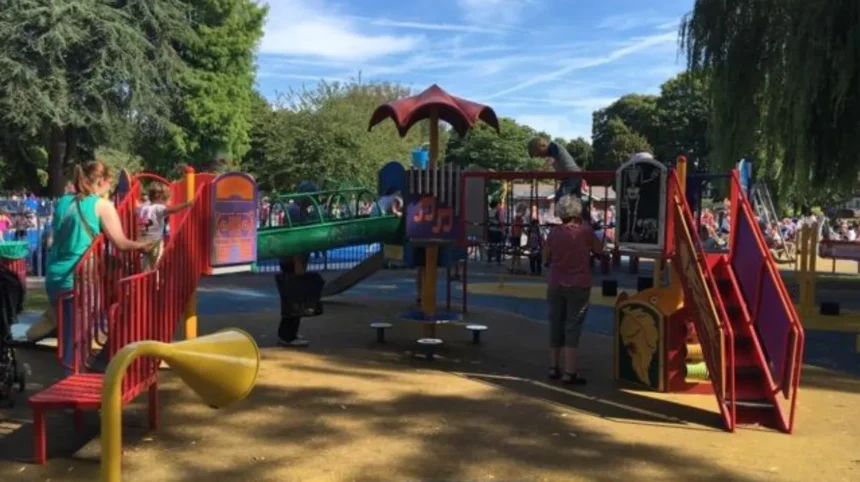
Children’s playgrounds are dedicated outdoor environments designed for active play, movement, exploration and social interaction. Typical facilities include swings, slides, climbing structures, balancing equipment, springers, play towers and open areas. The exact equipment varies between locations and is influenced by site size, age range, accessibility requirements and the surrounding landscape.
For families in Cardiff, playgrounds form part of a wider outdoor recreation network. Parks such as Roath Park, Victoria Park, Bute Park, Heath Park and Pontcanna Fields provide access to green space alongside other recreational opportunities. Cardiff Council also operates Children’s Play Services, with organised play sessions available across the city for children aged 5 to 14.
What are children’s playgrounds in Cardiff?
Children’s playgrounds in Cardiff are designated outdoor play spaces where children use equipment and open areas for physical activity, movement, exploration and social play. Cardiff Council manages many public play areas within parks and green spaces across the city.
A children’s playground is different from a general park. A park provides wider open space for walking, sports, nature and recreation. A playground contains equipment specifically designed around children’s play and physical development.
Playgrounds generally combine fixed equipment with circulation areas and impact-absorbing surfaces. Equipment can include swings, slides, climbing frames, rope structures, balancing elements and imaginative-play features. Open ground around the equipment gives children space to move between activities.
Cardiff’s public playground network operates within the city’s wider parks and green-space system. Cardiff Council provides an online facility for finding parks and play areas and also provides a reporting service for damaged playground equipment, damaged footpaths, flooding and other park problems.
This network is important because access to nearby play space reduces the need for every recreational activity to take place inside the home, school or commercial leisure facility. Public playgrounds also provide free or low-cost opportunities for outdoor recreation.
How did playgrounds develop in Cardiff?
Playgrounds developed alongside Cardiff’s expanding public-park system and changing ideas about children’s recreation. Historic Cardiff parks demonstrate that children’s informal play has long been part of public-space management, while modern playgrounds use dedicated equipment and safety standards.
The development of Cardiff’s parks provides important historical context. Roath Park was already an established recreational destination in the early twentieth century. A Cardiff Parks Superintendent’s report dated 28 June 1909 recorded extensive recreational activity at Roath Park, including boating, bathing, fishing, bowls, tennis and other games.
Historical records also document children’s use of Victoria Park. A 1909 parks report specifically discussed children using shelters as play spaces. This illustrates an important transition in public recreation: children used available park structures for play before the modern concept of purpose-built playground equipment became widespread.
By the twentieth century, dedicated play equipment became an increasingly important component of public recreational planning. Modern playgrounds separate children’s play equipment from other park functions and provide defined spaces for active recreation.
Cardiff’s parks have therefore evolved from broad recreational landscapes into multifunctional public environments. Present-day parks combine gardens, sports areas, paths, open lawns and dedicated children’s play areas.
Which Cardiff parks provide children’s play areas?
Cardiff Council provides a searchable network of parks and play areas across the city. Major green spaces associated with family recreation include Roath Park, Victoria Park, Bute Park, Heath Park and Pontcanna Fields, with facilities varying by individual location.
Roath Park is one of Cardiff’s best-known historic parks. The park is associated with a lake, gardens, recreational spaces and a long history of public use. Cardiff Council’s historic records identify Roath Park within the city’s established parks portfolio.
Victoria Park in Canton is another significant public green space. Historical Cardiff Parks records show that children’s recreational activity was already a management issue at the park in 1909. Today, Victoria Park remains part of Cardiff’s public park network.
Bute Park provides a large central green space adjacent to Cardiff city centre. Its location makes it particularly useful for families combining outdoor play with a wider city visit. Cardiff Council directs residents and visitors towards Bute Park information through its parks and holiday-activity services.
Heath Park provides another major recreational setting in northern Cardiff. Cardiff Council lists Heath Park facilities and provides a main car park with 243 spaces, including 9 Blue Badge bays.
Pontcanna Fields also forms part of Cardiff’s extensive western-central park network. Cardiff Council lists a Pontcanna Fields car park with 142 spaces, including 5 Blue Badge bays and 2 electric-vehicle charging bays.
The most accurate approach is to check Cardiff Council’s current parks and play-area information before travelling because equipment, access arrangements and maintenance conditions change over time.
What types of playground equipment can children find?
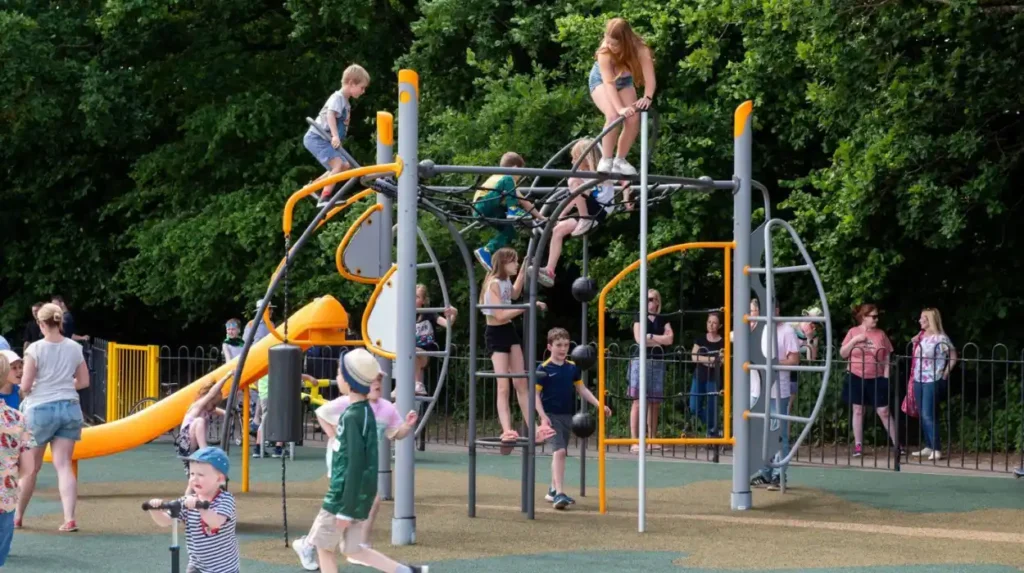
Children’s playground equipment supports different forms of movement and play. Common examples include swings for dynamic movement, slides for climbing and descent, climbing frames for upper-body activity, balancing equipment for coordination and imaginative structures for role play.
Playgrounds are designed around different movement patterns. Swings require repeated leg and trunk movement. Slides combine climbing with controlled descent. Climbing frames require children to coordinate hands, feet and body position.
Balancing equipment develops control and spatial awareness. Spring-mounted equipment provides smaller-scale movement. Play towers combine climbing, platforms, bridges and slides into a connected activity structure.
Playgrounds also contain equipment that supports imaginative play. Houses, tunnels, shop-style panels, steering wheels and themed structures allow children to create games around social interaction and pretend scenarios.
Open space is equally important. A playground does not need to rely entirely on fixed equipment to encourage movement. Children can run, chase, jump and create games within appropriately designed circulation areas.
Research supports the role of playground equipment in encouraging physical activity. A systematic review covering 30 studies found moderate evidence for an effect of providing play equipment on children’s physical activity, although findings differed according to intervention type and setting.
A later meta-analysis of 10 playground intervention studies involving children and adolescents found a small statistically significant increase in accelerometer-measured moderate-to-vigorous physical activity, with a pooled Hedges’ g of 0.13.
How do playgrounds support children’s physical activity?
Playgrounds support children’s physical activity by providing equipment and environments that encourage climbing, swinging, running, balancing, jumping and repeated movement. Research shows that well-designed playground interventions can increase moderate-to-vigorous physical activity in children.
Physical activity is one of the main functions of outdoor play. Children move between equipment, climb structures, use slides and swings, and participate in active games with other children.
The intensity of movement varies. Walking between equipment represents light activity. Climbing, running and repeated jumping increase exertion. Games involving chasing, racing or climbing can reach moderate-to-vigorous intensity.
A 2025 systematic review and meta-analysis assessed 28 studies involving 19,753 participants. It found significant increases in vigorous physical activity, moderate-to-vigorous physical activity and steps per minute following physical enrichment interventions. The review also reported substantial variation between studies and limited evidence for cognitive, psychological and social outcomes.
This evidence establishes an important distinction. Playground design creates opportunities for physical activity, but equipment alone does not guarantee a specific amount of exercise. Children’s behaviour, age, available space and the structure of play sessions influence how the environment is used.
A 2014 review of school and preschool playgrounds also found positive associations between play equipment and physical activity. It reported moderate evidence for the effect of play equipment while identifying less conclusive evidence for several other playground interventions.
How do playgrounds support social and developmental play?
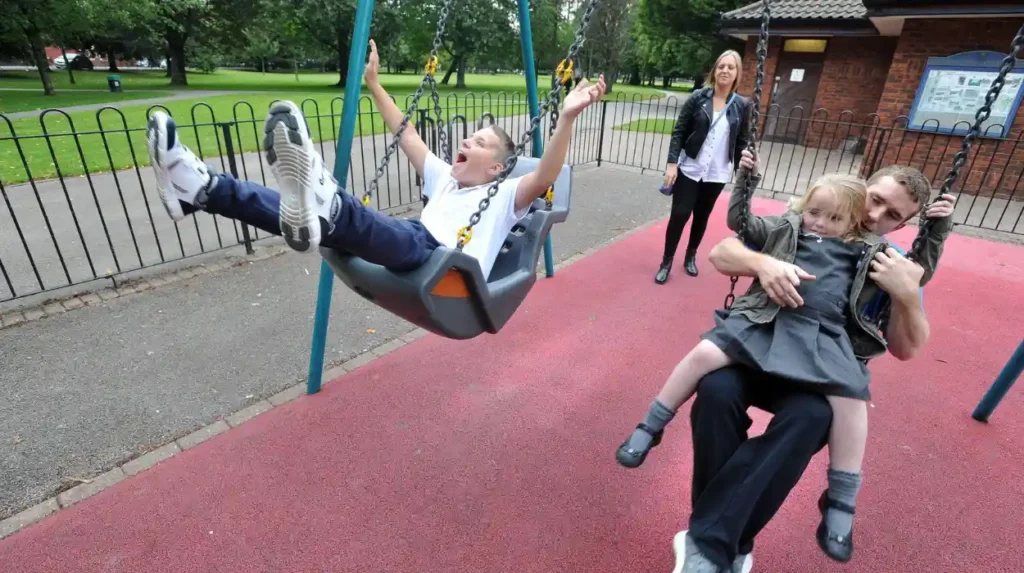
Playgrounds support social development by giving children shared environments for cooperative games, turn-taking, communication and negotiation. Climbing, balancing, imaginative equipment and group games also require children to coordinate movement, space and social behaviour.
Social interaction is a major feature of public playgrounds. Children often share swings, slides, climbing structures and open areas. These activities create natural opportunities for communication.
Turn-taking is particularly relevant to equipment with limited capacity. Children learn to wait, observe other users and follow informal rules. Group games require children to establish boundaries and agree on activities.
Imaginative equipment supports another form of social play. Children can assign roles, create scenarios and communicate rules. These activities use language and cooperation rather than physical movement alone.
Playground environments also expose children to different age groups and play styles. Younger children often use smaller equipment and simpler movement patterns. Older children use climbing structures, open spaces and more complex games.
Research on cognitive, psychological and social outcomes is less developed than research on physical activity. The 2025 systematic review found mixed evidence for cognitive, psychological and social development and noted that relatively few studies assessed these outcomes.
This distinction is important for accurate interpretation. Playgrounds clearly provide opportunities for social interaction, but research evidence should not be used to claim that every playground automatically produces measurable developmental outcomes.
What makes a children’s playground accessible and inclusive?
An inclusive playground provides opportunities for children with different physical, sensory and developmental needs to participate in play. Accessible routes, suitable surfaces, varied equipment and sufficient circulation space help more children reach and use the play environment.
Accessibility begins before a child reaches the equipment. Paths, entrances and transitions between surrounding park areas and the playground influence whether the site is usable.
Firm and appropriately designed surfaces support movement between equipment. Accessible routes reduce physical barriers for children using mobility aids and for parents pushing prams.
Inclusive design also involves variety. A playground containing only one type of movement excludes children who cannot perform that movement. Different activity levels provide more options.
Sensory considerations also matter. Children respond differently to noise, movement, textures and visual stimulation. Providing varied spaces creates more opportunities for children to select activities that suit their needs.
Inclusive playground design is therefore broader than installing one accessible piece of equipment. It involves the complete environment, including entrances, surfaces, circulation, equipment positioning and opportunities for social participation.
Families should assess the specific facilities available at an individual Cardiff playground rather than assuming every play area provides identical accessibility features. Cardiff Council’s parks service is the appropriate source for current site-level information.
How important is playground safety in Cardiff?
Playground safety depends on suitable equipment, appropriate surfacing, regular inspection, maintenance and responsible use. Cardiff Council provides a reporting route for damaged playground equipment and other park hazards, helping residents identify maintenance issues.
Safety begins with playground design. Equipment must be appropriate for its intended users and installed within a suitable environment.
Impact-absorbing surfaces are important beneath equipment where falls are foreseeable. The surface must be maintained because deterioration, displacement or damage can affect performance.
Regular inspection identifies defects such as broken components, loose fittings, damaged surfaces and structural problems. Maintenance then addresses identified faults.
Parents and carers also contribute to safe play. Children should use equipment appropriate to their age and ability. Supervising adults should pay particular attention to climbing structures, swings and areas where children of different sizes share equipment.
Cardiff Council explicitly asks residents to report damaged playground equipment, damaged paths and gates, flooding and other problems in parks and green spaces.
The council also operates Public Spaces Protection Orders affecting certain park behaviours. Cardiff’s current PSPO information states that dogs are prohibited from enclosed children’s play areas, games areas and school premises identified in the order.
This restriction has a direct relevance to playground hygiene and child safety. Families should follow displayed site rules and keep dogs out of prohibited children’s play areas.
How can families find children’s playgrounds in Cardiff?
Families can locate Cardiff playgrounds through Cardiff Council’s parks and green-spaces service, which provides a searchable way to find parks and play areas. Families should check current site information before travelling because facilities and maintenance conditions change.
The Cardiff Council parks service is the primary starting point for identifying public play areas. Its website specifically provides a search function for parks and play areas.
Location is an important practical consideration. Families living near Roath, Canton, Pontcanna, Heath, Whitchurch, Penylan or other Cardiff districts can compare nearby parks rather than travelling across the city for every play session.
Parking also differs between locations. Cardiff Council lists 243 spaces at Heath Park’s main car park, 142 at Pontcanna Fields and 50 at Penylan Library car park. Blue Badge provision also varies between sites.
Public transport and walking access also influence playground choice. A nearby playground that can be reached safely on foot provides a different practical benefit from a larger destination playground requiring a car journey.
Families should also consider toilets, cafés, open lawns, paths and other facilities when planning a longer visit. A playground within a larger park can support a full outdoor activity period rather than a short equipment-only visit.
What other children’s activities are available alongside playgrounds?
Cardiff provides children’s activities beyond fixed playground equipment, including organised play sessions, sports, arts and crafts, brain games, cycling training and leisure-centre activities. These options complement outdoor playground visits and provide different forms of physical and creative recreation.
Cardiff Council’s Children’s Play Services provides organised play sessions across the city for children aged 5 to 14. Activities include sports and physical activities, arts and crafts, brain games, solo games and group activities.
Holiday programmes provide another option. Cardiff Council lists free and inexpensive activities during school holidays, including leisure-centre activities, swimming, sports and soft play.
Cycling also forms part of Cardiff’s children’s recreation network. The council’s National Standard Cycle Training courses are available during school holidays at the Road Safety Centre in Maindy for Cardiff children aged 9 and above who own a bike and can ride.
These services demonstrate that children’s play in Cardiff is not limited to fixed playground equipment. Families can combine playground visits with organised activities, cycling, walking, sports and wider park recreation.
Explore More Area Guide
Local Sports Clubs in Cardiff: Complete Guide 2026
Leisure Centres Near Roath: Penylan, Eastern & Maindy | Cardiff 2026
How should families choose the right playground in Cardiff?
Families should choose a Cardiff playground according to the child’s age, equipment needs, accessibility, location, available space, supervision requirements and surrounding facilities. Checking current council information before visiting provides the most reliable information about individual sites.
Age suitability is the first consideration. Toddlers require smaller structures, lower platforms and equipment designed around early movement skills. Older children generally require greater climbing challenges and larger activity structures.
Accessibility is another important factor. Families should check whether the route to the playground is suitable, whether surfaces support mobility and whether equipment provides meaningful participation.
Location affects frequency. A playground within walking distance can support regular outdoor activity. A larger destination playground provides a different experience when families have more time.
Surrounding facilities also matter. Toilets, seating, open lawns, walking paths and parking influence the practicality of a family visit.
Weather is another Cardiff-specific consideration. Wet conditions can affect grass, paths and surfaces. Families should assess the condition of the site and follow any local notices.
The most reliable source for current park and play-area information remains Cardiff Council’s official parks service.
Why are children’s playgrounds important for Cardiff’s future?
Children’s playgrounds remain important to Cardiff because they provide local opportunities for outdoor activity, social interaction and recreation within public spaces. Future playground planning should prioritise safety, accessibility, varied movement opportunities and connections with wider green-space networks.
The long-term value of playgrounds is closely connected with access. Children need practical opportunities to move, play and interact outside school hours. Local playgrounds place these opportunities within neighbourhoods.
Research continues to support the role of physical playground environments in increasing activity. The 2025 meta-analysis identified significant improvements in vigorous activity, moderate-to-vigorous activity and steps following physical enrichment interventions, while also highlighting research limitations and variation between studies.
Design priorities are therefore becoming broader. Modern playground planning considers accessibility, equipment variety, movement opportunities, surface design, environmental context and the needs of different age groups.
Cardiff’s wider parks strategy also provides an important foundation. The council manages parks and green spaces throughout the city and provides dedicated information for play areas, outdoor recreation and reporting maintenance problems.
The future relevance of children’s playgrounds is not limited to individual pieces of equipment. Well-connected play spaces form part of the city’s wider recreational infrastructure. They connect children with parks, open space, walking routes and community activities.
For families, the most useful approach is simple: identify a suitable local playground, check current information, follow site safety rules and use the wider park environment as part of the visit. Cardiff’s combination of historic parks, neighbourhood green spaces and organised children’s services provides a substantial foundation for outdoor play.
What are the best children’s playgrounds in Cardiff?
Popular Cardiff family destinations include Roath Park, Victoria Park, Bute Park, Heath Park and Pontcanna Fields. Facilities vary by location, so families should check Cardiff Council’s current park and play-area information before visiting.