Roath is one of Cardiff’s best-known residential districts, but its present streetscape hides a much older landscape. Before large-scale Victorian and Edwardian development, Roath contained a rural village, manor houses, farms, cottages, a medieval mill, open fields and country lanes.
- What was Roath like before its historic buildings disappeared?
- Why did so many historic Roath buildings disappear?
- When was Old Roath Church demolished?
- What happened to Roath Mill?
- What happened to Great House or Ty Mawr?
- What happened to Roath Village School?
- Which Roath cottages were demolished?
- Which Roath mansions and estate buildings have disappeared?
- Did Roath lose historic industrial and electricity buildings?
- Did Roath lose railway buildings and stations?
- Which former cinemas and entertainment buildings belong to Roath’s lost-building story?
- What happened to former commercial and civic buildings in Roath?
- How can lost Roath buildings still be identified today?
- Why are the lost buildings of Roath important to Cardiff history?
- What does the future preservation of Roath’s history depend on?
The transformation accelerated during the nineteenth century as Cardiff expanded rapidly. New housing, roads, schools, public services, transport infrastructure and commercial premises replaced many older buildings. Some disappeared through planned redevelopment, while others were demolished after becoming obsolete, damaged or difficult to maintain.
The surviving historic buildings provide only part of the story. The lost buildings of Roath explain how the district changed from a rural settlement into an urban neighbourhood.
Historical records, local-history research and archaeological investigations identify numerous vanished structures. Examples include Old Roath Church, Roath Mill, Ty Mawr or Great House, Roath Village School, Roath Court Cottages, Ty-y-Cwn, Bronwydd House, the Roath power station, historic railway infrastructure and several former commercial and civic buildings.
The Cardiff Archaeological Society notes that very little remains above ground from early Roath. Major farmhouses including Great House and Dean’s Farm, together with cottages such as Ty Draw and Ty-y-cyw, disappeared during nineteenth- and twentieth-century suburban development.
Understanding these buildings requires looking beyond individual demolitions. Their disappearance reflects Cardiff’s industrial growth, population expansion, changing transport systems, public-health requirements, housing demand and twentieth-century redevelopment.
What was Roath like before its historic buildings disappeared?
Roath began as a rural settlement centred on the medieval manor of Roath Dogfield, with cottages, farms, a parish church, Roath Court, Roath Mill and open countryside surrounding the village before Victorian suburban development transformed the area.
The historic core of Roath was associated with Roath Dogfield, a medieval lordship connected with the wider Lordship of Glamorgan. Roath retained a recognisable village identity until the late nineteenth century.
The village centred on St Margaret’s Church and included cottages around the church and along the old Merthyr Road, now Albany Road. Open fields extended around the settlement, while farmhouses and estate buildings occupied the surrounding countryside.
Roath Court represented the historic estate landscape. Roath Mill represented the area’s agricultural and industrial activity. Small cottages and farm buildings provided housing and working spaces for the rural population.
This landscape changed rapidly when Cardiff’s urban expansion reached Roath. Housing estates spread along roads including Albany Road, City Road, Newport Road and surrounding streets.
The result was not simply the replacement of one building with another. Entire land uses disappeared. Fields became streets. Farmhouses disappeared beneath suburban development. Estate land became residential plots. Rural lanes became major urban routes.
The Roath Local History Society records that the village lost its distinctive rural character during the housing development of the late nineteenth century.
Why did so many historic Roath buildings disappear?
Historic Roath buildings disappeared primarily because Cardiff expanded rapidly, creating demand for housing, roads, schools, utilities, commercial premises and public services that replaced older rural, estate and industrial structures across the district.
Cardiff’s nineteenth-century growth created substantial pressure on land. Roath occupied an important position east of the historic city centre, making it suitable for suburban expansion.
Housing development required large areas of land. Existing farms and estate properties occupied land that developers could divide into streets and building plots.
Transport also changed the physical environment. Roads were widened and new routes were constructed to connect expanding neighbourhoods with central Cardiff and surrounding districts.
Public infrastructure created another source of change. Schools, hospitals, electricity infrastructure, drainage systems and other civic facilities required new buildings and larger sites.
Older buildings also became functionally obsolete. A small village school could not serve an expanding urban population. Agricultural buildings had little role within dense residential neighbourhoods. Industrial structures could become unsuitable when production methods changed.
Some buildings survived for decades after losing their original purpose. Others were demolished quickly after their functions ended.
The pattern is particularly visible along Albany Road and surrounding streets, where cottages, schools, estate structures and commercial buildings disappeared as the road became part of a dense urban district.
When was Old Roath Church demolished?
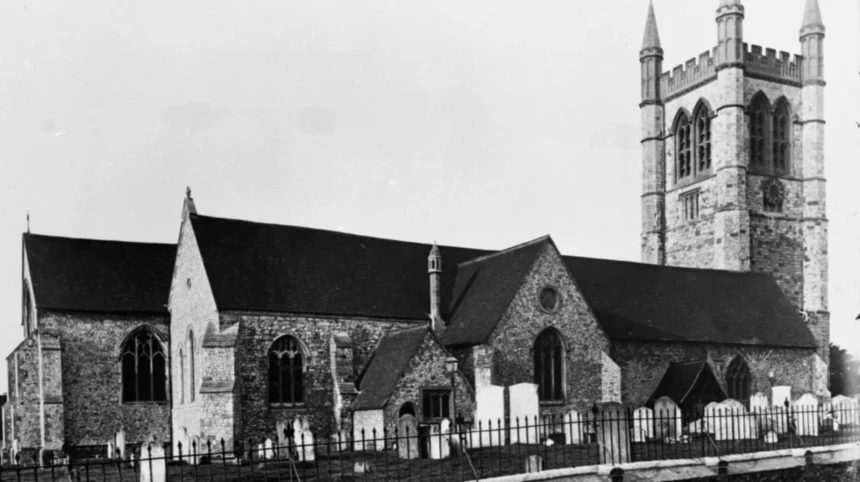
Old Roath Church was demolished in 1868 or 1869 after serving the historic Roath community, and the present St Margaret’s Church was subsequently built on the site, preserving the religious importance of the location while replacing the earlier structure.
St Margaret’s Church occupies one of the most historically important sites in Roath. The location was closely associated with the old village.
Cardiff’s historical records document the demolition of the old church in 1868 or 1869. A replacement church was built on the site.
The loss of the earlier church demonstrates how historic Roath sometimes retained a site’s function while losing the original building.
The church stood near the centre of the old village. Its position helps explain the structure of early Roath, where cottages and other buildings clustered around the parish church.
The old church is particularly significant because visual records survive. Cardiff’s historical record includes an image of Old Roath Church, photographed from a negative associated with Cardiff photographer J. S. Collings.
This type of surviving documentation allows researchers to reconstruct parts of Roath that no longer exist physically.
The present church therefore represents both continuity and change. The religious site survived, but the historic building itself did not.
What happened to Roath Mill?
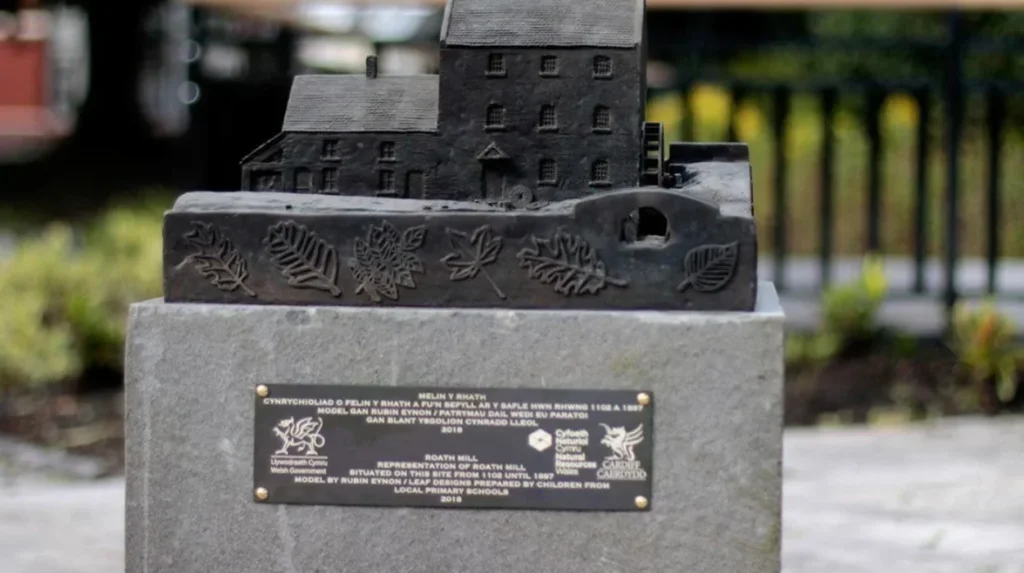
Roath Mill was a long-standing watermill beside the Roath stream, but the historic mill buildings disappeared during modern urban development; archaeological investigation later examined the site for surviving foundations, water-management features and evidence of the earlier medieval mill.
Roath Mill is one of the clearest examples of Roath’s rural and industrial past.
The mill stood beside the stream in the area now associated with Roath Mill Gardens. Milling depended on water management, making the stream and associated infrastructure central to the site.
The mill survived for centuries before disappearing during urban development.
The Cardiff Archaeological Society investigated the site using geophysical survey techniques. Magnetometry and ground-resistivity surveys were used to identify possible buried remains.
Some stonework associated with the mill and its water system remains within the sides of the stream.
The Mill Gardens themselves opened formally on 23 October 1912. Their creation represented a transition from an earlier working landscape to a public recreational environment.
The archaeological significance of Roath Mill extends beyond the visible remains. Buried foundations, channels and other subsurface evidence can reveal how the mill operated and how the landscape was organised.
Roath Mill therefore demonstrates that a demolished building can remain historically important even when little of its structure survives above ground.
What happened to Great House or Ty Mawr?
Great House, also known as Ty Mawr, was one of the major historic houses of early Roath and stood within the former rural landscape; the building was eventually demolished in 1967, leaving modern development over a significant historic site.
Great House was associated with the older estate and agricultural landscape of Roath.
The name Ty Mawr means “Great House” in Welsh. The property represented the larger houses that once stood among farms, cottages and open land before suburban development.
The Roath Local History Society records that Ty Mawr survived until as late as 1967.
Its late demolition is significant because most of Roath’s major transformation had already taken place by that time.
By the mid-twentieth century, Roath was a heavily urbanised district. The survival of an older estate house into the 1960s created a direct physical link with the rural settlement that had existed before Victorian expansion.
The demolition removed that physical connection.
Great House belongs to a wider group of lost Roath properties. The Cardiff Archaeological Society identifies Dean’s Farm, Ty Draw and Ty-y-cyw among the early buildings that disappeared during nineteenth- and twentieth-century development.
These losses show that Roath’s transformation involved the disappearance of many ordinary buildings, not just famous landmarks.
What happened to Roath Village School?
Roath Village School was a small detached school serving local children before Albany Road School opened in 1887; the older school became redundant, closed in 1902 and later disappeared as Roath’s original village landscape was replaced by urban development.
Education provides another clear example of changing Roath.
The original village school was a small building serving a relatively limited rural population. Its scale reflected the size of the historic settlement.
The opening of Albany Road School in 1887 coincided with Roath’s rapid transformation into a larger urban neighbourhood.
The older village school became redundant and closed in 1902.
The change reflects a broader process in Victorian Cardiff. Population growth required larger and more organised educational facilities.
Schools also became important markers of urban expansion. Their construction often accompanied new streets, housing and public infrastructure.
The disappearance of the village school removed another physical reminder of pre-suburban Roath.
Its story also demonstrates why building loss cannot always be attributed to demolition alone. Functional change often came first. Once an institution moved to a larger facility, the older building lost its original purpose.
Which Roath cottages were demolished?
Several cottages associated with historic Roath disappeared during the twentieth century, including Roath Court Cottages and Ty-y-Cwn; their demolition removed small-scale buildings that had formed part of the village landscape before modern roads, commercial premises and redevelopment changed Albany Road.
Roath Court Cottages stood close to the old village school and included three cottages known as Jessamine Cottage 1, Jessamine Cottage 2 and White Rose Cottage.
The cottages survived into the twentieth century. They were demolished in 1958 or 1959, according to local historical records.
Their site later contained a petrol filling station before further redevelopment.
Ty-y-Cwn was another distinctive lost structure. The name means “Dog Cottage” and refers to its reported connection with the lord of the manor’s hounds.
The cottage stood opposite the Claude Road and Albany Road junction. Local historical research records that it was demolished in May 1898 and describes it as a thatched and ramshackle building believed to date from the sixteenth century.
These cottages demonstrate the scale of architectural loss in Roath.
Large mansions attract attention because of their architectural importance. Small cottages often disappear with less public attention, even though they provide crucial evidence about everyday life.
Which Roath mansions and estate buildings have disappeared?
Roath lost several substantial houses and estate buildings as residential development and road construction expanded, including Great House, Bronwydd House and Roath Court Lodge, while surviving properties such as Roath Court and Birchwood Grange preserve parts of the former estate landscape.
Bronwydd House stood in Pen-y-lan and was one of the early villas constructed on Pen-y-lan Hill.
The house was associated with Daniel Thomas, a public works engineer and contractor, and later with Sir Alfred Thomas, who became Lord Pontypridd.
Bronwydd was demolished around 1970 to make way for the Eastern Avenue bypass. The Pen-y-lan wishing well was located within its grounds.
The demolition illustrates the impact of twentieth-century road infrastructure on historic properties.
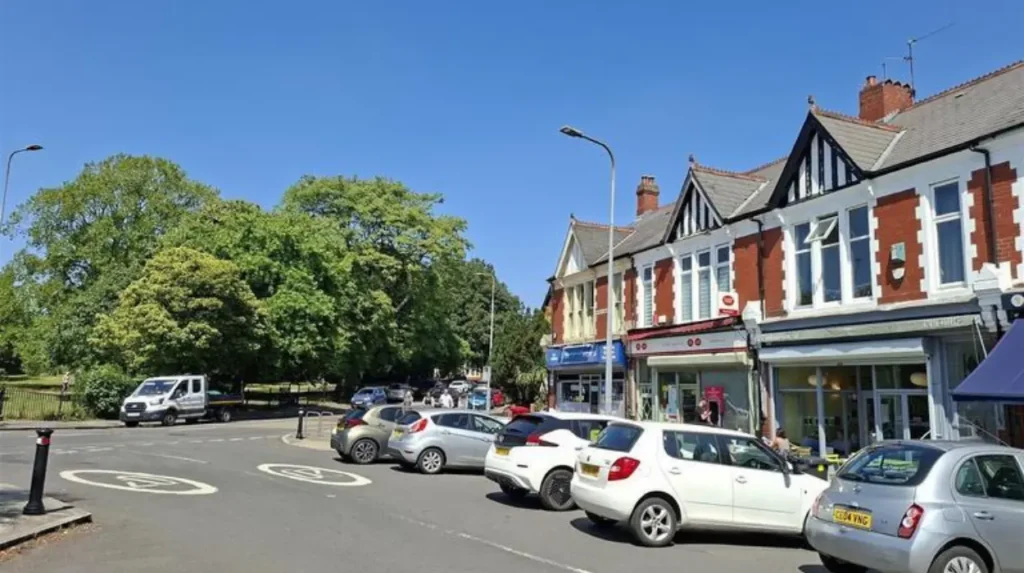
Roath Court Lodge also disappeared. The lodge stood at the junction of Albany Road and Newport Road. Cardiff Council acquired it in 1936, and it was later demolished as part of a road-widening scheme.
Other historic houses survived.
Roath Court remains an important historic building. Its history reaches back to the former manor landscape, and historical records connect the site with the ancient Manor House of Roath Dogfield.
Birchwood Grange in Penylan also survives and is associated with Sir William James Thomas. The building is now connected with Cardiff University’s Cyncoed campus facilities.
The contrast between surviving and demolished properties helps explain how fragments of Roath’s historic landscape remain embedded within modern Cardiff.
Did Roath lose historic industrial and electricity buildings?
Roath also lost major industrial infrastructure, including its former electricity generating station, which operated into approximately 1970 before its buildings were demolished in 1972 and the site was redeveloped for commercial use.
Electricity generation formed an important part of Cardiff’s twentieth-century infrastructure.
The Roath power station operated as part of the city’s electricity system. Generating capacity expanded during the twentieth century, reflecting rising demand from homes, businesses and industry.
The station operated until approximately 1970. Its buildings were demolished in 1972, after which the site was redeveloped with commercial premises.
This represents a different category of lost building from the rural cottages and Victorian villas.
The power station belonged to the industrial infrastructure of modern Cardiff. Its disappearance reflects changes in electricity generation, distribution and land use.
Historic industrial buildings often disappear quickly once their original technical function ends. Large sites also have commercial redevelopment value.
The loss of the power station means that much of Roath’s industrial landscape now exists primarily through photographs, maps, historical records and surviving street patterns.
Did Roath lose railway buildings and stations?
Roath’s wider railway landscape also included stations and railway buildings that disappeared, with the former Roath railway station opening in 1899, closing in 1917 and later being demolished after falling into disrepair and becoming heavily vandalised.
The former Roath railway station was located in the wider Roath-Splott area rather than the modern core of Roath.
The Great Western Railway opened the station in 1899. Passenger services ended on 2 April 1917.
The station contained two platforms with large wooden awnings. During the First World War, the station was used as a reception centre for wounded troops, who were transported to a nearby school being used as a hospital.
After closure, the buildings deteriorated and were vandalised.
One building was later used by the Splott and District Amateur Operatic Society as a workshop for scenery and props. The remaining station structures were eventually demolished.
The site is now associated with the Old Illtydians RFC extension.
The station illustrates how transport infrastructure can have several different phases of use before disappearing completely.
Which former cinemas and entertainment buildings belong to Roath’s lost-building story?
Roath’s entertainment landscape also changed substantially, with former cinemas and halls being converted, closed and redeveloped; the Gaiety Cinema, opened in 1912, later became a bingo hall and bowling venue before entering a prolonged period of vacancy and redevelopment pressure.
The Gaiety was one of Roath’s important twentieth-century entertainment buildings.
It opened in 1912 and originally operated as a cinema showing silent films. The venue could accommodate audiences of up to 800 people.
The building became a bingo hall in 1961 and remained in that role until 1994.
After several years of vacancy, the property became Spin, a bowling alley, restaurant and bar. That use lasted from 2001 until 2006.
The building subsequently remained vacant for extended periods. An evaluation in 2014 recorded substantial deterioration.
A demolition application was approved in 2018 but expired. A later application received approval in December 2023 as developers proposed residential redevelopment.
The Gaiety demonstrates an important distinction in Roath’s architectural history. Some buildings described as “lost” are completely demolished, while others survive in altered, threatened or repurposed forms.
That distinction matters when reconstructing the history of City Road and surrounding neighbourhoods.
What happened to former commercial and civic buildings in Roath?
Roath also lost smaller commercial and civic structures as streets were modernised, businesses changed and redevelopment intensified, including former public-laboratory buildings, shops and historic roadside premises that once supported the district’s expanding Victorian urban economy.
The former Cardiff Public Laboratory buildings on Crofts Street provide one example. Local historical research records their demolition around 2016.
Commercial premises also disappeared.
On Wellfield Road, four lock-up shops known collectively as Albany Buildings were constructed around 1900. They later became known as Cinema Buildings and were numbered 2(a), 2(b), 2(c) and 2(d) Wellfield Road.
The buildings were eventually demolished in 1985 to make way for the Globe Centre complex.
Such buildings formed part of the everyday commercial landscape of Roath.
They housed shops, services and local businesses rather than major civic institutions. Their disappearance therefore changes the character of historic streets just as significantly as the demolition of larger buildings.
The history of Roath is consequently found in both major landmarks and small premises.
How can lost Roath buildings still be identified today?
Lost Roath buildings can still be identified through historic maps, photographs, planning records, archaeological surveys, local-history archives, newspaper reports, architectural studies and surviving street patterns that connect modern Cardiff with its earlier buildings and landscapes.
Historical maps provide one of the most effective ways to reconstruct lost buildings.
Ordnance Survey maps record buildings, roads, fields, watercourses and property boundaries at different dates. Comparing editions reveals when structures appeared or disappeared.
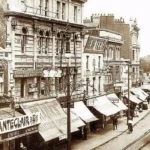
Photographs provide another source of evidence. Cardiff’s historical records contain images of Old Roath Church and other vanished buildings. Local history collections also preserve photographs of former streets and landmarks.
Archaeology provides physical evidence.
The Roath Mill investigation used geophysical survey techniques to search for buried remains associated with the mill and its water system.
Planning records provide evidence for modern demolitions and redevelopment.
Local historical societies add another layer of documentation. The Roath Local History Society has assembled research covering buildings, streets, estates and vanished features across the district.
These sources work together. A map identifies a structure. A photograph reveals its appearance. A planning record establishes its demolition. Archaeology identifies surviving physical evidence.
Explore More Area Guide
Forgotten Industries That Built Cardiff’s Industrial Legacy
Cardiff Streets Named After Historic Figures: Their History
Why are the lost buildings of Roath important to Cardiff history?
The lost buildings of Roath are important because they document Cardiff’s transition from rural settlement to Victorian suburb and modern urban district, revealing changes in housing, transport, education, industry, recreation, public services and land use across two centuries.
The history of Roath is not limited to surviving listed buildings.
Demolished structures reveal the scale and speed of urban change.
Old Roath Church documents the earlier village community. Roath Mill records rural industry and water management. Great House and other estate properties show the landholding structure that preceded mass suburbanisation.
The village school demonstrates changing educational needs. Cottages such as Roath Court Cottages and Ty-y-Cwn reveal everyday residential architecture.
Bronwydd House records the development of nineteenth-century villas, while its demolition demonstrates the later impact of major transport infrastructure.
The Roath power station represents modern electricity infrastructure. The former railway station demonstrates the importance of rail transport and the consequences of changing passenger services.
The Gaiety represents the changing entertainment economy of City Road.
Together, these buildings create a chronological record of urban transformation.
Their disappearance also explains why modern Roath looks different from the settlement shown on nineteenth-century maps.
What does the future preservation of Roath’s history depend on?
Preserving Roath’s history depends on identifying significant surviving structures, documenting threatened buildings, maintaining historic records, protecting archaeological evidence and interpreting lost sites so that redevelopment does not erase knowledge of the district’s earlier landscapes.
Historic preservation does not require every old building to survive.
Documentation is essential when buildings cannot be retained. Photographs, measured surveys, architectural descriptions, maps and archival records preserve information about structures that have already disappeared.
Roath’s archaeological evidence also requires attention. The survival of buried foundations and water-management features at former sites demonstrates that demolition above ground does not necessarily remove all historical evidence.
The history of Roath Park provides another useful example of preservation and change. Cadw designated Roath Park a Grade I registered historic park and garden in 2022. The park was created between 1887 and 1894 and remains an important example of late-Victorian public-park design.
Cadw records that the park retains much of its original framework even though planting, layout and built structures have changed.
This distinction is important.
Historic Roath is not simply a collection of buildings that survived or disappeared. It is a landscape shaped by continuity, replacement, adaptation and redevelopment.
The lost buildings provide the missing parts of that landscape.
For residents, researchers and visitors, understanding these vanished structures makes modern Roath easier to interpret. Roads, parks, commercial centres and residential streets often occupy sites with much older histories.
The lost buildings of Roath therefore remain part of Cardiff’s built heritage even when their walls no longer exist.
What are the lost buildings of Roath?
The lost buildings of Roath are historic structures that once stood in Roath, Cardiff, but have since been demolished or disappeared through redevelopment. Examples include Old Roath Church, Roath Mill, Great House, Ty-y-Cwn, Roath Village School and Bronwydd House.