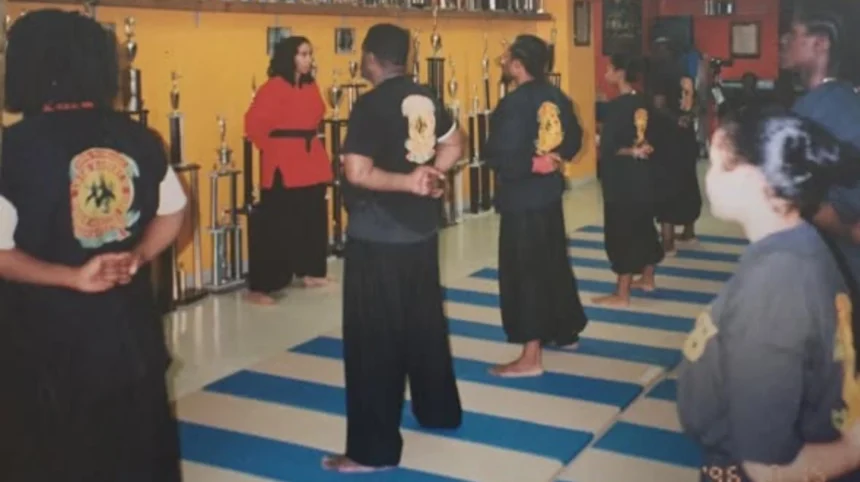
Martial arts can mean serious business for many. Gruelling bouts of sparring, hours of standing in awkward stances and even the wielding of complex weapons learned in a complicated sequence. They can activate our senses and even give us a degree of excitement and wonder for distant cultures and time periods. Training is often tough and even painful in different ways, and practitioners of martial arts must find a way to ease the mental, emotional and physical tension that can be built up over time. However, there is also an essential ingredient to a successful martial arts class: Humour. Despite many martial arts being designed primarily for civilian, martial or sporting combat, it is common to witness teachers joking from the outset of a class as people line up to bow, salute or limber up their bodies through the warm-up. My ethnographic research (sustained social scientific fieldwork) and active community engagement in a variety of fighting systems around the world has led me to observe sifus, sensei, mestres, instructors and the like all easing the tension with a few soft words or gestures.
Why might the martial arts teachers make jokes in a warm-up or a demonstration in the first place? One reason is that these public expressions of humour enable these educators to establish a sense of belonging and fraternity. Laughing at themselves and their habits, at the quirkiness of established members of the group at strange positions bodies might find themselves in or even the seemingly extreme versions of the same martial art taught down the road can all enable student to feel connected with a shared social identity. This in turn is contrasted to other potentially rival identities, such as other martial arts taught in the local area, historical antagonists or systems and styles that they believe are invalid (in terms of self-defence, competition or cultural authenticity). Our identity in terms of what we are and what we want to be known for is often developed off the basis of what we are not or what we wish to be distanced from, with rivals and antagonists being used as a deliberate contrast.
Some practitioners joked about how difficult the training is. I have seen this countless times in Tai Chi classes, where the holding of postures for many minutes leaves students with aching shoulders and sore feet. They share these comments with a wry smile, in the belief that they will be eventually transformed after years of dedicated practice. Colleagues training in wider organisations have told me of other forms of jokes in different martial arts in which age seems to present itself as a barrier, with students hinting that they are too old for this kind of exercise.
Other jokes can lead to the formation of nicknames in some groups, which can be a sign of endearment towards a particularly eccentric or alternative individual. Making both parties laugh ensures that students on the receiving end accept this jest, and now that they have established a reputation for being particularly evasive, “crazy” or aggressive. Jokes for longstanding students normally shows that others recognise their individual approach and unique characteristic. Fellow students openly joke about each other in front of others – especially in moments where the action has simmered down, as in the cool-down of a session. Beginners, however, are rarely given nicknames, and they are normally treated in a purely professional and gentle manner under most sensible instructors wishing for them to return for a second class.
As indicated by the examples above, the nature of a given martial art will enable certain kinds of jokes about specific topics. My research into historical European martial arts (HEMA), for instance, identified jokes about left-handed fencers who were labelled “filthy lefties.” This might initially appear as a derogatory, discriminatory term, but is turned out to be an in-house joke for a larger-than-normal contingent of left-handers who were respected as being tough opponents to fight with thanks to the “southpaw advantage” in combat sports. This advantage is also seen in tennis and a range of other sports in which left-handed athletes are overrepresented and highly successful.
Although jokes are normally expressed through oral language, the martial arts lend themselves well to physical comedy. I recall Wing Chun teachers mocking the rigid footwork movements of other practitioners of their art and those who tried to emulate the catlike movements of Bruce Lee in a competition. Beyond face-to-face interaction, online interactions and social media enable many quick comments and responses in which speed of thought and creative wit are needed for a successful pun and reply to initiate laughs, emojis and shares.
Nonetheless, we must be cautious about accepting an excess of humour. Martial arts and other challenging physical pursuits must balance serious training in proper technique coupled with safety measure including the wearing of the proper kit. Fellow students must strike or grapple to a sensible level of intensity. Joking too much in martial arts and related activities would be ludicrous and reckless, and it is not what fee-paying students sign up for. The nature of humour and the direction of it to a specific individual might take supposed “banter” too far, edging to the category of bullying and harassment. This is especially the case within an (often male-dominated) environment in which there is a significant power imbalance and a clear hierarchy. As with the balance between hard/soft, yin/yang and attack/defence, instructors and leaders of martial arts and combat sports must balance the serious matters of risk management, safeguarding and wellbeing with fun, games and relaxation.
The views expressed in this article are the author’s own and do not necessarily reflect (Cardiff Daily) editorial policy.