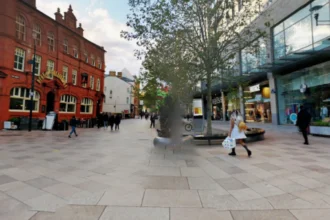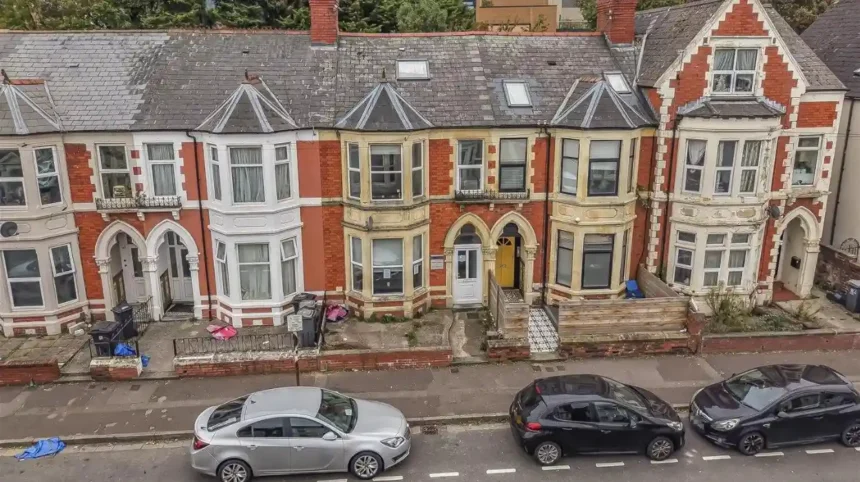
Cardiff’s terraced housing is one of the clearest surviving records of the city’s transformation from a small market town into an industrial and commercial capital. The terraces found across areas such as Roath, Splott, Grangetown, Canton, Riverside, Cathays, Adamsdown and parts of the city centre developed alongside railways, docks, coal exports, industry and rapid population growth.
- Why did Cardiff develop so many terraced houses?
- When did Cardiff’s terraced housing expand most rapidly?
- How did the coal industry influence Cardiff’s terraced housing?
- What did Victorian Cardiff terraces typically look like?
- Which Cardiff neighbourhoods are associated with historic terraced housing?
- Who built Cardiff’s terraced houses?
- How did railway expansion affect Cardiff’s terraced streets?
- What were living conditions like in Cardiff’s historic terraces?
- How did Cardiff’s terraced housing change during the twentieth century?
- How are Cardiff’s historic terraces protected today?
- Why are Cardiff’s terraces important to the city’s heritage?
- How does Cardiff’s terraced housing remain relevant today?
- What can Cardiff’s terraced housing tell us about the city’s history?
Terraced housing means a group of adjoining houses built in a continuous row, usually sharing side walls. In Cardiff, this form became particularly important during the nineteenth and early twentieth centuries because it provided relatively dense residential accommodation close to employment.
The history of these houses is therefore closely connected with Cardiff’s economic development. The expansion of Cardiff Docks, the growth of the South Wales coal trade and the arrival of railway infrastructure transformed demand for housing. Cardiff expanded rapidly from the 1830s, with its population increasing alongside the development of the port and surrounding industries. Coflein records that Cardiff grew at nearly 80% per decade between 1840 and 1870.
The surviving terraces also reveal changes in architecture, building regulation, household size, sanitation, transport, social class and land ownership. Their streetscapes remain important parts of Cardiff’s historic identity.
Why did Cardiff develop so many terraced houses?
Cardiff developed extensive terraced housing because industrial expansion created sustained demand for compact family homes near docks, railways, workplaces and commercial districts. Developers divided land into building plots and constructed repeated rows that accommodated growing urban populations efficiently.
Before industrialisation, Cardiff was considerably smaller than the city known today. Its economy was connected to agriculture, local commerce, coastal trade and regional administration.
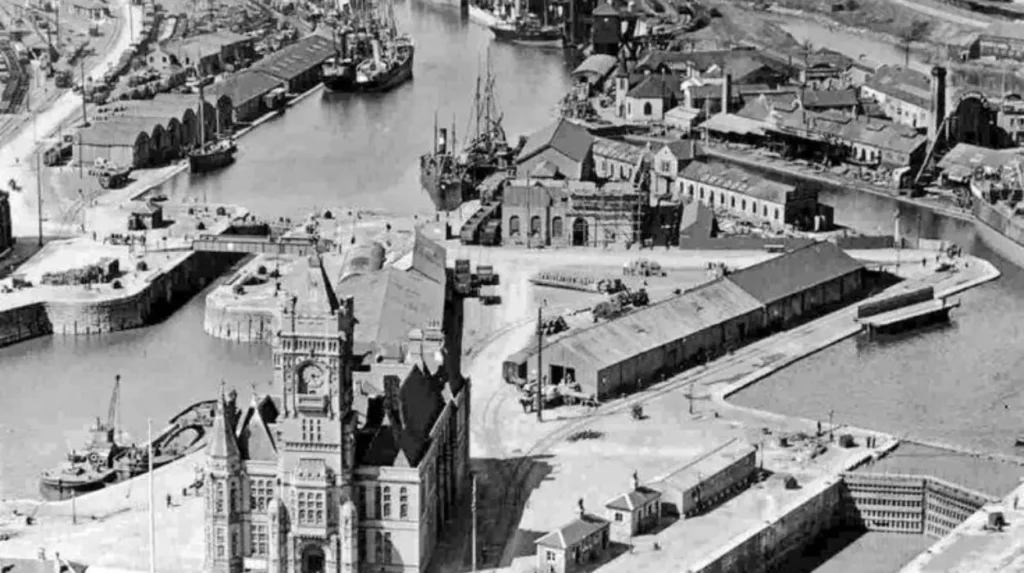
The industrial expansion of South Wales changed this position. The Glamorganshire Canal connected Cardiff with the industrial areas around Merthyr Tydfil. The canal system improved the movement of minerals towards the port. Cardiff’s first Bute Dock opened in 1839, followed by the East Bute Dock in 1859.
Coal became particularly important. Cardiff developed into a major export port for coal from the South Wales coalfield. Cardiff University records coal exports exceeding 10 million tons by 1913.
This economic growth generated employment in mining-related commerce, docks, railways, shipping, engineering, construction, retail and domestic services.
Workers needed homes close to their employment. Developers therefore created residential districts around the expanding urban area.
Terraces were suited to this environment because several houses could be constructed along a single street frontage. Shared walls reduced the amount of land required per dwelling. Repeated designs also simplified construction.
The result was a housing form capable of supporting rapid urban growth.
When did Cardiff’s terraced housing expand most rapidly?
Cardiff’s terraced housing expanded most rapidly during the nineteenth century and early twentieth century, particularly from the Victorian period onwards. Industrial growth, dock expansion, railway development and population increase created sustained demand for new residential streets across expanding suburbs.
The key period began during the nineteenth century. Cardiff’s earlier urban form was concentrated around the historic town and its immediate surroundings.
The development of Cardiff Docks changed the scale of the city. The West Bute Dock opened in 1839, while the East Bute Dock opened in 1859. Later dock development included Roath Dock in 1887 and the Queen Alexandra Dock in 1907.
Railways reinforced this expansion. The Taff Vale Railway opened in 1841 and connected Cardiff with industrial areas to the north. Rail transport supported both the movement of coal and the movement of people.
Housing construction followed these transport and employment networks.
By the late nineteenth century, large areas of Cardiff were being laid out with streets of houses. Building activity extended beyond the historic centre into districts that now form some of the city’s best-known residential neighbourhoods.
Glamorgan Archives holds Cardiff Borough building regulation plans and other records that document this development. These records provide evidence of individual building applications, property alterations and the construction process.
The Victorian period therefore represents the central phase in the creation of Cardiff’s characteristic terraced streets.
How did the coal industry influence Cardiff’s terraced housing?
The coal industry transformed Cardiff from a relatively small town into a major international port and created employment that increased housing demand. Terraced streets expanded around docklands, railway corridors and suburban districts serving workers, tradespeople, clerks and other urban occupations.
Coal from the South Wales valleys was the foundation of Cardiff’s nineteenth-century economic expansion.
The port provided an international outlet for coal produced in areas including the Rhondda, Cynon and Rhymney valleys. Cardiff University describes the city as a “Coal Metropolis” during the period from 1801 to the 1920s.
The economic effects extended far beyond dock labour.
Coal exports required railway workers, shipbuilders, engineers, warehouse employees, merchants, office workers, shopkeepers and construction workers. A growing workforce created demand for different forms of housing.
Terraced houses became particularly suitable for working and lower-middle-income households.
The relationship between industry and housing was also geographic. Residential districts developed within practical travelling distances of employment centres. Streets in areas such as Grangetown, Splott and Adamsdown became part of the urban expansion associated with Cardiff’s industrial economy.
The housing landscape therefore reflected the city’s employment structure.
The importance of the port continued into the early twentieth century. Cardiff’s coal exports exceeded 10 million tons in 1913, demonstrating the scale of the economic system supporting the city’s population.
When coal exports later declined, the housing remained. The terraces consequently became physical records of an economic system that had already changed.
What did Victorian Cardiff terraces typically look like?
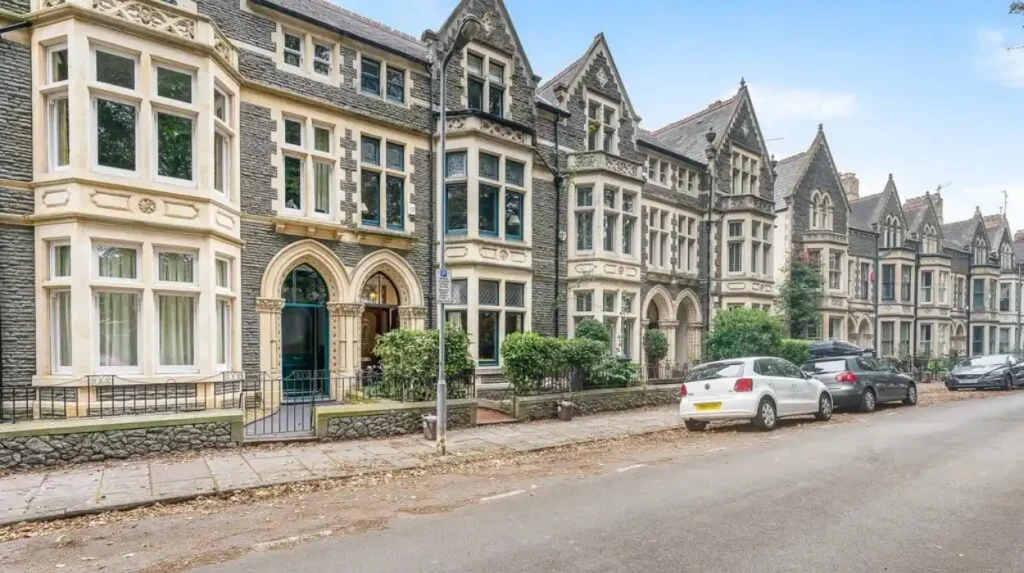
Victorian Cardiff terraces typically consisted of repeated two- or three-storey houses arranged along continuous street frontages. Common features included brick or rendered elevations, narrow plots, vertically proportioned windows, front doors facing pavements and rear yards or gardens.
Terraced housing was not architecturally identical across Cardiff.
The design varied according to date, location, developer, intended residents and land value.
Some streets contained modest two-storey houses. Other areas contained larger three-storey townhouses with more elaborate architectural detailing.
Cardiff Council’s conservation documentation identifies nineteenth-century terraces with classical and Italianate influences. Charles Street, for example, contains groups of two- and three-storey Victorian townhouses with repeated architectural elements and uniform plot widths.
Typical characteristics included:
- A narrow frontage facing the street.
- Shared party walls between adjoining properties.
- Two or three floors.
- A front entrance opening directly from the pavement or a small forecourt.
- A rear yard or garden.
- Repeated window and door arrangements.
- Chimneys serving fireplaces.
- Slate roofs.
- Brick, painted brick, rendered or stucco finishes.
Larger terraces often had stronger architectural detailing.
Decorative brickwork, stone surrounds, bay windows, moulded window openings, cornices and parapets appeared in higher-status developments.
The uniformity of terraces was practical as well as aesthetic. Repeated house plans allowed builders to develop entire streets in coordinated phases.
Which Cardiff neighbourhoods are associated with historic terraced housing?
Historic terraced housing survives across Cardiff neighbourhoods including Roath, Splott, Grangetown, Canton, Riverside, Cathays and Adamsdown. Each district reflects different phases of urban expansion, land development, housing demand and architectural change during Cardiff’s industrial growth.
Roath became one of the major residential areas associated with Cardiff’s nineteenth-century expansion.
Its development included terraces, villas, commercial premises and institutional buildings. The district’s location east of the historic centre provided substantial land for urban growth.
Adamsdown also contains extensive historic residential development. Its proximity to the city centre and employment areas made it suitable for dense housing.
Splott developed further east and became closely associated with industrial and railway activity.
Grangetown developed south of the central area, close to Cardiff Docks and the industries associated with the port.
Canton and Riverside expanded west of the city centre. Their terraces formed part of the wider suburbanisation of Cardiff.
Cathays developed rapidly during the later nineteenth century and became characterised by substantial Victorian and Edwardian residential architecture.
The surviving neighbourhood pattern demonstrates that terraced housing was not confined to one social group or one part of Cardiff. Different streets were built for different markets.
Dumfries Place provides a documented example. Glamorgan Archives records around 24 substantial houses dating from the 1870s, mostly forming a terrace, with development undertaken on a speculative basis by local builders.
Who built Cardiff’s terraced houses?
Cardiff’s terraces were constructed through a combination of landowners, developers, speculative builders, architects, contractors and investors. The Bute estate played a major role in controlling urban land, while local builders developed individual streets and groups of houses for expanding markets.
Land ownership was fundamental to Cardiff’s development.
The Bute family controlled extensive areas of land in and around Cardiff. The second Marquess of Bute, John Crichton-Stuart, invested heavily in transport and dock infrastructure that supported the city’s expansion.
Land was often leased rather than simply sold outright.
Urban development therefore involved ground rents, building agreements and estate management. The National Library of Wales holds Cardiff estate ledgers dating from 1893 to 1960, alongside earlier Glamorgan estate records covering urban ground rents.
Local builders also played a direct role.
Glamorgan Archives records the construction of Dumfries Place by several local builders during the 1870s. The evidence demonstrates that residential development was not solely controlled by a single construction company.
Speculative building was an important mechanism.
A builder acquired or leased land, constructed houses and then sold or rented them to households. Repeated terraces reduced design variation and allowed construction to proceed across multiple plots.
This system contributed significantly to Cardiff’s rapid suburban growth.
How did railway expansion affect Cardiff’s terraced streets?
Railway expansion increased Cardiff’s connectivity with industrial districts, docks and regional markets. New railway infrastructure supported employment growth and encouraged residential development along accessible corridors, helping extend terraced housing beyond the historic core into expanding nineteenth-century suburbs.
The Taff Vale Railway was particularly important to Cardiff’s industrial development.
Opened in 1841, it connected Cardiff with the coal-producing and industrial areas north of the city. The railway complemented canal and dock infrastructure.
Railways changed the geography of urban development.
Workers did not need to live immediately beside their workplace in every case. Transport connections expanded the practical residential area around employment centres.
Railway infrastructure also occupied significant amounts of urban land. Some residential streets were developed close to railway lines, sidings and industrial premises.
Dumfries Place offers an example of this relationship. Glamorgan Archives records that the residential development backed onto the Taff Vale Railway.
The railway therefore influenced both where houses were built and the physical character of neighbourhoods.
Industrial transport also increased the need for commercial services. Shops, schools, churches and public houses appeared alongside residential expansion.
Terraced streets were consequently components of larger urban systems rather than isolated housing projects.
What were living conditions like in Cardiff’s historic terraces?
Living conditions varied significantly between properties and periods. Historic terraces provided permanent family accommodation, but nineteenth-century households faced challenges involving sanitation, overcrowding, drainage, ventilation, water supply and limited domestic space before modern housing standards improved.
Terraced housing provided important advantages.
A permanent house gave working families greater residential stability than temporary or informal accommodation. The repeated street layout also created established communities with nearby shops, schools and services.
However, nineteenth-century urban housing faced serious public-health problems.
Population growth could produce high residential density. Houses sometimes accommodated large families, lodgers or multiple households. Rear yards were often small.
Sanitation standards also developed gradually.
The nineteenth century saw increasing recognition of the relationship between poor housing and disease. Local authorities progressively introduced requirements concerning drainage, sanitation, construction and public health.
Building regulation records are particularly important for understanding this process. Glamorgan Archives has catalogued Cardiff Borough building regulation plans, allowing researchers to examine historical applications and construction documentation.
Housing conditions also varied by income.
A substantial three-storey terrace for professional households differed from a smaller workers’ house near an industrial district.
This distinction is important when interpreting Cardiff’s terraced housing. The term “terrace” describes a building form, not a single social class.
How did Cardiff’s terraced housing change during the twentieth century?
Cardiff’s terraced housing changed through alterations, extensions, conversions, demolition, redevelopment and shifts in household use. Some streets retained their original residential character, while others experienced commercial conversion, modernisation or redevelopment during twentieth-century urban change.
The early twentieth century continued the development of residential neighbourhoods created during the Victorian period.
Edwardian construction introduced additional architectural styles and larger suburban properties. However, the basic terrace remained an established Cardiff housing form.
The First World War and economic changes affected household life and urban development.
The interwar period brought new housing policies and council-built estates. Public-sector housing expanded the range of accommodation available beyond privately developed terraces.
After the Second World War, planning priorities increasingly addressed overcrowding, traffic, redevelopment and modern housing standards.
Some older terraces were demolished.
Others were modernised.
Some properties changed from single-family residences into flats or other uses. Commercial activity also altered historic streets.
Cardiff’s city centre provides a clear example of changing land use. Cardiff Council’s Charles Street conservation assessment records that former residential properties increasingly acquired business uses from the 1870s onwards.
The twentieth century therefore did not simply preserve Victorian Cardiff. It changed the function and condition of its inherited housing stock.
How are Cardiff’s historic terraces protected today?
Cardiff’s historic terraces receive protection through conservation areas, planning controls, listed-building legislation and local heritage policies. Cardiff currently has 27 conservation areas covering places of special architectural or historic interest, with additional controls applying in designated locations.
Cardiff Council identifies 27 conservation areas across the city. These areas are designated because of their special architectural or historic interest.
Conservation-area status does not automatically mean every property is individually listed.
Instead, it protects the character of a wider area. This includes streetscape, building relationships, architectural details, trees and historic urban form.
Article 4 Directions provide additional planning controls in selected locations. Cardiff Council explains that these directions can remove certain permitted development rights, including controls over alterations such as windows.
This matters for terraced housing because small changes can affect the appearance of an entire street.
Replacement windows, doors, roof alterations, rendering, painting and extensions can change historic architectural character.
Owners therefore need to establish whether a property sits within a conservation area and whether additional planning controls apply before undertaking certain external works.
Historic housing protection balances continued residential use with preservation of architectural and urban heritage.
Why are Cardiff’s terraces important to the city’s heritage?
Cardiff’s terraced houses preserve evidence of industrialisation, population growth, migration, employment, land ownership, architecture and urban planning. Their repeated streetscapes show how Cardiff physically expanded alongside the coal trade, docks, railways and nineteenth-century economic development.
Terraced housing is valuable because it connects social history with physical evidence.
A surviving row can reveal the scale of an historic development. Uniform plots can indicate speculative construction. Architectural differences can identify changes in building periods.
The location of streets provides further information.
Terraces near former docks demonstrate the relationship between housing and port employment. Streets near railway corridors reveal transport connections. Larger houses in particular districts reflect differences in household income and development value.
Historical records strengthen this interpretation.
Glamorgan Archives uses census returns, maps, trade directories, photographs and other sources to investigate Cardiff’s communities and buildings.
Census records are particularly useful because surviving individual census returns cover the period from 1841 onwards. They can help researchers examine household composition and occupation at particular addresses.
Property records add another layer.
Estate ledgers, building plans and sales particulars can show ownership, rents, construction and changes in use.
Together, these sources transform terraced streets from architectural features into historical evidence.
Explore More Area Guide
Edwardian Homes Across Penylan: Architecture & History Cardiff 2026
Victorian Architecture in Roath Explained: Cardiff Guide
How does Cardiff’s terraced housing remain relevant today?
Cardiff’s terraced housing remains relevant because large numbers of historic homes continue to provide residential accommodation while preserving the physical structure of nineteenth- and early twentieth-century neighbourhoods. Their future depends on appropriate maintenance, adaptation and heritage-sensitive planning.
Historic terraces remain part of Cardiff’s active housing stock.
They are not simply museum buildings. Many continue as family homes, rental properties, flats and mixed-use premises.
Their compact urban form also remains relevant to contemporary city planning.
Terraced housing uses land efficiently and creates walkable residential streets. Many historic terraces are close to shops, public transport, schools, employment areas and city-centre services.
However, historic properties require appropriate maintenance.
Ageing roofs, masonry, windows, damp problems, drainage and building services require ongoing investment. Modern energy-efficiency improvements also need to consider the construction methods and architectural character of older buildings.
Heritage controls provide a framework for managing these changes.
Cardiff Council’s conservation programme recognises the importance of protecting the city’s historic built environment while providing planning guidance for property alterations.
The future of Cardiff’s terraces therefore involves continued residential use alongside conservation.
Their importance extends beyond appearance. They represent the physical consequences of the industrial transformation that created modern Cardiff.
What can Cardiff’s terraced housing tell us about the city’s history?
Cardiff’s terraced housing records the city’s transformation from a smaller pre-industrial settlement into a major industrial port and capital. Its streets reveal connections between coal exports, docks, railways, land ownership, population growth, architecture, public health and modern urban planning.
The history begins with a relatively small settlement connected to regional trade.
Transport infrastructure changed the city’s economic position.
The Glamorganshire Canal created a stronger connection between Cardiff and the industrial valleys. The nineteenth-century docks then established Cardiff as a major export centre.
Railways strengthened this economic network.
Population growth followed employment.
Terraced houses provided the physical infrastructure required for that population increase. Developers subdivided land, constructed repeated rows and established new neighbourhoods.
The architecture recorded social differences. Modest terraces housed working families, while larger townhouses reflected higher incomes and different residential markets.
Public-health reforms subsequently changed expectations for sanitation and housing.
Twentieth-century redevelopment altered some streets while preserving others.
Today, conservation areas and planning controls protect significant historic environments.
The history of Cardiff’s terraced housing is therefore the history of urban expansion itself. Each surviving terrace contributes evidence about when a neighbourhood developed, who lived there, how people worked and how the city responded to industrialisation.
For readers travelling from Bristol, Cardiff’s terraces also provide a useful way to understand the wider industrial history of South Wales. Cardiff’s growth was directly connected to regional coal production and international maritime trade, making its residential architecture an important part of the broader history of the Bristol Channel and South Wales.
When did terraced housing become common in Cardiff?
Terraced housing became widespread in Cardiff during the 19th century, especially during the Victorian period. Rapid industrialisation, population growth, railway expansion and the development of Cardiff Docks created strong demand for affordable and compact urban housing.