
Cardiff school transport helps eligible children travel between home and school through dedicated school buses, public bus services, and specialist transport arrangements. Cardiff Council manages eligibility assessments, bus passes, designated routes, and transport support for pupils with additional learning needs.
- What is Cardiff school transport and how does the system work?
- Which children qualify for free school transport in Cardiff?
- How does the two-mile rule apply to primary pupils?
- How does the three-mile rule apply to secondary pupils?
- How does Cardiff Council measure the distance to school?
- Where can parents find Cardiff school bus routes and timetables?
- How can parents identify the correct pickup point?
- What happens when a dedicated school bus is unavailable?
- How do parents apply for a Cardiff school bus pass?
- Does Cardiff provide free transport for sixth-form pupils?
- How does Cardiff school transport support pupils with additional learning needs?
- What happens if a pupil does not qualify for free school transport?
- What safety rules apply to Cardiff school bus journeys?
- How can parents challenge a Cardiff school transport decision?
- How is Cardiff school transport policy changing for September 2027?
- How should parents plan a reliable school journey in Cardiff?
- Where can families find official Cardiff school transport information?
Understanding Cardiff school transport eligibility is important for parents choosing a school, moving to a new address, or preparing a child to start Year 7. The rules depend on the child’s age, the distance to the relevant school, the walking route, and the council’s school transport policy.
For the 2026–2027 academic year, Cardiff Council’s published policy applies to school admissions up to August 2027. A refreshed policy approved in September 2026 is scheduled to apply to admissions from September 2027, with no substantive changes to eligibility or transport provision proposed in the published decision.
What is Cardiff school transport and how does the system work?
Cardiff school transport is a council-managed service that provides eligible pupils with free travel between home and school. It operates through designated school buses or public buses, with separate arrangements for pupils whose additional learning needs require specialist transport.
Cardiff Council is the local authority responsible for arranging mainstream home-to-school transport in the Welsh capital. The service supports children who live beyond the applicable walking-distance threshold for their qualifying school.
The system has three main components: eligibility assessment, transport allocation, and journey management. The council determines whether a pupil qualifies, identifies the appropriate service, and issues a bus pass when required.
Dedicated school buses operate on designated routes serving particular schools and pickup points. Where a dedicated school service is unavailable for an eligible pupil, Cardiff Council states that it issues a pass for public transport buses.
Specialist arrangements address individual needs that mainstream services do not adequately meet. These include transport by taxi or minibus for some pupils with additional learning needs.
Parents remain responsible for ensuring their children attend school. Free transport is available only when the relevant eligibility requirements are met, so families should check the council’s rules before relying on a school bus.
The official Cardiff Council school transport service provides access to mainstream transport, additional learning needs support, bus routes, passes, spare-seat information, appeals, and complaints.
Which children qualify for free school transport in Cardiff?
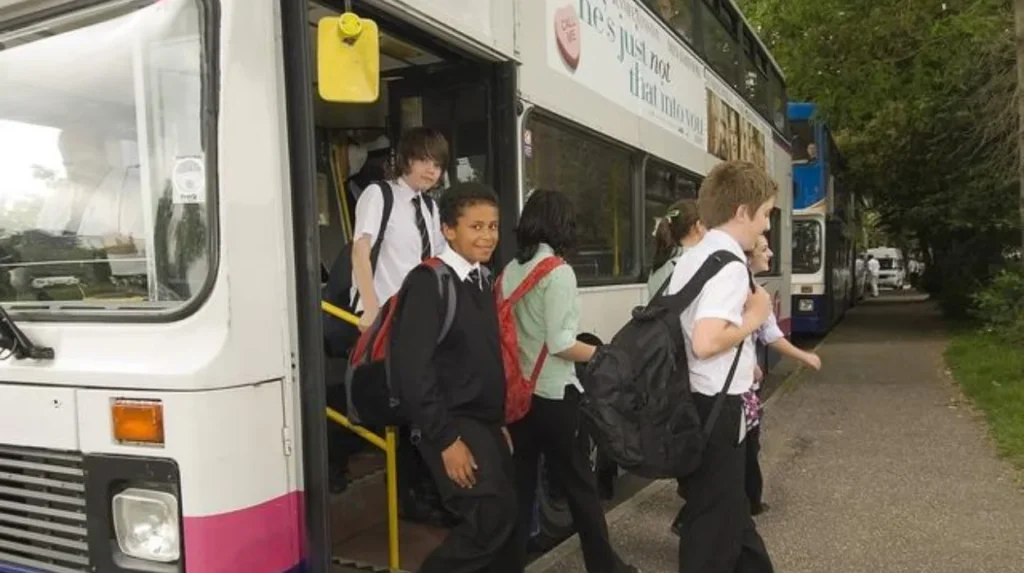
Children aged 5 to 16 can qualify for free school transport in Cardiff when they meet the applicable distance requirements and school-placement criteria. Primary pupils generally need to live over two miles from their qualifying school, while secondary pupils need to live over three miles away.
Cardiff Council assesses mainstream eligibility using the shortest walking route rather than simply measuring the straight-line distance between a home and school. This distinction matters because roads, pedestrian access, and the available walking route affect the measured journey.
For primary school pupils, the standard distance threshold is more than two miles from the relevant catchment school. For secondary school pupils, the standard threshold is more than three miles.
The council considers the catchment school and, in specified circumstances, the next nearest school applied for or offered when the catchment school is full. Eligibility therefore depends on the council’s assessment rather than the family’s preferred school alone.
The main age and distance criteria are consistent with the framework established by the Learner Travel (Wales) Measure 2008. The legislation places duties on Welsh local authorities to provide free transport for eligible compulsory-school-age learners attending qualifying schools.
How does the two-mile rule apply to primary pupils?
Primary pupils are assessed against the two-mile threshold. A child living beyond that distance from the qualifying school meets the standard distance condition, subject to the applicable school-placement and policy requirements.
For example, a primary school child living 2.4 miles from the relevant catchment school satisfies the distance threshold. The council still needs to establish that the school and circumstances meet the remaining eligibility criteria.
A child living 1.8 miles away does not meet the ordinary two-mile distance condition. Families in this position need to check whether another provision in the council’s policy applies.
How does the three-mile rule apply to secondary pupils?
Secondary pupils are assessed against the three-mile threshold. A child living more than three miles from the qualifying school meets the standard distance condition, subject to the council’s school-placement criteria.
For example, a secondary pupil living 3.6 miles from the relevant school meets the standard distance threshold. The final decision depends on the council’s assessment of the qualifying school and route.
A pupil living 2.7 miles away does not meet the ordinary three-mile condition. Parents should confirm the measured route and ask the council about any other applicable eligibility provisions.
These examples explain the thresholds; they do not constitute individual eligibility decisions.
How does Cardiff Council measure the distance to school?
Cardiff Council measures school transport eligibility using the shortest walking route between the home address and the relevant school. The assessment is based on walking distance, not driving distance or a straight-line map measurement, so the route itself matters.
The shortest walking route represents the journey a pupil can take on foot using the available pedestrian network. A driving route can be longer or shorter because vehicles use different roads, junctions, and access points.
Parents should begin by identifying their official home address and the school used in the council’s eligibility assessment. They should then check the walking route and compare the distance with the relevant primary or secondary threshold.
Cardiff Council provides a school map that helps families identify catchment areas, nearest primary and secondary schools, and special schools. This resource supports school selection, but the map alone does not replace an official transport eligibility decision.
Why does the catchment school matter?
A catchment school is the school associated with a particular residential area under the council’s school admission arrangements. Cardiff’s catchment boundaries help determine which school is relevant when assessing eligibility.
The nearest school and the catchment school are not always the same. Cardiff Council explicitly advises parents that living in a school’s catchment area does not guarantee a place.
Families choosing a school outside their catchment area should therefore check transport eligibility before accepting a place. A longer journey resulting from parental preference does not automatically create entitlement to free transport.
Where can parents find Cardiff school bus routes and timetables?
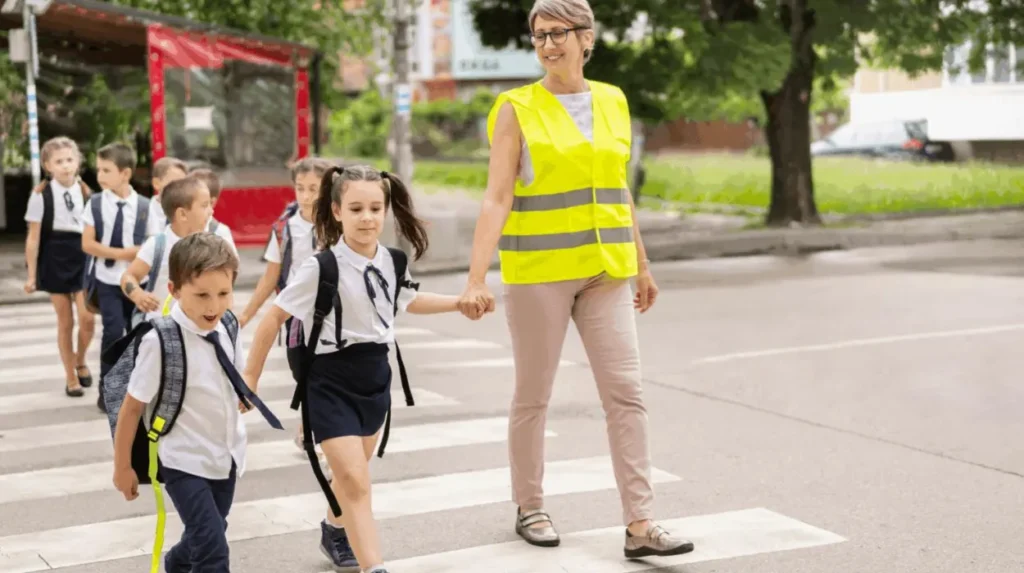
Parents can find Cardiff school bus routes, pickup points, and timetable information through Cardiff Council’s official school transport pages. Eligible families receive information about their allocated service, while published route timetables help parents plan school-day journeys and identify the correct stops.
The council’s school transport website links to route information for primary and secondary pupils. It also provides access to bus-pass services and information about transport for pupils with additional learning needs.
Families should use the current timetable for their child’s allocated service rather than relying on an old route map or information shared by another parent. Routes, pickup arrangements, and service details can change between academic years.
A practical route check should establish the following information:
- The school bus service allocated to the pupil, such as the dedicated service named in the council’s letter.
- The authorised pickup and drop-off points, including the stop closest to the home.
- The scheduled morning departure and afternoon arrival times.
- The school’s normal start and finish times, including any changes communicated by the school.
- The procedure for reporting a missed service, disruption, or an incident.
These details help families establish a reliable routine before the first school day.
How can parents identify the correct pickup point?
Parents should match the route timetable to the service specified in the council’s communication. They should verify the stop name, direction of travel, and scheduled time before the child starts using the service.
The nearest physical stop is not necessarily an authorised stop for every school bus. Some services operate fixed pickup points, and pupils need to use the stops assigned to their route.
For a new Year 7 pupil, checking the route before September helps the family establish how long the walk to the stop takes and when the child needs to leave home. Parents should also agree on a safe waiting point and a backup arrangement if the bus is delayed.
What happens when a dedicated school bus is unavailable?
Cardiff Council states that eligible pupils receive a pass for public transport buses when a dedicated school bus service is unavailable in their area. The allocated public service then provides the transport option for the qualifying journey.
Parents should check which public bus service the pass covers, whether it is valid for the required school journey, and which stops the pupil needs to use. They should not assume that every public bus route is included.
For general journey planning, Traveline Cymru provides public transport information across Wales. It helps families plan connections and compare available services, although the council remains the authority for school transport eligibility and allocated passes.
How do parents apply for a Cardiff school bus pass?
Cardiff Council assesses eligible pupils for mainstream free school transport and normally sends an eligibility letter during the summer. Eligible families receive details of the allocated service, and bus passes are usually distributed during the first two weeks of September.
The application process differs from a standard public transport ticket purchase. For mainstream pupils who meet the council’s eligibility criteria, parents generally do not need to submit a separate application for ordinary eligibility assessment.
Cardiff Council explains that primary pupils who qualify receive information about the service and route timetable. The council also assesses secondary pupils, including pupils entering Year 7 and those progressing through Years 8 to 11.
- Confirm the child’s home address and relevant catchment school.
- Check the distance and school-placement requirements.
- Look out for the council’s eligibility letter during the summer.
- Review the allocated service and its timetable.
- Check that the pupil has the correct pass before travelling.
For pupils starting Year 7 in September, the council assesses eligibility and sends a letter over the summer. If the letter has not arrived by the week before term begins, parents should contact the council.
For pupils entering Years 8 to 11, eligibility is reviewed each year. If the circumstances remain unchanged and the pupil continues to qualify, the council sends confirmation during the summer. It also notifies families when a pupil is no longer eligible.
What should parents do if a school bus pass is lost?
Parents should use Cardiff Council’s official school bus pass service to request a replacement. The council also provides a form for submitting photographs for a new pass where required.
A lost pass should be reported promptly because the pupil needs valid travel authorisation for the allocated service. Parents should check the council’s current replacement instructions rather than assume that a photograph, photocopy, or another pupil’s pass is acceptable.
The official school bus passes page contains the relevant replacement and photograph-submission information.
Does Cardiff provide free transport for sixth-form pupils?
Cardiff Council does not provide free mainstream school transport to pupils in Years 12 and 13 under its published policy. Some sixth-form pupils can purchase a pass for a school bus service they previously used, subject to the council’s arrangements and available options.
Post-16 education covers learning beyond the compulsory school years, including sixth-form study. A pupil entering Year 12 should not assume that a bus pass issued during secondary school remains valid.
Cardiff Council distinguishes compulsory-school-age transport from travel arrangements for pupils continuing their education after Year 11. Its published guidance states that eligible sixth-form pupils can explore purchasing a pass for a relevant school bus service.
Families planning for sixth form should check the cost and availability of a pass before the new academic year. They should also compare public bus services and other available travel options.
The legal framework allows local authorities to exercise certain discretionary powers for learners outside compulsory school age, but that does not establish an automatic right to free transport in Cardiff.
How does Cardiff school transport support pupils with additional learning needs?
Cardiff Council provides a separate school transport service for pupils with additional learning needs. Transport decisions depend on the child’s individual requirements and relevant assessment, with arrangements including specialist vehicles or other suitable support where the council determines they are necessary.
Additional learning needs, commonly abbreviated to ALN in Wales, refers to learning needs that require additional support compared with the majority of pupils of the same age. Some pupils need transport arrangements tailored to their disability, mobility, communication, or independence requirements.
Parents should contact their child’s ALN caseworker to discuss transport options. If the child does not have an ALN caseworker, Cardiff Council advises contacting the school’s ALN Co-ordinator.
The council also provides information about independent travel training. This scheme helps eligible pupils develop the skills needed to travel more independently. Families with questions about applications can contact the council’s ALN helpline at ALNhelpline.
How are specialist transport arrangements organised?
The process begins with a discussion about the child’s needs and the transport support required for school attendance. The relevant council team considers the pupil’s circumstances and the arrangements appropriate to the individual case.
Depending on the assessment, transport can involve a taxi, minibus, or another suitable arrangement. Parents should confirm the pickup location, travel schedule, supervision arrangements, and contact procedure directly with the council.
A mainstream bus pass and a specialist transport allocation are not interchangeable. Families should follow the arrangements confirmed for their child rather than select a service based only on distance.
What happens if a pupil does not qualify for free school transport?
Pupils who do not meet Cardiff Council’s free school transport criteria need to arrange another way to reach school. Common alternatives include public buses, walking, cycling, scooting, and family-arranged travel, depending on the child’s age, journey, and safety needs.
Not qualifying for free transport does not remove the family’s responsibility to ensure regular school attendance. Cardiff Council identifies active travel, including walking, cycling, and scooting, as preferred options when suitable.
Parents should compare the complete journey rather than considering distance alone. A public bus route with a short walk to school can be practical for some pupils, while a younger child needs an appropriate level of adult supervision.
For public transport, families can use Traveline Cymru to investigate routes and journey connections. They should confirm current fares, service times, and ticket conditions before travelling.
Parents who cannot arrange a suitable journey should contact the council to clarify the eligibility decision and establish whether any other provision applies to their circumstances.
Can parents buy a spare seat on a school bus?
Cardiff Council provides information about purchasing spare seats on school transport services. This option is separate from entitlement to free transport and depends on the council’s applicable arrangements and seat availability.
A spare seat should not be treated as a guaranteed place on a particular route. Families need to check the current terms, price, availability, and allocation process directly with the council.
This option is especially relevant to families whose children do not meet the normal distance criteria but live near an existing school bus route. Availability and payment arrangements must be confirmed before the family relies on the service.
What safety rules apply to Cardiff school bus journeys?
School transport in Cardiff operates within Welsh learner travel legislation and the All-Wales Travel Behaviour Code. These rules support safe conduct, appropriate vehicle standards, and responsible behaviour throughout the journey, including boarding, travelling, and leaving the vehicle.
The Learner Travel (Wales) Measure 2008 established the legal framework for school transport provision. The Safety on Learner Transport (Wales) Measure 2011 strengthened the framework for improving safety and confidence in dedicated learner transport.
The All-Wales Travel Behaviour Code provides guidance on expected conduct during journeys to and from school. Its purpose includes helping learners understand their responsibilities when using school transport.
Parents should explain the importance of arriving at the correct stop, following driver instructions, remaining seated where required, and behaving respectfully towards other passengers.
Families should also confirm the arrangements for younger children travelling to and from pickup points. A bus pass does not replace the need to establish a safe journey between home, the stop, and the school.
What should parents do when a transport incident occurs?
Parents should report school transport incidents through Cardiff Council’s official school transport service. The council provides an incident-reporting route covering problems involving school transport, including a pupil’s current transport arrangements.
When reporting an incident, families should record the date, approximate time, route, stop, and a clear description of what happened. These details help the relevant team identify the service and investigate the concern.
For an immediate emergency, parents should contact the appropriate emergency service. Routine complaints, delays, and concerns about school transport should be reported through the council’s designated channels.
How can parents challenge a Cardiff school transport decision?
Parents who disagree with a Cardiff school transport eligibility decision can use the council’s official appeal process. They should review the reasons for the decision, verify the relevant address and walking distance, and provide supporting information that directly addresses the assessment.
A transport decision can affect the daily cost and organisation of a child’s school journey. Families should therefore understand the stated reason for refusal before submitting an appeal.
Cardiff Council provides an online form for appealing a school transport decision. It also has a separate process for complaints about the service.
An appeal should focus on the facts relevant to the decision. These include the home address, the qualifying school, the walking route, and any circumstances covered by the council’s policy.
Parents should retain the council’s original letter and attach relevant evidence where the appeal process permits it. They should follow the published submission instructions and deadlines rather than assume that contacting the school automatically starts an appeal.
What is the difference between an appeal and a complaint?
An appeal challenges the decision about entitlement or provision. A complaint raises concerns about the way a service has operated, such as a reported incident or an issue with existing transport arrangements.
For example, a family disputing the measured distance to school would normally examine the appeal process. A family reporting a problem with an allocated bus service would use the relevant reporting or complaints procedure.
If both issues arise, parents should identify each concern clearly and use the appropriate council channel. The distinction helps the council direct the matter to the correct team.
How is Cardiff school transport policy changing for September 2027?
Cardiff Council’s refreshed home-to-school transport policy is scheduled to apply to school admissions from September 2027. The September 2026 council decision states that the refresh does not propose substantive changes to existing eligibility, entitlement, or the level of transport provision.
The policy update aims to align Cardiff’s rules more clearly with legislation, guidance, and operational practice. It also aims to make transport information more accessible to learners, families, and schools.
Cardiff Council’s published policy page distinguishes between the current policy, which applies to school admissions up to August 2027, and the refreshed policy for admissions from September 2027.
This distinction is important for families choosing schools or planning a move. The relevant policy depends on the admission circumstances and applicable implementation date, so parents should check the official guidance rather than assume that every pupil is assessed under a newly introduced rule.
The policy refresh also sits within Wales’s wider learner travel framework. The Welsh Government’s 2025 consultation on revised operational guidance addressed matters including additional learning needs, access to Welsh-medium education, and sustainable travel. The consultation outcome was published in February 2026.
Parents should continue to use Cardiff Council’s current eligibility information and route pages for operational decisions. Future policy updates should be checked against the council’s published documents when they become applicable.
Explore More Area Guide
English-Medium Schools in Cardiff: A Parent Guide
Welsh-Medium Schools in Cardiff: A Parent Guide
How should parents plan a reliable school journey in Cardiff?
Parents can plan a reliable school journey by confirming eligibility early, identifying the allocated route, checking pickup times, and preparing a backup option. Regularly reviewing council communications helps families respond to changes in school placement, home address, bus passes, or transport arrangements.
The first step is to confirm which school is relevant to the transport assessment. Parents should then establish whether the child meets the distance requirement and whether the council has confirmed eligibility.
The next step is to check the route and timetable. Families should identify the authorised stop, estimate the time needed to reach it, and make sure the pupil understands the morning and afternoon arrangements.
Parents should also keep the council’s contact information accessible. If a pass has not arrived, a route is unclear, or a decision appears incorrect, the family can contact the relevant council team before relying on an unconfirmed service.
For children using public transport, families should practise the journey where appropriate. This includes identifying the correct stop, understanding where to get off, and knowing what to do if a service is missed.
For pupils with additional learning needs, planning should follow the child’s confirmed arrangements and individual support requirements.
These practical steps help families make informed decisions about school choice, daily travel, and the costs associated with education in Cardiff.
Where can families find official Cardiff school transport information?
Cardiff Council is the main source for local eligibility rules, allocated school bus routes, bus passes, specialist transport, spare seats, appeals, and complaints. Welsh Government publications explain the national legal framework that governs learner travel across Wales.
Cardiff school transport eligibility depends primarily on the pupil’s age, the relevant school, and the distance measured along the shortest walking route. The standard thresholds are over two miles for primary pupils and over three miles for secondary pupils, subject to the council’s full policy.
Eligible pupils can receive a pass for a dedicated school bus or public transport service. Pupils with additional learning needs can receive separately assessed arrangements, while sixth-form pupils do not receive free mainstream school transport under the published Cardiff policy.
Parents should verify eligibility, check official route timetables, and follow the council’s pass and appeal procedures. With the refreshed policy scheduled for September 2027, Cardiff Council’s official school transport pages remain the appropriate source for current rules and service information.
Who qualifies for free school transport in Cardiff?
Children aged 5 to 16 can qualify for free school transport if they meet Cardiff Council’s eligibility requirements, including the relevant school-placement criteria and walking-distance threshold.