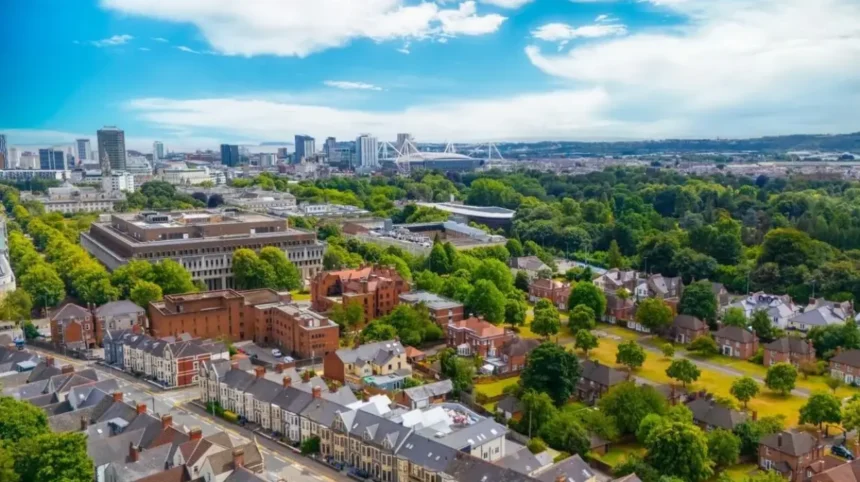
Cathays is one of Cardiff’s most historically significant residential and educational districts. Located immediately north of Cardiff city centre, the area combines Victorian housing, historic cemeteries, university buildings, civic architecture and established neighbourhood streets. Its development reflects Cardiff’s transformation from a developing Welsh town into an industrial, administrative and educational capital.
- Where Is Cathays in Cardiff and What Makes It Historically Important?
- What Was Cathays Like Before It Became a Cardiff Suburb?
- When Did Cathays Become an Established Suburb of Cardiff?
- Why Did Cardiff Expand Towards Cathays?
- Which Streets Formed the Early Residential Neighbourhood?
- How Did Industrial Growth Change the Population?
- How Did Cathays Cemetery Shape the History of the Neighbourhood?
- Why Was Cathays Cemetery Established in 1859?
- What Is the Architectural Significance of Cathays Cemetery?
- Why Is Cathays Cemetery Important to Welsh Heritage?
- How Did Cardiff University Transform Cathays?
- When Was Cardiff University Established?
- How Did University Buildings Influence the Neighbourhood?
- Why Is Cathays Known as a Student Neighbourhood?
- Why Is Cathays Park Important to the History of Cardiff?
- When Was Cathays Park Purchased for Public Development?
- Which Historic Buildings Define Cathays Park?
- What Are Alexandra Gardens, Gorsedd Gardens and Friary Gardens?
- How Did Cathays Park Influence Cardiff’s National Identity?
- How Did Transport and Railway Development Influence Cathays?
- How Did the Victorian Railway Network Affect Cathays?
- When Did Cathays Railway Station Open?
- How Does the Railway Station Support Modern Cathays?
- What Architectural Features Reveal the History of Cathays?
- Why Are Victorian Terraced Houses Important in Cathays?
- How Does Edwardian Architecture Appear in Cathays?
- Which Historic Areas Preserve Cathays’ Character?
- How Have Education, Culture and Local Communities Shaped Modern Cathays?
- How Has Student Life Changed the Local Economy?
- What Cultural Institutions Connect Cathays With Cardiff?
- How Does Cathays Balance Historic Preservation With Modern Development?
- What Can Visitors Explore to Understand the History of Cathays?
- Which Historic Places Should Visitors See?
- How Can Visitors Understand the Different Historical Periods?
- How Has Cathays Changed From Its Victorian Origins to the Present Day?
The history of Cathays, Cardiff, is closely connected with the growth of the Bute Estate, the expansion of Cardiff during the nineteenth century, the establishment of Cardiff University and the development of Wales’s national civic institutions. Its streets and buildings preserve evidence of these changes, while its modern identity reflects a large student population, residential communities and cultural activity.
Understanding Cathays requires looking beyond its association with Cardiff University. Its history includes private estates, Victorian suburban expansion, public infrastructure, religious institutions, burial grounds and the creation of Cardiff’s Civic Centre.
Where Is Cathays in Cardiff and What Makes It Historically Important?
Cathays is an established district immediately north of Cardiff city centre in South Wales. It is historically important because its development connects nineteenth-century suburban expansion, Victorian residential architecture, Cardiff University and the creation of the Welsh capital’s major civic institutions.
Cathays forms part of the central urban area of Cardiff, the capital city of Wales. Its location places it close to important commercial, educational, administrative and cultural destinations. Cardiff Queen Street and Cardiff Central provide wider transport connections, while Cathays railway station serves the local university and residential district.
The neighbourhood is particularly associated with Cardiff University, Cathays Cemetery and the wider Cathays Park area. These places represent different stages of Cardiff’s development, from Victorian urban expansion to twentieth-century civic and educational growth.
Cathays also has a distinctive residential character. Streets containing nineteenth-century and early twentieth-century terraced houses sit alongside student accommodation, university buildings, local businesses and public facilities.
The area’s historical importance comes from three connected developments:
- The expansion of Cardiff beyond its earlier urban centre during the nineteenth century.
- The growth of educational and civic institutions during the late nineteenth and twentieth centuries.
- The transformation of Cathays into a mixed residential, student and institutional neighbourhood.
These developments explain why Cathays remains an important part of Cardiff’s urban history.
What Was Cathays Like Before It Became a Cardiff Suburb?
Before becoming a residential suburb, Cathays was predominantly rural land associated with agricultural activity and the Bute Estate. Farms, open fields and privately controlled parkland characterised the area before Cardiff’s nineteenth-century industrial expansion encouraged large-scale housing development.
The early history of Cathays is connected with the land surrounding Cardiff Castle and the estates controlled by influential landowning families. During the eighteenth and early nineteenth centuries, much of the northern area beyond Cardiff’s established urban settlement remained countryside.
The Bute family played an important role in shaping the area’s early development. The Marquesses of Bute controlled extensive land around Cardiff and influenced the city’s physical expansion through estate management and property development.
How Did the Bute Estate Influence Cathays?
The Bute Estate was a major landed property belonging to the Marquesses of Bute. Its landholdings included areas surrounding Cardiff Castle and Cathays Park.
The estate’s influence increased during the nineteenth century as Cardiff developed into an important industrial and commercial centre. Landowners controlled how land was leased, sold and developed, influencing the location and pattern of new housing.
Cathays Park originated as private parkland associated with the Bute Estate. The historic record held by the Royal Commission on the Ancient and Historical Monuments of Wales identifies 1812 as the beginning of its development as a private park.
The estate’s landscaped grounds established an important connection between the northern part of Cardiff and the land surrounding the castle.
What Was the Original Landscape of Cathays?
The original landscape consisted largely of agricultural fields, rural properties and estate land. Farms including Allensbank and Wedal remained identifiable features during the area’s transition into an urban neighbourhood.
The historic landscape also included common land and routes connecting Cardiff with surrounding settlements. These rural features gradually disappeared as residential streets expanded northwards.
The transformation was particularly noticeable during the second half of the nineteenth century, when Cardiff’s population increased rapidly.
The change from countryside to residential development established the geographical foundations of modern Cathays.
When Did Cathays Become an Established Suburb of Cardiff?
Cathays officially developed as a suburb of Cardiff in 1875, when the expanding city began replacing surrounding rural land with residential streets. Housing construction accelerated during the late nineteenth century, and urban development was virtually complete by 1900.
The year 1875 represents an important milestone in the history of Cathays. Before this period, the neighbourhood retained a largely rural character, apart from the developing cemetery and a limited number of roads.
Cardiff’s economic expansion created demand for housing beyond the older city centre. Industrial employment, commercial activity and population growth encouraged the development of residential districts across the city.
Cathays became part of this wider suburban expansion.
Why Did Cardiff Expand Towards Cathays?
Cardiff’s nineteenth-century expansion was closely connected with the coal industry and the development of its docks.
The South Wales coalfield supplied substantial quantities of coal for domestic and international markets. Cardiff became a major export centre, attracting workers, merchants, transport businesses and industrial investment.
The development of the Bute Docks strengthened the city’s economic position. New employment opportunities increased the demand for housing and encouraged construction beyond the historic town centre.
Cathays provided suitable land for residential expansion north of the established commercial district.
The neighbourhood developed alongside other expanding districts, including Roath, Adamsdown and parts of Riverside.
Which Streets Formed the Early Residential Neighbourhood?
Woodville Road and Cathays Terrace were among the important streets associated with the early development of the suburb.
Initially, only a limited number of streets extended into the surrounding countryside. Residential construction subsequently spread through adjoining plots and roads.
The growth of terraced housing created a relatively dense urban neighbourhood. Houses were built to accommodate Cardiff’s expanding working and middle-class population.
By the beginning of the twentieth century, the residential landscape had changed substantially. Allensbank and Wedal farms had disappeared as functioning rural properties, although their names survived in local geography.
The transition established the street network that continues to influence the character of Cathays.
How Did Industrial Growth Change the Population?
Industrial expansion attracted people from different parts of Wales, England, Ireland and other regions. Cardiff’s growing economy encouraged migration from rural communities and industrial settlements.
The new population required housing, transport, education, religious facilities and commercial services.
Cathays developed as part of the city’s wider response to these needs. Its residential streets provided accommodation within walking distance of central Cardiff and its employment areas.
This relationship between urban employment and suburban housing remained important throughout the twentieth century.
How Did Cathays Cemetery Shape the History of the Neighbourhood?
Cathays Cemetery opened in 1859 as Cardiff New Cemetery, providing a large burial ground for a rapidly expanding population. Its Victorian landscape, historic memorials, Gothic chapels and original layout preserve important evidence of Cardiff’s nineteenth-century social and religious history.
Cathays Cemetery is one of the most significant historic sites associated with the neighbourhood. Its establishment predates Cathays becoming an officially recognised suburb in 1875.
The cemetery was created when Cardiff needed additional burial space to serve its growing population. Its original location was outside the developed urban area, reflecting the availability of land north of the town.
Today, it provides an important historical record of Cardiff’s population, religious communities and architectural development.
Why Was Cathays Cemetery Established in 1859?
Cardiff’s population growth increased pressure on existing burial grounds. The opening of Cardiff New Cemetery in 1859 provided a larger facility outside the older urban centre.
The cemetery was designed as a multi-denominational burial ground. Its organisation reflected the religious diversity of Victorian Cardiff.
The site included separate Anglican and nonconformist chapels, allowing different religious communities to conduct funeral services according to their traditions.
The cemetery also included a formal entrance, landscaped grounds, paths and areas for burial plots.
The Royal Commission on the Ancient and Historical Monuments of Wales records the cemetery as a well-preserved Victorian burial ground retaining much of its original layout and ornamental evergreen planting.
What Is the Architectural Significance of Cathays Cemetery?
The cemetery contains several important nineteenth-century architectural features.
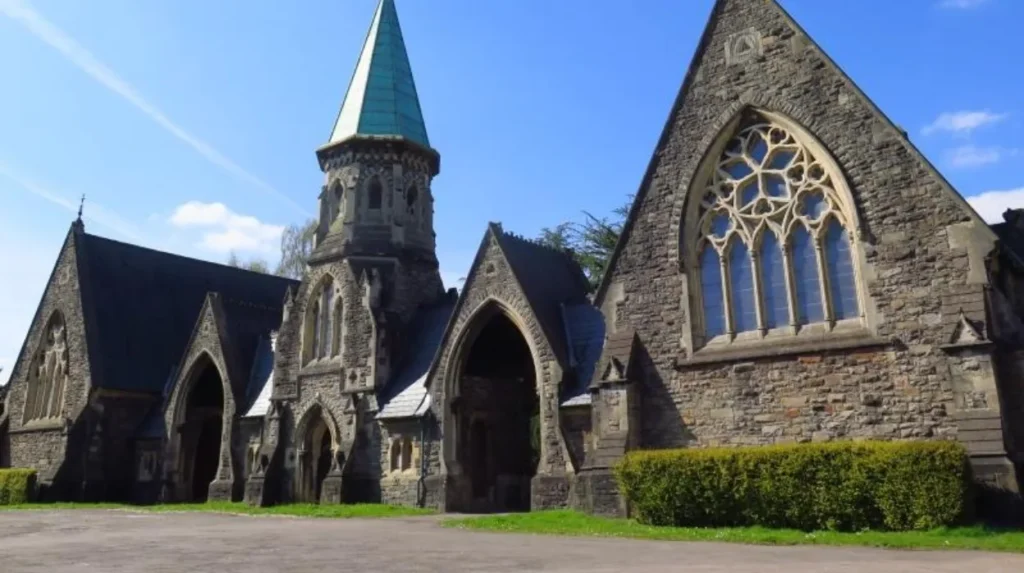
Its main entrance gateway was built in 1859 and designed by R.G. Thomas, an architect from Newport, working with T. Waring, Cardiff’s Borough Surveyor.
The entrance uses Gothic architectural details, including pointed arches, decorative stonework and formal pedestrian entrances.
The cemetery’s mortuary chapels were also designed in the Gothic style. They served Anglican and nonconformist communities and formed an important part of the original cemetery arrangement.
Cadw, the Welsh Government’s historic environment service, designated the mortuary chapels Grade II listed buildings in 1975. The entrance gateway and forecourt walls also hold Grade II listed status.
Why Is Cathays Cemetery Important to Welsh Heritage?
Cathays Cemetery provides evidence of how Cardiff managed burial, religion and public space during the Victorian period.
Its memorials document individuals and families associated with the city’s commercial, industrial, religious and civic development.
The cemetery also preserves information about changing memorial styles, burial practices and the social structure of nineteenth-century communities.
On 1 February 2022, Cadw designated Cathays Cemetery a Grade II* registered historic park and garden. This recognition reflects its historic landscape, original layout, planting and architectural features. Reports
The cemetery therefore represents more than a burial facility. It is an important heritage landscape within the history of Cathays and Cardiff.
How Did Cardiff University Transform Cathays?
Cardiff University transformed Cathays by establishing a major educational institution in the district during the late nineteenth century. Founded in 1883, the university encouraged institutional development, student accommodation, local commerce and the area’s emergence as an important academic centre.
The establishment of Cardiff University was a defining development in the history of Cathays. It strengthened the neighbourhood’s connection with education and helped shape its modern identity.
Cardiff University began as the University College of South Wales and Monmouthshire. Its establishment reflected growing demand for higher education in Wales and the desire to create a major educational institution in Cardiff.
The university’s presence subsequently influenced the development of buildings, streets, transport and local businesses.
When Was Cardiff University Established?
Cardiff University opened its doors on 24 October 1883. It was formally established by Royal Charter in 1884.
At its opening, the institution had:
- 13 academic staff.
- 12 academic departments.
- 102 full-time degree students.
- 49 part-time students.
These figures demonstrate the relatively small scale of the original institution compared with its present-day position.
In 1893, the college became one of the founding institutions of the University of Wales and began awarding University of Wales degrees.
The institution later became University College, Cardiff, in 1972. It merged with the University of Wales Institute of Science and Technology in 1988 and adopted the public name Cardiff University in 1999.
A further merger with the University of Wales College of Medicine took place in 2004. Cardiff University
How Did University Buildings Influence the Neighbourhood?
The university’s expansion created a growing concentration of academic buildings around Cathays and Cathays Park.
Park Place became an important institutional location. Its architecture and proximity to the city centre helped establish the area’s educational character.
The university campus includes historic buildings alongside modern teaching, research and student facilities.
The Cathays Park campus currently accommodates 22 of Cardiff University’s 26 academic schools. The university also reports ongoing investment in its facilities. Cardiff University
The expansion of academic activity encouraged demand for nearby housing, shops, cafés, restaurants and student services.
This process changed the local economy and contributed to the neighbourhood’s distinctive combination of residential and educational functions.
Why Is Cathays Known as a Student Neighbourhood?
Cathays is strongly associated with student accommodation because of its proximity to Cardiff University and other educational facilities.
Terraced houses provide a significant part of the neighbourhood’s residential housing stock. Many properties have been adapted for shared student accommodation.
Student demand has supported local businesses, including independent cafés, convenience shops, takeaway restaurants and other services.
The university also contributes to the area’s cultural activity through academic events, public lectures, student societies and performances.
This educational influence is one of the most recognisable features of modern Cathays.
Why Is Cathays Park Important to the History of Cardiff?
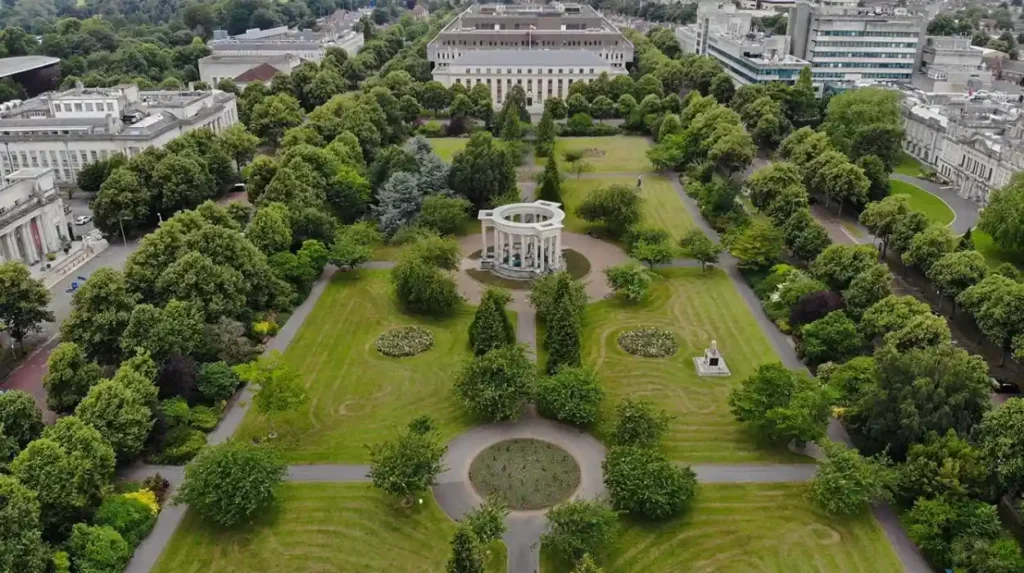
Cathays Park is Cardiff’s historic Civic Centre, developed on former Bute Estate land purchased by Cardiff Corporation in 1898. Its formal gardens, monumental public buildings and architectural landmarks reflect Cardiff’s growing political, administrative and cultural importance.
Cathays Park is closely associated with the wider history of the Cathays district. Although the park and the residential neighbourhood are distinct geographical areas, their development is interconnected.
The creation of the Civic Centre established Cathays as an important location for public administration, education and national institutions.
When Was Cathays Park Purchased for Public Development?
Cardiff Corporation purchased Cathays Park from the Third Marquess of Bute in 1898 for approximately £160,000.
The purchase provided land for a planned civic centre that would demonstrate Cardiff’s growing status.
The development followed a coordinated architectural and landscape plan. William Harpur was associated with the original civic layout, while architects and designers were commissioned to create individual public buildings.
According to the historic environment record, the Civic Centre’s principal construction phases took place between 1903 and 1906 and between 1924 and 1928. Archwilio+2
The development established a formal arrangement of public buildings, landscaped gardens and wide avenues.
Which Historic Buildings Define Cathays Park?
Cathays Park contains several important buildings that represent different aspects of Cardiff’s civic and cultural development.
Cardiff City Hall: Cardiff City Hall is one of the Civic Centre’s most recognisable buildings. Designed by Lanchester, Stewart and Rickards, construction took place between 1901 and 1904. Its Portland stone exterior and monumental architectural style established a design reference for other buildings in the area.
National Museum Cardiff: The National Museum is an important cultural institution displaying art, natural history and collections connected with Wales. Its location within Cathays Park strengthens the area’s role as a cultural destination.
The Law Courts: The historic Law Courts form part of the original Civic Centre development and represent Cardiff’s judicial and administrative importance.
Temple of Peace and Health: Designed by Percy Thomas, the Temple of Peace and Health was developed during the 1930s. It is associated with the promotion of peace and international cooperation following the First World War.
Welsh Government buildings: Government offices in the area demonstrate the continuing administrative importance of Cathays Park within modern Wales.
These buildings collectively establish the Civic Centre as an important architectural and institutional landscape.
What Are Alexandra Gardens, Gorsedd Gardens and Friary Gardens?
Cathays Park contains three principal garden spaces, each with its own historic character.
Alexandra Gardens is a formal public garden containing the Welsh National War Memorial. The memorial commemorates Welsh people who died during the First World War.
Gorsedd Gardens contains standing stones associated with the 1899 National Eisteddfod. The National Eisteddfod is a major Welsh cultural festival celebrating literature, music, performance and the Welsh language.
Friary Gardens contains formal landscaping and a historic Dutch Garden design.
The three gardens retain important elements of the original Edwardian layout. Cadw records Cathays Park as a Grade II registered historic park and garden, with its main development phases dated 1903–1906 and 1924–1928. Reports+1
How Did Cathays Park Influence Cardiff’s National Identity?
The development of the Civic Centre reflected Cardiff’s changing position within Wales.
Cardiff received city status in 1905, during the period of major civic development. Its growing importance as an administrative and commercial centre created demand for public buildings that represented its status.
The Civic Centre subsequently became an important location for national institutions, public administration and cultural activities.
Its architecture also demonstrates how urban planning was used to communicate political and civic identity during the early twentieth century.
Today, Cathays Park remains one of the strongest representations of Cardiff’s development as the capital of Wales.
How Did Transport and Railway Development Influence Cathays?
Railway development supported Cathays’ transformation by connecting Cardiff with industrial settlements and surrounding communities. Railway infrastructure shaped the neighbourhood’s geography, while the modern Cathays station, opened in 1983, improved access to its university and civic destinations.
Transport played an important role in the wider development of Cardiff. Railway connections supported industrial activity, commercial growth and population movement throughout the nineteenth century.
Cathays developed within an urban landscape influenced by railway routes extending northwards from Cardiff.
These connections contributed to the area’s physical layout and its relationship with the city centre.
How Did the Victorian Railway Network Affect Cathays?
Railway infrastructure expanded across Cardiff during the nineteenth century as the city developed into a major industrial and export centre.
The Taff Vale Railway and Rhymney Railway were important parts of the wider network connecting Cardiff with industrial communities and the South Wales Valleys.
Railway corridors influenced the shape of residential development in Cathays. The neighbourhood’s built-up area developed between important railway routes, contributing to its distinctive urban layout.
Railways also supported the movement of workers, materials and commercial goods.
Although the railway network initially served wider industrial and economic purposes, its presence became increasingly important for local passenger transport.
When Did Cathays Railway Station Open?
The present Cathays railway station opened on 3 October 1983.
Its construction represented an important investment in local public transport at a time when railway station closures had affected many parts of Britain.
The station was funded by British Rail and South Glamorgan County Council. It was developed to improve access to central Cardiff and nearby institutions.
Transport for Wales identifies Cathays as the closest railway station to many Cardiff University buildings. Its two platforms serve passengers travelling through the local railway network. Transport for Wales+1
How Does the Railway Station Support Modern Cathays?
Cathays station provides connections towards Cardiff Central and communities north of the city.
Its location makes it particularly useful for university students, academic staff, local residents and visitors.
The station also supports access to Cathays Park, the National Museum and nearby cultural facilities.
Transport for Wales reports that the station handles more than one million passengers annually. This demonstrates the continuing importance of public transport within the neighbourhood. Transport for Wales
The station’s development also reflects the changing role of Cathays. Its transport requirements are now closely connected with education, employment, tourism and everyday residential activity.
What Architectural Features Reveal the History of Cathays?
Cathays preserves architectural evidence of its nineteenth-century suburban expansion and twentieth-century institutional development. Victorian terraced houses, Edwardian buildings, historic religious structures and monumental civic architecture collectively explain how the neighbourhood evolved.
The built environment is one of the clearest ways to understand the history of Cathays.
Its residential streets demonstrate the rapid growth of Cardiff during the Victorian period, while its university and civic buildings reflect later institutional expansion.
The area’s architectural character is therefore the result of several historical development phases rather than a single building programme.
Why Are Victorian Terraced Houses Important in Cathays?
Victorian terraced housing forms a significant part of Cathays’ residential character.
These houses were developed to accommodate Cardiff’s growing population during the nineteenth century.
Terraced housing provided relatively efficient use of urban land. Properties were constructed in continuous rows, sharing side walls and following established street layouts.
Typical architectural features include:
- Brick and stone exterior detailing.
- Traditional sash-style windows.
- Decorative door surrounds.
- Bay windows on selected properties.
- Slate roofs and prominent chimneys.
These features reflect the construction methods and architectural preferences of the Victorian period.
The housing stock also demonstrates the relationship between industrial expansion and suburban development in Cardiff.
How Does Edwardian Architecture Appear in Cathays?
Edwardian architecture is particularly visible around Cathays Park and the university district.
The Civic Centre introduced large public buildings with classical proportions, substantial stone façades and carefully designed external spaces.
Portland stone became an important material in the Civic Centre’s architectural identity.
The buildings were designed to communicate institutional authority and civic importance.
Their formal arrangements contrast with the smaller scale of the surrounding residential streets, creating a distinctive architectural relationship between the university, government buildings and housing.
Which Historic Areas Preserve Cathays’ Character?
Cathays contains several areas with historic and architectural significance.
Cathays Park Conservation Area was designated in 1975 and extended in 1992. It protects the architectural and landscape character of the historic Civic Centre.
Cardiff Council’s conservation records also identify other protected conservation areas within the wider central district, including Charles Street, Churchill Way, Queen Street and Windsor Place. |+1
Conservation designations help protect historically significant buildings, streetscapes and public spaces.
They also provide planning guidance for alterations and new development, helping maintain the relationship between historic architecture and the modern city.
How Have Education, Culture and Local Communities Shaped Modern Cathays?
Modern Cathays combines its historic residential identity with university life, public institutions and established community facilities. Education, local commerce, cultural activity and transport continue to influence how residents, students and visitors use the neighbourhood.
Cathays has developed into a mixed urban neighbourhood where residential life and institutional activity operate alongside one another.
Its historical development created the foundations for this combination. Victorian housing provided the residential structure, while Cardiff University and the Civic Centre introduced major educational and administrative functions.
How Has Student Life Changed the Local Economy?
The expansion of Cardiff University increased the demand for accommodation and everyday services.
Local businesses developed around the needs of students and permanent residents.
Food outlets, cafés, convenience shops, restaurants and independent services contribute to the neighbourhood’s economy.
Student accommodation has also changed the use of traditional residential properties. Some Victorian houses have been converted into shared housing, creating a housing market closely associated with higher education.
This development has helped maintain commercial activity throughout the academic year.
What Cultural Institutions Connect Cathays With Cardiff?
Cathays benefits from its proximity to several important cultural institutions.
The National Museum Cardiff provides access to Welsh art, natural history and national collections.
Cardiff University contributes academic events, research activities, exhibitions and public engagement programmes.
The Sherman Theatre, situated near the university district, provides a venue for professional theatre, contemporary performances and community-focused cultural programmes.
Cathays Park also provides an important setting for public commemorations, civic events and cultural activities.
Together, these institutions make Cathays an important part of Cardiff’s cultural and educational landscape.
How Does Cathays Balance Historic Preservation With Modern Development?
The neighbourhood faces the challenge of accommodating changing residential and institutional requirements while protecting its historic character.
University expansion, student housing demand and modern infrastructure create pressure for new development.
Historic properties require maintenance, appropriate alterations and long-term conservation.
Cardiff Council uses conservation area policies and planning guidance to protect buildings and spaces with special architectural or historic interest.
Its conservation framework recognises the importance of preserving significant urban environments while allowing appropriate development.
The future character of Cathays depends on maintaining this balance between its historic built environment and the needs of a growing urban population.
Explore More Area Guide
The History of Roath Cardiff: From Village to Suburb
The History of Canton Cardiff: From Medieval Village to Modern Suburb
What Can Visitors Explore to Understand the History of Cathays?
Visitors can explore Cathays through its historic residential streets, university buildings, cemetery, Civic Centre gardens and cultural institutions. These locations provide direct evidence of Victorian suburban growth, Welsh educational development and Cardiff’s emergence as a national administrative centre.
Cathays offers several opportunities to understand the area’s history through its surviving architecture and public spaces.
A historical visit can begin around Cathays Park before continuing towards the university campus and the residential streets.
Which Historic Places Should Visitors See?
Cathays Park: The Civic Centre provides an introduction to Cardiff’s twentieth-century administrative and architectural history. Visitors can explore the gardens and view the historic public buildings.
Alexandra Gardens: This garden contains the Welsh National War Memorial and provides an important location for understanding Welsh remembrance history.
National Museum Cardiff: The museum offers access to national art and natural history collections. Its building is an important part of the Civic Centre’s architectural landscape.
Cardiff University: The university buildings illustrate the development of higher education in Wales from the institution’s establishment in 1883.
Cathays Cemetery: The cemetery preserves Victorian memorials, Gothic architecture and historic landscape features.
Residential Cathays: Streets around Woodville Road and Cathays Terrace provide examples of the Victorian housing development that transformed the area into a suburb.
How Can Visitors Understand the Different Historical Periods?
A visit to Cathays becomes more informative when its locations are considered in chronological order.
The cemetery introduces the mid-nineteenth-century period, when Cardiff required new public facilities to support its growing population.
The residential streets demonstrate the suburban expansion that followed during the late nineteenth century.
The university buildings represent the development of higher education from 1883 onwards.
Cathays Park illustrates the civic ambitions of Cardiff around the turn of the twentieth century and during the interwar period.
Together, these locations provide a clear picture of the neighbourhood’s development across different historical periods.
How Has Cathays Changed From Its Victorian Origins to the Present Day?
Cathays has evolved from rural estate land into a densely developed residential, educational and administrative district. Its modern identity reflects more than 150 years of suburban expansion, university growth, transport investment and continuing protection of historic buildings.
The transformation of Cathays demonstrates the wider development of Cardiff.
During the nineteenth century, industrial growth encouraged the construction of residential streets. The establishment of Cardiff University introduced a major educational institution, while the Civic Centre strengthened the area’s administrative importance.
The twentieth century brought further institutional expansion and improved public transport.
What Is Cathays Like Today?
Modern Cathays combines residential neighbourhoods with educational, commercial and cultural facilities.
Its population includes permanent residents, university students, academic staff and people working in nearby public institutions.
The neighbourhood’s traditional terraced housing remains an important feature, although some properties have been adapted to accommodate changing housing requirements.
Its location close to Cardiff city centre provides access to employment, shopping, education and public transport.
Why Does Cathays Remain Historically Significant?
Cathays remains significant because its buildings and public spaces preserve evidence of Cardiff’s transformation.
Its historical importance can be understood through five developments:
- Estate history: The Bute Estate influenced the early landscape and ownership of land.
- Victorian suburbanisation: Residential expansion transformed rural Cathays into an established Cardiff suburb.
- Public infrastructure: Cathays Cemetery demonstrated the city’s response to nineteenth-century population growth.
- Educational development: Cardiff University established Cathays as an important academic district.
- Civic development: Cathays Park became a major centre for Welsh public administration, architecture and culture.
These developments continue to influence the neighbourhood’s identity and urban structure.
What Is the Future Historical Importance of Cathays?
The future importance of Cathays depends on preserving its architectural heritage while accommodating modern residential and educational requirements.
Historic buildings, university facilities, public gardens and community spaces form an interconnected urban environment.
Conservation policies, responsible property maintenance and appropriate development help protect this heritage.
Cathays will continue to represent an important part of Cardiff’s development because its history connects the city’s industrial expansion with its present role as the capital of Wales.
The neighbourhood is therefore not simply a student district. It is a historic urban area that reflects Cardiff’s economic, educational, architectural and social transformation.
Where is Cathays located in Cardiff?
Cathays is a historic neighbourhood immediately north of Cardiff city centre in South Wales. It is known for Cardiff University, Cathays Park, Victorian residential streets and Cathays Cemetery.