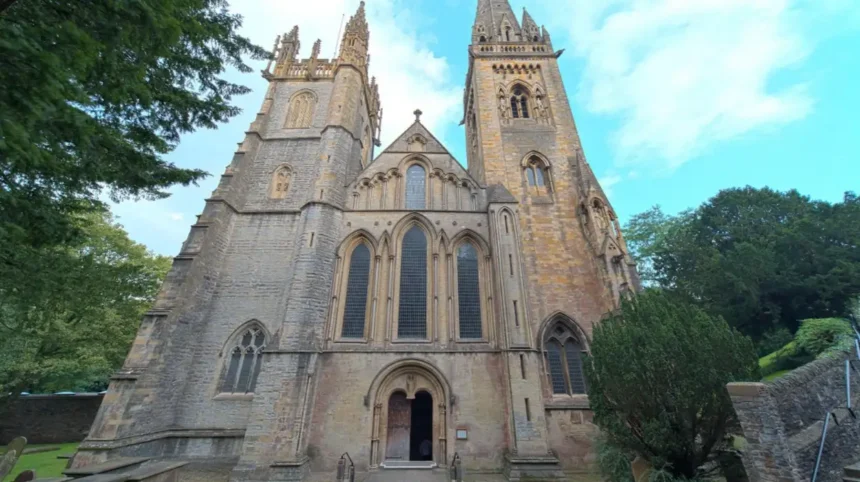
Llandaff is one of the oldest historic settlements in Cardiff, Wales. Located approximately two miles north-west of Cardiff city centre, Llandaff developed around an early Christian religious community beside the River Taff. Its history spans more than 1,500 years, connecting Celtic Christianity, medieval Welsh history, Norman architecture, industrial-era development and modern Cardiff.
- What Is the Historical Background of Llandaff in Cardiff?
- How Did Llandaff Develop During the Celtic and Early Christian Period?
- Saint Dyfrig and the Early Christian Community
- Saint Teilo and the Religious Tradition
- Bishop Euddogwy and the Establishment of Llandaff
- Why Was Llandaff Cathedral Important to the History of Cardiff?
- The Norman Construction of the Cathedral
- Medieval Architectural Development
- The Cathedral’s Religious Importance
- What Happened to Llandaff During the Medieval Period?
- How Did the Reformation Affect Llandaff Cathedral?
- How Did Llandaff Change During the Eighteenth and Nineteenth Centuries?
- John Wood’s Cathedral Reconstruction
- Victorian Cathedral Restoration
- Residential Expansion and Wealthy Families
- What Was Llandaff’s Relationship with Cardiff During the Industrial Revolution?
- When Did Llandaff Become Part of Cardiff?
- How Did the Second World War Affect Llandaff Cathedral?
- Which Historic Buildings and Landmarks Preserve Llandaff’s Past?
- How Has Modern Llandaff Developed as Part of Cardiff?
- Residential and Community Development
- Education and Cultural Connections
- Llandaff as a Historic Visitor Destination
- How Is Llandaff’s Historical Heritage Protected Today?
- Why Does the History of Llandaff Remain Important to Cardiff?
- The History of Llandaff Cardiff
The neighbourhood is best known for Llandaff Cathedral, a historic religious landmark associated with early Welsh bishops and the development of Christianity in south Wales. Its medieval streets, ruined Bishop’s Palace, historic village green and surviving traditional buildings preserve evidence of its former importance as an ecclesiastical centre.
Today, Llandaff forms part of the Welsh capital while retaining a distinct historic identity. Its development explains how a small religious settlement became an important medieval centre before gradually becoming an established residential neighbourhood within Cardiff.
What Is the Historical Background of Llandaff in Cardiff?
Llandaff is an ancient settlement in north-west Cardiff that developed around a Christian religious community established during the early medieval period. Its cathedral, medieval buildings and historic street pattern preserve evidence of its importance in Welsh religious, political and social history.
Llandaff occupies elevated ground near the River Taff, approximately two miles from Cardiff city centre. Its Welsh name, Llandaf, combines llan, meaning an enclosed religious settlement or church, with Daf, referring to the River Taff. The name therefore reflects the settlement’s close relationship with Christianity and its surrounding landscape.
The location influenced the development of the settlement. The elevated ground provided a relatively secure position above the low-lying river plain, while the River Taff supplied water and created an important route through the region.
The surrounding landscape included marshy ground and fertile river deposits. These environmental conditions influenced early settlement patterns, transport routes and agricultural activity.
Llandaff became particularly important because of its religious establishment. During the early medieval period, Christian communities developed throughout south Wales. Llandaff emerged as one of the principal ecclesiastical centres in the region.
Unlike Cardiff, which developed around its castle and commercial harbour, Llandaff developed around its religious institutions. The settlement became closely associated with the bishops of Llandaff and the administration of the medieval Church.
The Royal Commission on the Ancient and Historical Monuments of Wales records Llandaff as an ancient settlement that gradually became absorbed into Cardiff during the nineteenth and twentieth centuries. Its official incorporation into Cardiff took place in 1922.
This historical development explains why Llandaff retains a distinctive identity within the modern Welsh capital.
How Did Llandaff Develop During the Celtic and Early Christian Period?
Llandaff developed as an important Christian settlement during the sixth century. Its early religious history is associated with Welsh saints Dyfrig, Teilo and Euddogwy, whose ecclesiastical activities established the foundations of the Diocese of Llandaff.
The origins of Llandaff are closely connected with the spread of Christianity across south Wales during the fifth and sixth centuries.
Christian communities developed throughout the region during this period. Religious leaders established churches, monasteries and educational centres that became important institutions in early Welsh society.
Three figures are particularly important in Llandaff’s religious history.
Saint Dyfrig and the Early Christian Community
Saint Dyfrig, also known as Dubricius, is traditionally recognised as one of the earliest bishops associated with the region.
He lived approximately between 450 and 540 and became an important figure in the development of Christianity in south Wales. Historical traditions associate him with several early religious communities.
Dyfrig’s influence established the religious foundations upon which the later Diocese of Llandaff developed.
Saint Teilo and the Religious Tradition
Saint Teilo was another important figure in the development of Christianity in south Wales.
Traditional accounts connect him with the foundation of the early religious establishment at Llandaff during the sixth century. His influence extended across several Welsh religious communities.
Teilo became one of the principal saints associated with Llandaff Cathedral. His name remains part of the cathedral’s formal dedication.
Bishop Euddogwy and the Establishment of Llandaff
Saint Euddogwy occupies an important position in the recorded history of the Diocese of Llandaff.
According to the Diocese of Llandaff, Euddogwy settled at Llandaff during the late sixth century. His establishment of the ecclesiastical centre helped transform the settlement into an important religious administrative location.
This development strengthened Llandaff’s influence across Morgannwg, the historic Welsh kingdom and territory associated with much of modern Glamorgan.
The Diocese of Llandaff identifies these early religious leaders as central figures in its institutional history.
Why Was Llandaff Cathedral Important to the History of Cardiff?
Llandaff Cathedral became the religious centre of an important medieval Welsh diocese. Its origins date to the early Christian period, while its surviving Norman structure began developing under Bishop Urban around 1120, establishing Llandaff’s lasting ecclesiastical importance.
Llandaff Cathedral is the most significant historic building in the neighbourhood.
The cathedral stands near the River Taff and represents the development of Christianity in south Wales over many centuries. Its history includes early medieval worship, Norman construction, medieval architectural additions, religious changes following the Reformation and twentieth-century reconstruction.
The Norman Construction of the Cathedral
The present cathedral developed during the Norman period.
Bishop Urban, who became bishop in 1107, initiated an ambitious rebuilding programme around 1120. He sought to establish a substantial stone cathedral that reflected the importance of the diocese.
Urban also brought the remains of Saint Dyfrig from Bardsey Island to Llandaff, strengthening the cathedral’s association with the early Welsh saint.
Parts of Urban’s original building survive, including architectural features around the sanctuary.
The cathedral’s development continued under subsequent bishops. During the twelfth century, further construction included the north and south doorways of the nave.
Medieval Architectural Development
The cathedral underwent significant architectural changes during the thirteenth century.
Bishop Henry of Abergavenny was associated with the construction of the early Gothic west front and nave. The Chapter House was added during the middle of the century.
The Lady Chapel was built under Bishop William de Braose, who served from 1266 to 1287.
These additions demonstrate how the cathedral developed from a Norman religious building into a substantial medieval ecclesiastical complex.
The Cathedral’s Religious Importance
Llandaff Cathedral became the principal church of the Diocese of Llandaff.
The diocese historically exercised religious authority across a large area of south Wales. Its bishops influenced religious administration, education and the establishment of churches throughout the region.
The cathedral also attracted pilgrims and visitors because of its connections with early Welsh saints.
Its position established Llandaff as a religious centre distinct from Cardiff’s political and commercial institutions.
What Happened to Llandaff During the Medieval Period?
Medieval Llandaff developed around its cathedral, episcopal residence and religious institutions. Bishops exercised considerable local influence, while the settlement experienced conflict, architectural expansion and political changes that shaped its buildings and surrounding communities.
During the medieval period, Llandaff became the centre of an ecclesiastical lordship.
The bishops controlled religious institutions and exercised authority over surrounding lands. The medieval territory associated with Llandaff included settlements such as Canton, Ely, Fairwater, Gabalfa and Llandaff North.
The relationship between Llandaff and Cardiff was important during this period. Both settlements held significant positions in medieval Glamorgan, although their functions differed.
Cardiff developed around its castle and Norman town, while Llandaff remained primarily associated with religious administration.
The Bishop’s Palace and Episcopal Authority
The Bishop’s Palace was an important part of medieval Llandaff.
The palace served as a residence and administrative centre for the bishops. Its substantial defensive appearance reflected the political and institutional authority of the medieval Church.
The structure is generally dated to approximately 1275 and is associated with Bishop William de Braose.
Its surviving remains include the gatehouse and sections of the surrounding defensive walls. Archaeological records identify it as a medieval fortified enclosure rather than simply a domestic residence.
The Attack of Owain Glyndŵr
One of the most significant events in Llandaff’s medieval history occurred during the Welsh uprising led by Owain Glyndŵr.
Glyndŵr led a major revolt against English rule in Wales, beginning in 1400. The uprising affected settlements, castles and religious institutions throughout the country.
The Bishop’s Palace suffered damage during the rebellion of 1402–1405. Following this destruction, the bishops abandoned the palace as their principal residence and increasingly preferred a more secure residence at Mathern in Monmouthshire.
The damaged palace gradually lost its original function.
Its surviving ruins now provide important evidence of medieval episcopal power and the political instability of fifteenth-century Wales.
How Did the Reformation Affect Llandaff Cathedral?
The Protestant Reformation transformed religious institutions throughout Wales during the sixteenth century. Llandaff Cathedral experienced periods of neglect and structural deterioration, while changing religious practices affected its buildings, administration and wider ecclesiastical influence.
The Reformation introduced major religious and institutional changes across England and Wales.
During the sixteenth century, the English Crown established greater control over the Church. The dissolution of religious institutions and changes in religious authority affected many historic churches.
Llandaff Cathedral also experienced a difficult period.
The cathedral’s condition deteriorated following the Reformation. Parts of the building remained in a damaged or neglected state for extended periods.
Its importance as the principal church of the diocese continued, but the institution faced considerable financial and structural challenges.
The cathedral’s later restoration became necessary because of the accumulated damage and the changing expectations of religious architecture.
The Cathedral During the Seventeenth Century
The seventeenth century brought further political and religious instability.
The English Civil War, which lasted from 1642 to 1651, affected religious institutions and historic buildings across Britain.
Llandaff’s ecclesiastical buildings experienced damage and disruption during this wider period of conflict.
The Bishop’s Palace also suffered destruction, probably during the English Civil War, although the precise sequence of its decline remains part of its historical record.
The surviving medieval ruins reflect these successive periods of damage and abandonment.
How Did Llandaff Change During the Eighteenth and Nineteenth Centuries?
Llandaff experienced architectural restoration and residential expansion during the eighteenth and nineteenth centuries. The cathedral underwent major rebuilding, while wealthy families constructed substantial houses that transformed the settlement into an increasingly fashionable residential district.
The eighteenth century was a period of considerable architectural change.
The cathedral had suffered serious structural problems, including the collapse of its south-east tower. Its nave remained roofless for a substantial period.
John Wood’s Cathedral Reconstruction
Architect John Wood the Elder of Bath undertook an unusual rebuilding project during the eighteenth century.
Instead of fully restoring the medieval cathedral, he constructed a new Italianate-style church beyond the roofless nave.
The design reflected the architectural preferences of the period, but it did not preserve the cathedral’s medieval character.
Wood’s building was subsequently demolished when restoration work began during the nineteenth century.
Victorian Cathedral Restoration
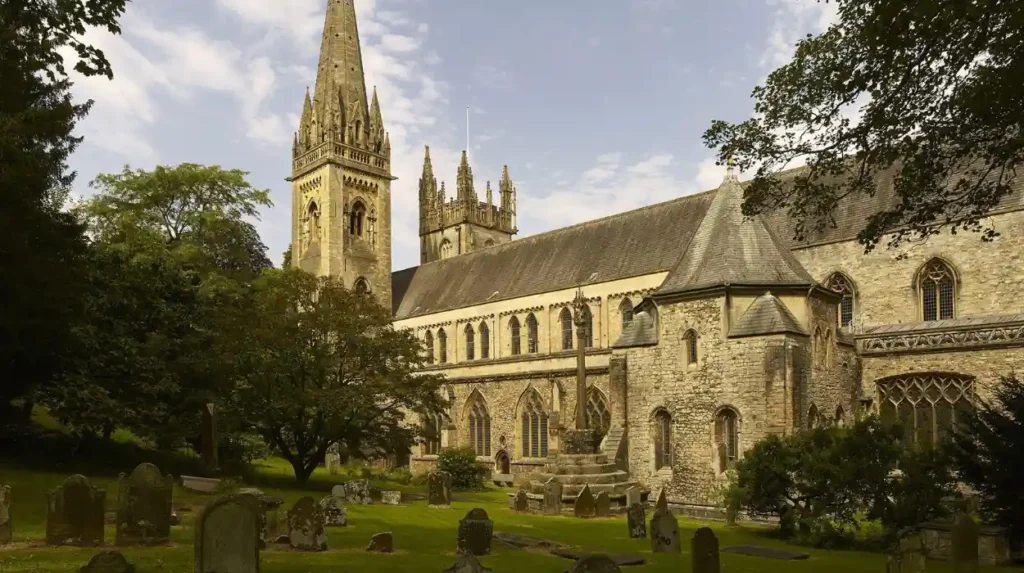
The nineteenth century brought a major restoration programme led initially by architects John Prichard and John Pollard Seddon.
Their work aimed to restore the cathedral’s medieval architectural character while introducing new decorative and structural features.
The restoration included the construction of the south-west tower, commonly known as the Prichard Tower, between 1867 and 1869.
The project also introduced important artistic contributions associated with the Victorian Gothic Revival.
Artists and designers connected with the restoration included Dante Gabriel Rossetti and William Morris.
Their involvement strengthened the cathedral’s connection with the wider Victorian arts and crafts movement.
Residential Expansion and Wealthy Families
The nineteenth century also transformed Llandaff’s residential character.
Cardiff’s industrial growth increased demand for housing among merchants, professionals and wealthy industrial families.
Llandaff became an attractive residential location because of its historic setting, green spaces and distance from the busiest industrial districts.
Several substantial properties were constructed during this period.
These included:
- Insole Court, associated with the Insole family and Cardiff’s coal industry.
- Llandaff Court, a significant historic residential property.
- Baynton House, part of the area’s nineteenth-century residential development.
- Rookwood, a substantial property later associated with institutional use.
The construction of these properties demonstrates the growing economic importance of Cardiff during the coal-export era.
Llandaff’s residential development also established architectural features that remain visible in its streets today.
What Was Llandaff’s Relationship with Cardiff During the Industrial Revolution?
Llandaff developed alongside Cardiff’s industrial expansion during the nineteenth century. Although Cardiff became an important coal-exporting port, Llandaff retained its ecclesiastical identity and increasingly attracted wealthy residents seeking established homes outside the industrial centre.
The Industrial Revolution transformed Cardiff from a relatively small town into one of Britain’s most important coal-exporting centres.
The development of the South Wales coalfield increased commercial activity throughout Glamorgan. Cardiff’s docks became essential to the transportation of coal from the surrounding valleys to international markets.
This economic expansion created new employment opportunities and increased the city’s population.
Llandaff experienced the effects of this transformation without becoming an industrial settlement itself.
Its historic position, established institutions and residential character attracted people connected with Cardiff’s growing commercial economy.
The Influence of Cardiff’s Coal Industry
Cardiff’s coal industry generated considerable wealth during the nineteenth century.
Coal owners, merchants and industrial professionals invested in substantial residential properties. Llandaff became one of the locations associated with this development.
The construction of large houses reflected the increasing prosperity of Cardiff’s commercial and industrial communities.
Insole Court provides an important example of this historical relationship.
How Insole Court Reflects Llandaff’s Industrial History
Insole Court is one of Llandaff’s most important historic residential properties.
The mansion developed through the nineteenth century and is associated with the Insole family, whose wealth came from the South Wales coal industry.
The property demonstrates how industrial wealth influenced the architecture and social development of Cardiff’s surrounding neighbourhoods.
Its restoration and community use also demonstrate the importance of preserving historic buildings for modern public access.
When Did Llandaff Become Part of Cardiff?
Llandaff gradually became integrated into Cardiff during the nineteenth and twentieth centuries. Although it historically maintained a separate ecclesiastical identity, the settlement was officially incorporated into Cardiff in 1922 as the Welsh capital expanded.
Historically, Llandaff was an independent ecclesiastical settlement rather than an ordinary incorporated town.
Its status as the seat of a bishop gave it religious importance, but it did not develop the same municipal structure as Cardiff.
The Royal Commission on the Ancient and Historical Monuments of Wales records that Llandaff was gradually absorbed into Cardiff during the nineteenth and twentieth centuries.
By the nineteenth century, it was increasingly regarded as a village despite its historical reputation as a city.
The expansion of Cardiff changed this relationship.
Residential development, improved transport connections and the growth of surrounding communities brought Llandaff closer to the urban area.
The official incorporation of Llandaff into Cardiff took place in 1922.
This development established its position within the expanding Welsh capital while preserving its distinctive historic identity.
Why Did Llandaff Retain Its Historic Identity?
Llandaff retained its identity because its historical development differed from that of Cardiff’s commercial districts.
Its cathedral remained the central landmark, while the medieval street pattern and traditional buildings preserved the character of the original settlement.
The historic village centre also maintained a clear distinction from the surrounding modern residential areas.
This combination of architectural heritage and institutional continuity explains Llandaff’s continuing recognition as one of Cardiff’s historic neighbourhoods.
How Did the Second World War Affect Llandaff Cathedral?
Llandaff Cathedral suffered extensive damage during a German air attack on 2 January 1941. A parachute landmine caused major structural destruction, leading to a post-war restoration programme that introduced significant modern architectural and artistic features.
The Second World War was one of the most destructive periods in the cathedral’s history.
On 2 January 1941, a German parachute landmine struck the cathedral after initially catching on the Prichard Tower.
The explosion caused extensive damage to the building.
The roof collapsed, the south aisle was destroyed and several other areas suffered serious structural damage.
The destruction made Llandaff one of the most severely damaged cathedrals in Britain during the Second World War, second only to Coventry according to the cathedral’s historical account.
George Pace and the Post-War Restoration
Architect George Pace led the post-war restoration programme.
His work repaired the damaged medieval structure while introducing modern architectural elements.
The restoration included the addition of the St David or Welsh Regiment Chapel on the north side of the cathedral.
The rebuilt cathedral represented a combination of medieval architecture and twentieth-century design.
A service marking the restoration took place in 1960. Queen Elizabeth II and Prince Philip attended the occasion.
Jacob Epstein’s Majestas Sculpture
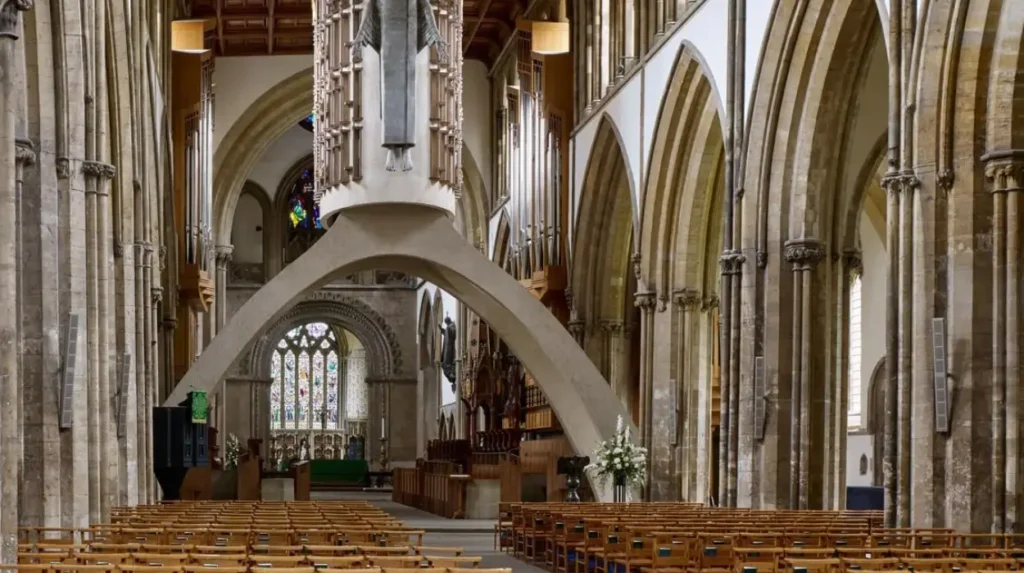
One of the most recognisable features of the restored cathedral is Majestas, a sculpture created by Jacob Epstein.
Installed in 1957, the sculpture represents Christ in Majesty and measures approximately 16 feet in height.
It stands above the nave on a dramatic concrete arch designed by George Pace.
The sculpture became an important feature of the cathedral’s post-war identity.
Its presence demonstrates how modern artistic approaches became part of the restoration of historic religious buildings.
Which Historic Buildings and Landmarks Preserve Llandaff’s Past?
Llandaff preserves its history through religious buildings, medieval ruins, historic residences and traditional streets. Llandaff Cathedral, the Bishop’s Palace, Insole Court and the surviving village centre provide important evidence of its architectural and social development.
The historic character of Llandaff is visible throughout its central area.
Its most important landmarks represent different periods, from early Christian settlement to Victorian residential development.
Llandaff Cathedral
The cathedral remains the most significant historic landmark.
Its architecture contains evidence of Norman construction, medieval Gothic additions, Victorian restoration and twentieth-century reconstruction.
The building also maintains its religious function as the principal church of the Diocese of Llandaff.
Bishop’s Palace
The medieval Bishop’s Palace stands near the cathedral grounds.
Its surviving gatehouse and defensive walls provide evidence of the authority exercised by medieval bishops.
The surrounding grounds were developed as an ornamental park during the 1970s.
Today, the ruins are an important part of the historic landscape.
Llandaff Village and High Street
Llandaff’s village centre preserves the traditional settlement pattern that developed around the cathedral.
High Street contains historic buildings and local businesses that contribute to the neighbourhood’s established character.
The surrounding streets provide evidence of its gradual transition from an ecclesiastical settlement into a residential community.
Insole Court
Insole Court represents the influence of Cardiff’s nineteenth-century industrial prosperity.
Its architecture and grounds provide insight into the lifestyle of wealthy industrial families.
The property also demonstrates the importance of community-led heritage preservation.
Llandaff Fields
Llandaff Fields form an important part of the neighbourhood’s historic landscape.
The open green space lies within the wider landscape surrounding the River Taff and the historic settlement.
Its continued presence provides a connection between Llandaff’s historic setting and modern recreational use.
How Has Modern Llandaff Developed as Part of Cardiff?
Modern Llandaff combines its historic ecclesiastical centre with established residential streets, educational institutions, green spaces and community facilities. Its development reflects Cardiff’s wider urban expansion while retaining important architectural and archaeological features.
During the twentieth century, Cardiff expanded significantly beyond its original urban boundaries.
Llandaff became increasingly connected to the wider city through residential development, transport improvements and public services.
However, its historic centre retained much of its traditional character.
Residential and Community Development
Modern Llandaff contains a mixture of historic properties, traditional residential streets and more recent housing.
The neighbourhood’s residential development reflects its changing role within Cardiff.
The cathedral area remains the historic focus, while surrounding residential streets accommodate families, professionals and established local communities.
Education and Cultural Connections
Llandaff has developed an established educational and cultural identity.
Its religious history provides an important connection with the development of education in south Wales.
The cathedral also continues to support religious services, cultural activities, musical performances and heritage visits.
These activities maintain the area’s historical importance beyond its architectural appearance.
Llandaff as a Historic Visitor Destination
Llandaff attracts visitors interested in Welsh history, medieval architecture and Cardiff’s historic neighbourhoods.
Its main attractions include the cathedral, Bishop’s Palace ruins, Insole Court and the village centre.
The compact historic centre also allows visitors to explore several important heritage sites within the same neighbourhood.
Visit Cardiff recognises Llandaff as one of the capital’s important historic destinations.
How Is Llandaff’s Historical Heritage Protected Today?
Llandaff’s historic heritage is protected through conservation planning, listed-building controls, archaeological investigation and the preservation of important historic monuments. Cardiff Council and heritage organisations help maintain the area’s architectural and archaeological character.
Historic preservation is essential because Llandaff contains buildings and archaeological remains from different periods.
The settlement’s significance extends beyond individual landmarks. Its historic street pattern, landscape, religious buildings and surviving architectural features collectively explain its development.
Llandaff Conservation Area
Cardiff Council uses conservation-area designations to protect locations with special architectural and historic interest.
Llandaff’s historic centre benefits from conservation planning controls that help preserve its traditional character.
These controls influence changes to buildings, streets and other elements of the historic environment.
They also help ensure that new development respects the architectural character of the surrounding area.
Archaeological Protection
Llandaff contains archaeological evidence associated with early Christian settlement and medieval development.
Roman-British burials have been discovered beneath the present cathedral.
The cathedral also preserves early medieval architectural remains, including a carved stone cross dating from the late tenth or early eleventh century.
These discoveries provide evidence of activity before the construction of the present Norman cathedral.
The Bishop’s Palace is another important archaeological site. It is recognised as a scheduled monument and Grade I listed building.
The Role of Historic Organisations
Several organisations contribute to understanding and protecting Llandaff’s history.
These include:
- Cadw: The Welsh Government’s historic environment service, responsible for protecting important monuments and supporting heritage conservation.
- Royal Commission on the Ancient and Historical Monuments of Wales: An organisation responsible for recording and researching Wales’s archaeological and architectural heritage.
- Cardiff Council: The local authority responsible for conservation planning and the management of the historic built environment.
- The Diocese of Llandaff: The ecclesiastical organisation responsible for the cathedral’s religious and institutional heritage.
- The Llandaff Society: A local organisation that promotes awareness and understanding of the neighbourhood’s history.
Their work supports the preservation of Llandaff’s historic identity for future generations.
Explore More Area Guide
History of Cathays Cardiff: From Rural Land to University District
The History of Roath Cardiff: From Village to Suburb
Why Does the History of Llandaff Remain Important to Cardiff?
Llandaff’s history explains the religious, architectural and social development of Cardiff beyond its castle and industrial waterfront. Its early Christian origins, medieval cathedral, industrial-era residences and surviving historic landscape preserve important evidence of Welsh heritage.
Llandaff represents a different historical dimension of Cardiff.
Cardiff Castle and the historic city centre demonstrate the development of political authority, commerce and urban administration. Llandaff provides a complementary record of religious authority and early Welsh Christianity.
Its cathedral preserves connections with the sixth-century religious tradition, while the medieval Bishop’s Palace demonstrates the influence of the Church during the Middle Ages.
The nineteenth-century residential properties reveal the impact of industrial prosperity on Cardiff’s surrounding settlements.
Its incorporation into Cardiff in 1922 also illustrates how the Welsh capital expanded while absorbing historically independent communities.
Llandaff’s heritage remains relevant to several areas of historical research.
Religious history: The cathedral provides evidence of the development of Christianity and ecclesiastical administration in south Wales.
Medieval Welsh history: The Bishop’s Palace and its association with Owain Glyndŵr preserve evidence of political conflict during the fifteenth century.
Architectural history: Norman, Gothic, Victorian and post-war architectural features demonstrate changing construction and restoration practices.
Industrial history: Properties such as Insole Court reveal how Cardiff’s coal industry influenced residential development and social structure.
Urban history: Llandaff’s incorporation in 1922 provides an example of the expansion of Cardiff during the twentieth century.
These connections establish Llandaff as an important part of the wider historical story of Wales.
The History of Llandaff Cardiff
Llandaff has developed through more than fifteen centuries of religious, political, architectural and social change. Its origins as an early Christian settlement during the sixth century established the foundations of an important ecclesiastical centre in south Wales.
The construction of Llandaff Cathedral under Bishop Urban around 1120 strengthened its religious importance. Medieval bishops expanded the cathedral and established a substantial episcopal residence, while the rebellion led by Owain Glyndŵr contributed to the destruction of the Bishop’s Palace.
The Reformation, eighteenth-century architectural changes and Victorian restoration transformed the cathedral’s appearance. Cardiff’s industrial expansion subsequently influenced Llandaff’s residential development, particularly through the construction of substantial properties associated with wealthy coal-industry families.
The cathedral’s destruction during the Second World War and its post-war reconstruction introduced another significant chapter in its history.
Today, Llandaff forms an important historic neighbourhood within Cardiff. Its cathedral, medieval ruins, traditional village centre, historic residences and green spaces preserve evidence of its development from an early Welsh religious settlement into part of the modern capital.
Understanding the history of Llandaff provides a deeper understanding of Cardiff’s development and the wider cultural heritage of Wales.
How old is Llandaff in Cardiff?
Llandaff dates back to the early medieval period, with its Christian origins traditionally associated with the sixth century. It is one of the oldest historic settlements in Cardiff, Wales.