
Cardiff’s public libraries are no longer defined only by shelves of printed books. The city’s library network combines borrowing services with digital resources, public computers, free Wi-Fi, learning opportunities, advice services, heritage collections, community activities and accessible public spaces. Cardiff Council operates libraries within a wider network of community hubs, linking cultural resources with practical services for residents and visitors.
- What do Cardiff public libraries offer beyond books?
- How did Cardiff libraries develop into wider community services?
- Can Cardiff library members access digital books and magazines?
- Do Cardiff libraries provide free computers and Wi-Fi?
- Can Cardiff libraries help with family history and local history?
- What learning services are available through Cardiff libraries?
- Can Cardiff libraries provide employment and financial advice?
- Do Cardiff libraries host community activities and events?
- How do Cardiff libraries support Welsh-language and community-language access?
- Can visitors use Cardiff libraries as public community spaces?
- Which Cardiff libraries provide the widest range of services?
- Why are Cardiff libraries important for digital inclusion and community life?
- What is the future role of Cardiff public libraries?
This model reflects the wider development of public libraries in Wales. Under the Welsh public library framework, libraries provide access to resources, activities and services that support learning, personal development, wellbeing, community participation, culture and recreation. The current Welsh Public Library Standards Framework 7 covers 2025 to 2028.
For Cardiff residents, this means a library visit can involve much more than borrowing a novel. A visitor can use a computer, access online newspapers, research family history, attend a community activity, seek employment support, access financial advice or use a quiet public space for learning.
What do Cardiff public libraries offer beyond books?
Cardiff public libraries provide far more than printed books, including eBooks, eAudiobooks, computers, Wi-Fi, online reference resources, printing, scanning, community activities, advice services, heritage collections and learning opportunities across the city.
The core library service remains book lending, but the wider service now covers physical and digital information. Cardiff Libraries allow members to browse and borrow books, audiobooks and other resources. Members can also use online services to search, reserve and renew items.
Digital borrowing extends access beyond physical opening hours. Cardiff library members can access eBooks, eAudiobooks, eMagazines and newspapers through the online service. This creates a library service that operates both inside buildings and remotely.
The network also connects library provision with Cardiff Council services. Many libraries operate within community hubs where residents can access advice relating to housing, benefits, employment, adult learning and other council services. The exact services vary between locations.
This wider model changes the practical role of libraries. A library becomes a place for information access, digital participation, education, community activity and local support as well as reading.
How did Cardiff libraries develop into wider community services?
Cardiff’s library service developed from the traditional free-library model into a broader public information network, preserving books and historical resources while adding computers, digital collections, community activities, advice services and shared civic facilities.
The historical development of public libraries in Cardiff is connected with the nineteenth-century expansion of free public access to knowledge. Historical records held by the National Library of Wales document Cardiff free libraries and library activity from the nineteenth and early twentieth centuries.
The National Library of Wales holds archival material relating to free libraries, including an 1880 essay by John Ballinger on the development and benefits of free libraries. It also holds historical records relating to Cardiff libraries and photographs of Cardiff free-library buildings from around 1905.
Cathays has a particularly strong historical connection. The present Cathays Branch and Heritage Library provides access to the Cardiff Heritage and Local Studies Collection. Its holdings include historical documents, maps, photographs, newspapers, street directories, electoral registers and parish registers.
The transition from a predominantly book-based service to a broader information service reflects changes in public needs. Printed books remain important, but modern residents also require internet access, digital information, electronic publications, employment resources and public spaces.
Welsh Government standards formalise this wider role. The standards require Welsh libraries to provide services and resources supporting learning, wellbeing, development, community participation, culture and recreation.
Can Cardiff library members access digital books and magazines?
Cardiff library members can borrow eBooks and eAudiobooks and access eMagazines, newspapers and electronic reference resources through the library’s digital services, extending access beyond physical shelves and enabling residents to use library resources from home.
Digital resources are a major part of the modern Cardiff library service. Library members can access electronic books, audiobooks, magazines and newspapers through online platforms.
The service also includes electronic reference material. Cardiff Libraries provide access to resources covering subjects such as IELTS preparation, historical newspapers, The Times Digital Newspaper Archive and Life in the UK.
Some resources have different access arrangements. Find My Past and the library edition of Ancestry.com are available from computers within Cardiff Hubs and Libraries. These resources support genealogical and historical research.
Digital access also reduces dependence on physical stock. A resident does not need to wait for a printed copy when an electronic edition is available. eBooks and eAudiobooks can be accessed remotely using library membership credentials.
This digital expansion also supports accessibility. Audiobooks provide an alternative format for people who find conventional print difficult to use. Electronic resources provide additional ways to access information according to individual needs.
The Welsh public library standards recognise digital access as part of modern public library provision. Free access to computers, internet services and Wi-Fi is included among the core entitlements established for libraries in Wales.
Do Cardiff libraries provide free computers and Wi-Fi?
Cardiff libraries provide public computer access and free Wi-Fi at most locations, giving residents access to internet services, Microsoft Office applications, online information, printing and other digital facilities that support work, education and everyday tasks.
Digital inclusion is an important function of Cardiff’s library network. Cardiff Council states that free Wi-Fi is available at its libraries except Tongwynlais, while public computers are available at specified locations. The computers provide internet access and Microsoft Office applications.
Computer access supports residents who do not have suitable equipment at home. It also provides a public location for completing online forms, accessing government information, studying, preparing documents and searching for employment.
Printing and scanning services add another practical function. Cardiff libraries provide public printers, while Wi-Fi printing allows users to send documents from phones or tablets at participating locations.
These services form part of the wider digital inclusion role of public libraries. Internet access is not treated simply as an optional extra under the Welsh public library framework. Free use of internet-connected computers and Wi-Fi is a recognised core entitlement.
For students, jobseekers, older residents and people managing online services, these facilities provide direct access to technology and information within a public setting.
Can Cardiff libraries help with family history and local history?
Cardiff libraries support family and local history research through specialist collections, historical newspapers, maps, photographs, registers, directories and digital genealogy resources, with Cathays Branch and Heritage Library serving as a major location for Cardiff heritage and local studies material.
Historical research is one of the clearest examples of a library service extending beyond ordinary book lending.
Cathays Branch and Heritage Library houses the Cardiff Heritage and Local Studies Collection. The collection includes local books, leaflets, bound articles, newspapers on microfilm, Ordnance Survey and tithe maps, street directories, electoral registers, parish registers, photographs, prints, periodicals and online resources.
These materials provide evidence for researching Cardiff neighbourhoods, buildings, streets, organisations and families. Historical newspapers provide contemporary accounts of events, while maps show how the city’s built environment changed.
Family-history research is also supported through digital resources. Cardiff Libraries provide access to Ancestry Library Edition and Find My Past on library computers. Cardiff Hubs also host dedicated family-history sessions. For example, Llanrumney Hub has hosted regular Ancestry sessions focused on helping people research their family history.
The service therefore combines physical archives with digital databases. This combination is particularly useful because historical research often requires several types of evidence rather than a single source.
For visitors interested in Cardiff history, the heritage collection also provides a direct connection with the city’s documentary past.

What learning services are available through Cardiff libraries?
Cardiff libraries support learning through books, electronic resources, public computers, adult learning connections, research facilities, community activities and specialist information services, giving residents practical places to develop digital, academic, employment and personal skills.
Learning is a central part of the modern public-library role. Welsh library standards specifically identify learning and personal development among the purposes supported by public library services.
In Cardiff, learning support operates through both library resources and wider Hub services. Adult Learning Cardiff is available through the Hub network, while some locations provide computer facilities, training rooms and spaces for community activities.
Digital learning is supported through access to computers, office software and online information. Residents can use these facilities for study, applications, document preparation and research.
Language learning is another area supported through digital resources. Cardiff library collections include Welsh-language publications and community-language publications at various locations. The network therefore supports access to information in different languages.
Libraries also provide physical spaces for learning. Reading areas, community rooms and rooms for hire create locations for classes, meetings and educational activities.
This model reflects a wider Welsh policy direction. The Welsh Public Library Standards Framework 7 identifies sustainable and connected communities as a major focus for public libraries between 2025 and 2028.
Can Cardiff libraries provide employment and financial advice?
Several Cardiff Hubs combine library facilities with practical support covering employment, money, housing and benefits, creating accessible locations where residents can obtain information, complete digital tasks and connect with specialist council or partner services.
The Hub model is particularly important because library services are integrated with other public services.
Cardiff Hubs provide access to Money Advice, IntoWork advice services, Adult Learning Cardiff and assistance with housing and benefit enquiries. Service availability differs between locations and days, so residents need to check the relevant Hub before visiting.
Central Library Hub provides a clear example. The city-centre facility offers library services alongside welfare and benefit advice, housing support, homelessness support, bus-pass assistance and employment-related services.
Canton Library provides another example. Its Hub services include housing and benefit enquiries, free-school-meal applications, council tax enquiries, school admissions and IntoWork advice, alongside library services.
This integration makes libraries useful for practical civic tasks. Residents can combine information access with public-service support during the same visit.
The model also supports digital access. Public computers can help residents complete online applications, search for jobs, prepare documents and access official information.
Libraries therefore function as accessible points of contact within a wider public-service network.
Do Cardiff libraries host community activities and events?
Cardiff libraries and Hubs host community activities covering children’s sessions, parent-and-toddler groups, talks, creative activities, wellbeing programmes, family-history sessions and cultural events, with individual locations offering different programmes throughout the year.
Community activity is now a visible part of Cardiff’s library network.
The Cardiff Hubs programme lists activities for different ages and interests. Examples include reminiscence cafés, neurodivergent-friendly children’s sessions, stay-and-play activities and creative events.
Canton Library hosts activities such as children’s craft sessions. Cathays Branch and Heritage Library hosts author talks and poetry events. Llanrumney Hub has hosted Ancestry sessions for family-history researchers.
Central Library Hub also functions as a cultural and community venue. Its building contains spaces that support community activities and room hire, alongside its library and advice services.
These activities give libraries a role in community participation. They create structured opportunities for learning, cultural engagement and shared interests.
The programme also changes over time. Cardiff Hubs publishes current events and activities, so users should check individual locations for dates, booking requirements and eligibility.
How do Cardiff libraries support Welsh-language and community-language access?
Cardiff libraries provide Welsh-language publications and services alongside community-language resources at participating locations, supporting access to information and culture in Welsh and in languages used by Cardiff’s diverse communities.
Language access forms part of the public library framework in Wales.
Welsh library standards require libraries to provide access to services, cultural activities and high-quality resources in the Welsh language. They also recognise the importance of serving diverse audiences and working with partners to extend access.
Cardiff library locations list Welsh-language publications among their services. Some locations also provide community-language publications, allowing residents to access reading and information resources in languages other than English and Welsh.
Cathays Branch and Heritage Library provides Welsh-language publications as part of its library services while also maintaining specialist historical resources.
Bilingual public-service design is also a wider Welsh Government principle. The Digital Service Standard for Wales states that public services should be designed in Welsh and English and should meet the needs of people who use Welsh in everyday life.
Libraries therefore contribute to both cultural access and practical language inclusion.
Can visitors use Cardiff libraries as public community spaces?
Cardiff libraries provide accessible public spaces for reading, studying, community activities, meetings, digital access and advice, with locations such as Central Library Hub combining library facilities with cultural, civic and community functions.
Physical space remains important even as library services become increasingly digital.
Cardiff library locations include reading and relaxation areas, public computers, community rooms and rooms for hire. Specific facilities differ between locations.
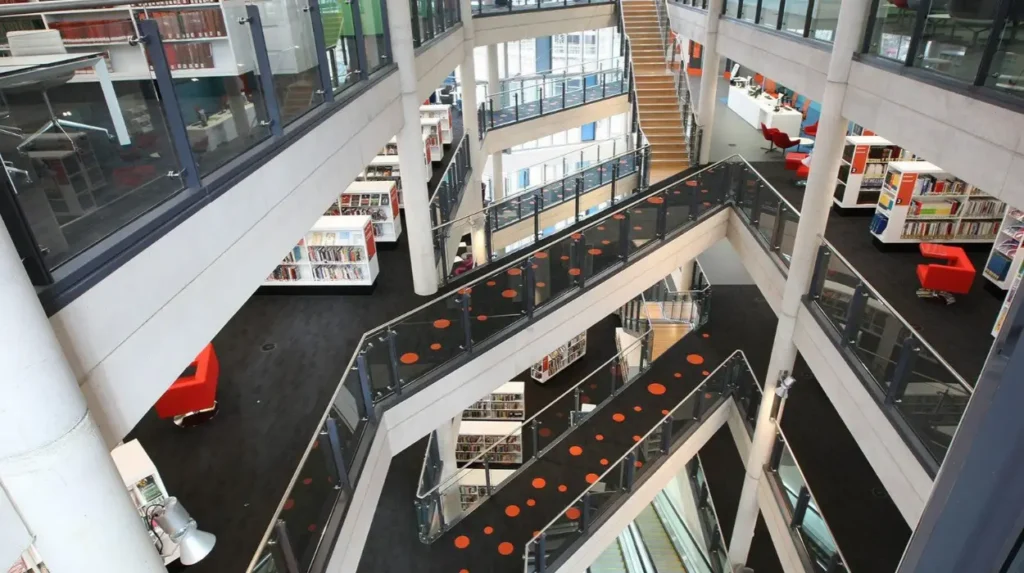
Central Library Hub is particularly significant because its city-centre building operates as a cultural venue, community centrepiece and home for library and advice services. The building also contains rooms and spaces available for hire.
Other libraries provide community rooms and training spaces. Canton Library, for example, has community and training rooms. St Mellons Hub provides multi-use, sports and training spaces alongside library services.
These facilities give residents places to access information without requiring commercial premises. They also support local groups, learning activities and public meetings.
The physical library therefore remains relevant despite the growth of online information. Its function has expanded from storing and lending resources to providing publicly accessible infrastructure.
Which Cardiff libraries provide the widest range of services?
The widest combination of services is found at Cardiff Hubs that integrate full library facilities with council support, computers, Wi-Fi, community rooms, advice services, learning opportunities and events, including Central Library Hub, Canton Library and several neighbourhood Hubs.
Service provision differs across Cardiff, so no single list applies equally to every location.
Central Library Hub provides full library services alongside money advice, housing support, IntoWork services, Citizens Advice access, public computers, digital services, community activities and rooms for hire.
Canton Library combines full library services with housing and benefit support, school-related council services, IntoWork advice, public computers, Wi-Fi, printing, scanning and community rooms.
Cathays Branch and Heritage Library is particularly important for research because it combines ordinary library services with the Cardiff Heritage and Local Studies Collection, archives, historical newspapers, maps, photographs and family-history resources.
Neighbourhood Hubs such as Llanishen, Rhiwbina, Rhydypennau, Llanrumney, Rumney and St Mellons provide different combinations of library, digital, advice and community facilities.
Residents should therefore choose a location according to the service required rather than assuming every library provides identical facilities.
Explore More Area Guide
Cardiff Community Councils: Areas, Services and Local Democracy
How Cardiff Ward Boundaries Changed: Cardiff Council History
Why are Cardiff libraries important for digital inclusion and community life?
Cardiff libraries support digital inclusion, education, cultural participation, local research and access to public services by combining free information resources with computers, Wi-Fi, community spaces, advice services and activities across neighbourhoods.
Digital exclusion remains a practical barrier when essential services increasingly depend on online access. Public libraries provide physical locations where residents can use computers and internet services.
The library network also supports information literacy. Staff help users navigate library resources, while electronic databases provide access to specialised information.
Community access is equally important. Cardiff Hubs connect library facilities with employment, money, housing and adult-learning services. This makes libraries part of the city’s broader community infrastructure.
The Welsh Government’s current library framework emphasises sustainable and connected communities. The framework recognises public libraries as services that contribute to wider community outcomes rather than functioning solely as book-lending facilities.
Cardiff’s model reflects that approach through the integration of libraries and Hubs.
The result is a multi-purpose public service network. Books remain central, but residents also gain access to digital resources, heritage information, learning facilities, community events, public computers and practical advice.
What is the future role of Cardiff public libraries?
The future role of Cardiff public libraries centres on combining physical collections with digital access, learning, heritage, community activity and public services, while maintaining free access, bilingual provision and accessible spaces across Cardiff’s neighbourhoods.
The direction of Welsh public library policy is clear. Framework 7 covers 2025 to 2028 and focuses on public libraries supporting sustainable and connected communities.
For Cardiff, the Hub model provides an established structure for delivering this broader role. Libraries already combine traditional collections with electronic resources, computers, Wi-Fi, community events and public-service support.
Digital resources will remain important because residents increasingly access information through electronic platforms. At the same time, physical library buildings remain necessary for public computers, specialist collections, staff assistance, events and community activity.
Heritage services also provide a permanent role for physical collections. Historical newspapers, maps, photographs, registers and local documents cannot be replaced entirely by general online search results. Cardiff’s specialist local studies resources provide primary material for understanding the city’s development.
The future library is therefore both physical and digital. It provides access to knowledge, technology, culture, local history and community services.
For Cardiff residents, the practical message is straightforward: a library membership provides access to substantially more than printed books. The city’s library network functions as an information, learning, digital, heritage and community resource embedded within neighbourhood life.
What do Cardiff public libraries offer besides books?
Cardiff public libraries offer eBooks, eAudiobooks, eMagazines, newspapers, public computers, free Wi-Fi, printing, scanning, community activities, learning opportunities, heritage resources and access to advice services.