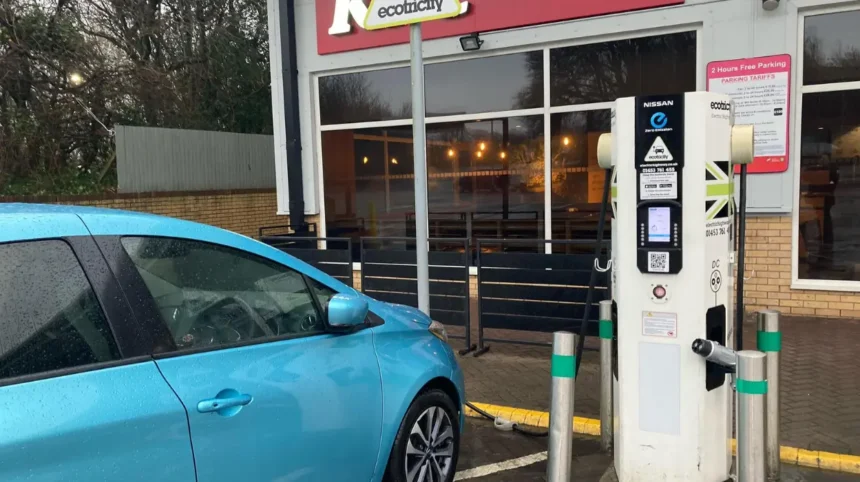
Electric vehicle charging points are an essential part of Cardiff’s transport infrastructure. They allow electric cars and vans to recharge away from home and support the wider transition from petrol and diesel vehicles to zero-emission transport.
- What are EV charging points in Cardiff?
- Why does Cardiff need more EV charging points?
- What types of EV chargers are available in Cardiff?
- How long does it take to charge an EV in Cardiff?
- Where can drivers find EV charging points in Cardiff?
- How do you use a public EV charger in Cardiff?
- How much do EV charging points cost in Cardiff?
- Which payment methods are available at Cardiff EV chargers?
- What should Cardiff drivers check before using an EV charging point?
- How is Cardiff Council expanding EV charging infrastructure?
- How does Cardiff fit into the wider EV charging network in Wales?
- What role do home and workplace chargers play in Cardiff?
- What are the main challenges facing EV charging in Cardiff?
- What is the future of EV charging points in Cardiff?
Cardiff Council is expanding its charging infrastructure, while commercial charging operators continue to add public charging sites across the city. The network includes residential on-street chargers, destination chargers, fast chargers, rapid chargers and ultra-rapid facilities.
Cardiff Council currently lists 18 council-installed electric vehicle charging points across Canton, Cathays, Penylan, Plasnewydd and Riverside. The council also confirms that many other charging points operate across Cardiff through commercial providers.
The wider UK charging network is also expanding rapidly. Department for Transport statistics recorded 119,080 public EV chargers across the UK on 1 April 2026, including 27,372 chargers rated at 50kW or above. Wales had 179.3 public EV chargers per 100,000 residents, including 39.6 rapid-or-above chargers per 100,000 residents.
What are EV charging points in Cardiff?
EV charging points in Cardiff are electrical facilities that supply energy to electric vehicles through compatible charging equipment, cables and connectors. They include residential, workplace, destination, on-street, rapid and ultra-rapid chargers operated by councils and private networks.
An electric vehicle charging point is a physical installation that transfers electricity from the electricity network into an electric vehicle battery. The technical term for the equipment is electric vehicle supply equipment, commonly abbreviated to EVSE.
A charging point normally consists of electrical protection equipment, a charging unit, a connector or socket, communication systems and payment or authentication technology. Public installations also include signage, parking controls and network management systems.
Charging points serve different purposes. A 7kW residential or on-street charger is designed for longer parking periods. A 22kW destination charger provides faster AC charging where vehicles remain parked for several hours. A 50kW or higher DC rapid charger is designed for shorter stops.
Cardiff’s charging network reflects the needs of a dense urban area. Residential streets contain properties without private driveways, while retail parks, car parks, hotels, workplaces and major roads provide locations for destination and rapid charging.
Cardiff Council states that its charging system is managed by Evolt. Users need a compatible plug-to-plug cable and an Evolt Network account or another accepted payment method. Evolt chargers rated at 7kW and above also accept contactless payment on a pay-as-you-go basis.
Why does Cardiff need more EV charging points?
Cardiff needs more EV charging points because urban residents have different parking arrangements, electric vehicle ownership is increasing, and public infrastructure supports drivers without private driveways. Charging availability also supports businesses, visitors, fleets and Cardiff’s wider transport decarbonisation goals.
Home charging remains important for drivers with off-street parking. However, many Cardiff properties rely on streets, communal parking or public car parks. These households cannot simply install a private wallbox outside their homes.
On-street charging therefore has a specific role in Cardiff. It provides access to electricity for residents who park near their homes but do not have a private driveway.
Cardiff Council’s 2024 Electric Vehicle Infrastructure Roadmap identified areas with lower levels of off-street parking as priorities. These included Heath, Gabalfa, Cathays, Roath, Penylan, Adamsdown, Riverside, Canton, Grangetown and Butetown. The council announced plans to support up to 100 additional charging points over two years, predominantly using 7kW standard chargers and some chargers of up to 50kW.
The roadmap also identified significant growth in commercial public charging. Cardiff Council expected the city to reach approximately 600 to 700 publicly accessible charge points during 2025/2026, compared with around 200 at the time of the 2024 announcement.
This growth has several functions. It supports residents who lack private parking. It supports visitors travelling into Cardiff. It provides charging opportunities for businesses and commercial fleets. It also strengthens the city’s ability to accommodate increasing numbers of electric vehicles.
Welsh Government’s Electric Vehicle Charging Strategy established a national vision for users of electric cars and vans to have confidence that charging infrastructure is available when and where required. The strategy covers charging provision through to 2030 and recognises the need for public and private sector investment.
What types of EV chargers are available in Cardiff?
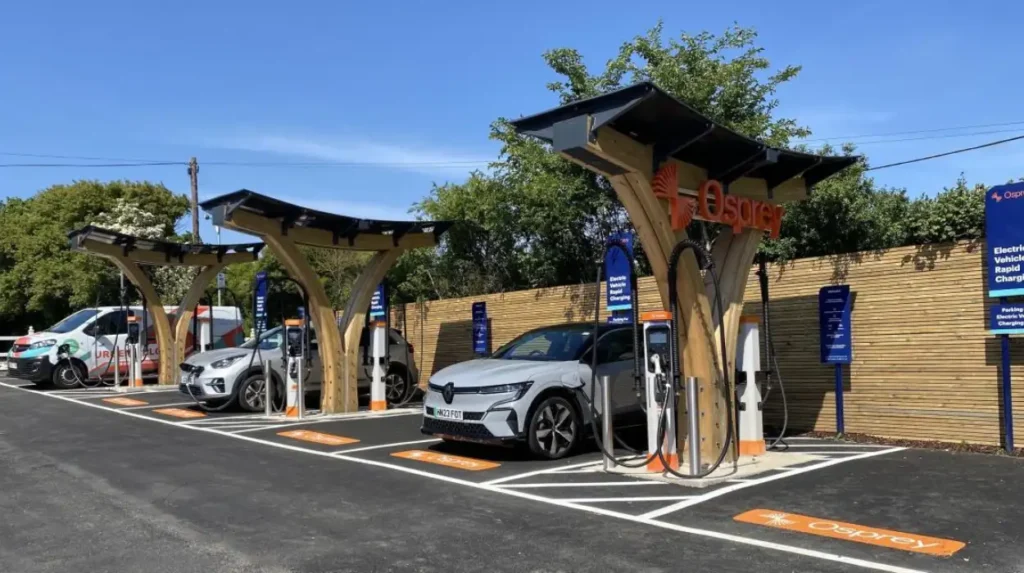
Cardiff has several charging categories, including slow, fast, rapid and ultra-rapid equipment. Examples include 7kW residential chargers, 22kW destination chargers, 50kW rapid chargers and 150kW-plus ultra-rapid chargers, with actual speed depending on vehicle capability.
Charging speed is measured in kilowatts, abbreviated to kW. A higher kW rating generally allows more electricity to be transferred within a given period, but the vehicle’s maximum charging rate also controls the result.
Standard and slow charging
Standard chargers are suitable for longer parking periods. Cardiff Council states that its public charging system includes chargers that take approximately four to six hours for a full average EV charge. Its published guidance lists slow charging at approximately six to eight hours.
A 7kW charger is particularly useful overnight or during long residential parking periods. It suits drivers who do not need to recover a large amount of range quickly.
Fast AC charging
Fast charging generally operates at higher power than standard residential charging. A 7kW to 22kW AC charger is common at workplaces, car parks and destinations where vehicles remain parked for several hours.
A 22kW charger does not automatically deliver 22kW to every vehicle. The vehicle’s onboard AC charger determines how much power it accepts.
Rapid DC charging
Rapid chargers normally use direct current, or DC, to provide higher charging power. Cardiff Council lists rapid charging as taking approximately 30 minutes in its general guidance, although actual charging time varies according to battery size, battery temperature, state of charge and vehicle charging capability.
Ultra-rapid charging
Ultra-rapid charging operates at substantially higher power. The Department for Transport classifies public EV chargers rated at 150kW and above as ultra-rapid. On 1 April 2026, 11% of UK public EV chargers were in this category.
Ultra-rapid facilities are designed for short stops and longer-distance journeys. They are particularly useful when a driver needs to restore significant battery range during a journey.
How long does it take to charge an EV in Cardiff?
EV charging time in Cardiff depends on charger power, battery capacity, vehicle charging limits and the battery’s state of charge. Cardiff Council states that an average full charge takes around four to six hours, while rapid charging can take approximately 30 minutes.
Charging time is not determined by the charger rating alone. The vehicle controls the electricity it accepts according to its battery management system and charging capability.
For example, a vehicle that accepts a maximum of 7kW on AC charging does not gain the full benefit of a 22kW AC charger. Similarly, a vehicle with a lower maximum DC charging rate cannot use the full output of a higher-powered rapid charger.
Battery state of charge also affects charging performance. DC charging is generally fastest at lower battery percentages. Charging power normally reduces as the battery approaches a high state of charge.
Temperature is another factor. Battery management systems regulate charging to protect the battery. Cold batteries often charge more slowly until they reach an appropriate operating temperature.
For everyday Cardiff driving, a driver does not necessarily need a full charge during every public charging session. A shorter session can provide enough additional range for the next part of a journey.
Cardiff Council’s published charging guidance provides a useful general reference: slow charging takes around six to eight hours, fast charging around three to four hours and rapid charging around 30 minutes. These are average guidance figures rather than guaranteed charging times for every vehicle.
Where can drivers find EV charging points in Cardiff?
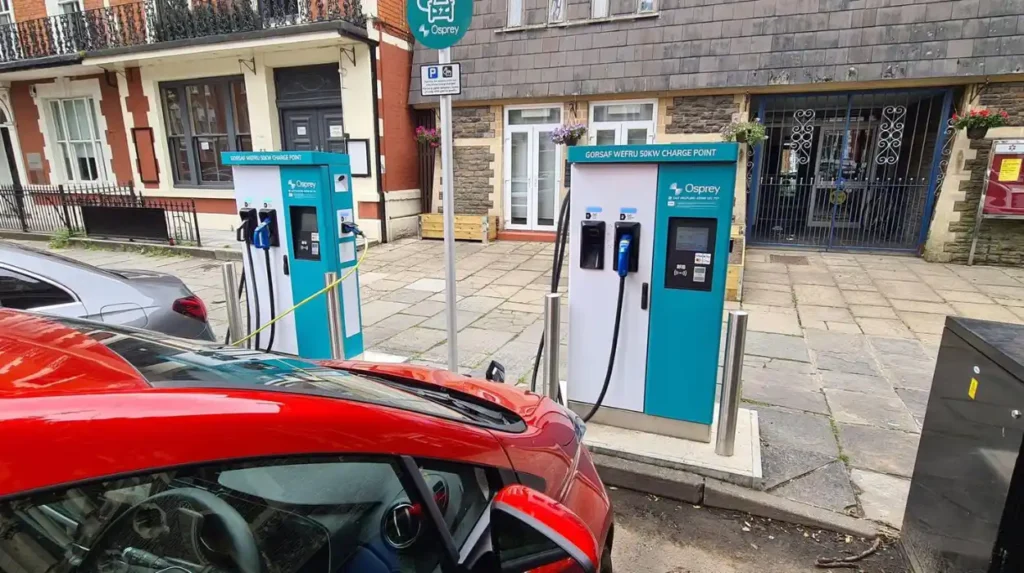
Drivers can find EV charging points across Cardiff in residential streets, public car parks, retail areas, workplaces, commercial sites and major travel corridors. Council installations currently cover Canton, Cathays, Penylan, Plasnewydd and Riverside, alongside commercial networks across the city.
Cardiff’s public charging network is not operated by a single organisation. Different operators provide chargers at different locations, so drivers need to check the network, connector, price, operating status and payment method before starting a session.
Council-operated infrastructure has a specific residential function. Cardiff Council identifies suitable locations based on factors such as pavement width, parking availability and the absence of private driveways or garages. The council does not normally install a public charging point immediately outside an individual residential property.
Commercial charging is available in other parts of Cardiff. Examples include retail parks, car parks and roadside locations. Commercial operators have continued to expand their networks alongside council investment.
Drivers should use a live charging map or the operator’s own application before travelling to a charger. A location appearing on a static directory does not guarantee that the charger is operational or available.
The Department for Transport’s public charging statistics are compiled from charge point operator data. The Office for National Statistics also warns that local charger figures can change because of data revisions, replacement of old chargers and changes in operator reporting.
How do you use a public EV charger in Cardiff?
Using a public EV charger in Cardiff involves checking compatibility, parking correctly, connecting the vehicle, starting the charging session through the required payment method and stopping the session before leaving. Drivers should follow operator instructions displayed on the charger.
The first step is identifying the charger type and connector. Most modern UK electric cars use the Combined Charging System, commonly called CCS, for rapid DC charging. AC charging commonly uses a Type 2 connection.
Some vehicles use different connector arrangements, so compatibility must be confirmed before arrival.
At Cardiff Council’s Evolt-operated points, users need a compatible cable supplied with the vehicle. Drivers can register with the Evolt Network app and add payment details. Cardiff Council also states that Evolt chargers of 7kW and above accept contactless payment on a pay-as-you-go basis.
After parking, the driver connects the vehicle and follows the charger instructions. Depending on the equipment, the session starts through an app, contactless bank card, RFID card or another authentication method.
The charging session should be monitored through the vehicle or charging network. When the required charge has been reached, the driver ends the session and disconnects the cable according to the operator’s instructions.
Parking restrictions are important. Cardiff Council states that charging bays are reserved for vehicles using the charging point. Drivers should therefore avoid occupying a charging space without charging.
How much do EV charging points cost in Cardiff?
The cost of charging an EV in Cardiff depends on the operator, charger speed, electricity tariff, payment method, parking arrangements and session duration. Public charging prices are set by individual operators and should be checked before charging.
There is no single Cardiff-wide public charging tariff. Different charge point operators establish their own pricing structures.
Some chargers use a price per kilowatt-hour. Others can include connection fees, minimum charges, parking charges, overstay fees or different rates based on location and time.
The price per kilowatt-hour is particularly important because it allows drivers to compare charging costs with home electricity costs. However, the total cost also depends on how much electricity the vehicle needs.
Contactless payment is increasingly important for public charging. Cardiff Council confirms that its Evolt chargers rated at 7kW and above accept contactless payment on a pay-as-you-go basis.
Drivers should check the displayed tariff before starting a session. The charger screen, operator website or mobile application provides the most relevant current pricing information.
Membership can also affect cost. Some networks provide standard pay-as-you-go pricing, while registered customers receive different rates or account-based features.
Parking charges must also be considered separately. A charging session can therefore involve both an electricity charge and a parking charge, depending on the location.
Which payment methods are available at Cardiff EV chargers?
Cardiff EV chargers use different payment methods depending on the operator, including contactless bank cards, mobile applications and RFID cards. Cardiff Council’s Evolt network supports app registration, RFID access and contactless payment on eligible chargers.
Payment systems vary across Cardiff because commercial operators manage many public chargers independently.
Cardiff Council’s Evolt network allows users to register through the Evolt Network app and provide payment details. An RFID card is another access method. Evolt chargers rated at 7kW and above also accept contactless payment.
Commercial networks have their own payment arrangements. Some accept contactless payment directly at the charger. Others use applications, RFID cards or account-based payment.
Drivers should check the network name on the charging unit before arriving. Cardiff Council specifically advises users of non-Evolt chargers to check the provider information displayed on the charging point.
Keeping a small number of widely used charging applications installed can simplify longer journeys. Drivers should also ensure that payment cards and account details are current.
What should Cardiff drivers check before using an EV charging point?
Cardiff drivers should check charger availability, connector compatibility, charging power, pricing, payment options, parking restrictions and opening access before travelling. A backup charger is useful when a preferred location is occupied, unavailable or unsuitable for the vehicle.
Live availability is particularly important. Public chargers can be occupied, temporarily unavailable or undergoing maintenance.
The connector should be checked before travelling. AC and DC charging use different connection arrangements, and some vehicles have restrictions on maximum charging power.
The charging speed should also match the purpose of the journey. A 7kW charger is appropriate for long parking periods, while a rapid charger is more suitable for a short stop.
Pricing is another essential check. Drivers should confirm the price per kWh and identify any additional parking or overstay fees.
Access restrictions also matter. Some charging sites are located within private car parks, retail areas or other premises with specific opening hours or parking rules.
A backup location reduces the risk of disruption. This is especially important for longer journeys where reaching the next charger depends on having sufficient battery range.
Cardiff Council advises drivers to identify the relevant charging network and use appropriate provider information when accessing chargers outside its own Evolt network.
How is Cardiff Council expanding EV charging infrastructure?
Cardiff Council is expanding EV infrastructure through council installations, private-sector partnerships, planning requirements and support for charging in areas with limited off-street parking. Its 2024 roadmap targeted up to 100 additional charging points over two years.
Cardiff Council’s Electric Vehicle Infrastructure Roadmap is designed to support the transition to electric vehicles while addressing charging access across different neighbourhoods.
The council identified residential areas with limited off-street parking as a key priority. The proposed locations included Heath, Gabalfa, Cathays, Roath, Penylan, Adamsdown, Riverside, Canton, Grangetown and Butetown.
The planned infrastructure was predominantly based on 7kW standard chargers, supported by some chargers up to 50kW. The council planned to deliver the installations through private-sector partnerships without a net cost to the council.
Cardiff Council also states that charging points are being included in new developments and that more charging points are planned for residential areas.
The council’s approach recognises that different parts of the city have different charging requirements. Dense residential streets require different infrastructure from retail parks, workplaces and major travel routes.
The strategy therefore combines on-street infrastructure with commercial public charging and charging facilities associated with new developments.
How does Cardiff fit into the wider EV charging network in Wales?
Cardiff forms part of Wales’s wider electric vehicle charging network, which is being developed through national strategy, local authority investment and private-sector infrastructure. Wales recorded 179.3 public EV chargers per 100,000 residents on 1 April 2026.
Welsh Government’s Electric Vehicle Charging Strategy covers charging requirements for electric cars and vans through to 2030. It identifies increased charging provision, charging quality, sustainability and local benefits as important outcomes.
The strategy also recognises the importance of electricity network capacity. Large-scale charging infrastructure requires suitable electrical connections and coordination with the electricity sector.
National infrastructure supports journeys between Cardiff and other Welsh locations. Cardiff is also connected to the wider UK road network, making reliable public charging important for visitors arriving from England and other parts of Wales.
Official Department for Transport data recorded 119,080 public EV chargers across the UK on 1 April 2026. Wales had 179.3 chargers per 100,000 residents, compared with 171.9 across the UK as a whole.
The figures demonstrate the importance of measuring infrastructure by both total chargers and population. A large number of chargers does not automatically mean every neighbourhood has equal access.
Cardiff’s urban structure creates a specific requirement for residential charging. Areas with terraced housing and limited private parking need accessible on-street options alongside commercial charging hubs.
What role do home and workplace chargers play in Cardiff?
Home and workplace charging reduce dependence on public chargers by allowing EVs to recharge during long parking periods. Home charging suits properties with suitable off-street parking, while workplace charging supports employees, company fleets and vehicles parked during working hours.
Public chargers are only one part of the EV charging system.
Home charging is generally suited to overnight charging. A vehicle can remain connected for several hours while the driver is at home.
Workplace charging provides another long-duration option. Employees can charge while working, while businesses can provide infrastructure for company vehicles and fleets.
Cardiff Council also recognises the importance of charging in new developments. Its current electric vehicle information states that charging points are being incorporated into new developments.
The UK government also operates and records different charging grant schemes. Official statistics for 1 April 2026 include schemes covering residential charging, workplace charging, commercial landlords and other infrastructure categories.
Grant availability and eligibility change over time, so property owners, landlords and businesses should check current government guidance before making financial assumptions.
Explore More Area Guide
Best Cycling Routes in Cardiff: Taff Trail & Bay 2026
Cardiff Metro Plans Explained: South Wales Metro 2026
What are the main challenges facing EV charging in Cardiff?
The main Cardiff EV charging challenges are uneven access to off-street parking, demand for public bays, electricity capacity, charger reliability, payment complexity and the need to expand infrastructure alongside electric vehicle adoption across different neighbourhoods.
Off-street parking is one of the most important local issues. Households with driveways have greater access to private charging, while residents relying on public streets depend more heavily on public infrastructure.
Parking space management is another challenge. A charging bay must remain accessible to EV users while avoiding unnecessary occupation.
Electricity network capacity is also relevant. High-power chargers require substantial electrical capacity, and large charging sites need appropriate grid connections.
Reliability affects user confidence. A charger that is unavailable, damaged or difficult to access does not provide the same practical value as an operational charger.
Payment fragmentation creates another challenge. Drivers can encounter different operators, applications, tariffs and payment systems across the city.
The Welsh Government charging strategy recognises that delivery requires cooperation between government, local authorities, electricity companies, private operators and other stakeholders.
These challenges make infrastructure planning important. Cardiff’s charging network needs to combine residential access, destination charging and rapid infrastructure rather than relying on one charger type.
What is the future of EV charging points in Cardiff?
The future of EV charging in Cardiff centres on expanding public access, improving residential charging, increasing rapid infrastructure, integrating chargers into new developments and coordinating private investment with local and national transport policy through 2030.
Cardiff’s charging network is expected to continue developing as electric vehicle ownership increases.
The council’s 2024 roadmap identified an estimated requirement for around 2,000 public charging sockets in Cardiff by 2030 based on demand analysis.
This is a planning projection rather than a current infrastructure total. Actual deployment depends on vehicle adoption, electricity capacity, private investment, public policy and local demand.
The future network will contain different charging speeds. Residential streets require long-duration charging. Retail and leisure destinations benefit from destination charging. Major travel routes require rapid and ultra-rapid facilities.
Data quality will also become increasingly important. The Department for Transport changed its primary public infrastructure measure in 2026 to focus on individual EV chargers, also known as EVSE. The new approach provides more detailed information on operational public charging infrastructure.
The UK network recorded 3,028 additional public EV chargers during the first quarter of 2026. In 2025, 13,281 chargers were added to the public network.
For Cardiff, continued expansion will depend on matching charger locations with actual charging demand. Residential areas with limited off-street parking remain particularly important.
The long-term objective is a charging system that gives residents, businesses and visitors reliable access to suitable charging without requiring every journey to depend on a single type of charger.
EV charging points are now an established part of Cardiff’s transport infrastructure. The city’s network combines council-installed chargers with commercial charging sites across residential areas, car parks, retail destinations and major routes.
Cardiff Council currently operates 18 listed charging points across Canton, Cathays, Penylan, Plasnewydd and Riverside, while its wider infrastructure programme supports additional installations and private-sector growth.
The council’s 2024 roadmap targeted up to 100 additional chargers over two years and identified areas with limited off-street parking as priorities. The roadmap also projected significant growth in commercial public charging and identified a potential requirement for around 2,000 public charging sockets by 2030.
For drivers, the most important factors are charger compatibility, power rating, availability, price, payment method and parking rules. Checking these details before travelling makes public charging more predictable.
For Cardiff as a city, the next stage involves expanding infrastructure while ensuring that residential streets, workplaces, destinations and strategic travel routes receive suitable charging provision.
How many EV charging points are there in Cardiff?
Cardiff has a growing network of public EV charging points operated by Cardiff Council and private charging companies. The council’s network covers locations including Canton, Cathays, Penylan, Plasnewydd and Riverside, alongside commercial charging sites across the city.