Cardiff has a structured parking system designed to manage demand for limited kerbside space, protect residential parking, support local businesses, improve road safety and reduce commuter parking. The main mechanism is the Controlled Parking Zone (CPZ), where on-street parking is regulated through signs, marked bays, permits, waiting restrictions and payment requirements.
- What are parking zones in Cardiff?
- Why has Cardiff introduced controlled parking zones?
- How do controlled parking zones work in Cardiff?
- Which parking zones operate in Cardiff?
- How much does parking cost in Cardiff controlled zones?
- Who can use resident parking permits in Cardiff?
- Can visitors park inside Cardiff parking zones?
- What parking restrictions should drivers understand in Cardiff?
- How do drivers pay for parking in Cardiff zones?
- What happens if a driver breaks Cardiff parking rules?
- How do Cardiff parking zones affect residents, businesses and visitors?
- How is Cardiff changing its parking strategy?
- How should drivers check the correct Cardiff parking zone before parking?
- Why will parking zones remain important for Cardiff?
Cardiff Council operates parking zones across residential and central areas. Each zone has its own operating hours, parking bays, permit arrangements and payment rules. Drivers must follow the signs displayed within the relevant zone because restrictions differ between locations. Cardiff Council states that most CPZs operate seven days a week, while specific restrictions depend on the individual area.
The system also connects with wider Cardiff transport policy. The council’s city parking plan is designed to prioritise residents, reduce traffic, support cleaner air and manage parking demand through different parking management areas.
What are parking zones in Cardiff?
Parking zones in Cardiff are designated areas where on-street parking is controlled during specified periods through signs, marked bays, permits, waiting restrictions and payment requirements. They regulate kerbside space for residents, visitors, businesses and other authorised users.
A parking zone establishes a defined area where normal unrestricted kerbside parking does not apply. Drivers entering a controlled area are informed through prominent zone-entry signs. Cardiff Council explains that a CPZ controls all on-street parking during certain times and requires vehicles to use designated parking bays.
The purpose is not simply to charge motorists. Parking controls manage demand for limited road space. They help prevent long-term commuter parking in residential streets and provide greater turnover in areas where shoppers, visitors and residents compete for parking.
Cardiff Council identifies several objectives for CPZs. These include simplifying restrictions, saving parking spaces for residents and visitors, discouraging commuter parking, encouraging walking, cycling and public transport, improving highway safety and improving parking conditions for local communities.
A zone therefore operates as a local parking management framework rather than as a single parking tariff. A driver must consider the zone entry sign, road markings, parking bay sign, operating hours, maximum stay and payment or permit requirements before leaving the vehicle.
Why has Cardiff introduced controlled parking zones?
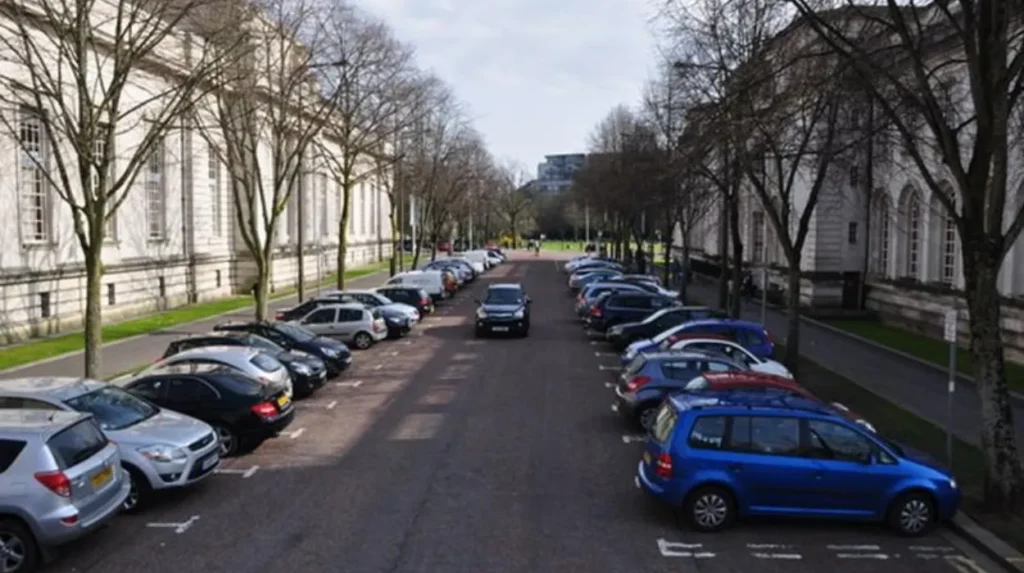
Cardiff introduced controlled parking zones to manage high parking demand, protect residential spaces, discourage commuter parking, improve road safety and support sustainable transport. The zones also create clearer parking rules for residents, visitors, businesses and other road users.
Parking pressure increases when residential streets are used by commuters travelling into central Cardiff, students, visitors, shoppers and employees. Without controls, vehicles can remain parked for long periods and reduce turnover.
Cardiff Council identifies commuter parking as a specific problem addressed through controlled zones. The council’s current city parking plan states that free commuter parking in residential areas has made it harder for residents and businesses to find available space.
Parking management also supports wider transport objectives. Cardiff’s parking strategy links parking controls with traffic reduction and cleaner air. The city parking plan divides Cardiff into three proposed parking management areas: the city and civic centre, inner area and outer area. Each area is intended to have parking controls suited to local conditions.
The legal foundation for parking restrictions comes from traffic regulation legislation. Welsh Government legal guidance identifies the Road Traffic Regulation Act 1984 and Traffic Management Act 2004 as major sources of traffic management powers. Traffic authorities use Traffic Regulation Orders (TROs) to regulate roads and parking.
A TRO provides the legal mechanism for restrictions such as waiting controls and designated parking places. Its purposes include improving safety, facilitating traffic movement, preserving local amenities and controlling vehicle movements to improve air quality.
How do controlled parking zones work in Cardiff?
Controlled parking zones operate through entry signs, marked parking bays, time restrictions, permits, payment systems and waiting restrictions. Drivers must follow the specific rules displayed for their zone because operating hours, tariffs, maximum stays and permit rights differ between locations.
A driver first identifies the CPZ through its entry signage. The sign establishes the controlled area and indicates relevant operating times. Within the zone, individual parking bays provide additional instructions.
Cardiff Council states that most of its CPZs operate seven days a week, although the exact restriction times vary by location. Drivers must check local signs before parking.
Parking zones contain different types of spaces. A resident permit holder bay is reserved for vehicles displaying or holding an appropriate resident permit. A limited waiting bay allows parking for a specified period. A pay-and-stay bay requires payment under the applicable tariff.
Shared-use bays combine more than one parking function. For example, a Cardiff zone can allow resident permit holders to use a bay while also allowing other drivers to park after making the required payment.
Yellow-line restrictions operate separately from ordinary parking bays. Cardiff Council states that double yellow lines, dropped footways and kerb crossing restrictions apply 24 hours a day in its CPZ information.
This distinction is important. A driver cannot assume that a parking permit overrides every restriction in the street. A permit provides rights only within the parking places and zones specified by the permit and remains subject to regulatory signs.
Which parking zones operate in Cardiff?
Cardiff has numerous controlled parking zones covering residential and central areas, including examples such as Cathays East, Cathays Central, Cathays West, Gabalfa, Fairoak Road, Wedal Road, Plasnewydd South and Butetown South, with rules specific to each zone.
Cardiff Council publishes an official list of controlled parking zone locations. Examples include Zone B5A Plasnewydd South, Zone C1 Cathays East, Zone C2 Cathays Central, Zone C3 Cathays West, Zone C4 Gabalfa, Zone C5 Fairoak Road, Zone C6 Wedal Road and Zone K1 Butetown South.
The zones do not operate under one universal set of rules. This is one of the most important facts for drivers.
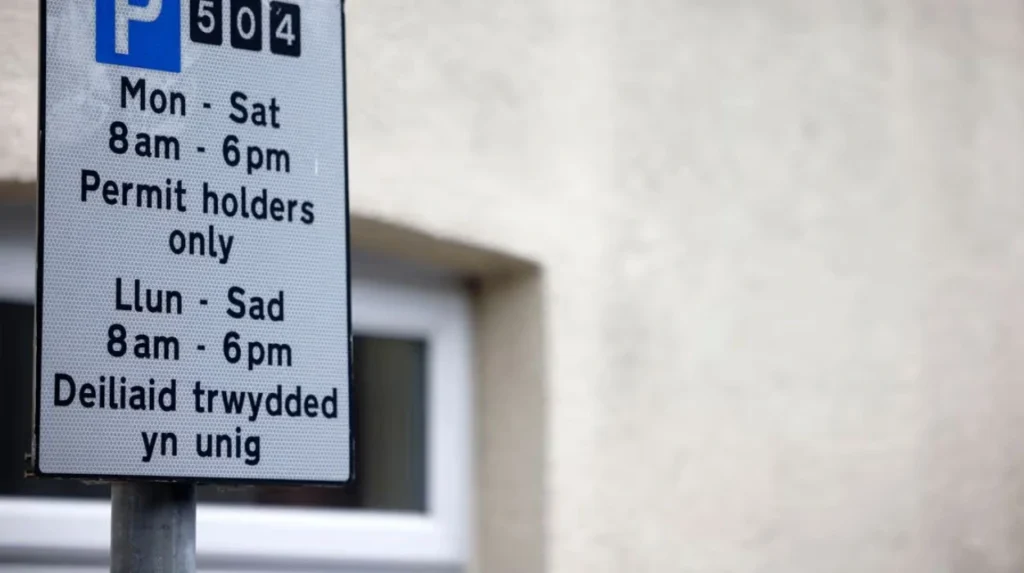
For example, Cardiff Council states that parking in Cathays East, Cathays Central and Cathays West is controlled from 8am to 6pm, Monday to Sunday, excluding Christmas Day. Permit parking in those zones is enforceable from 8am to 10pm.
In Fairoak Road, controlled parking also operates from 8am to 6pm, Monday to Sunday, while permit parking operates from 8am to 10pm. The zone includes resident permit holder and pay-and-stay arrangements.
Wedal Road has different characteristics. Cardiff Council states that its parking control operates from 8am to 6pm, while permit parking is enforceable at all times.
Plasnewydd South, identified as Zone B5A, has parking controlled from 8am to 10pm, Monday to Sunday, excluding Christmas Day. Permit parking is enforceable at all times.
These examples demonstrate why drivers should never rely on a generic statement such as “Cardiff parking zones operate from 8am to 6pm.” The individual zone and street signage determine the applicable restriction.
How much does parking cost in Cardiff controlled zones?
Controlled-zone parking charges differ according to location, duration and parking type. Cardiff’s standard listed controlled-zone tariff includes a free first hour in specified pay-and-stay areas, followed by charges for longer stays, while individual zones have separate published tariffs.
Cardiff Council’s general on-street parking information lists controlled-zone parking for Zones C1, C2, C3 and C5. The standard tariff provides a free first hour, but drivers must register the vehicle and obtain a digital ticket. The maximum stay is five hours.
The published standard tariff lists:
1 hour — free
2 hours — £1.50
3 hours — £3
4 hours — £4.50
5 hours — £6
Payment is cashless through MiPermit for these specified controlled zones. Cardiff Council states that digital tickets can be purchased through the MiPermit app, website, text or telephone service.
Individual zones have different arrangements. For example, Cardiff Council lists Fairoak Road at £1.30 per hour, with the first hour free and a five-hour maximum stay. Wedal Road is listed at 70p for the first hour and £1.30 per hour afterwards.
Other zones use different tariffs. The Riverside South Zone B3 information, for example, lists pay-and-stay prices of £2 for one hour, £4 for two hours, £6 for three hours and £8 for four hours at applicable locations.
Tariffs are therefore location-specific. Drivers should check the current council information and the signs at the parking place before making payment.
Who can use resident parking permits in Cardiff?
Resident parking permits are available to eligible residents living within designated residential parking schemes. Permits are linked to the resident’s property and vehicle details, and they provide priority parking rather than a guaranteed space outside the resident’s home.
Cardiff Council’s resident parking terms state that resident permits are issued only to residents of properties included within a residential parking permit scheme. Applicants must provide evidence of residence and nominate the vehicle correctly.
A resident permit is linked to the qualifying property and parking zone. Cardiff Council states that a resident cannot hold a resident permit for more than one property or zone.
The permit applies to specified resident permit holder bays and shared-use parking places within the relevant zone. It does not create a private parking space.
This distinction matters in high-demand streets. A valid permit confirms eligibility to use designated spaces, but another permit holder can occupy the available space first.
Cardiff’s parking plan also proposes changes involving residents, students, businesses, carers and community premises. The plan states that vehicles above 2.4 tonnes would have higher resident permit charges, while vehicles above 3.5 tonnes would not be eligible for permits under the proposed system.
Because parking policy changes through consultations and formal orders, motorists should check the current council rules before applying or renewing a permit.
Can visitors park inside Cardiff parking zones?
Visitors can park in Cardiff parking zones where suitable visitor, limited-waiting or pay-and-stay spaces exist. Residents can also receive visitor parking arrangements under applicable schemes, but visitors must follow the specific bay restrictions, time limits and payment requirements.
Visitor parking depends on the zone. A non-permit holder can often use a limited-waiting bay or pay-and-stay bay where the signs allow it.
Cardiff Council’s Riverside South Zone B3 provides an example. Limited-waiting bays allow free parking for either 30 minutes or one hour depending on location. Pay-and-stay bays provide longer stays, with maximum periods determined by the individual location.
Plasnewydd Central and South provides another example. Cardiff Council’s published information states that drivers without permits can use limited-waiting bays for up to two hours and pay-and-stay bays for up to six hours.
Visitor arrangements are also included in Cardiff’s wider parking plan. The plan proposes daily visitor permits alongside hourly permits, with limits designed to prevent misuse.
Visitors should therefore avoid assuming that a resident’s permit automatically transfers to a visiting vehicle. The applicable visitor permit process and vehicle registration requirements must be followed.
What parking restrictions should drivers understand in Cardiff?
Cardiff parking restrictions include resident-only bays, limited waiting, pay-and-stay requirements, single yellow lines, double yellow lines, loading restrictions and dropped-footway controls. Each restriction has specific legal effects that drivers must follow.
Single yellow lines prohibit waiting during the times shown on the associated sign. Cardiff Council explains that outside the stated operating times, the single-yellow restriction does not apply.
Double yellow lines indicate no waiting at any time. Cardiff Council states that passengers can board or leave the vehicle, while loading and unloading is permitted when it is continuously observed.
Kerb markings identify loading restrictions. A single yellow kerb mark indicates a loading prohibition during specified times. Double yellow kerb marks indicate no loading or unloading at any time.
Dropped footways have specific enforcement protections because they support pedestrian movement. Cardiff Council lists dropped-footway restrictions among controls that apply 24 hours a day in its controlled parking zones.
Drivers must also respect maximum-stay rules. Staying beyond the permitted period can result in a Penalty Charge Notice, including when the driver initially paid for parking.
How do drivers pay for parking in Cardiff zones?
Drivers pay for applicable Cardiff controlled-zone parking through the payment method specified for the location, including MiPermit digital parking in relevant areas. Correct vehicle registration, location and payment duration are essential because incorrect payment details can invalidate parking.
Cardiff Council uses MiPermit for cashless parking in specified controlled zones. The council states that drivers can purchase digital tickets through the MiPermit app, website, text or telephone.
Payment must correspond with the vehicle being parked. Cardiff Council states that a MiPermit payment must contain the correct vehicle details and parking location to qualify as valid payment.
The driver should therefore check the registration number before confirming the transaction. The driver should also check the parking location identifier when using a digital system.
A free first hour still requires registration in the relevant controlled zones. Cardiff Council specifically states that motorists must register their vehicle with MiPermit to obtain the digital ticket even when the first hour carries no charge.
Payment requirements differ between locations. The physical sign and official council information remain the controlling sources for the specific parking space.
What happens if a driver breaks Cardiff parking rules?
Cardiff Council can issue a Penalty Charge Notice when a vehicle breaches an enforced parking restriction. Current council information states that parking PCNs are generally £50 or £70 depending on the offence, with a 50% reduction for payment within 14 days.
A Penalty Charge Notice (PCN) is a civil enforcement notice issued when a vehicle breaches a relevant parking or moving-traffic restriction.
Cardiff Council states that parking PCNs are £50 or £70 depending on the offence. Payment within 14 days reduces the amount by 50%.
Examples of parking contraventions include parking without valid payment, remaining after the paid period expires, parking in a restricted area and parking without displaying a required valid ticket.
A PCN does not prevent the recipient from challenging the enforcement. Cardiff Council provides an appeal process for motorists who believe a PCN was issued incorrectly or who have grounds for cancellation.
Ignoring the notice increases the financial liability. Cardiff Council states that if a PCN is ignored, the penalty increases by 50% through a charge certificate, after which the recipient loses the normal right to appeal.
The safest approach is to check the restriction immediately, preserve relevant evidence and follow the council’s payment or appeal process within the stated deadline.
How do Cardiff parking zones affect residents, businesses and visitors?
Parking zones redistribute limited kerbside space between residents, visitors, businesses and other users. Their main effects include improved parking turnover, reduced commuter parking, clearer restrictions and stronger management of high-demand residential and commercial streets.
Residents benefit from parking systems that prioritise eligible permit holders in designated bays. This reduces competition from vehicles that have no connection with the surrounding residential area.
Businesses benefit from turnover in suitable pay-and-stay and limited-waiting spaces. Shorter parking periods allow more customers to access commercial streets rather than allowing a small number of vehicles to occupy spaces throughout the day.
Visitors benefit from clearer information about where parking is permitted and how long vehicles can remain. The system also provides designated spaces rather than relying on unrestricted kerbside availability.
Cardiff Council explicitly links parking zones with supporting businesses, improving visitor parking and preventing commuter or inconsiderate parking.
The wider transport impact is also important. Cardiff’s city parking plan identifies reduced traffic and cleaner air as central objectives of its proposed parking management approach.
Parking policy therefore influences more than where vehicles stop. It forms part of Cardiff’s wider approach to managing urban mobility, residential streets and demand for limited public road space.
How is Cardiff changing its parking strategy?
Cardiff’s parking strategy is moving toward a more structured citywide management system based on three parking management areas, controlled parking zones, revised permits and measures designed to prioritise residents, essential services, businesses and cleaner transport.
Cardiff Council’s city parking plan responds to the limits of the 2016 parking strategy. The council states that the previous strategy no longer meets the needs of a growing city and identifies free commuter parking in residential areas as a significant pressure.
The proposed structure divides Cardiff into three areas: the city and civic centre, inner area and outer area. Parking restrictions are intended to reflect the needs of each area.
The plan also proposes permit availability for residents, students, businesses, carers and community premises. Visitor permits form another part of the proposed system.
New parking zones continue to be considered through local consultation. The Pontcanna Central Zone P1 consultation, for example, considered operating periods including 8am to 6.30pm, 8am to 8pm and 8am to 10pm, alongside Monday-to-Saturday or Monday-to-Sunday operation.
This consultation-based process means Cardiff’s parking map and operating arrangements remain subject to formal decisions, legal orders and implementation schedules.
Explore More Area Guide
EV Charging Points in Cardiff: Complete 2026 Guide
Best Cycling Routes in Cardiff: Taff Trail & Bay 2026
How should drivers check the correct Cardiff parking zone before parking?
Drivers should identify the zone, read the entry and bay signs, check operating hours, confirm permit or payment requirements, verify maximum stay rules and use Cardiff Council’s current parking information before leaving the vehicle.
The first step is to identify the controlled zone. Cardiff Council provides an official controlled parking zone location service showing individual zones and their operating arrangements.
The second step is to read the street signs. Cardiff Council specifically instructs motorists to check signs because restrictions differ between zones.
The third step is to identify the type of bay. A resident-only bay, shared-use bay, limited-waiting bay and pay-and-stay bay have different requirements.
The fourth step is to confirm the operating period. A parking restriction that applies from 8am to 6pm is different from a permit restriction that operates until 10pm or throughout the day.
The fifth step is to make the correct payment where required. Digital payment must contain the correct vehicle and parking-location information.
The final step is to check the maximum stay and return restrictions. Paying for parking does not automatically provide unlimited parking rights.
Why will parking zones remain important for Cardiff?
Parking zones will remain important because Cardiff has finite kerbside space and continuing demand from residents, commuters, businesses and visitors. Structured parking controls provide a legal framework for allocating that space while supporting safer streets and wider transport objectives.
Cardiff’s parking system is part of broader urban transport management. The council uses controlled zones to regulate parking demand, improve residential access and reduce inappropriate use of limited road space.
The legal framework also supports long-term adaptation. Traffic authorities can use Traffic Regulation Orders to introduce, modify or remove restrictions in response to changing transport conditions, safety requirements, environmental objectives and parking demand.
Future parking arrangements therefore depend on local evidence, public consultation, formal decisions and legally enforceable traffic orders. Individual streets can receive different controls because parking pressure varies across Cardiff.
For residents, the most important principle is that a permit provides priority access rather than ownership of a road space. For visitors, the key requirement is to follow the signs and use permitted bays. For businesses, parking turnover supports customer access. For all motorists, accurate payment and compliance prevent avoidable penalties.
Cardiff’s controlled parking zones provide the practical structure through which these competing needs are managed. Checking the current Cardiff Council zone information before parking remains the most reliable way to understand the applicable restrictions, payment arrangements, permit rules and operating times.
What is a Controlled Parking Zone (CPZ) in Cardiff?
A Controlled Parking Zone is an area where Cardiff Council regulates on-street parking through signs, marked bays, permits, payment requirements and waiting restrictions. Drivers must follow the rules shown on signs within the relevant zone.