Cardiff’s historic fire stations form an important part of the city’s industrial, civic and wartime history. Firefighting developed alongside Cardiff’s rapid growth as a coal-exporting port during the nineteenth century. The expanding docks, warehouses, mills, workshops and dense residential districts created new fire risks and required organised emergency services.
- What were Cardiff’s historic fire stations?
- When did Cardiff begin developing municipal fire stations?
- Why was Westgate Street Fire Station important in Cardiff?
- What happened to Cardiff’s Westgate Street Fire Station?
- How did Cardiff fire stations support the city during the Second World War?
- How did Cardiff’s fire service change after the Second World War?
- Which historic Cardiff fire stations and sites can still be traced?
- What role did specialist fire facilities play in Cardiff?
- How can people research historic fire stations in Cardiff?
- Why do historic Cardiff fire stations matter to the city’s heritage?
- How does the history of Cardiff fire stations connect with modern emergency services?
The history of Cardiff fire stations also reflects major changes in local government. The city moved from early municipal firefighting arrangements to a professional Cardiff Fire Brigade, wartime emergency organisation, county-borough administration and later regional fire services.
Some historic stations have disappeared completely. Others survive through photographs, maps, archives and local memories. The former Westgate Street Fire Station is the best-known example. Its prominent building stood close to Cardiff Castle and the modern Principality Stadium before its demolition in the 1970s.
Historic fire stations therefore provide more than architectural interest. They explain how Cardiff responded to industrial expansion, urban population growth, wartime bombing and changing emergency-service technology.
What were Cardiff’s historic fire stations?
Historic fire stations in Cardiff were purpose-built or adapted premises used by municipal, county-borough and wartime firefighting organisations to house fire engines, equipment and crews. They developed as Cardiff expanded and fire risks increased.
Early Cardiff firefighting did not operate through the modern nationwide fire-service structure. Nineteenth-century firefighting included private insurance-based brigades and municipal provision. Fire marks identified properties protected by insurance-company brigades, while local authorities gradually developed public firefighting arrangements.
Cardiff’s transformation into a major coal-exporting port increased the need for organised fire protection. Coal-handling facilities, warehouses, timber yards, mills and densely built housing created concentrated fire risks. The docks were particularly important because industrial activity and combustible materials were concentrated around commercial infrastructure.
A fire station was therefore both an operational workplace and a civic facility. Its design had to support rapid mobilisation. Engine accommodation required large access openings. Equipment needed secure storage. Crews required living and working facilities.
The development of Cardiff’s stations followed the wider professionalisation of British firefighting. The Fire Brigades Act 1938 made fire cover compulsory for every local authority in Britain. The legislation marked an important stage in the development of organised public fire protection.
When did Cardiff begin developing municipal fire stations?
Cardiff developed municipal firefighting facilities during the nineteenth century as population growth, industrial expansion and dock activity increased fire risk. An early engine house operated behind the new Town Hall, while later stations served a growing city.
A documented early Cardiff fire facility was constructed in the 1850s at the rear of the new Town Hall. Historical fire-station records identify an engine house built around this period with access from Guildhall Place. The site became associated with Cardiff’s chief fire station.
This location demonstrates the close relationship between civic administration and emergency services during the nineteenth century. Firefighting was becoming a municipal responsibility as towns expanded and local authorities developed stronger public-service structures.
Cardiff’s growth was exceptionally rapid during the nineteenth century. The coal trade transformed the town into an international port. The docks generated warehouses, transport infrastructure, commercial premises and worker housing.
Fire stations had to serve this expanding urban environment. Their location was important because horse-drawn fire engines depended on road access and rapid mobilisation. A station positioned close to the civic centre also provided a practical base for responding to fires across the central districts.
The historical record shows that Cardiff’s firefighting arrangements continued to evolve throughout the nineteenth century. The city’s changing physical structure required additional facilities and increasingly professional organisation.
Why was Westgate Street Fire Station important in Cardiff?
Westgate Street Fire Station was Cardiff’s major historic central fire station and became one of the city’s most recognisable civic buildings. Completed in 1917, it combined large engine bays, a tall watchtower and accommodation for firefighters’ families.
The Westgate Street station represented the maturity of Cardiff’s municipal fire service. Its location placed firefighting resources close to the city centre, major commercial streets and important public buildings.
The building was completed in 1917. It stood as a substantial six-storey structure with large engine bays and a steeply pitched tiled roof. A prominent watchtower formed part of its architectural composition.
The watchtower had an operational purpose. It provided an elevated observation point from which fires could be detected across the city. Before modern electronic detection systems and sophisticated communications networks, visual observation formed an important element of emergency response.
The station also included accommodation. Around 30 flats were provided for firefighters’ families within the building. This arrangement reflected the residential nature of historic fire stations, where crews could live close to their workplace.
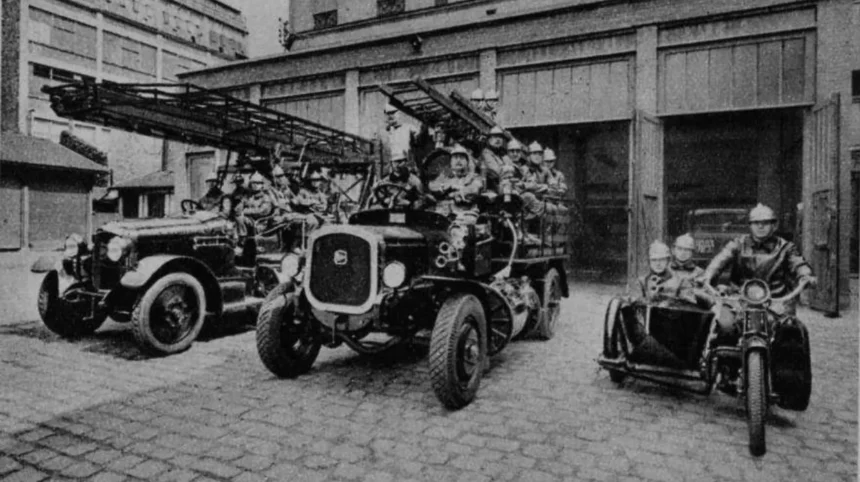
The building was also photographed in operation during the twentieth century. A 1924 film preserved by Film Hub Wales records the Cardiff Fire Brigade turning out from Westgate Street Fire Station. The film describes the station as having an eight-minute mobilisation record.
Westgate Street therefore survives as an important visual record of Cardiff’s historic firefighting infrastructure even though the building itself no longer exists.
What happened to Cardiff’s Westgate Street Fire Station?
Westgate Street Fire Station closed in 1973 after more than half a century of service. The substantial Edwardian-era building was subsequently demolished, and its former site became a multi-storey car park opposite what is now the Principality Stadium.
The station served Cardiff through major changes in firefighting technology and local government. It remained a prominent city-centre landmark for decades.
Its history overlapped with the First World War, the interwar period, the Second World War and the post-war redevelopment of Cardiff.
The building closed in 1973. It had not received listed-building status and was eventually demolished. A multi-storey car park replaced the former fire station site.
The loss of Westgate Street Fire Station illustrates the wider challenge of preserving twentieth-century civic architecture. Historic buildings connected with public services often face redevelopment pressures because their original operational functions become obsolete.
Cardiff’s changing transport requirements and city-centre redevelopment also altered the surrounding area. Westgate Street itself later became part of a heavily used central transport and pedestrian environment.
Today, the location remains significant because it sits close to major Cardiff landmarks. The modern Principality Stadium occupies the site of the former National Stadium, while Cardiff Castle and central shopping streets are nearby.
The former station is therefore best understood through historical photographs, film, maps and archival records rather than through surviving architecture.
How did Cardiff fire stations support the city during the Second World War?
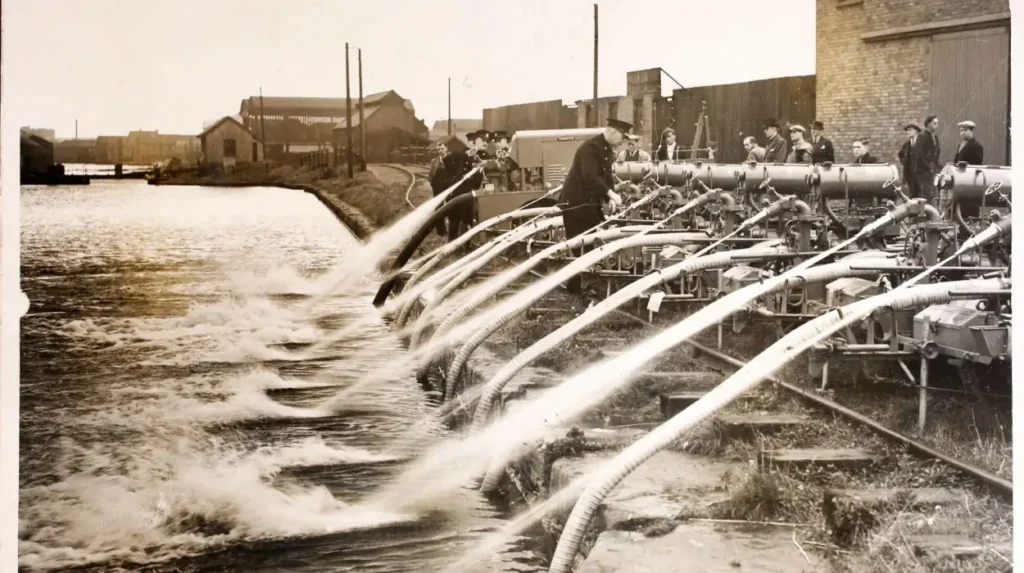
Cardiff fire stations became critical emergency-service facilities during the Second World War because bombing created widespread fires across the city. Firefighters worked with the Auxiliary Fire Service before the National Fire Service was established in August 1941.
Cardiff experienced its worst wartime raid on 2 January 1941. More than 100 German bombers attacked the city during a period lasting around ten hours. Historical records report 165 deaths, 427 injuries and approximately 350 homes destroyed.
The attack produced widespread fires in several Cardiff districts. Riverside and Canton were affected, while Llandaff Cathedral also suffered damage. The concentration of fires created a major emergency for local firefighting organisations.
The response involved Cardiff’s municipal fire brigade and the Auxiliary Fire Service. The Auxiliary Fire Service was established as part of Britain’s pre-war civil-defence preparations.
The National Fire Service did not exist when the worst Cardiff raid occurred. It was established on 18 August 1941, bringing local fire brigades and auxiliary services into a national wartime structure.
Historic stations therefore became part of a much larger wartime emergency network. Fire engines, crews, communications systems and civil-defence organisations operated under extraordinary conditions.
Individual Cardiff firefighters also lost their lives during wartime duties. Historical memorial records identify members of Cardiff’s Auxiliary Fire Service who died while carrying out emergency work. Francis Wilberforce Gaccon, a Cardiff Auxiliary Fire Service divisional commander, was killed in Newport Road in March 1941 while on duty.
The wartime history of Cardiff’s fire stations is therefore directly connected to the wider civilian experience of the Cardiff Blitz.
How did Cardiff’s fire service change after the Second World War?
Cardiff regained a local fire brigade in 1948 after the National Fire Service was dissolved. The Cardiff County Borough Fire Brigade operated until 1974, when local-government reorganisation transferred responsibility to the new South Glamorgan Fire Service.
The Fire Services Act 1947 reshaped British firefighting after the war. From 1 April 1948, fire services returned to local authorities.
Cardiff, as a county borough, operated its own fire brigade during the post-war period. This arrangement continued until local government reorganisation in 1974.
The 1974 changes were significant because Cardiff ceased to operate as an independent county-borough fire-service area. The city became part of the new South Glamorgan county structure.
The South Glamorgan Fire Service covered Cardiff and the Vale of Glamorgan. This created a larger operational area and changed the administrative structure behind the city’s fire stations.
The transition reflected a wider British trend towards regional coordination of emergency services. Fire stations remained local facilities, but their management increasingly operated across larger administrative areas.
The next major change came in 1996. South Glamorgan Fire Service became part of South Wales Fire Service following the creation of the regional service structure. The modern service is known as South Wales Fire and Rescue Service.
This administrative history helps explain why historic Cardiff fire stations can appear under different organisational names in newspapers, directories, maps and archival records.
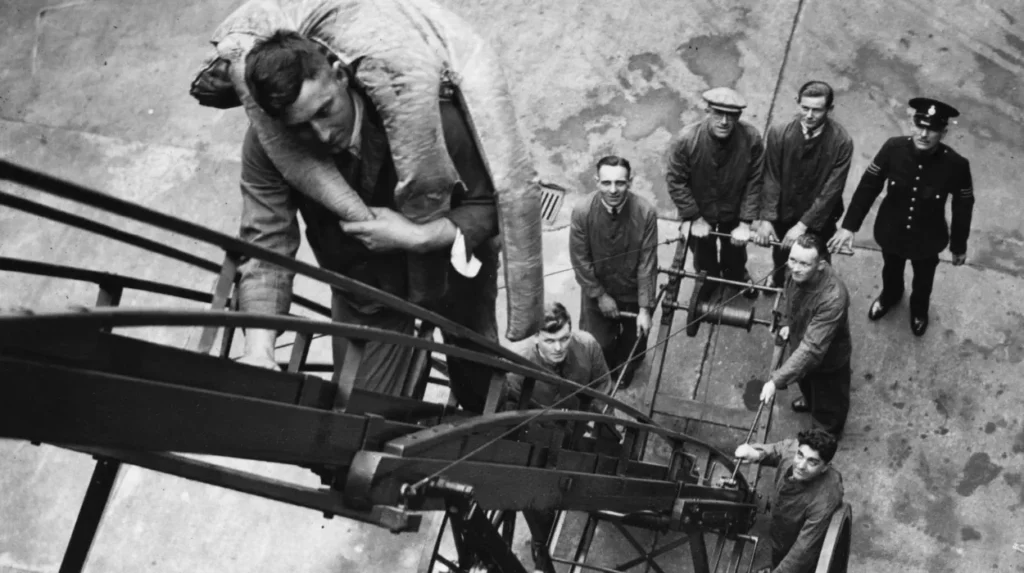
Which historic Cardiff fire stations and sites can still be traced?
Several historic Cardiff firefighting locations remain traceable through archives, photographs, maps and surviving buildings. Important examples include the former Westgate Street station, the early Town Hall engine house site and later facilities associated with Adamsdown and Roath.
Westgate Street provides the clearest example of a lost major station. Historical photographs show fire engines positioned outside the building during the twentieth century. Cardiffians’ historical image collections preserve photographs of the station and its engines.
The earlier Town Hall engine-house location provides evidence of Cardiff’s nineteenth-century municipal firefighting arrangements. Fire-station records place the facility behind the new Town Hall, with access from Guildhall Place.
Adams Street and Adamsdown also form an important part of Cardiff’s fire-service history. Historical local records identify a former fire station on Adam Street and record the construction of a newer station nearby during the early twenty-first century.
Roath provides another important connection. Colchester Avenue has been associated with Roath Fire Station, and historical photographs and records document Cardiff City Fire Service vehicles operating from the area during the twentieth century.
These locations demonstrate that Cardiff’s fire-station history extends beyond one central building. Firefighting infrastructure developed across different parts of the city as population, housing and industrial activity expanded.
What role did specialist fire facilities play in Cardiff?
Specialist fire facilities supported particular institutions and emergency networks in Cardiff. Hospitals, civil-defence centres and other major sites maintained dedicated emergency arrangements, demonstrating that fire protection extended beyond ordinary municipal fire stations.
Large institutions often required their own fire-protection infrastructure. Whitchurch Hospital provides a documented example. The hospital was built between 1902 and 1908 and included its own fire station as part of the large institutional complex.
Institutional fire stations served different purposes from central municipal stations. They provided immediate response within large sites containing patients, staff, kitchens, workshops, mechanical equipment and other potential hazards.
Cardiff’s wartime civil-defence network added another layer. Insole Court became associated with emergency-service activity during the Second World War. A Civil Defence Sub-Control Centre was later built beside Insole Gardens in 1953.
The Insole Sub-Control Centre formed part of a wider network. Cardiff County Borough Council developed a main control centre on Allensbank Road and sub-control facilities at Insole Gardens and Penylan.
The Insole building was designed by E. C. Roberts, Cardiff’s city surveyor. It later received listed-building status because of its significance to the history of twentieth-century civil defence.
This history is important because emergency planning involves more than fire engines. Control centres, communications facilities and civil-defence buildings formed part of Cardiff’s wider emergency infrastructure.
How can people research historic fire stations in Cardiff?
Historic fire stations in Cardiff can be researched through Glamorgan Archives, Cadw records, historical maps, local-history societies, photographic collections, newspapers and film archives. These sources reveal station locations, dates, buildings, personnel, equipment and operational changes.
Glamorgan Archives is one of the most important research resources for Cardiff’s local history. The archive serves Cardiff and surrounding authorities and preserves documents dating from the medieval period to the present. Its catalogue contains descriptions of more than 180,000 items.
Researchers can use archive material to investigate former fire-station buildings, municipal records, photographs, planning documents and local-government administration.
Cadw provides another important source for historic emergency-service buildings. Its listed-building records document architectural descriptions, construction dates, historical significance and reasons for designation.
Historical maps are particularly useful for tracing demolished stations. A building that no longer exists can often be identified on Ordnance Survey maps or city directories.
Local-history organisations also preserve photographs and oral histories. The Roath Local History Society, for example, documents Cardiff residents, streets and wartime experiences and provides evidence connected with the city’s former fire service.
Film provides another source. Film Hub Wales preserves a 1924 film showing the Cardiff Fire Brigade turning out from Westgate Street Fire Station. Such footage provides evidence of station architecture, fire engines and operational practice.
Combining these sources produces a more reliable history than relying on a single photograph or online reference.
Explore More Area Guide
Historic Fire Stations in Cardiff: Westgate Street & Fire Brigade History
Public Art Across Cardiff Neighbourhoods: Statues, Murals & Sculptures
Why do historic Cardiff fire stations matter to the city’s heritage?
Historic Cardiff fire stations document the growth of public services alongside industrialisation, urban expansion and wartime emergency planning. Their history connects architecture, local government, transport, employment, technology and community safety across more than a century.
Fire stations are physical records of changing urban priorities. Their locations show where Cardiff’s population and commercial activity required emergency protection.
Their architecture also reflects the technology of different periods. Nineteenth-century engine houses accommodated horse-drawn equipment. Later stations required larger vehicle bays, improved communications and dedicated crew facilities.
Westgate Street illustrates the scale reached by municipal firefighting in the early twentieth century. Its six-storey structure, watchtower and family accommodation demonstrated how central firefighting had become to civic life.
The disappearance of the building also illustrates changes in Cardiff’s approach to heritage. The station was demolished after closing in 1973, leaving photographs and archival records as the main evidence of its appearance.
Other sites have survived in different forms. The listing of the Insole Sub-Control Centre demonstrates how relatively modest emergency-service buildings can gain heritage significance because of their historical context.
Historic fire stations also preserve the history of firefighters themselves. Wartime memorials, personnel records and local histories provide evidence of the people who operated these facilities.
For Cardiff residents and visitors, these sites provide a way to understand how the city developed from a nineteenth-century port into the capital of Wales.
How does the history of Cardiff fire stations connect with modern emergency services?
Modern Cardiff firefighting is part of South Wales Fire and Rescue Service, while historic stations remain evidence of earlier municipal and regional systems. The transition reflects changes in administration, technology, vehicles, communications and the scale of emergency response.
Cardiff’s current emergency arrangements differ substantially from those of the nineteenth and early twentieth centuries. Firefighters now operate with modern vehicles, communications systems, protective equipment and specialist rescue capabilities.
The organisational structure also changed repeatedly. Cardiff operated its own municipal and county-borough fire arrangements before becoming part of South Glamorgan in 1974 and the wider South Wales fire-service structure in 1996.
The historical sequence explains why older photographs and documents contain different organisational names. A station can remain geographically important while its administrative identity changes.
Modern Cardiff is also served through a broader emergency-service network. South Wales Fire and Rescue Service provides fire and rescue coverage, while Cardiff Council and other public authorities work within wider community-safety arrangements. Cardiff Council lists South Wales Fire and Rescue Service as the emergency fire service for the city.
Historic fire stations therefore remain relevant even when their buildings disappear. Their locations, records and stories help explain the development of modern public safety.
Cardiff’s fire-station heritage ultimately forms part of the city’s wider industrial and civic history. The former Westgate Street station, early municipal engine houses, Roath and Adamsdown facilities, institutional stations and wartime control centres each represent a different stage in that development.
The surviving evidence is distributed across buildings, archives, maps, photographs, films and memorials. Together, these sources show how Cardiff built increasingly organised systems for protecting residents, workers, businesses and public institutions.
Historic fire stations are therefore not isolated architectural subjects. They are records of Cardiff’s transformation from a nineteenth-century industrial port into a modern Welsh capital.
What is the oldest known fire station in Cardiff?
An early Cardiff municipal engine house operated behind the new Town Hall during the 1850s. It formed part of the city’s developing public firefighting system as Cardiff expanded during the industrial period.