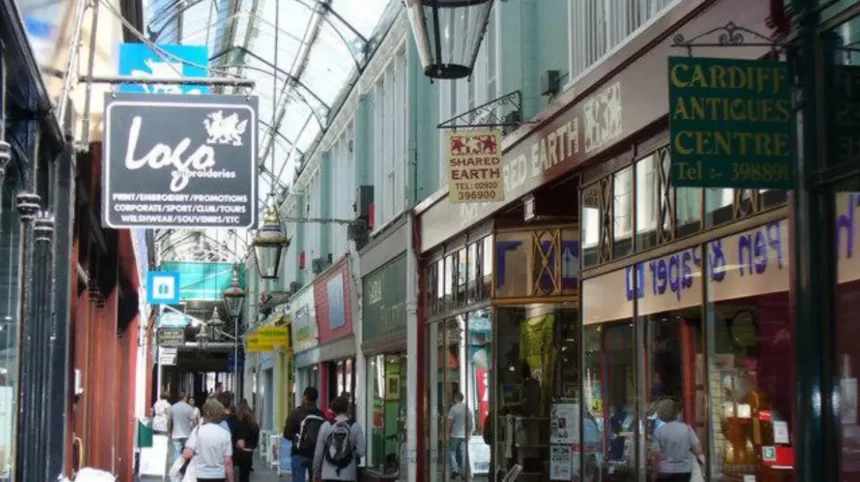
Cardiff’s historic shopfronts form one of the most distinctive parts of the city’s built heritage. The strongest concentration is in the Victorian and Edwardian shopping arcades around St Mary Street, The Hayes, High Street and Castle Street. These commercial interiors preserve historic façades, timber details, decorative glazing, ironwork and traditional signage alongside active modern businesses.
- What makes Cardiff’s historic shopfronts important?
- How did Cardiff develop its historic shopping streets?
- Which historic Cardiff shopfronts are worth seeing first?
- What should you look for in Cardiff’s Victorian shopfronts?
- Why is Royal Arcade one of Cardiff’s most important historic shopfront locations?
- What makes Morgan Arcade significant for architectural heritage?
- Why should visitors explore High Street Arcade?
- How do Castle Arcade, Wyndham Arcade and Duke Street Arcade add to Cardiff’s heritage?
- How does Cardiff Market contribute to the city’s historic retail character?
- Are Cardiff’s historic shopfronts protected by heritage rules?
- How can visitors explore Cardiff’s historic shopfronts efficiently?
- Why do historic shopfronts still matter to Cardiff’s future?
Cardiff is widely recognised as the City of Arcades. Visit Cardiff identifies seven historic arcades in the city centre, containing more than 100 shops, cafés, bars and restaurants. The surviving network demonstrates how Cardiff’s retail environment developed during the nineteenth and early twentieth centuries.
Historic shopfronts are important because they preserve evidence of commercial life. A shopfront records how retailers displayed goods, advertised services, managed entrances and responded to changing architectural fashions. Details such as stallrisers, pilasters, fascia boards, timber frames, glazed panels and decorative entrances help explain the original design of commercial streets.
Cardiff’s heritage also reflects the city’s rapid nineteenth-century transformation. The central area developed from a medieval settlement into a major industrial and commercial centre. Cardiff’s growth was closely connected with the coal-export economy, expanding docks, railway connections and increasing urban investment.
Museum Wales describes modern Cardiff as substantially shaped by Victorian development, while its historic centre retains evidence of Roman and Norman origins.
For visitors, the historic shopfronts provide an accessible way to study this transformation. Most are concentrated within a compact city-centre walking area. The result is a heritage experience that combines architecture, retail, food, independent businesses and urban history.
What makes Cardiff’s historic shopfronts important?
Cardiff’s historic shopfronts are important because they preserve architectural evidence of Victorian and Edwardian commerce, including timber frames, decorative glazing, traditional entrances, fascia boards and detailed façades. Their survival connects modern retail streets with Cardiff’s nineteenth-century commercial expansion and urban heritage.
A historic shopfront is more than an old-looking entrance. It forms part of the architectural character of a building and its surrounding street. Original materials, proportions and decorative details provide evidence about construction methods and commercial practices.
Cardiff’s arcades are particularly significant because their shopfronts sit within purpose-built covered shopping environments. These buildings were designed to bring multiple businesses together under glazed roofs and along narrow pedestrian routes.
Visit Cardiff describes Cardiff’s arcades as Victorian and Edwardian shopping environments with more than 150 years of history. The seven principal arcades are Castle Arcade, High Street Arcade, Duke Street Arcade, Dominions Arcade, Morgan Arcade, Royal Arcade and Wyndham Arcade.
The shopfronts also demonstrate continuity. Retail premises have changed hands, businesses have evolved and interiors have been modernised, but many architectural features remain visible.
This continuity matters for heritage management. Cadw defines the historic environment as a finite, non-renewable resource containing buildings, archaeological remains, conservation areas, townscapes and other historic assets.
Historic shopfronts therefore contribute to Cardiff’s collective townscape rather than functioning as isolated decorative objects.
How did Cardiff develop its historic shopping streets?
Cardiff developed its historic shopping streets through centuries of urban growth, followed by rapid nineteenth-century commercial expansion linked to industry, docks, railways and population growth. Victorian and Edwardian investment created covered arcades, markets and substantial commercial buildings that shaped today’s city centre.
Cardiff’s central urban history is considerably older than its Victorian shopfronts. Museum Wales records Roman and Norman phases in the city’s development, with the medieval settlement growing around Cardiff Castle and expanding southwards.
The major transformation came during the nineteenth century. Cardiff became an important industrial and maritime centre because of its position on the River Taff and its expanding dock system.
The construction of Cardiff’s docks strengthened commercial connections with the South Wales coalfield. Coal exports generated investment and increased demand for retail, banking, hospitality and professional services.
This economic expansion changed the physical appearance of the city centre. Streets gained larger commercial buildings, purpose-built shopping premises and covered arcades.
The Royal Arcade opened in 1858. Visit Cardiff identifies it as Cardiff’s oldest arcade and the city’s first shopping centre.
Cardiff Market followed in 1891 and remains another major example of Victorian commercial architecture. Visit Cardiff’s historical timeline records the market’s construction in that year.
By the late nineteenth century, Cardiff had developed a distinctive retail environment in which enclosed arcades complemented open streets. The architecture reflected the confidence and investment associated with a rapidly expanding industrial city.
Which historic Cardiff shopfronts are worth seeing first?
The strongest historic shopfronts are concentrated inside Royal Arcade, Morgan Arcade, High Street Arcade, Castle Arcade, Wyndham Arcade and Duke Street Arcade, where visitors can see surviving Victorian and Edwardian architectural details alongside active independent retailers and specialist businesses.
The arcades provide the clearest route for examining Cardiff’s historic retail architecture. They are close together and can be explored as a continuous walking circuit.
The Royal Arcade is the essential starting point because it dates from 1858. It connects St Mary Street with The Hayes and remains an active shopping passage. Its age gives it particular significance within Cardiff’s retail history.
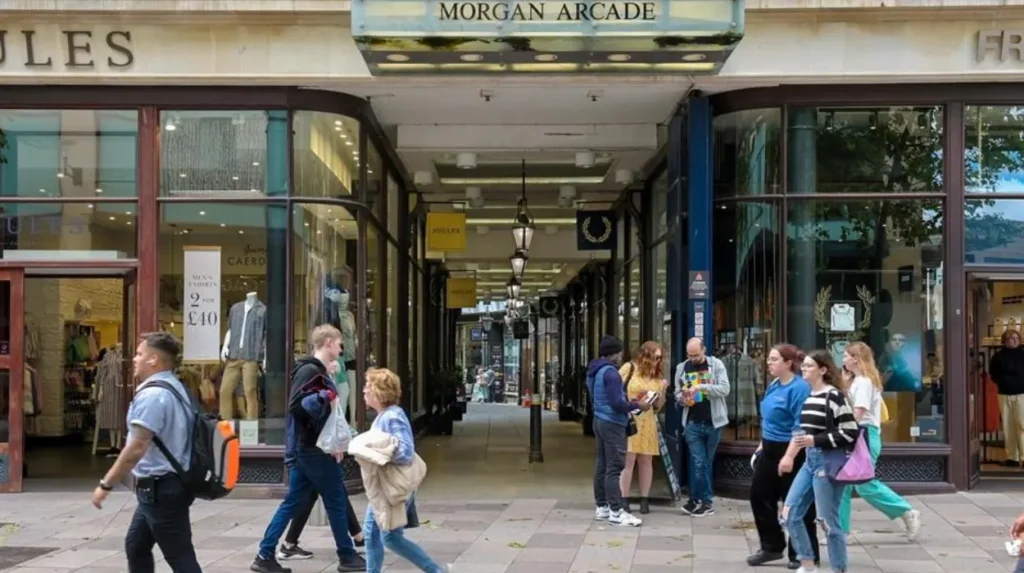
The Morgan Arcade was built in 1896. Visit Cardiff describes it as one of the best-preserved arcades in the city. Its surviving architectural character combines historic commercial design with contemporary retail.
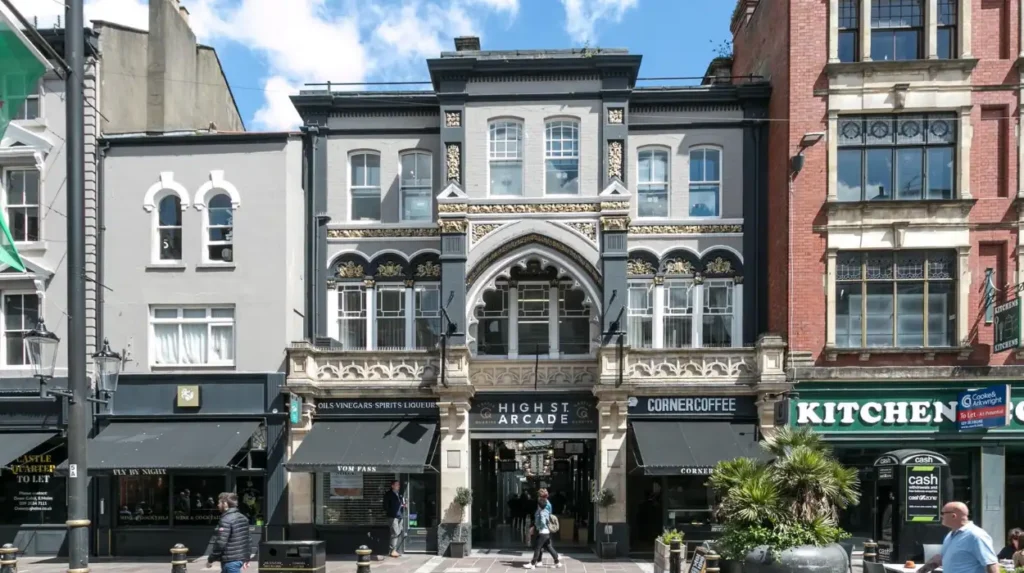
The High Street Arcade was completed in 1885. Its position between High Street and St John Street places it directly within Cardiff’s historic central shopping area.
The Wyndham Arcade was built in 1887 and connects St Mary Street with Mill Lane. Its red-brick entrance is an identifiable Victorian architectural feature.
The Duke Street Arcade was completed in 1902. It represents the transition into Edwardian commercial architecture and retains distinctive decorative features, including its curved connection towards High Street Arcade.
Castle Arcade occupies a prominent position opposite Cardiff Castle and connects Castle Street with High Street. Its architectural setting makes it an important part of the historic shopping circuit.
What should you look for in Cardiff’s Victorian shopfronts?
Visitors should examine timber framing, pilasters, stallrisers, fascia boards, decorative glazing, recessed entrances, cornices, ironwork, brickwork and painted signage. These details reveal how nineteenth-century retailers designed shopfronts to display merchandise while maintaining architectural consistency with surrounding buildings.
The most useful approach is to look above eye level as well as at entrances. Modern advertising often attracts immediate attention, but historic evidence frequently survives around windows, upper façades and structural junctions.
Timber framing is one of the most recognisable traditional shopfront elements. Timber allowed manufacturers to create narrow frames around large glazed display areas.
Pilasters are vertical architectural elements positioned beside entrances or display windows. They create visual divisions and give the shopfront a formal composition.
Stallrisers form the solid lower section beneath display windows. They protected the glazing and created a durable base for the shopfront.
Fascia boards provided space for business names and advertising. Their proportions and placement can reveal the original relationship between architecture and commercial branding.
Decorative glazing is another important feature. Coloured, etched or patterned glass provided privacy, decoration and visual distinction.
Recessed entrances allowed customers to enter beneath a protected threshold while creating additional display space.
Traditional shopfronts were designed as complete architectural compositions. The entrance, windows, fascia and decorative elements were intended to work together.
Cardiff Council maintains specific Shop Fronts and Signage Design Guidance covering design, lighting, security and advertising. The guidance demonstrates that shopfront design remains an active part of Cardiff’s city-design policy.
Why is Royal Arcade one of Cardiff’s most important historic shopfront locations?
Royal Arcade is one of Cardiff’s most important historic shopping locations because it opened in 1858 and is recognised as the city’s oldest arcade. Its surviving commercial setting provides direct evidence of Cardiff’s early Victorian retail development and long-running shopping tradition.
Royal Arcade provides the clearest starting point for understanding Cardiff’s arcade heritage. Its 1858 opening places it at the beginning of the city’s major covered-shopping tradition.
The arcade links St Mary Street and The Hayes, two important parts of the modern city centre. Its position also makes it easy to combine with Morgan Arcade and Cardiff Market.
The passage has remained commercially active for more than a century and a half. Contemporary occupants include independent shops, cafés, delicatessens, clothing businesses and specialist retailers.
The continued commercial function is significant. Heritage survives most effectively when historic buildings retain practical uses compatible with their architectural character.
Royal Arcade also illustrates how Cardiff’s shopping environment has evolved without completely abandoning its historic structure. Modern retail activity operates within a nineteenth-century spatial framework.
For architectural observation, focus on the entrances, shopfront proportions, upper façades and the relationship between individual businesses and the continuous arcade passage.
What makes Morgan Arcade significant for architectural heritage?
Morgan Arcade is significant because it was built in 1896 and retains a particularly well-preserved historic character. Its long commercial frontage, decorative architectural details and continuing retail use demonstrate the importance of late-Victorian shopping architecture within Cardiff’s central urban landscape.
Morgan Arcade opened in 1896, during a period when Cardiff’s commercial expansion was producing increasingly sophisticated retail buildings. Visit Cardiff identifies it as arguably the best-preserved of Cardiff’s arcades.
The arcade forms part of the Morgan Quarter, a central shopping area associated with independent retailers and specialist businesses.
One of its most recognisable characteristics is continuity of frontage. Individual shopfronts form part of a larger architectural environment rather than standing independently.
Morgan Arcade also demonstrates the adaptability of historic commercial buildings. Modern businesses occupy spaces originally designed for earlier generations of retailers.
A notable business connection is Spillers Records, which Visit Cardiff identifies as the world’s oldest record shop. The business opened in Cardiff in 1894, creating an additional connection between the city’s retail heritage and its music history.
The arcade therefore combines architectural heritage with a continuing commercial identity.
Why should visitors explore High Street Arcade?
High Street Arcade deserves attention because it was completed in 1885 and retains the enclosed pedestrian layout associated with Cardiff’s Victorian retail boom. Its shopfronts now accommodate cafés, food businesses, vintage retailers and specialist services within the historic arcade structure.
High Street Arcade opened in 1885, placing it firmly within Cardiff’s mature Victorian shopping period. It connects High Street with St John Street and forms part of the compact central arcade network.
The arcade historically accommodated a variety of commercial activities. Visit Cardiff records former associations with apothecaries and fortune tellers, demonstrating the diversity of services that occupied Cardiff’s arcades.
Today, the arcade contains cafés, restaurants, vintage clothing businesses, barbers and specialist retailers.
This mixture demonstrates how historic shopfronts remain commercially useful. Businesses can update interiors, branding and displays while retaining the historic building shell and arcade structure.
High Street Arcade is particularly useful for visitors interested in the relationship between architecture and changing retail categories.
How do Castle Arcade, Wyndham Arcade and Duke Street Arcade add to Cardiff’s heritage?
Castle Arcade, Wyndham Arcade and Duke Street Arcade extend Cardiff’s historic shopping network across different periods, combining Victorian and Edwardian architecture. Their entrances, covered passages, decorative details and continuing commercial uses demonstrate how the city adapted specialist retail environments over time.
Castle Arcade occupies the area opposite Cardiff Castle and provides an important architectural connection between the castle precinct and the historic commercial centre. Visit Cardiff describes its distinctive balcony and Victorian architectural character.
Wyndham Arcade provides another important example. Built in 1887, it runs from St Mary Street to Mill Lane. Its red-brick entrance is a strong visual feature associated with Victorian design.
Duke Street Arcade represents a later phase. Completed in 1902, it belongs to the Edwardian period and retains distinctive architectural details, including a painted floor and curved passage connection.
Together, these three arcades demonstrate chronological development. Royal Arcade represents 1858, High Street Arcade 1885, Wyndham Arcade 1887, Morgan Arcade 1896 and Duke Street Arcade 1902.
This sequence allows visitors to understand how Cardiff’s commercial architecture developed over approximately half a century.
How does Cardiff Market contribute to the city’s historic retail character?
Cardiff Market contributes to historic retail character through its Victorian market architecture and continuing food and shopping functions. Built in 1891, the market represents the larger public retail environment that developed alongside Cardiff’s covered shopping arcades during the city’s industrial expansion.
Cardiff Market was built in 1891 and forms part of Cardiff’s historic commercial core. Visit Cardiff’s historical timeline records its construction and identifies it as a Grade II* listed building.
The market differs from the arcades because it was designed as a large indoor public market rather than a narrow covered shopping passage.
Its continuing commercial function provides an important example of adaptive heritage use. Market stalls, food businesses and independent traders operate within a historic building that remains part of everyday city life.
The market is also positioned close to High Street, Castle Arcade and the other central shopping areas. Visitors can therefore include it within a wider architectural walk.
Its significance extends beyond individual shopfronts. The building demonstrates the importance of collective retail spaces in nineteenth-century urban planning.
Are Cardiff’s historic shopfronts protected by heritage rules?
Historic shopfronts receive protection through different heritage and planning mechanisms depending on their building, location and significance. Listed buildings require listed building consent for relevant alterations, while conservation areas provide additional controls over demolition and external changes.
Not every historic shopfront is individually listed. Protection depends on the status of the building and the area in which it stands.
Cadw explains that conservation areas are designated because of special architectural or historic interest. Their significance relates to wider character, including settlement patterns, streets, building types, materials and detailing.
The Historic Environment (Wales) Act 2023 provides the legislative framework for conservation areas in Wales. Cadw states that Part 4 covers conservation-area designation, preservation and enhancement, demolition controls and related planning responsibilities.
Listed buildings have additional protection. Cadw states that many types of alterations to listed buildings require listed building consent. This can include changes involving external doors, painting, cleaning and historic fixtures or fittings.
This protection is important because replacing an original shopfront with an incompatible modern installation can reduce the architectural significance of an entire building.
Cardiff Council also provides dedicated shopfront and signage guidance addressing design, lighting, security and advertising.
The objective is not to freeze commercial buildings in time. Conservation policy supports carefully managed change that retains important historic character.
Explore More Area Guide
Conservation Architecture in Pontcanna, Cardiff 2026
Evolution of Cardiff Housing Styles: History and Architecture
How can visitors explore Cardiff’s historic shopfronts efficiently?
The most efficient route begins around St Mary Street and The Hayes, continues through Royal Arcade and Morgan Arcade, then moves towards High Street, Castle Arcade, Duke Street Arcade and Wyndham Arcade before finishing near Cardiff Market.
Cardiff’s compact centre makes an arcade walking route practical. Visit Cardiff describes the city centre as compact and walkable, with the major historic attractions and shopping areas located close together.
A useful route starts at Royal Arcade, where the 1858 history provides a clear introduction to Cardiff’s covered-shopping tradition.
Continue towards Morgan Arcade and examine the relationship between the two connected commercial environments.
Move towards High Street Arcade to compare its 1885 Victorian character with the earlier Royal Arcade.
Continue towards Castle Arcade and Cardiff Castle. The contrast between historic shopping architecture and the castle precinct illustrates the depth of Cardiff’s central urban history.
Proceed to Duke Street Arcade for its 1902 Edwardian character.
Finish through Wyndham Arcade and Cardiff Market.
Visitors should allow time to examine shopfronts rather than simply walking through the arcades. Look for differences in glazing, entrances, signage, materials, decorative details and shopfront proportions.
The route also supports independent retail. Visit Cardiff identifies more than 100 shops, cafés, bars and restaurants across the city’s seven principal arcades.
Why do historic shopfronts still matter to Cardiff’s future?
Historic shopfronts matter because they preserve architectural identity while supporting contemporary businesses. Their continued use strengthens Cardiff’s distinctive city-centre character, supports heritage-led regeneration and provides a tangible connection between nineteenth-century commercial development and modern urban life.
Historic shopfronts are part of Cardiff’s wider economic and cultural heritage. They provide physical evidence of commercial history while supporting present-day businesses.
Cadw describes the historic environment as a social and economic asset as well as a cultural resource. Its conservation principles emphasise understanding significance before making changes and managing historic assets for present and future generations.
Research published by Cadw on historic-environment investment also identifies economic benefits from repairing and renovating historic shopfronts. Evidence from a Townscape Heritage Initiative in Cardigan showed improvements in town-centre function, reductions in vacant shops and increased visitor interest following heritage investment.
Cardiff’s arcades demonstrate the same fundamental principle: heritage buildings remain useful when their historic character is integrated with contemporary commercial activity.
The future relevance of these shopfronts therefore depends on appropriate maintenance, sensitive alterations and continued occupation.
For owners planning changes to historic properties, Cadw recommends a structured heritage impact assessment. This process evaluates the significance of an asset and the effect of proposed changes.
Cardiff’s historic shopfronts will remain valuable because they combine architecture, commerce and urban history in a concentrated city-centre environment.
The strongest examples are found within the Royal, Morgan, High Street, Castle, Wyndham and Duke Street arcades, alongside Cardiff Market. Together, they provide a clear architectural record of the city’s Victorian and Edwardian commercial expansion.
For anyone exploring Cardiff’s built heritage, these shopfronts offer an accessible way to understand how the city developed from an older settlement into a major industrial centre and ultimately the capital of Wales.
What are the best historic shopfronts to see in Cardiff?
The best historic shopfronts are concentrated in Cardiff’s Victorian and Edwardian arcades. Royal Arcade, Morgan Arcade, High Street Arcade, Castle Arcade, Wyndham Arcade and Duke Street Arcade provide the strongest collection of historic retail architecture.