Butetown is a historic district in southern Cardiff, Wales, recognised for its maritime past, international connections and multicultural heritage. Its development is closely linked to the growth of Cardiff Docks, the export of Welsh coal and the migration of workers and seafarers from different parts of the world. The area became widely associated with Tiger Bay, a name used for the lively dockside district and its diverse communities.
- What Is Butetown, and Where Is It Located in Cardiff?
- How Did the Bute Docks Shape the Early History of Butetown?
- Why Did Cardiff Become One of the World’s Leading Coal-Exporting Ports?
- How Did Immigration Shape Tiger Bay and Butetown’s Multicultural Identity?
- What Role Did Somali and Yemeni Communities Play in Butetown’s History?
- How Did the Norwegian Community Contribute to Butetown’s Maritime Heritage?
- What Happened During the 1919 Cardiff Race Riots?
- How Did World War I and the Decline of the Coal Trade Affect Butetown?
- How Did Redevelopment Change Butetown and Tiger Bay in the 1960s and 1970s?
- How Did Cardiff Bay Regeneration Transform the Former Docklands?
- Which Historic Landmarks Help Explain Butetown’s Past?
- How Did Butetown’s History Influence Welsh Culture and Community Life?
- Why Is Butetown’s History Important to Understanding Modern Cardiff?
- How Can Visitors Explore and Learn About Butetown’s History Today?
- What Does the History of Butetown Tell Us About Cardiff?
The history of Butetown reflects the transformation of Cardiff from a relatively small Welsh settlement into a major industrial port. During the nineteenth and early twentieth centuries, the docks connected South Wales with international markets, attracting sailors, merchants and families from Europe, Africa, the Middle East and Asia. These connections shaped local culture, religious life, businesses and community identity.
Today, Butetown remains an important part of Cardiff’s historical landscape. Its story connects industrial expansion, global trade, migration, urban redevelopment and the preservation of cultural memory.
What Is Butetown, and Where Is It Located in Cardiff?
Butetown is a historic district in southern Cardiff, Wales, situated near Cardiff Bay and the former docklands. It developed around the port economy and became known for its international maritime workforce, diverse communities and close connection to the coal-exporting industry.
Butetown forms part of Cardiff’s wider waterfront area. Its historical identity is closely connected to Cardiff Docks, which expanded during the nineteenth century as demand for South Wales coal increased. The district provided housing, commercial premises and community facilities for people working in the port and related industries.
The name Butetown is associated with the Bute family, particularly the Marquesses of Bute, who played a major role in Cardiff’s industrial and commercial development. Their investments in dock infrastructure helped establish Cardiff as one of the principal coal-exporting ports of the world during the industrial era.
The district is also associated with Tiger Bay, a name historically applied to the docklands and surrounding neighbourhoods. Tiger Bay became known for its cosmopolitan population, maritime employment and cultural exchange. Although the names are closely linked, their historical use does not always describe precisely the same geographical area.
Butetown’s location made it a meeting point between the city, the sea and international trade. Its proximity to the docks shaped employment, migration and everyday life for generations.
How Did the Bute Docks Shape the Early History of Butetown?
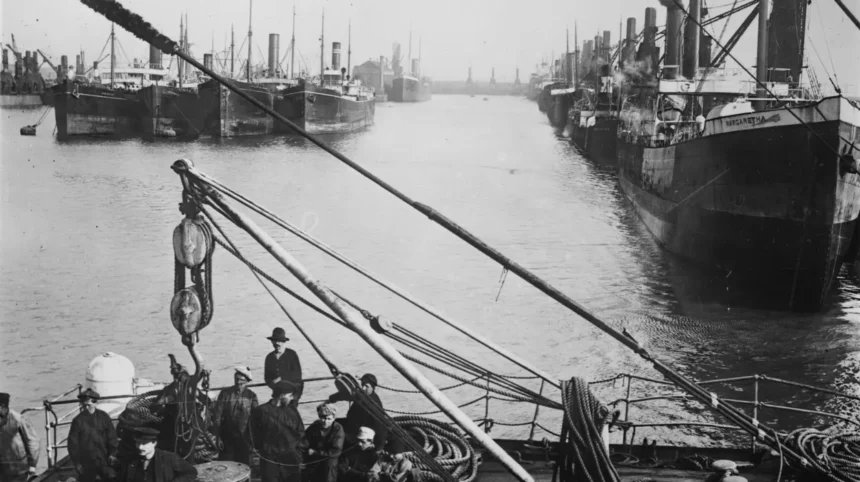
The Bute Docks transformed Cardiff’s waterfront during the nineteenth century by providing facilities for exporting coal and iron from South Wales. Their expansion created employment, encouraged migration and established Butetown as a residential and commercial centre for the growing maritime industry.
Before industrial development, parts of the area south of Cardiff’s historic centre consisted of marshland, grazing land and low-lying ground. The growth of the coal industry changed this landscape. Engineers, landowners and merchants developed dock infrastructure to move industrial goods efficiently from inland mining communities to overseas markets.
The Second Marquess of Bute, John Crichton-Stuart, played a central role in developing Cardiff’s dock facilities. The Bute West Dock opened in 1839, providing a dedicated harbour for the expanding export trade. The Bute East Dock followed in 1855, increasing the port’s capacity. Later additions included Roath Basin in 1874, Roath Dock in 1887 and Queen Alexandra Dock in 1907. Cardiff Harbour Authority+1
These developments changed the local economy. Dock construction created work for labourers, builders and engineers, while daily port operations required sailors, coal trimmers, warehouse workers and transport employees.
The docklands also generated demand for housing, shops, public houses, boarding houses and places of worship. Butetown developed alongside these facilities, accommodating people whose livelihoods depended on maritime trade.
Cardiff’s position near the South Wales coalfield gave its docks a significant commercial advantage. Railways connected mining districts to the port, allowing coal to reach ships in large quantities. Butetown’s growth therefore depended on a wider industrial network linking inland communities with international shipping routes.
Why Did Cardiff Become One of the World’s Leading Coal-Exporting Ports?
Cardiff became a leading coal-exporting port because the South Wales coalfield supplied large quantities of industrial fuel and railway connections transported it efficiently to the docks. By the late nineteenth century, Cardiff’s port handled more coal than any other port worldwide.
The South Wales coalfield supplied coal for steamships, ironworks, factories and railway networks. High-quality steam coal from the region attracted overseas buyers who needed dependable fuel for industrial production and maritime transport.
Cardiff connected this inland resource to global markets. Railways brought coal from mining towns across Glamorgan and neighbouring areas, while dock facilities enabled cargoes to be loaded onto ships bound for industrial centres around the world.
The expansion of the Bute Docks made larger volumes of coal exports possible. As trade increased, Cardiff attracted shipping companies, brokers, merchants and financial services. These businesses strengthened the city’s commercial importance and supported further urban development.
The port’s international reach also influenced the composition of Butetown’s population. Ships brought sailors from different countries, and many remained in Cardiff after completing voyages or finding employment ashore. Some established families and businesses, making the district a permanent home rather than a temporary stop.
The National Library of Wales records that Cardiff had become Wales’s largest town by the 1880s and that its port was handling more coal than any other port in the world.
This industrial success created prosperity for some businesses and employment opportunities for many workers. However, the wealth generated by maritime trade did not eliminate poor housing, insecure work or social inequality in the dockland neighbourhoods.
How Did Immigration Shape Tiger Bay and Butetown’s Multicultural Identity?
Immigration shaped Butetown through the arrival of seafarers, dock workers, merchants and families from Africa, the Caribbean, the Middle East, Europe and Asia. Their settlement created a longstanding multicultural community whose cultural traditions remain central to Cardiff’s history.
During the nineteenth and early twentieth centuries, Cardiff’s docks attracted people from many parts of the world. International shipping routes brought workers from Somalia, Yemen, West Africa, the Caribbean, Norway, Spain, Italy and Ireland, alongside migrants from other regions. National Library of Wales+1
Some migrants arrived as sailors and found permanent employment or settled after marrying locally. Others worked in dockside businesses, boarding houses, shops and maritime services. Their presence reflected Cardiff’s role in international commerce rather than a single migration event.
The district became known as Tiger Bay, a name associated with the docklands’ busy maritime environment and diverse population. The area contained residential streets, businesses, meeting places and religious institutions serving people with different languages, customs and backgrounds.
Intercultural relationships developed through shared workplaces, neighbourhood connections, friendships and marriage. Families with Welsh, English, Somali, Yemeni, Caribbean and other backgrounds contributed to the area’s distinctive social history.
The community also faced discrimination. Historical accounts document racial prejudice and negative portrayals of dockland residents, particularly during periods of economic tension. Such attitudes often obscured the contributions of migrants to Cardiff’s economy and civic life.
Tiger Bay’s history is therefore not simply a record of immigration. It documents the creation of an established, interconnected community in which people from different backgrounds built lives across generations.
The National Library of Wales identifies Tiger Bay as one of Wales’s oldest multi-ethnic communities, while academic research highlights the importance of local identity, community networks and cultural memory in understanding Butetown.
What Role Did Somali and Yemeni Communities Play in Butetown’s History?
Somali and Yemeni seafarers helped establish long-lasting communities in Butetown through maritime employment, family settlement, religious institutions and local businesses. Their presence contributed to Cardiff’s early Muslim history and strengthened the district’s connections with international shipping networks.
Cardiff’s maritime economy connected South Wales with ports across the Mediterranean, the Middle East, Africa and Asia. These routes brought Muslim seafarers to the city, including people from Yemen and Somalia who worked aboard merchant ships and subsequently established local roots.
Some sailors settled permanently rather than returning to their countries of origin. They formed families, maintained cultural traditions and contributed to the development of community networks in Butetown. Their experiences demonstrate how global trade influenced the religious and cultural geography of a Welsh city.
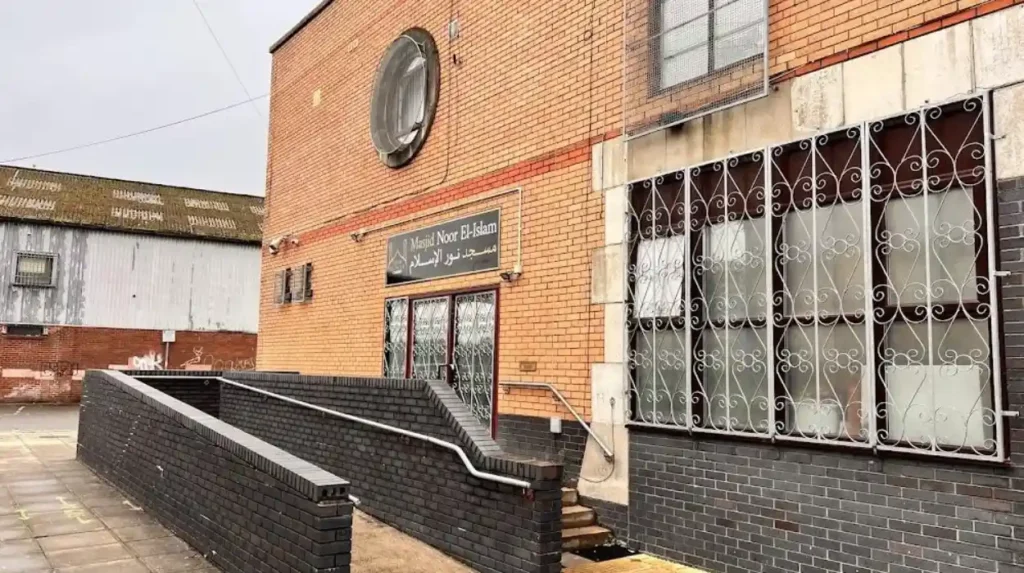
Islamic community life developed alongside the area’s commercial activity. A centre for Muslim worship and cultural activity was established on Peel Street during the late 1930s. Approval to build a purpose-built mosque was granted on 11 November 1938, and Noor el-Islam Mosque opened in a temporary structure in July 1943 before developing into a permanent place of worship.
Noor el-Islam Mosque represents an important part of Cardiff’s religious heritage. Its history demonstrates that Muslim life in Wales developed long before more recent migration patterns associated with the post-war period.
Somali and Yemeni families also contributed to the area’s wider social life through commerce, family networks and community activities. Their history challenges accounts of British multiculturalism that begin only after the Second World War.
Butetown’s Muslim heritage is part of the wider story of Welsh migration, maritime labour and cultural exchange. It connects local streets and institutions with the global routes that sustained Cardiff’s docks.
How Did the Norwegian Community Contribute to Butetown’s Maritime Heritage?
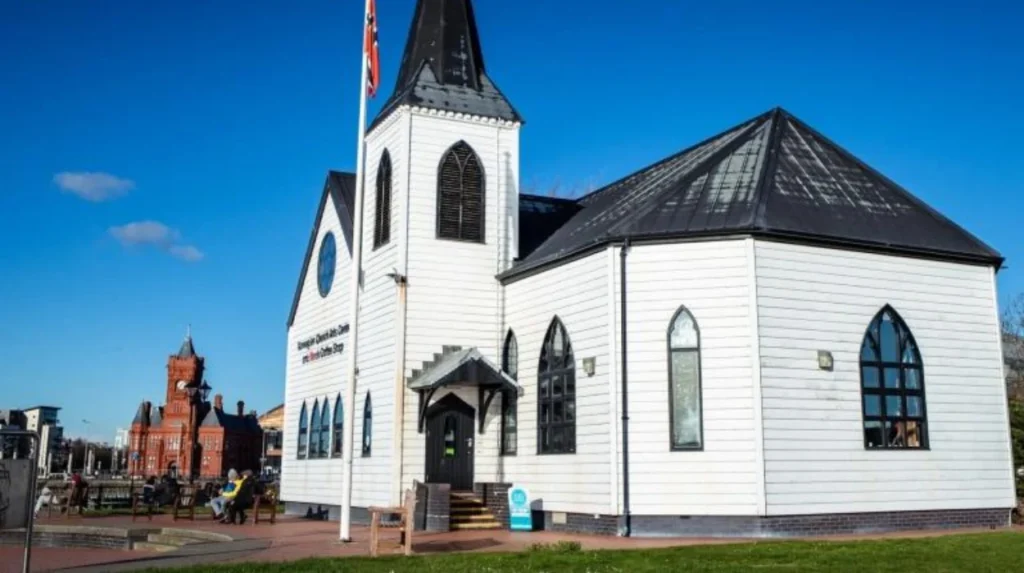
The Norwegian community developed around Cardiff’s coal-exporting port during the nineteenth century. Norwegian sailors and merchants established social and religious connections in the docklands, with the Norwegian Church becoming a lasting landmark of Cardiff’s international maritime history.
Norwegian ships regularly visited Cardiff to collect coal for overseas markets. Their presence created demand for religious services, community facilities and support for sailors spending time away from home.
Pastor Lars Oftedal arrived in Wales in 1866 and began serving Norwegian seafarers. A purpose-built Norwegian Church was constructed at Cardiff’s West Dock in 1868 and consecrated in 1869. It provided worship, social support and a meeting place for Norwegian sailors and residents. Norwegian Church Arts Centre+1
The church reflected the practical needs of an international port. Sailors often spent extended periods abroad, and religious institutions offered continuity, social contact and assistance within unfamiliar surroundings.
The Norwegian presence also illustrates the diversity of Cardiff’s maritime population. Butetown’s history includes European shipping communities alongside Somali, Yemeni, Caribbean and West African residents. Each group contributed to the district’s social structure in different ways.
The church was relocated to its current waterfront position during the 1990s as the surrounding docklands underwent redevelopment. It remains known as the Norwegian Church Arts Centre and continues to represent an important connection between Cardiff Bay and its maritime past.
Its survival provides a physical link between the industrial port and the modern waterfront. The building also demonstrates how historic structures can retain cultural significance after their original economic purpose changes.
What Happened During the 1919 Cardiff Race Riots?
The 1919 Cardiff race riots were episodes of racial violence against Black and other non-white residents, including seafarers and members of Cardiff’s dockland communities. They exposed racial prejudice, economic tensions and the vulnerability of established migrant communities in post-war Britain.
The riots occurred in June 1919, when racial tensions intensified in several British port cities following the First World War. Cardiff’s docklands became one of the locations where violence targeted Black residents and other people perceived as outsiders.
The end of the war brought major economic and social pressures. Demobilised servicemen returned to civilian life, employment remained uncertain, and competition over work and housing contributed to public tension. These conditions did not justify racial violence, but they formed part of the environment in which attacks occurred.
Cardiff’s established Black and international communities faced hostility despite their long-standing contributions to maritime trade. Black seafarers and local residents became targets of racist attacks, illustrating how racial prejudice shaped experiences of work, safety and belonging.
The events are significant to the history of Butetown because they reveal the challenges experienced by its multicultural population. The district’s diverse identity developed alongside discrimination and unequal treatment, rather than outside these wider social problems.
The National Library of Wales includes the 1919 riots in its educational resources on Tiger Bay and migration history. Academic studies of Cardiff’s docklands also examine the relationship between race, social attitudes and the representation of migrant communities.
Remembering the riots places the experiences of affected residents within the wider history of modern Wales. It also provides historical context for discussions about racism, community solidarity and the rights of minority groups.
How Did World War I and the Decline of the Coal Trade Affect Butetown?
The decline of Cardiff’s coal-exporting industry weakened the economic foundations of Butetown during the twentieth century. Changing fuel demand, reduced maritime activity and declining employment affected local businesses, household incomes and investment in the surrounding docklands.
Cardiff’s port reached a major peak in coal exports in the early twentieth century. The First World War accelerated changes in maritime fuel use, while international economic shifts gradually reduced the dominance of South Wales coal.
Oil became increasingly important for ships and industrial operations. International competition and changes in energy demand further weakened Cardiff’s traditional export trade. The docks continued operating, but their economic importance diminished compared with their industrial peak.
The decline affected Butetown because many households depended directly or indirectly on port employment. Fewer opportunities in shipping and dock work reduced demand for local services. Businesses that relied on sailors, cargo workers and merchants also faced changing conditions.
Academic research on Butetown describes the longer decline of the docks from the 1920s, with coal exports ending in 1964. This marked a major turning point in the history of Cardiff’s traditional coal-exporting economy. Taylor & Francis Online+1
The effects extended beyond employment. Reduced investment and economic change affected the physical condition of the docklands and the relationship between Butetown and Cardiff’s expanding commercial centre.
However, the decline of the coal industry did not erase the community’s identity. Families continued to maintain local relationships, cultural traditions and memories of the maritime era. The district’s history remained shaped by generations of residents, even as its economic foundations changed.
How Did Redevelopment Change Butetown and Tiger Bay in the 1960s and 1970s?
Redevelopment during the 1960s and 1970s transformed parts of Tiger Bay through housing demolition, clearance schemes and changes to the docklands. These interventions disrupted established neighbourhoods and displaced residents while reshaping the physical landscape of historic Butetown.
As the traditional port economy weakened, parts of Cardiff’s docklands faced declining investment and deteriorating buildings. Authorities pursued urban improvement and redevelopment programmes to address housing conditions and adapt land to changing economic needs.
The consequences for residents were substantial. Demolition removed houses, streets and familiar neighbourhood spaces that had supported community life for generations. Relocation disrupted relationships among neighbours, families and local businesses.
The changes also affected the physical evidence of Tiger Bay’s past. Streets associated with dock workers, migrant families and maritime commerce disappeared or changed significantly. As a result, later generations increasingly relied on photographs, oral histories, family memories and surviving landmarks to understand the area’s earlier character.
The National Library of Wales records that regeneration began in the late 1950s and continued through the development of Cardiff Bay, while houses were demolished during the 1960s and 1970s. National Library of Wales
Redevelopment was not simply an architectural process. It changed the way residents experienced their neighbourhood and how outsiders understood its identity. The loss of historic streets made community-led preservation particularly important.
The history of these changes also raises questions about urban planning. Improvements to buildings and infrastructure must be considered alongside the experiences of residents whose homes, businesses and social networks are affected.
Butetown’s experience demonstrates why regeneration history requires both physical and social evidence. Maps and buildings explain changes to the landscape, while oral histories help document the personal consequences of those changes.
How Did Cardiff Bay Regeneration Transform the Former Docklands?
Cardiff Bay regeneration converted large areas of former industrial dockland into a modern waterfront district with leisure, commercial, residential and cultural uses. The transformation brought new investment to southern Cardiff while raising continuing questions about heritage preservation and the recognition of established communities.
By the late twentieth century, Cardiff’s traditional dock economy had lost much of its former importance. Large areas of waterfront land required new uses, creating the conditions for a major redevelopment programme.
The Cardiff Bay Development Corporation was established in 1987 to lead regeneration across the wider waterfront area. Its work formed part of a broader effort to replace declining industrial activity with new commercial, residential and leisure development.
The modern Cardiff Bay landscape includes cultural venues, waterfront public spaces, housing, restaurants and visitor attractions. These facilities have changed the area’s economic profile and strengthened its role within Cardiff’s wider visitor economy.
However, regeneration also generated debate about whose history and needs received priority. Academic research on Butetown highlights concerns that the original multicultural community was not sufficiently represented in the early plans for Cardiff Bay’s redevelopment. Local heritage initiatives subsequently played an important role in asserting the district’s identity.
This distinction matters because Cardiff Bay and Butetown are closely connected but are not interchangeable historical concepts. Cardiff Bay describes the wider waterfront and regeneration area, while Butetown retains a specific neighbourhood identity shaped by generations of residents.
The redevelopment of the waterfront demonstrates how industrial landscapes can acquire new economic functions. It also shows why regeneration programmes need to preserve local stories, recognise existing communities and interpret historic places accurately.
Today, the history of the docks remains essential to understanding the modern waterfront. Without that context, Cardiff Bay’s development appears disconnected from the workers, sailors and families who built the area’s earlier economy.
Which Historic Landmarks Help Explain Butetown’s Past?
Butetown’s history is reflected in surviving religious buildings, historic streets and dockland structures. Landmarks such as the Norwegian Church, Noor el-Islam Mosque and Mount Stuart Square help explain the area’s maritime economy, international migration and enduring multicultural identity.
Although redevelopment altered much of the historic landscape, several places provide important connections to the district’s past.
1. Norwegian Church Arts Centre
The Norwegian Church began serving seafarers in the nineteenth century. Its original building dates to 1868, and its history illustrates the relationship between Norwegian shipping, Welsh coal exports and international religious communities. Today, the relocated building serves as a cultural venue overlooking Cardiff Bay.
2. Noor el-Islam Mosque
Noor el-Islam Mosque represents the history of Cardiff’s established Muslim community. Its origins during the late 1930s and its opening in 1943 document the lasting presence of Somali, Yemeni and other Muslim residents in the docklands. OpenLearn – Open University
3. Mount Stuart Square
Mount Stuart Square belongs to the historic dockland landscape. Its surroundings developed alongside Cardiff’s commercial port, reflecting the businesses, institutions and urban infrastructure that supported maritime trade. The square helps explain how commercial activity shaped the district beyond the docks themselves.
4. Bute West Dock and Oval Basin
The Bute West Dock opened in 1839, marking a major stage in Cardiff’s industrial expansion. The Oval Basin, associated with the dock’s entrance, helps visitors understand the infrastructure that connected the South Wales coalfield with international shipping. Cardiff Harbour Authority
These landmarks tell different parts of the same story. Religious buildings document the needs of migrant communities, commercial streets reflect the port economy, and surviving dock structures reveal the engineering that supported industrial growth.
Together, they help explain why Butetown remains important to the heritage of Cardiff and Wales.
How Did Butetown’s History Influence Welsh Culture and Community Life?
Butetown influenced Welsh cultural life through generations of interaction between local families, international seafarers and migrant communities. Shared neighbourhood experiences shaped music, food, religious practice, family identities and community celebrations, creating a distinctive cultural heritage within Cardiff.
The district’s multicultural character developed through everyday contact rather than migration alone. People worked in the same industries, used local businesses, raised families and participated in neighbourhood activities. These connections produced relationships that crossed national, linguistic and religious boundaries.
Food and music formed part of this exchange. Residents brought cultural traditions from their countries of origin while adapting to life in Wales. Over time, family histories reflected connections between Cardiff and locations across Africa, the Caribbean, the Middle East and Europe.
Community celebrations became an important way to express this shared identity. Butetown Carnival is one example of a cultural initiative associated with the area’s multicultural history. Its development reflects the influence of international carnival traditions alongside local Welsh cultural practices.
The community’s cultural identity also developed in response to discrimination and redevelopment. Preserving memories of earlier generations became a way to challenge negative representations of Tiger Bay and recognise the contributions of residents whose experiences were often underrepresented in conventional accounts of Welsh history.
Butetown therefore occupies an important place in discussions of Welsh identity. Its history demonstrates that international migration and multicultural communities have contributed to Wales for generations, particularly through industrial employment and maritime trade.
Why Is Butetown’s History Important to Understanding Modern Cardiff?
Butetown’s history explains how Cardiff became an international port city and developed one of Wales’s longest-established multicultural communities. Understanding its industrial growth, migration, racial tensions and redevelopment provides essential context for the city’s modern economy, cultural identity and waterfront transformation.
The district connects several major themes in Welsh history. Its industrial development illustrates the importance of coal exports, while its population history demonstrates the influence of international shipping on migration and settlement.
Its experience also challenges the idea that multicultural Britain emerged only after the Second World War. Butetown’s established Somali, Yemeni, Caribbean, African and European connections demonstrate that diverse communities existed in Cardiff long before recent immigration debates.
The district’s twentieth-century history is equally significant. The decline of the coal trade, demolition of housing and subsequent waterfront regeneration show how economic change affects established communities. These events altered both the physical environment and the ways residents understood their neighbourhood.
Academic research into Butetown also demonstrates the importance of community-led heritage work. Local history projects, oral histories and cultural initiatives help residents preserve experiences that official redevelopment narratives sometimes overlook.
For visitors, historians and Cardiff residents, Butetown offers a way to understand the relationship between industrial infrastructure and everyday life. The docks explain how goods travelled across the world, while the community’s history explains how those connections influenced the people who lived nearby.
Explore More Area Guide
Cardiff Before It Became the Capital of Wales
How Cardiff Became the Capital of Wales in 1955
How Can Visitors Explore and Learn About Butetown’s History Today?
Visitors can explore Butetown’s history through its surviving landmarks, Cardiff Bay’s waterfront, local heritage resources and historical research. Walking through the district helps connect the former dock infrastructure with the religious buildings, streets and community institutions that document its multicultural past.
A historical visit benefits from combining physical exploration with reliable documentary evidence.
The Norwegian Church provides an introduction to the maritime community that developed around Cardiff’s docks. The surrounding waterfront offers views of an area transformed from an industrial port into a modern visitor destination.
Mount Stuart Square and the wider Butetown street network provide additional context for understanding the commercial and residential development of the district. Visitors should distinguish between surviving historic buildings and modern structures that occupy former dockland sites.
Noor el-Islam Mosque is an important part of the area’s religious history. Visitors should respect the mosque’s role as a place of worship and check access arrangements before planning a visit.
Historical learning can also draw on resources from the National Library of Wales, Cardiff University and the Norwegian Church Arts Centre. These institutions provide material on migration, industrial development, historic buildings and the experiences of dockland communities.
Oral histories and family accounts are particularly valuable because they preserve experiences that maps and official records cannot fully capture. They reveal how residents understood their neighbourhood, responded to economic change and maintained community connections.
Exploring Butetown through these different sources provides a fuller account of its past than focusing exclusively on its docks or modern waterfront attractions.
What Does the History of Butetown Tell Us About Cardiff?
The history of Butetown is inseparable from Cardiff’s transformation into a major industrial port. The opening of Bute West Dock in 1839, the expansion of coal exports and the growth of international shipping established the economic foundations of the district.
These commercial connections brought people from across the world to Cardiff. Somali and Yemeni seafarers, Norwegian sailors, Caribbean residents, West African migrants and families from many other backgrounds contributed to the area’s multicultural identity. Their experiences shaped its businesses, religious institutions, family networks and cultural traditions.
The district also experienced significant challenges. Racial violence in 1919, the decline of the coal trade, housing demolition and large-scale redevelopment altered its social and physical landscape. These changes demonstrate that industrial success and urban regeneration have consequences for the communities that sustain a place.
Today, Butetown’s heritage remains essential to understanding Cardiff’s identity. Its story extends beyond dock infrastructure to include migration, religious life, community resilience and the preservation of local memory.
Recognising this history provides a more complete understanding of Welsh industrial heritage and the longstanding international connections that shaped modern Cardiff.
What is Butetown in Cardiff famous for?
Butetown is famous for its historic docks, multicultural heritage and connection to Tiger Bay. Its history includes coal exports, international shipping, migrant communities and landmarks such as the Norwegian Church and Noor el-Islam Mosque.