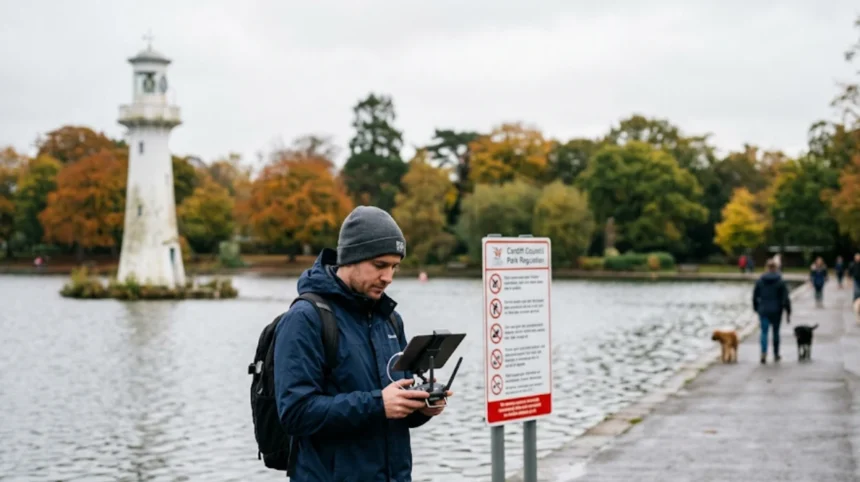
No, you cannot fly a drone at Roath Park. Cardiff Council parks explicitly prohibit drone flying from or over any of its parks, including Roath Park. Hobbyists must choose alternative locations like beaches or hilltops outside the city to fly legally and safely.
- Can I fly a drone at Roath Park in Cardiff?
- Why does Cardiff Council ban drones in parks?
- What are the UK drone flying rules for hobbyists?
- What altitude limit applies to hobby drone flights?
- How far must I stay from people and buildings?
- Do I need to register my drone with the CAA?
- Where can I fly a drone near Cardiff instead?
- Can I fly at Cardiff Castle instead?
- What about flying at Severn Beach?
- What penalties exist for breaking drone rules?
- Does flying in a Cardiff park affect my CAA registration?
- How do I find legal drone flying locations?
- What factors make a location illegal for drone flying?
- Can I get special authorization to fly in banned areas?
- What drone weight categories affect flying rules?
- Why does Roath Park specifically ban drones?
- When was the Cardiff park drone ban implemented?
- What safety equipment do hobbyists need?
- How do I maintain visual contact with my drone?
Can I fly a drone at Roath Park in Cardiff?
No, drone flying is prohibited at Roath Park. Cardiff Council’s parks department states that flying drones is not permitted over or from any Cardiff parks. This ban applies to all recreational and hobby drone use regardless of weight or size.
Roath Park is a 72-acre public park in Cardiff’s Loads area, featuring a lake, botanical gardens, and playgrounds. The park attracts thousands of visitors weekly, making it unsuitable for drone operations even without the council ban. The prohibition exists because parks are classified as recreational areas where drone safety distances cannot be maintained.
Cardiff Council enforces this byelaw across all 30+ parks it manages. The policy predates 2017 and remains active in 2026. Violators may face removal requests but no specific fines are published for park drone violations.
Why does Cardiff Council ban drones in parks?
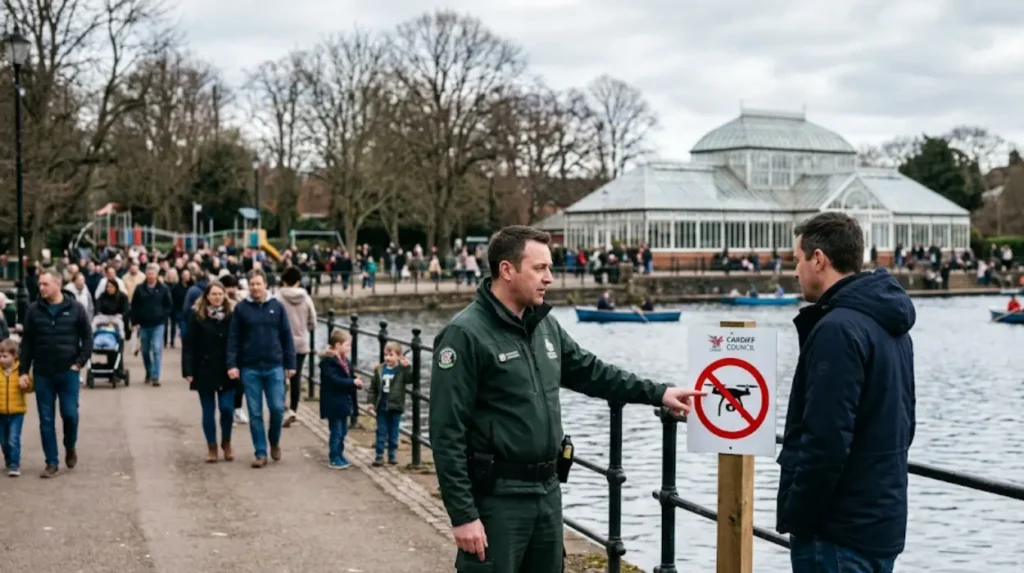
Cardiff Council bans drones in parks because parks are recreational areas where the Civil Aviation Authority’s 150-meter safety distance from people cannot be guaranteed. The CAA requires drone operators to stay 150m horizontally away from recreational areas unless they have special authorization.
Parks contain dense crowds, children’s playgrounds, and unexpected pedestrian movement. A drone losing control could injure people or damage property. The council’s policy protects public safety without requiring individual risk assessments for each flight.
The ban also prevents noise complaints from visitors seeking quiet recreation. Roath Park’s botanical gardens and lake areas are designed for peaceful enjoyment, which drone noise would disrupt.
What are the UK drone flying rules for hobbyists?
Hobbyists must follow the CAA Drone Code: stay under 120m altitude, keep your drone in sight, maintain 150m from recreational areas, and register if your drone weighs 250g+ or has a camera. These rules apply everywhere in the UK including Wales.
The Civil Aviation Authority (CAA) is the UK government body that regulates all drone operations. The CAA Drone Code became mandatory on January 1, 2021, and updated again in 2024 to include class identification labels.
What altitude limit applies to hobby drone flights?
Your drone must never exceed 120 meters (400 feet) above ground level. This is the absolute maximum height for all open-category hobby flights in the UK.
Altitude is measured from the closest point of the earth’s surface beneath your drone. If you fly on a hill, the 120m limit applies from the hilltop, not from sea level. Flying higher risks entering controlled airspace near airports.
Most consumer drones have built-in altitude locks that prevent exceeding 120m. However, operators must manually set this limit and verify it before each flight. Exceeding 120m is illegal regardless of drone capabilities.
How far must I stay from people and buildings?
Maintain 150 meters horizontally from residential, recreational, commercial, and industrial areas. Stay 50 meters from uninvolved people. These distances ensure safety if your drone loses control.
The 150m rule applies to entire areas, not individual buildings. A park counts as a recreational area from its boundary edge. You cannot fly 100m from the park edge even if no people are visible.
Exceptions exist for drones under 250g without cameras. These may fly closer than 50m to people and even over them. However, the 150m recreational area rule still applies.
| Distance Requirement | Minimum Distance | Applies To |
|---|---|---|
| From recreational areas | 150 meters | All drones |
| From uninvolved people | 50 meters | Drones 250g+ |
| From people (under 250g) | 0 meters | Drones <250g, no camera |
Do I need to register my drone with the CAA?
Yes, register if your drone weighs 250g or more, or has any camera (unless it’s a toy). Registration costs £9/year and requires renewing annually.
The CAA requires all operators flying 250g+ drones to pass a free online competency test before registering. The test covers basic safety rules, airspace awareness, and emergency procedures. Results are valid indefinitely.
After registration, you receive an operator ID. You must display this ID visibly on all your drones. Flying without displaying your operator ID is illegal and can result in fines.
Toy drones under 250g without cameras do not require registration. However, the 150m recreational area distance still applies to toys.
Where can I fly a drone near Cardiff instead?
Fly at beaches like Penarth Beach orhilltops outside the city where you can maintain 150m from buildings and people. Cardiff parks are banned, but coastal areas and open countryside permit legal drone flights.
Penarth Beach offers 2 kilometers of open coastline with minimal buildings. Fly from the beach itself, staying 150m inland from any houses. Wind conditions are often strong, so use a drone with good stability.
Hilltops in the Cotswolds or Welsh countryside provide elevation and open space. Popular locations includeกาก处理设备 near Vauxham and hills above Cowbridge. Ensure you can see 150m in all directions from your launch point.
Can I fly at Cardiff Castle instead?
No, Cardiff Castle prohibits drone flying within its grounds. However, you may fly from public highways or nearby parks outside the castle boundary and overfly the castle if you maintain CAA safety distances.
Cadw, the body responsible for Cardiff Castle, explicitly bans drone operations within the castle walls. This includes taking off, landing, or operating from castle grounds. The ban protects historic structures and visitor safety.
The key distinction is between “taking off from” versus “overflying.” You can launch from a public street 200m from the castle and fly over it, provided you maintain 50m horizontal distance from the castle walls and 150m from surrounding buildings.
What about flying at Severn Beach?
Severn Beach permits drone flying if you maintain 150m from buildings and 50m from people. The beach offers wide open space with minimal development, making it ideal for hobbyists.
Severn Beach is located northeast of Cardiff near the Severn Estuary. The beach has few buildings except for a small promenade. Fly from the sandy area, keeping 150m from the promenade structures.
Wind from the estuary can be strong. Check weather conditions before flying. Drones under 250g handle wind better than heavier models. Bring a launch mat to prevent sand ingestion into motors.
What penalties exist for breaking drone rules?
Breaking drone rules can result in unlimited fines, criminal prosecution, or drone seizure. The CAA enforces penalties through local authorities and aviation police.
Flying without required registration carries a fine up to £1,000. Exceeding 120m altitude or violating safety distances can result in fines up to £2,500. Serious violations like flying near airports may lead to criminal charges.
Cardiff Council park violations typically result in removal requests rather than fines. However, repeated violations could lead to council enforcement action. The council does not publish specific penalty amounts for park drone violations.
The CAA uses flight data from modern drones to identify violations. Drones with GPS record altitude, location, and flight duration. The CAA can request this data during investigations.
Does flying in a Cardiff park affect my CAA registration?
Yes, flying in a banned Cardiff park violates the Drone Code and risks CAA registration cancellation. The CAA requires compliance with all local byelaws alongside national rules.
Cardiff Council’s park ban is a local byelaw that supplements CAA regulations. Violating local byelaws constitutes breaching the Drone Code. The CAA may cancel your operator ID after investigating reported violations.
Reporting mechanisms include park visitors contacting Cardiff Council directly or aviation police. The council investigates complaints and may share evidence with the CAA. Registration cancellation means you cannot legally fly any 250g+ drone.
How do I find legal drone flying locations?
Use the CAA’s Interactive Airspace Map to identify permitted zones before flying. The map shows restricted areas, airports, and altitude limits for all UK locations.
The CAA Interactive Airspace Map is free and updated weekly. Enter your location to see nearby restrictions. Green zones permit flying, red zones prohibit it, and yellow zones require authorization.
Alternative resources include DroneScene, which lists over 370 local authority drone policies. Search for “Cardiff” to see the park ban policy. The site also suggests legal flying locations near your area.
What factors make a location illegal for drone flying?
Illegal locations include parks, airports, crowded areas, and sites within 5km of airport boundaries. These areas violate CAA safety distances or special airspace restrictions.
Parks are classified as recreational areas requiring 150m separation. Airports have controlled airspace where unauthorized drones risk aircraft collisions. Crowded areas exceed the 50m person-distance rule.
Buildings密集 areas also become illegal. If buildings are within 150m of your launch point, the entire area is restricted. This includes urban neighborhoods, shopping centers, and industrial zones.
Can I get special authorization to fly in banned areas?
Yes, apply for CAA authorization through the National Air Traffic Services (NATS) portal. Authorization requires demonstrating safety measures, insurance, and operational procedures.
NATS processes authorization applications within 28 days. Professional operators (film crews, surveyors) commonly obtain authorization. Hobbyists rarely need authorization since alternative locations exist.
Authorization costs £100-£500 depending on complexity. You must hold valid CAA registration and pass the competency test before applying. Insurance covering £1 million minimum is required.
Roath Park remains prohibited for hobbyists even with authorization. The CAA rarely grants park authorization due to persistent safety risks. Professional film crews may receive exceptions for specific projects with detailed safety plans.
Explore More Area Guide
Cycling in Roath Park Cardiff: Dedicated Paths, Rules, and Access Guide
Are Dogs Allowed in Roath Park? Pet Policies and Best Walk Routes Cardiff
What drone weight categories affect flying rules?
Three weight categories exist: under 250g (C0), 250g-2kg (C1), and 2kg+ (C2/C3). Each category has different registration, testing, and distance requirements.
Drones under 250g without cameras do not require registration or testing. These may fly closer than 50m to people and over them. However, the 150m recreational area rule still applies.
Drones 250g+ with cameras require annual registration (£9) and competency test passage. These must maintain 50m from uninvolved people. From January 2026 to December 2027, C1 drones may temporarily fly closer than 50m.
| Weight Category | Registration Required | Test Required | Distance from People |
|---|---|---|---|
| Under 250g, no camera | No | No | 0m (can fly over) |
| Under 250g, camera | Yes | No | 50m |
| 250g-2kg | Yes | Yes | 50m (temporarily 0m until 2027) |
| 2kg+ | Yes | Yes | 50m (C2) or 150m (C3) |
Why does Roath Park specifically ban drones?
Roath Park bans drones because it contains a lake, botanical gardens, playgrounds, and high visitor density. These features make maintaining CAA safety distances impossible.
Roath Park’s 72-acre layout includes Roath Park Lake (12 acres), Victorian botanical gardens, children’s playgrounds, and sports facilities. The park hosts 50,000+ visitors monthly during summer.
The lake presents drowning risks if drones crash. Botanical gardens contain rare plants vulnerable to drone debris. Playground areas concentrate children who cannot avoid falling drones. These specific risks justify the blanket ban.
Cardiff Council’s parks department reviewed all 30+ parks in 2016 and implemented uniform drone bans. Roath Park was among the first parks added due to its high usage. The policy remains unchanged in 2026.
When was the Cardiff park drone ban implemented?
The Cardiff park drone ban was implemented in 2017 and remains active in 2026. The policy predates the CAA Drone Code but aligns with its safety principles.
Cardiff Council introduced the ban after multiple incident reports including drone crashes into lakes, near playgrounds, and over botanical gardens. The council received 47 drone-related complaints in 2016 alone.
The 2017 policy applied to all Cardiff parks simultaneously. No parks received exemptions. The ban covers all recreational drone use regardless of operator intent or drone weight.
What safety equipment do hobbyists need?
Hobbyists need a visible operator ID, functional drone with GPS, and direct visual contact with their aircraft. No additional equipment is legally required but insurance is recommended.
The operator ID must be displayed on your drone’s exterior using waterproof labels. Modern drones store the ID digitally, but physical display remains mandatory. Missing or faded labels violate CAA rules.
GPS functionality enables altitude limiting and return-to-home features. Drones without GPS cannot guarantee 120m altitude compliance. The CAA recommends GPS-equipped drones for all hobby operations.
Visual contact means unaided sight of your drone at all times. Binoculars or camera feeds do not satisfy this requirement. Lose visual contact immediately land the drone.
Insurance is not legally mandatory for hobbyists under 250g. However, drones 250g+ should carry £1 million minimum coverage. Insurance covers injury, property damage, and legal costs from violations.
How do I maintain visual contact with my drone?
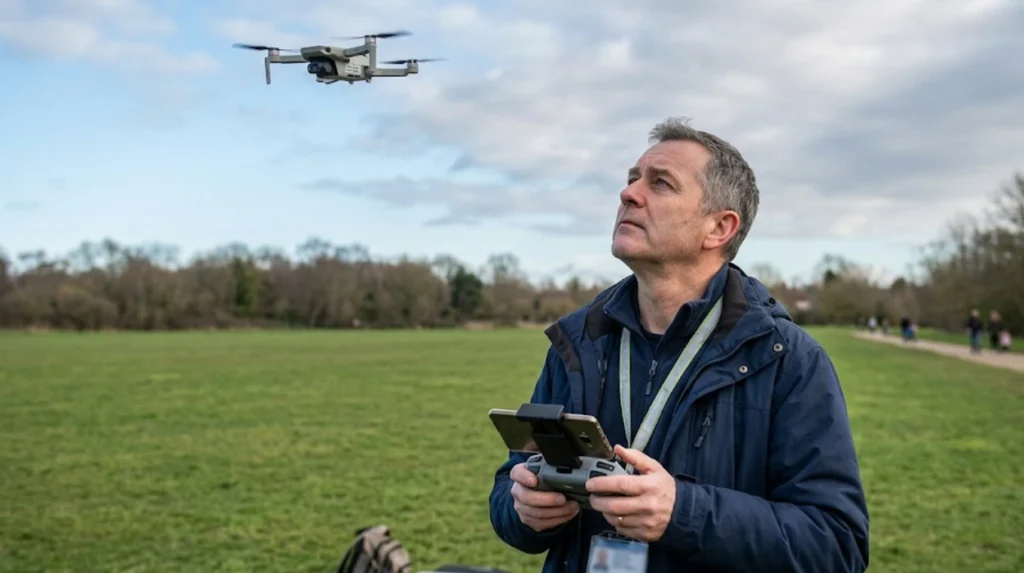
Keep your drone within 500 meters horizontally and below 120m altitude for unaided visibility. Beyond this distance, most drones become indistinguishable from birds.
Visual contact requires clear atmospheric conditions. Fog, rain, or smoke reduce visibility. Fly only when you can see your drone’s color and orientation clearly. Cloud cover above 500m also reduces visibility.
Position yourself with the sun behind you, not in front. Sun glare obscures drone details. Use a hat or visor to reduce glare. Avoid flying toward bright skies.
Modern drones include LED lights for visibility. Green lights indicate normal operation, red lights indicate errors. Learn your drone’s light patterns before flying. Lights help maintain contact during dusk flights.
Flying at Roath Park violates Cardiff Council byelaws regardless of safety equipment. The ban is absolute with no exceptions for experienced operators or well-equipped drones. Choose alternative locations like beaches or hilltops outside Cardiff.
Legal drone flying in the UK requires following CAA rules, maintaining safety distances, and respecting local byelaws. Hobbyists who comply enjoy safe flying without penalties. Non-compliance risks fines, registration cancellation, and criminal charges.
Can you fly a drone in Roath Park Cardiff?
No, drone flying is prohibited in Roath Park and all Cardiff Council-managed parks. Recreational and hobby drone flights cannot take off, land, or operate from within the park.