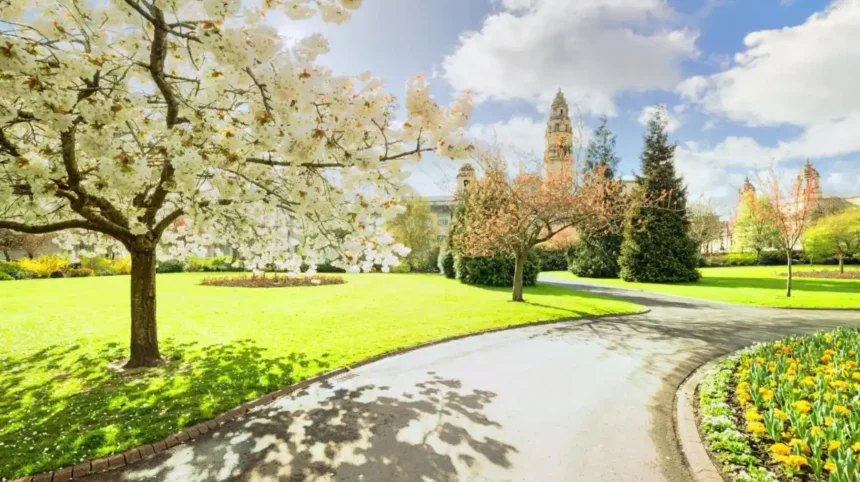
Cardiff is one of Wales’s strongest urban destinations for spring walking. The city combines historic parks, landscaped gardens, mature tree-lined avenues, woodland valleys and riverside green spaces. Spring transforms these places as flowering trees, bulbs and shrubs create seasonal displays across Cardiff.
- What are spring blossom walks in Cardiff?
- When is the best time to see spring blossom in Cardiff?
- Which Cardiff parks are best for spring blossom walks?
- Why is Bute Park one of Cardiff’s strongest blossom walking locations?
- What makes Roath Park important for a spring blossom walk?
- Which Cardiff walks offer woodland and natural spring displays?
- What spring flowers and trees should you look for on Cardiff walks?
- How does spring weather affect Cardiff blossom walks?
- How can visitors plan an accessible spring blossom walk in Cardiff?
- How should walkers behave around blossom trees and wildlife?
- How does Cardiff’s tree planting support future spring blossom walks?
- Which Cardiff blossom walk is best for different types of visitors?
- What makes spring blossom walks in Cardiff worth repeating each year?
The city has more than 330 parks and gardens, giving residents and visitors a wide choice of places for outdoor recreation. Bute Park, Roath Park, Parc Cefn Onn, Llandaff Fields, Heath Park and Insole Court provide different walking environments, from formal Victorian landscapes to woodland paths.
Spring blossom is particularly valuable because the flowering period connects visual interest with ecological activity. Trees in the cherry, plum, apple and hawthorn groups produce flowers that support pollinating insects. The Woodland Trust identifies blossom as the flowers of stone-fruit trees and related members of the rose family, including cherries, plums, apples and hawthorns.
For walkers, the best approach is to treat blossom as a seasonal sequence rather than a single event. Different species flower at different times. Location, exposure, temperature and tree variety all affect the display. This makes Cardiff suitable for repeat spring walks from March through May.
What are spring blossom walks in Cardiff?
Spring blossom walks in Cardiff are seasonal walks through parks, gardens, woodland and tree-lined avenues where flowering trees create a concentrated display. The best-known settings include Bute Park, Roath Park, Parc Cefn Onn, Llandaff Fields and Insole Court gardens throughout.
A blossom walk is not a separate official walking category. It describes a walking experience centred on flowering trees and other spring plants. The route itself can be a public park path, riverside trail, garden walkway or woodland footpath.
Cardiff provides several environments for this type of walk. Bute Park combines historic parkland, woodland, an arboretum, horticultural areas and the River Taff corridor. Its 56 hectares contain more than 2,000 trees, including nationally recognised champion specimens.
Roath Park provides a different landscape. Its Victorian park design includes a 30-acre man-made lake, formal gardens, promenades and the Scott Memorial Lighthouse. The park opened to the public on 20 June 1894.
Parc Cefn Onn provides a woodland-focused alternative. The Grade II listed historic park contains native and exotic trees, streams, ponds and winding paths within a valley setting. Its spring displays include flowering shrubs and carpets of spring bulbs.
The variety of landscapes means a Cardiff blossom walk does not need to follow one fixed route. Walkers can select a formal garden for ornamental planting, a park for accessible paths or a woodland setting for a more natural spring landscape.
When is the best time to see spring blossom in Cardiff?
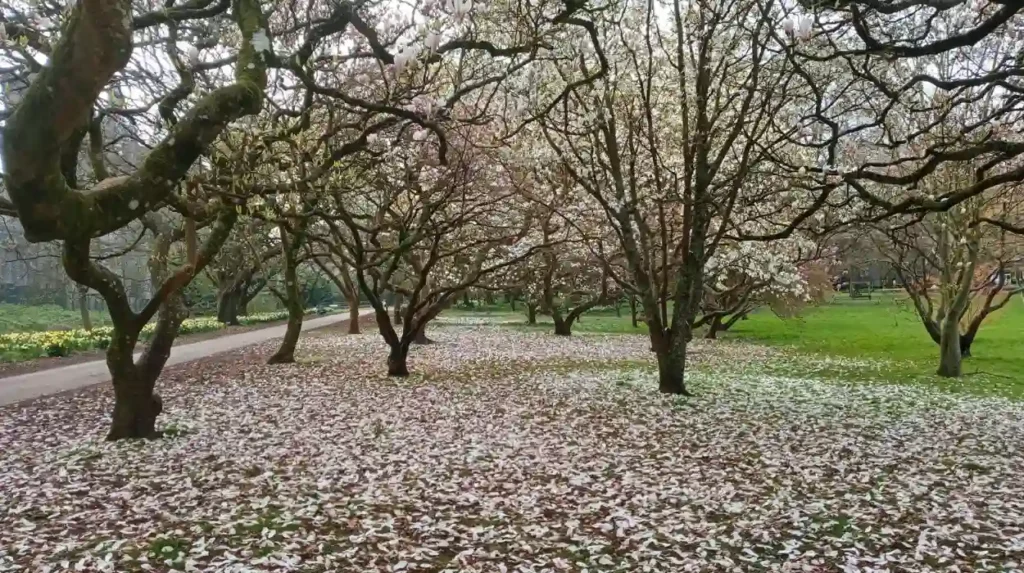
Cardiff’s main blossom period runs from late winter into late spring, with flowering timing varying by tree species and weather. Early cherries and magnolias appear before many apples and hawthorns, while cooler conditions delay peak displays across the city.
Meteorological spring in the UK runs from 1 March to 31 May. Astronomical spring begins around 20 March in the Northern Hemisphere. These definitions provide a useful framework, but individual plants respond to temperature and daylight rather than a fixed calendar date.
The Woodland Trust places pear and plum blossom among the earlier spring displays, often beginning in March. April commonly brings wild cherry, crab apple and hawthorn blossom. Domestic apple and some other flowering trees continue later into spring.
This sequence is important when planning Cardiff walks. A visit in early March focuses more on early flowering trees and spring bulbs. April provides a broader combination of cherry blossom, ornamental trees and emerging foliage. May brings later blossom, hawthorn, established greenery and mature spring planting.
Weather also changes the timing. Research from the Met Office found that budburst in nine of eleven studied UK tree species was associated with March temperatures. A 1°C temperature difference was associated with changes of several days in budburst timing, depending on species and region.
Cardiff therefore benefits from checking current local conditions before travelling for a specific blossom display. A warm spring can accelerate flowering, while a cooler period delays it. The 2026 spring demonstrated this relationship clearly. Wales recorded its warmest spring on record, according to provisional Met Office statistics, with a mean temperature of 9.73°C for March to May.
Which Cardiff parks are best for spring blossom walks?
Bute Park, Roath Park, Parc Cefn Onn, Llandaff Fields and Heath Park provide strong spring walking choices because they combine mature trees, landscaped areas, woodland, gardens or established pedestrian routes within Cardiff’s extensive public green-space network.
Bute Park
Bute Park is the most central choice. It sits beside Cardiff Castle and the River Taff, making it straightforward to combine a blossom walk with the city centre.
The park covers 56 hectares and contains more than 2,000 trees. Its landscape includes an arboretum, historic gardens, woodland, open areas and river corridors. The park is also a Grade I listed historic landscape on the Cadw Register.
The tree collection gives Bute Park particular value for seasonal observation. Walkers can explore different sections rather than following a single short path. Nature trails are also available through Outdoor Cardiff, including a dedicated Bute Park Wildlife Explorer Trail.
Roath Park
Roath Park is especially suitable for walkers who want blossom, formal horticulture and water views within one route.
The park opened in 1894 after work began in 1889. Its Victorian design remains an important part of its identity. The 30-acre lake forms the central landscape feature, while promenades, formal gardens and the Scott Memorial Lighthouse provide recognisable landmarks.
In 2026, Roath Park received Green Heritage Site Accreditation alongside its Green Flag status. The heritage accreditation recognises the park’s historic character and interpretation. A ten-step heritage trail also explains features of the park’s history.
Parc Cefn Onn
Parc Cefn Onn is the strongest choice for a woodland-style spring walk. It is a Grade II listed historic park and a designated country park on Cardiff’s northern edge.
Its landscape includes native and exotic trees, woodland, streams, ponds and winding paths. Outdoor Cardiff also identifies waymarked routes and connections towards surrounding countryside. Spring brings floral carpets, camellias, rhododendrons and azaleas.
Llandaff Fields
Llandaff Fields offers a flatter urban walking environment. The park forms part of an extensive Grade II listed parkland network extending north from central Cardiff on both sides of the River Taff.
The site was acquired as playing fields by Cardiff Corporation in 1898. Mature tree-lined pedestrian avenues cross the park, making it useful for walkers who want open lawns combined with established trees.
Heath Park
Heath Park provides another northern Cardiff option. The 37-hectare park contains woodland, ponds, wetlands, sports areas and a sensory garden. Its habitats support a wide range of plants and wildlife.
The park also has a Wildlife Explorer Trail, giving families and nature-focused walkers an additional way to explore the spring landscape.

Why is Bute Park one of Cardiff’s strongest blossom walking locations?
Bute Park stands out because its 56 hectares combine more than 2,000 trees, an arboretum, historic gardens, woodland and River Taff scenery beside Cardiff city centre, creating a large, varied setting for observing spring flowers, trees, wildlife and seasonal changes.
Bute Park has an unusually strong combination of accessibility and horticultural interest. It is immediately beside Cardiff Castle and within walking distance of Cardiff’s central railway stations.
The park’s history also explains its mature landscape. Parts of the present park were developed as private pleasure gardens for the Bute family between 1873 and 1903. Andrew Pettigrew, a respected nineteenth-century gardener and horticulturist, was responsible for the designed layout. In 1947, the fifth Marquess of Bute presented the park to Cardiff.
The tree collection is a major feature. Bute Park contains more than 2,000 trees, with champion trees representing exceptionally large specimens of their species. Visit Cardiff identifies 41 UK champion trees among the park’s wider attractions.
For blossom walkers, this scale creates flexibility. A short visit can concentrate on central paths and horticultural features. A longer walk can incorporate the river corridor, woodland and wider tree collection.
The park also provides practical facilities. Visit Cardiff lists three cafés, an education centre, natural play features and self-led trails. The published opening hours are from 7:30am until 30 minutes before sunset.
What makes Roath Park important for a spring blossom walk?
Roath Park combines Victorian landscape design, a 30-acre lake, formal gardens, mature trees, promenades and the Scott Memorial Lighthouse, making it one of Cardiff’s most distinctive spring walking locations and a strong choice for blossom, horticulture and heritage in one visit.
Roath Park is important both botanically and historically. Its public opening in 1894 places it among Cardiff’s earliest major public parks.
The park began with land donated by the Marquis of Bute and other landowners in 1887. Construction started in 1889 before the park officially opened on 20 June 1894. The development formed part of Cardiff’s expanding public park system during the Victorian period.
The lake creates a natural walking reference point. Walkers can follow the water, explore formal planting areas and view the Scott Memorial Lighthouse. The park’s conservatory adds another horticultural feature, with unusual plant species and seasonal displays.
Spring also provides an opportunity to combine natural observation with heritage interpretation. The current heritage trail has ten steps and uses QR codes to provide additional information about the park’s history.
Roath Park is also within a conservation area. Cardiff Council identifies Roath Park and Roath Park Lake and Gardens within its conservation framework. Tree protection forms part of the conservation approach.
This status matters because mature trees contribute to the historic character of the park. It also reinforces the importance of respecting planted areas, tree roots, paths and formal gardens during seasonal visits.
Which Cardiff walks offer woodland and natural spring displays?
Parc Cefn Onn provides Cardiff’s clearest woodland-focused spring walk, while Heath Park, Llandaff Fields and selected Outdoor Cardiff wildlife trails add woodland, wetland, mature-tree and riverside environments for visitors seeking natural spring scenery beyond formal ornamental gardens.
Parc Cefn Onn is particularly significant because its landscape combines historic design with semi-natural woodland. The park sits within an intimate valley containing the Nant Fawr stream.
The site was laid out partly by Ernest Prosser, former owner and Director of the adjacent Rhymney Valley Railway. The upper park was developed around a century ago, while the wider landscape incorporates older woodland and planting.
Spring is a strong season at Cefn Onn because the park contains spring bulbs, camellias, rhododendrons and azaleas. The combination creates colour at different heights, from low-growing bulbs to flowering shrubs and mature trees.
Heath Park provides another naturalistic setting. Its 37 hectares contain woodland, ponds and wetland habitats. Great crested newts are among the wildlife associated with its ponds.
Outdoor Cardiff also provides Wildlife Explorer Trails at Bute Park, Parc Cefn Onn, Chapel Wood, Forest Farm, Grangemoor, Heath Park, Howardian, Parc Tredelerch, Nant Fawr Woodlands and Roath Park. These routes support structured wildlife observation alongside ordinary walking.
Llandaff Fields offers a different experience. Its mature tree-lined avenues are more formal and open, but they connect with Cardiff’s wider riverside parkland network.
Together, these locations create a practical spring walking network. Visitors can move from formal gardens to woodland and then to riverside landscapes without leaving Cardiff.
What spring flowers and trees should you look for on Cardiff walks?
Spring walkers in Cardiff can look for cherry, plum, pear, apple, crab apple and hawthorn blossom, alongside magnolia, camellia, rhododendron, daffodils and bluebells. Flowering periods differ by species, so observing several locations produces a longer seasonal display.
Blossom has a specific botanical meaning. The Woodland Trust defines blossom as the flowers of stone-fruit trees and related members of the rose family, including plum, cherry, apple and hawthorn. These trees commonly produce abundant flowers over a relatively short spring period.
Cherry blossom is particularly recognisable because flowers range from white to pink. Different cultivars also produce single or more complex flowers and bloom at different times.
The National Botanic Garden of Wales provides a useful example of cherry diversity. Its Sakura project added 100 Japanese cherry trees, including Prunus ‘Tai Haku’, Prunus ‘Beni-Yutaka’ and Prunus × yedoensis. The garden describes an avenue of 25 ‘Tai Haku’ trees and a wider planting of more than 75 trees across a hillside.
The same institution identifies Prunus species as important early-season sources of nectar and pollen for pollinators. Its horticultural guidance notes that cherries, apples and plums provide spring flowers used by honeybees, solitary bees and hoverflies.
Cardiff’s spring landscape extends beyond cherry trees. Hawthorn provides white blossom later in spring. Crab apple produces small flowers before fruit develops. Magnolia produces large flowers on bare or lightly leafed branches. Camellias and rhododendrons provide strong ornamental displays at Parc Cefn Onn.
Spring bulbs also contribute to the visual character. Daffodils and bluebells appear beneath trees and shrubs, particularly in woodland and garden environments.
The best walking practice is to observe the complete plant rather than focusing only on flowers. Bark, buds, emerging leaves, flower structure, pollinating insects and later fruit provide additional clues for identifying trees.
How does spring weather affect Cardiff blossom walks?
Spring weather directly affects blossom timing, walking conditions and the length of individual displays. Warmer temperatures generally advance seasonal development, while cold spells delay flowering or shorten displays after flowers open, making timing important for Cardiff blossom walks.
Phenology is the scientific study of recurring natural events and their relationship with environmental conditions. Budburst and flowering are important phenological indicators because they respond to temperature, daylight and other seasonal factors.
Met Office research found a clear relationship between March temperature and budburst in nine of eleven studied UK tree species. A change of 1°C was associated with budburst shifts of approximately three to six days, depending on species and region.
The relationship is also visible in longer-term observations. The Met Office reported in 2025 that climate change is affecting the timing of natural processes, with leaf emergence and flowering occurring earlier for several UK species compared with historical periods.
The weather also affects the walking experience itself. Cardiff spring conditions include rain, wind, sunshine, cool mornings and occasional late frosts. The Met Office notes that March has a statistically greater likelihood of snow or sleet than December in the UK, demonstrating that early spring remains changeable.
For practical planning, waterproof footwear is appropriate after wet periods, while a light waterproof layer provides protection during showers. Paths through formal parks are generally more predictable than muddy woodland routes.
Strong wind also affects blossom. Flowers are temporary structures, so a period of wind and rain can quickly change the appearance of a tree. This makes a flexible walking schedule more effective than relying on one exact date.
How can visitors plan an accessible spring blossom walk in Cardiff?
Visitors can plan accessible blossom walks by choosing established park paths, checking current access information, using public transport where practical, and selecting routes with nearby facilities. Bute Park, Roath Park, Llandaff Fields and other established parks provide varied urban walking options.
Accessibility differs between Cardiff’s green spaces. Historic parks contain a mixture of formal paths, grass, slopes, woodland routes and older landscape features. Visitors with mobility requirements should check the latest access information for the chosen site before travelling.
Bute Park has a major advantage because of its central location. Visit Cardiff states that it is within walking distance of Cathays, Queen Street and Cardiff Central stations. Bus services also provide access, including the number 6 service between the city centre and Cardiff Bay.
Llandaff Fields provides tree-lined pedestrian avenues and a relatively open landscape. Its facilities include a children’s playground, tennis courts and year-round toilet and refreshment provision.
Parc Cefn Onn offers additional accessibility support through all-terrain mobility scooters known as Trampers. Outdoor Cardiff states that two Trampers are available on specified dates through Countryside Mobility, subject to booking arrangements.
Visitors using wheelchairs or mobility aids should distinguish between the main park paths and informal woodland routes. Weather affects surface conditions, particularly after prolonged rainfall.
Families also benefit from choosing parks with toilets, cafés, playgrounds and clear routes. Bute Park provides three cafés and natural play features, while Roath Park includes formal facilities around the lake and gardens.
How should walkers behave around blossom trees and wildlife?
Walkers should remain on established paths, avoid climbing trees, protect planted areas, keep dogs under control where required, avoid picking flowers, and leave wildlife undisturbed. These practices protect roots, soil, flowers, nesting areas and Cardiff’s historic landscapes for future visitors.
Blossom trees are living infrastructure within Cardiff’s parks. Their roots depend on surrounding soil for water, oxygen and nutrients. Repeated trampling around tree bases can compact soil and damage vegetation.
Flowers should remain on the trees and plants. Picking blossom reduces the display for other visitors and removes reproductive structures that support plant life and pollinators.
Cardiff Council manages more than 12,000 street trees and undertakes inspections every three years to assess health and structural integrity. The council states that blossom, fruit, berries, seeds and leaves are not reasons for routine tree removal.
Some trees also have additional legal protection. Cardiff Council uses Tree Preservation Orders, known as TPOs, to protect specific trees and woodlands. It is illegal to fell, prune, destroy or damage a tree covered by a TPO without appropriate permission.
Roath Park has additional conservation protection because of its historic landscape character. Visitors therefore have a particular responsibility to respect formal planting, mature trees and heritage features.
Wildlife also becomes more active during spring. Flowering trees provide nectar and pollen, while woodland and park habitats support birds, insects and other animals. Keeping a respectful distance helps minimise disturbance.
Dogs should remain under effective control and follow local park rules. Cardiff identifies Bute Park, Llandaff Fields, Roath Park, Insole Court grounds and other green spaces among its dog-walking locations.
Responsible behaviour keeps blossom routes attractive and protects the ecological functions that make spring walking valuable.
How does Cardiff’s tree planting support future spring blossom walks?
Cardiff’s expanding tree canopy supports the long-term future of urban blossom walks by increasing tree numbers, improving green infrastructure and strengthening connections between parks, streets, schools and other sites across the city for future generations.
Cardiff has invested significantly in urban tree planting. The council’s 2024/25 Annual Wellbeing Report states that 36,552 trees and approximately 3 kilometres of new hedgerows were planted between November 2024 and March 2025 with assistance from more than 4,200 volunteers.
The same report states that 280 new semi-mature trees were planted on streets with low or no tree canopy cover. Since its establishment in 2021, the Coed Caerdydd project had resulted in more than 118,000 new trees planted at 280 sites across the city, including parks, schools and highway land.
These figures have long-term implications for spring walking. Newly planted trees require years to establish before they provide the mature canopy associated with older parks. However, planting creates the foundation for future urban landscapes.
Tree canopy also contributes to Cardiff’s wider environmental strategy. The council’s Stronger Fairer Greener strategy identifies biodiversity, high-quality open spaces and accessible green infrastructure as priorities for a greener city.
Blossom is therefore part of a wider urban landscape system. Flowering trees contribute seasonal colour, pollinator resources, shade, habitat and visual structure.
Future blossom walks will also depend on protecting established trees. Mature specimens take decades to develop, so conservation and new planting work together. Existing parks such as Bute Park and Roath Park provide mature landscapes, while newer planting expands Cardiff’s future tree network.
Explore Morw Area Guide
Cardiff Bonfire Night Guide: Fireworks, Safety & Events 2026
Cardiff Christmas Lights Guide: Best Displays in Cardiff 2026
Which Cardiff blossom walk is best for different types of visitors?
Bute Park suits central city visitors, Roath Park suits heritage and lake walks, Parc Cefn Onn suits woodland and spring flowers, Llandaff Fields suits open tree-lined routes, and Heath Park suits wildlife-focused walks with woodland, ponds and accessible urban facilities.
For a first Cardiff blossom walk, Bute Park provides the strongest all-round starting point. Its central location, extensive tree collection, historic landscape, River Taff setting and self-led nature trails make it suitable for visitors with limited time.
Roath Park is better suited to visitors who want horticulture combined with heritage. The lake, lighthouse, formal gardens and Victorian design provide a clearly structured route with recognisable landmarks. The 2026 heritage trail adds historical interpretation.
Parc Cefn Onn is appropriate for visitors prioritising woodland, spring bulbs and flowering shrubs. Its historic landscape, streams, ponds and winding paths create a more natural setting than the central city parks.
Llandaff Fields works well for walkers seeking open space and mature trees. Its tree-lined avenues and connection with the wider Taff-side parkland network provide a straightforward urban walking environment.
Heath Park suits wildlife-focused visits. Its 37 hectares include woodland, ponds, wetlands and a sensory garden. The park also has a Wildlife Explorer Trail.
Insole Court provides a heritage-garden alternative in Llandaff. The Grade II* Victorian Gothic mansion is surrounded by gardens and has been restored through a long community-led regeneration process. The gardens are open from sunrise to sunset.
Together, these locations create a complete Cardiff spring walking itinerary. Visitors can choose between city-centre trees, Victorian gardens, woodland flowers, riverside parkland and historic garden landscapes.
What makes spring blossom walks in Cardiff worth repeating each year?
Spring blossom walks in Cardiff change from year to year because flowering dates, weather, tree development and planting conditions vary. Returning to established parks such as Bute Park, Roath Park and Cefn Onn reveals different seasonal stages and long-term landscape changes.
A blossom walk is inherently seasonal. The same route changes between March, April and May as flowers open, leaves emerge, petals fall and later species begin flowering.
This creates a reason to revisit the same park during the season. Early spring highlights early flowering species and bulbs. Mid-spring brings broader blossom displays. Later spring shifts attention towards hawthorn, established foliage, woodland flowers and flowering shrubs.
Climate observations reinforce the importance of repeat visits. Warmer spring temperatures are associated with earlier biological events, including tree budburst. The Met Office’s phenology research provides evidence that seasonal timing responds to temperature variation.
Cardiff’s expanding tree canopy adds another long-term dimension. The Coed Caerdydd programme has already planted more than 118,000 trees at hundreds of sites, creating a growing network of future urban woodland and tree-lined spaces.
The city’s established parks provide the mature foundation of this network. Bute Park’s more than 2,000 trees, Roath Park’s Victorian landscape and Cefn Onn’s historic woodland demonstrate the value of protecting established green infrastructure.
Spring blossom walks therefore connect seasonal recreation with Cardiff’s wider environmental and heritage landscape. They provide opportunities to observe flowering trees, pollinators, historic gardens, woodland habitats and the development of the city’s urban tree canopy.
For the strongest experience, choose a route based on the type of landscape you want to see, check current flowering conditions, wear suitable footwear, stay on established paths and allow enough time to observe the trees and surrounding habitat. Cardiff’s combination of mature parks and expanding tree planting ensures that spring remains an important season for exploring the city on foot.
When is the best time for spring blossom walks in Cardiff?
The best period is generally March to May, with early blossom appearing from March and many cherry, apple, crab apple and hawthorn trees flowering during April and May. Exact flowering dates depend on weather and tree species.