Cardiff has one of Wales’s longest public-library traditions. The city established its first public library in 1861, making Cardiff the first town in Wales to establish a public library under the Victorian public-library movement. The original service began above the St Mary Street entrance to the Royal Arcade before moving to larger premises.
- What is the oldest library in Cardiff?
- When was Cardiff’s Old Library built?
- How did Cardiff Central Library develop from the nineteenth-century library service?
- Which Cardiff libraries date from the Victorian period?
- What was Cardiff’s first branch library?
- When did Cardiff University establish its library tradition?
- What is the Salisbury Library at Cardiff University?
- What is the oldest surviving library building in central Cardiff?
- Which Cardiff libraries were funded by Andrew Carnegie?
- Why is Cathays Library historically important?
- What happened to Cardiff’s historic library collections?
- How can people research Cardiff’s oldest libraries today?
- How have Cardiff’s oldest libraries influenced the city’s cultural history?
- Why do Cardiff’s oldest libraries still matter today?
The history of Cardiff libraries extends beyond one building. It includes the original Cardiff Free Library, the surviving Old Library on The Hayes, the early university collections associated with Cardiff University, Victorian branch libraries, Carnegie-funded buildings and specialist historical collections.
Today, Cardiff Council operates a citywide library and hub service, while Cardiff University maintains major academic, archive and special-collections resources. Cardiff’s historic libraries therefore represent several different stages of the city’s educational and civic development.
What is the oldest library in Cardiff?
The oldest public library institution in Cardiff dates to 1861, when a free library opened above the St Mary Street entrance to the Royal Arcade. Cardiff was the first town in Wales to establish a public library through the Victorian public-library movement.
The first Cardiff public library opened in 1861. Its establishment followed local interest in creating a free library and reading room under public-library legislation.
Councillor George Smart played an important role in promoting the project. In 1860, he asked Cardiff’s mayor to convene a meeting of the burgesses to consider establishing a free library and reading room.
The first premises were located above the St Mary Street entrance to the Royal Arcade. The service was initially supported through voluntary subscriptions.
The Public Libraries Act 1855 provided a framework for local authorities to establish public libraries. Cardiff’s adoption of the movement represented an important stage in the development of organised public access to books and reading facilities in Wales. Cadw records Cardiff as the first town in Wales to establish a public library in 1861.
The early library quickly required larger accommodation. In 1864, it moved to larger premises in St Mary Street. The institution expanded beyond lending and reading facilities and became associated with a museum and Schools of Science and Art.
This expansion shows that the Victorian library was not simply a book-lending service. It was part of a wider educational programme covering reading, science, art, museums and public learning.
When was Cardiff’s Old Library built?
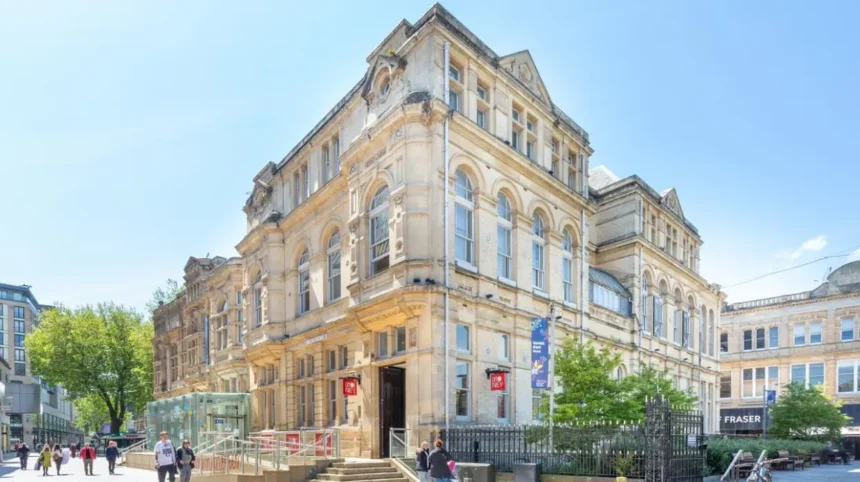
Cardiff’s Old Library was opened on 31 May 1882 as the Cardiff Free Library, Museum and Schools for Science and Art. The building stands at The Hayes and replaced the earlier 1861 library premises with a purpose-built civic institution.
The Old Library is one of the most important surviving physical links with Cardiff’s nineteenth-century library movement.
Cardiff Corporation selected a site at the northern end of The Hayes for a new library. A design competition was held, and the winning architects were James, Seward and Thomas.
Construction cost just over £9,000. The building opened on 31 May 1882 under the name Cardiff Free Library, Museum and Schools for Science and Art. It included an art gallery as well as library and educational facilities.
The opening was a major civic event. The building became an important centre for education and culture as Cardiff expanded during the industrial period.
The library also benefited from donations of books. Cadw records that the Marquess of Bute arranged for books from his extensive private collection at Cardiff Castle to be donated to the library.
The building therefore combined several functions that later became separate institutions.
Why is the Old Library important?
The Old Library represents the transition from Cardiff’s early subscription-based library service to a permanent municipal cultural institution.
The building operated as the city’s principal library for more than a century. It remained the central library building until 1988.
Its later history is also significant. The Royal Welsh College of Music & Drama secured a 99-year lease on the Grade II listed building from Cardiff Council and is developing it as a cultural and educational hub. The redevelopment includes performance, exhibition and community spaces.
The project gives the historic building a new role while retaining its connection with education and public culture.
How did Cardiff Central Library develop from the nineteenth-century library service?
Cardiff Central Library developed from the free library established in 1861, moved into the Old Library in 1882, expanded in 1896 and eventually transferred to a modern building in 1988 before the current Central Library opened in 2009.
The name Cardiff Central Library describes an institution with a much longer history than its current building.
The first library service began in 1861. The Old Library opened in 1882. Fourteen years later, the building received a major extension and was officially reopened as the Central Library by the Prince of Wales on 27 July 1896.
The extension more than doubled the building’s size. The expanded premises provided additional accommodation for a growing library service.
The institution continued to develop as Cardiff’s population increased. Its collections also became more historically significant.
By the twentieth century, Cardiff’s central library had developed substantial Welsh and local-history resources. A research study of Cardiff City and County Library records notes that the library developed extensive newspaper holdings during its early years and collected material from across Wales.
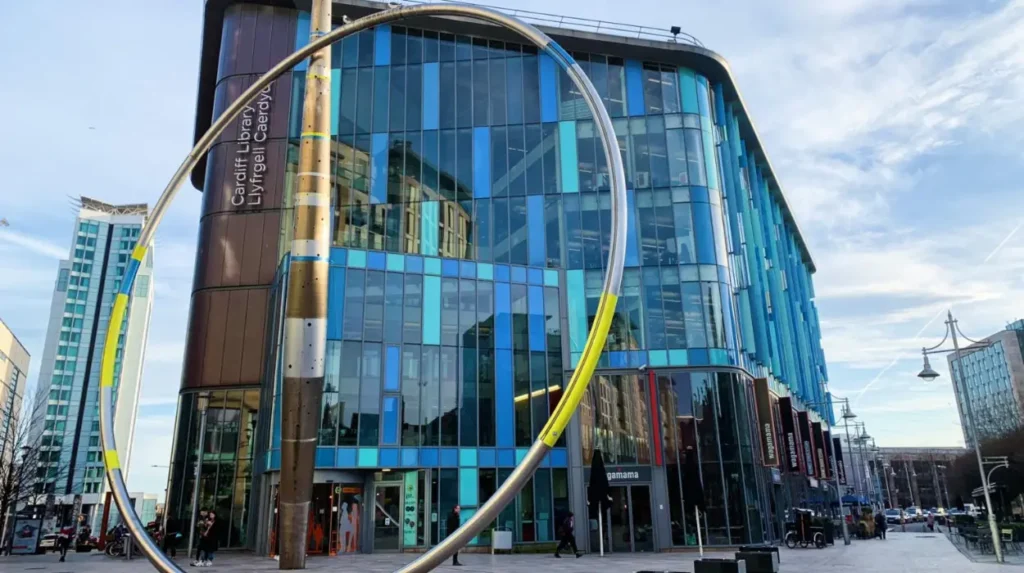
In December 1988, a new Central Library opened in Frederick Street, replacing the Old Library as the city’s principal library building.
The current Central Library building opened in 2009 as part of the redevelopment of Cardiff’s eastern city centre. The institution therefore has a continuous history extending back to the nineteenth century even though its premises have changed.
Which Cardiff libraries date from the Victorian period?
Several Cardiff library services originated during the Victorian period, including the central service founded in 1861 and early branch provision established as the city expanded. The nineteenth-century branches reflected population growth in neighbourhoods such as Cathays, Roath, Canton, Grangetown and Splott.
The growth of branch libraries followed Cardiff’s rapid urban expansion.
Historical records compiled by the Roath Local History Society identify early branch provision in Cathays and Roath in 1889, followed by branches in Canton, Grangetown and the Docks in 1891, and Splottlands in 1894.
These dates are important because the buildings visible today do not always represent the date when a library service first appeared in a neighbourhood.
A branch could begin in a smaller reading room before receiving a purpose-built library building decades later.
This distinction is particularly important when discussing Cardiff’s oldest libraries. The oldest library service and oldest surviving library building are different historical categories.
The 1882 Old Library is a surviving nineteenth-century building. Some branch services began in the 1880s and 1890s, while several purpose-built branch buildings were constructed during the Edwardian period.
What was Cardiff’s first branch library?
Splott received Cardiff’s first local branch library in 1894, extending municipal library provision beyond the central district. The branch reflected Cardiff’s expanding residential areas and the growing demand for convenient access to books, newspapers, reading rooms and educational resources.
Splott became an important part of Cardiff’s early branch-library network.
The opening in 1894 occurred during a period of rapid urban and industrial growth. Cardiff’s population and built-up area were expanding, creating demand for library services closer to residential communities.
Cardiff’s first branch system allowed the central library service to operate across different districts rather than concentrating resources in the city centre.
The original Splott library building no longer functions as the city’s nineteenth-century branch in its original form. The modern STAR Library and Hub provides library services in the area.
The historical importance of Splott therefore lies in its place within the development of neighbourhood-based public library provision.
When did Cardiff University establish its library tradition?
Cardiff University traces its academic library tradition to the foundation of the University College of South Wales and Monmouthshire in 1883. Early university collections developed rapidly, including the important Salisbury Library collection associated with Welsh and Celtic studies.
Cardiff University opened its doors on 24 October 1883 as the University College of South Wales and Monmouthshire.
The institution began with 13 academic staff, 12 departments and 102 full-time degree students alongside 49 part-time students. It was formally established by Royal Charter in 1884.
The new university needed a substantial academic book collection.
One major development involved Enoch Robert Gibbon Salisbury, a Welsh collector whose personal library contained important Welsh studies material. Cardiff scholars and businessmen helped preserve the collection, which became an important part of the university’s library heritage.
The Salisbury Library remains significant within Cardiff University’s Special Collections and Archives.
Today, Cardiff University’s libraries hold more than 1.1 million printed books and provide access to more than 1.5 million online books, journals and other resources.
The modern university library system therefore combines nineteenth-century collections with digital research infrastructure.
What is the Salisbury Library at Cardiff University?
The Salisbury Library is a historic Cardiff University collection associated with Enoch Robert Gibbon Salisbury, a nineteenth-century Welsh book collector. It contains important Welsh studies material and forms part of the university’s wider Special Collections and Archives.
Enoch Robert Gibbon Salisbury lived from 1819 to 1890 and built a substantial personal library focused on Welsh studies and related subjects.
The collection became important to Cardiff University’s early academic development because the university needed books when it opened in 1883.
Cardiff University identifies the Salisbury Library as a major personal library of Welsh studies books. The wider Special Collections service includes rare books, manuscripts, archives, newspapers, maps, photographs and other research materials.
The university’s special collections also contain books dating from the fifteenth century. These materials provide evidence for research into Welsh history, language, culture, science and medicine.
This makes Cardiff’s library heritage broader than municipal libraries. University collections preserve research material that serves specialist historical and academic purposes.
What is the oldest surviving library building in central Cardiff?
The Old Library on The Hayes is the key surviving nineteenth-century library building in central Cardiff. Opened in 1882, it replaced the original 1861 premises and continued as the city’s central library until a new Central Library opened in 1988.
The Old Library is historically distinct from the current Cardiff Central Library.
Its construction followed the rapid development of Cardiff’s first free library. The building was designed specifically for library, museum, science and art functions.
The original 1882 building was later extended. The 1896 extension created a larger Central Library complex and accommodated the growing demands of Cardiff’s population and educational institutions.
The building’s survival gives Cardiff a tangible example of Victorian municipal library architecture.
Its current cultural role also connects its history with modern education and the arts. The Royal Welsh College of Music & Drama is transforming the building into a cultural and educational hub, with Phase One scheduled for completion in autumn 2026.
Which Cardiff libraries were funded by Andrew Carnegie?
Cardiff has several Carnegie library buildings, including Cathays and Canton, built in the early twentieth century. Andrew Carnegie funded public libraries internationally, and his philanthropy helped Cardiff expand permanent neighbourhood library buildings.
Andrew Carnegie was a Scottish-American industrialist and philanthropist who financed thousands of public library buildings internationally.
Cardiff received Carnegie funding during a period when the city was expanding its branch-library infrastructure.
Cathays Library
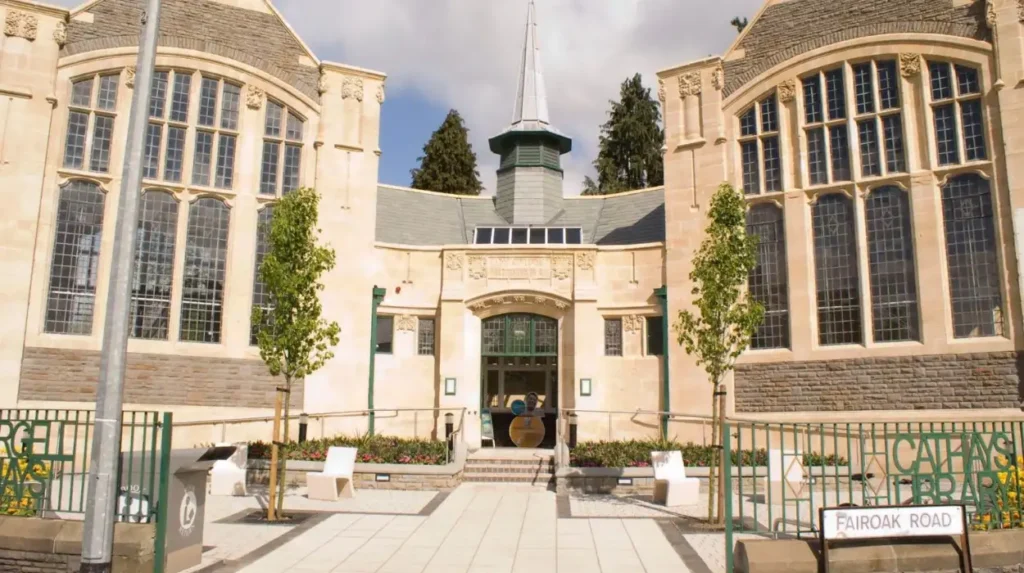
Cathays Library was built in 1906–1907 and designed by Cardiff architects Speir and Bevan. Coflein, the Royal Commission on the Ancient and Historical Monuments of Wales, identifies it as a free public library endowed by Andrew Carnegie.
The building uses an unusual symmetrical butterfly plan. Its central section connects two reading wings, providing separate areas for different library functions.
Cathays Library is Grade II* listed. Its architectural importance is linked to its Arts and Crafts design and unusually well-preserved plan.
Canton Library
Canton Library was also developed with Carnegie support and opened in 1907. It was designed by Cardiff architect R. M. Bruce Vaughan.
The building remains associated with public library provision in Canton. Historical records identify its official opening as 7 March 1907.
Cathays and Canton therefore represent a later phase of Cardiff’s library history than the 1861 central service and the 1882 Old Library.
Why is Cathays Library historically important?
Cathays Library is historically important because its 1906–1907 building combines Carnegie philanthropy, Arts and Crafts architecture and early twentieth-century public library planning. Its Grade II listing recognises its architectural and historic significance.*
The library occupies a prominent site near Cathays Cemetery at the junction of Crwys Road, Whitchurch Road and Fairoak Road.
Coflein describes the building as a symmetrical single-storey Arts and Crafts Gothic library constructed from coursed rock-faced stone with Bath stone dressings and a slate roof.
Its internal arrangement reflects the principles of early twentieth-century public library design.
The building contained a central lending section and reading halls. A separate ladies’ reading room also formed part of the original arrangement.
The design maximised natural light and ventilation through the building’s distinctive plan.
Cathays Library demonstrates how public libraries had evolved from nineteenth-century central institutions into purpose-built neighbourhood facilities.
What happened to Cardiff’s historic library collections?
Cardiff’s historic library collections expanded from newspapers and general reading material into substantial Welsh, local-history and rare-book resources. Important material was transferred, preserved or integrated into specialist institutions as Cardiff’s library network and cultural organisations developed.
The original Cardiff Free Library collected newspapers and periodicals as major parts of its early service.
A doctoral study of Cardiff City and County Library records notes that the library sought material from across Wales and developed significant newspaper holdings. Some material was later transferred to the National Library of Wales.
Cardiff Central Library also developed rare and historical collections.
Cardiff University records that Cardiff City Council built an important collection of Cardiff rare books from the late nineteenth century onwards.
University Special Collections and Archives now provide access to rare books, manuscripts, archives, newspapers, photographs, maps and digitised resources.
These collections are important for local-history research because they preserve evidence that is not available through ordinary modern lending collections.
How can people research Cardiff’s oldest libraries today?
Researchers can investigate Cardiff’s library history through Cardiff Council libraries, Cardiff University’s Special Collections and Archives, Glamorgan Archives, Cadw records and digitised historical collections. These sources preserve buildings, catalogues, newspapers, manuscripts, photographs and institutional records.
Cardiff Council continues to provide public library services across the city. Membership is free, and users can borrow physical books and digital resources and access public computers.
Cathays Library has particular importance for local studies because Cardiff Council’s local studies department operates from the branch.
Cardiff University Special Collections and Archives provide supervised access to rare books, unique archives and manuscripts. Appointments are required for specialist research access.
Glamorgan Archives provides another major source for Cardiff’s local history. Its records include material relating to library buildings, committees, maps and photographs.
Cadw’s historic-environment records provide information about significant surviving buildings, including historic libraries.
Together, these sources allow researchers to study Cardiff libraries through both physical buildings and documentary evidence.
Explore More Area Guide
Biggest Parks in Cardiff Ranked: Bute Park, Roath Park & More
Cardiff’s Historic Bridges: Taff, Ely and Cardiff Bridge
How have Cardiff’s oldest libraries influenced the city’s cultural history?
Cardiff’s oldest libraries helped establish public access to books, newspapers, science, art and education during the city’s industrial expansion. Their legacy continues through municipal libraries, university collections, heritage buildings, archives, digital resources and community learning services.
The 1861 library established a new model of public access to knowledge in Cardiff.
The 1882 Old Library expanded that model into a major civic institution combining library, museum, science and art functions.
The university library tradition beginning in the 1880s created another route to knowledge through higher education and research.
The branch-library movement then brought library services into growing residential districts.
Carnegie-funded buildings such as Cathays and Canton added purpose-built neighbourhood facilities in the early twentieth century.
This development reflects broader changes in Cardiff society. Industrial growth created demand for education, technical knowledge, newspapers and self-directed learning. Libraries provided infrastructure for these activities.
The role continues today. Cardiff Council libraries provide books, eBooks, eAudiobooks, computers, internet access, events and advice services, while Cardiff University’s libraries support advanced research and preserve historic collections.
Why do Cardiff’s oldest libraries still matter today?
Cardiff’s oldest libraries remain important because they connect modern public and academic services with more than 160 years of organised access to knowledge. Historic buildings and collections preserve Cardiff’s civic, educational and cultural development for current and future research.
Cardiff’s public-library story began in 1861 and continues through a modern citywide network.
The historic buildings provide architectural evidence of changing ideas about education and public access. The collections provide documentary evidence about Cardiff, Wales and wider society.
The Old Library illustrates Victorian civic ambition. Cardiff University’s Salisbury collection represents nineteenth-century academic development. Cathays and Canton illustrate the early twentieth-century expansion of neighbourhood library services.
The present library system adds digital access to this historical foundation. Cardiff residents can access electronic books, audiobooks, newspapers and other resources alongside physical collections.
Cardiff’s oldest libraries are therefore not only heritage subjects. They are part of a continuous information infrastructure that began in the nineteenth century and has adapted to changing technologies, educational needs and community requirements.
The central historical sequence is clear: Cardiff established its first public library in 1861, opened the Old Library in 1882, developed university library collections from 1883, expanded branch services during the late nineteenth century and built significant Carnegie libraries in the early twentieth century.
That sequence explains why Cardiff has one of the most distinctive library histories in Wales.
What is the oldest library in Cardiff?
The oldest public library service in Cardiff dates to 1861, when a free library opened above the St Mary Street entrance to the Royal Arcade. Cardiff became the first town in Wales to establish a public library through the Victorian public-library movement.