Cardiff has an extensive network of public playgrounds, play areas and recreation spaces distributed across established neighbourhoods and newer residential districts. Cardiff Council maintains an official directory of parks and play areas, while individual regeneration projects continue to upgrade facilities across the city.
- Which Cardiff areas have the most playgrounds?
- Why does Cardiff have so many separate playgrounds?
- Which areas have the highest concentration of playgrounds in north Cardiff?
- Which Cardiff areas have the most playgrounds in the east?
- Which Cardiff neighbourhoods have the most playgrounds in the west?
- Why is Victoria Park one of Cardiff’s best playground areas?
- Which Cardiff areas are best for multiple playground choices?
- Why is Butetown significant for playground access?
- How do Cardiff playgrounds support different ages and abilities?
- How does Cardiff maintain and improve its playground network?
- Which Cardiff parks are important for family playground access?
- How should families compare playground areas in Cardiff?
- What does Cardiff’s playground distribution mean for future family life?
The distribution is not uniform. Some neighbourhoods contain several separate playgrounds within a relatively small area. Others rely on one larger destination playground serving surrounding streets. Llanishen, Butetown, Fairwater, Splott, Victoria Park and the wider Canton area, Pentwyn, Trowbridge, Whitchurch and Llanrumney stand out because of their concentration of children’s play provision and larger recreation spaces.
Cardiff’s demographic profile also makes playground provision important. The 2021 Census recorded about 362,400 usual residents in Cardiff, making it Wales’s largest local authority by population. The population increased by 4.7% between 2011 and 2021, while the number of children aged under 15 increased by 5.3%.
Playgrounds therefore form part of Cardiff’s wider network of parks, green spaces, children’s services and community facilities.
Which Cardiff areas have the most playgrounds?
Llanishen, Butetown, Fairwater, Splott, Pentwyn, Trowbridge, Canton, Llanrumney and Whitchurch contain some of Cardiff’s strongest concentrations of public play areas. These neighbourhoods combine multiple local playgrounds with larger parks, recreation grounds or recently improved facilities serving different age groups.
Cardiff Council’s published information provides a useful picture of how widely play areas are distributed. A council list published during the 2020 reopening programme identified 107 play areas across Cardiff. The list included separate toddler and junior facilities at several locations, such as Victoria Park, Schooner Way, Hailey Park, Bryn Glas, St Martin’s Crescent, Cemaes Crescent and Whitchurch Library Gardens.
The number should not be treated as a permanent current total because playgrounds are replaced, refurbished, relocated or newly constructed. Cardiff Council continues to operate a searchable parks and play-area service.
The strongest concentrations occur where Cardiff has large residential populations, substantial public open space and established recreation grounds.
Llanishen is particularly notable because its historic play provision includes Llanishen Park, Bryn Glas, Heol y Barcud, Parkland/Thornhill Recreation Ground, St Martin’s Crescent and Watkin’s Square.
Butetown also has a high concentration relative to its compact urban footprint. The council’s published list included Belmont Walk, Britannia Park, Canal Park, Craiglee Drive, Hamadryad Park, Hodges Square, Loudoun Square, Schooner Way Junior, Schooner Way Toddler and Windsor Esplanade.
These examples show that playground density depends on both the number of facilities and the geographical size of the neighbourhood.
Why does Cardiff have so many separate playgrounds?
Cardiff’s playground network developed through parks, housing estates, recreation grounds, regeneration schemes and residential development. Local facilities provide everyday play close to homes, while larger destination parks offer wider recreation, landscaped spaces and equipment for different age groups.
Cardiff Council’s parks service covers parks and green spaces throughout the city and provides a dedicated search function for parks and play areas.
The structure reflects Cardiff’s urban development. Older neighbourhoods developed around Victorian and Edwardian parks. Later housing estates added smaller recreation grounds and local play areas. More recent developments have incorporated open space and children’s facilities through planning and infrastructure arrangements.
The planning system also contributes. Cardiff Council documentation states that Section 106 planning agreements can secure contributions towards playgrounds and play areas from residential development. For larger developments, developer contributions can fund new playgrounds after specified occupancy thresholds are reached, with remaining funds also available for future refurbishment subject to agreement conditions.
This creates a continuing mechanism for expanding or improving play provision as neighbourhoods change.
Cardiff’s Play Sufficiency Assessment also informs investment in children’s play. Council documents record funding bids for projects including a durable playground at College Road and a new play area at Caerau Hill/Heol Trelai.
The result is a layered network rather than a single city-centre playground system.
Which areas have the highest concentration of playgrounds in north Cardiff?
Llanishen has one of the clearest concentrations of playground provision in north Cardiff, supported by Llanishen Park, Bryn Glas, Heol y Barcud, Parkland/Thornhill Recreation Ground, St Martin’s Crescent and Watkin’s Square. Nearby Rhiwbina, Heath and Lisvane add further facilities.
Llanishen’s concentration is closely connected with its residential geography. The neighbourhood contains several established housing areas and substantial public open space.
The council’s published play-area list included:
- Bryn Glas Junior
- Bryn Glas Toddler
- Heol y Barcud
- Llanishen Park
- Parkland/Thornhill Recreation Ground
- St Martin’s Crescent Toddler
- St Martin’s Crescent Junior
- Watkin’s Square
This makes Llanishen one of the most useful areas for families seeking multiple playground choices within one part of Cardiff.
Llanishen Park has also received significant improvement work. Cardiff Council documentation describes a redesigned play area positioned on higher ground, equipment for toddlers and junior children, balancing equipment and an assault-course-style section, alongside drainage improvements.
The work addressed an important practical issue. The former play area and parts of the park experienced surface-water flooding, which affected usability. The redesigned site incorporated drainage and landscape measures.
Nearby Rhiwbina also contributes to north Cardiff’s playground network through Heol Llanishen Fach. Lisvane has facilities including Heol y Delyn and Mill Heath Drive. Heath Park adds another substantial green-space setting.
The wider northern sector therefore offers both small neighbourhood play areas and larger park-based facilities.
Which Cardiff areas have the most playgrounds in the east?
Eastern Cardiff has extensive playground provision across Splott, Tremorfa, Trowbridge, Llanrumney, Pentwyn, Pontprennau and St Mellons. These areas contain local play spaces alongside larger parks and recreation grounds serving established and expanding residential communities.
The eastern side of Cardiff contains a particularly broad distribution of play facilities.
The council’s published list identified multiple facilities in Splott, including Beaufort Square, Horwood Close, Moorland Library Gardens, Runway Road, Splott Park and Tremorfa Park.
Splott Park is especially significant following its recent redevelopment.
The upgraded playground reopened in July 2025 with a games-and-puzzles theme. It includes equipment for toddlers, juniors and teenagers, accessible play equipment and natural play spaces. A wheelchair-accessible roundabout, climbing equipment, swings, seesaw, slide and climbing mound form part of the redesigned environment.
The project also incorporates local industrial history. Its toddler train references Jessie, a 1937 0-6-0 saddle-tank steam locomotive that served at Cardiff’s East Moors steelworks.
Trowbridge also has several play facilities, including Cemaes Crescent toddler and junior areas, Coleford Drive, Heol Maes Eirwg and Heritage Park. Llanrumney includes Rumney Recreation Ground and Sedgemoor Road, while Pentwyn contains Coed y Gores, Chapelwood, Glenwood, Parc Coed y Nant and Waun Fach.
This distribution makes eastern Cardiff particularly strong for neighbourhood-level access to playgrounds.
Which Cardiff neighbourhoods have the most playgrounds in the west?
Western Cardiff has strong playground provision across Fairwater, Ely, Caerau, Canton, Llandaff, Llandaff North, Riverside and Whitchurch. Large parks such as Victoria Park and Hailey Park complement smaller local play spaces distributed through residential neighbourhoods.
Fairwater is one of the stronger western clusters. The council’s published list included Beechley Road, Chorley Close, Fairwater Park, Rosedale and Whitland Crescent.
Fairwater Park provides a larger green-space setting, while smaller facilities distribute play opportunities closer to residential streets.
Ely also has several facilities, including Green Farm Road and separate Wilson Road toddler and junior areas. Caerau has facilities such as Emblem Close, Emerson Close, Heol Homfrey, Heol Trelai, Trelai Park and Treseder Park.
Whitchurch and Tongwynlais also contain several play areas. The council list includes Heol Booker, Hollybush, Ironbridge Road and separate toddler and junior areas at Whitchurch Library Gardens.
This distribution is important because western Cardiff contains a mixture of dense residential areas, established villages and large green corridors.
Why is Victoria Park one of Cardiff’s best playground areas?
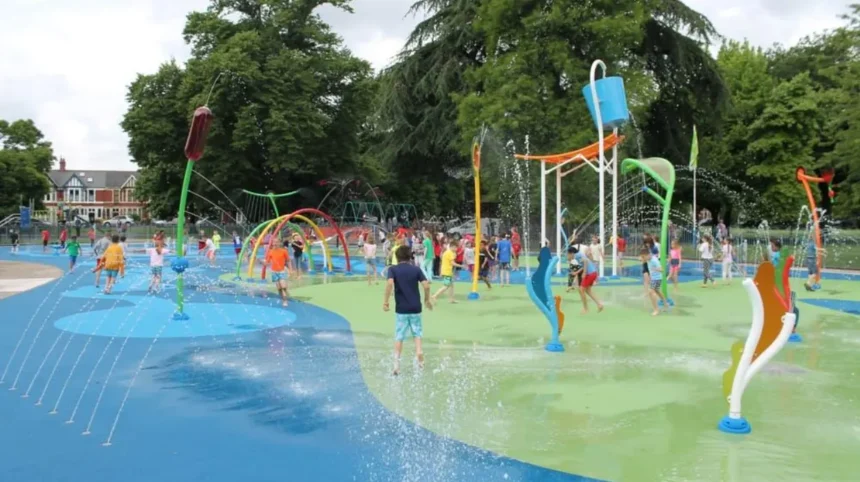
Victoria Park in Canton provides dedicated children’s playgrounds for younger and older children, a seasonal splash play area, toilets, baby-changing facilities, tennis courts and a multi-use games area, creating one of Cardiff’s most comprehensive family recreation destinations.
Victoria Park is one of Cardiff’s best-known urban parks.
Outdoor Cardiff states that its children’s playground caters for children up to approximately 12 years old. The park also has a seasonal splash play area, multi-use games area, tennis courts, refreshment facilities and public toilets with baby-changing facilities.
The splashpad contains 33 features and occupies the site of the former paddling pool. It provides a dedicated water-play component during the seasonal operating period.
The park therefore serves several recreational needs in one location.
Visit Wales also identifies Victoria Park as a Green Flag Award park and specifically highlights playgrounds for younger and older children and the summer splash pad.
The wider Canton area adds other play opportunities, including Jubilee Park and Sanatorium Road, alongside Victoria Park’s dedicated toddler and junior facilities listed by Cardiff Council.
Victoria Park is therefore important not simply because it has playground equipment, but because it combines children’s play with wider park infrastructure.
Which Cardiff areas are best for multiple playground choices?
Families seeking several playground choices should focus on neighbourhoods with multiple council-listed play areas, including Llanishen, Butetown, Splott, Pentwyn, Fairwater, Trowbridge and Caerau. These districts provide alternatives when equipment, age suitability or park conditions differ between locations.
Multiple playgrounds provide practical choice.
A toddler requires different equipment from an older child. A teenager needs different recreational infrastructure from a preschool child. Separate facilities allow neighbourhoods to serve these age groups more effectively.
Llanishen demonstrates this model through separate toddler and junior areas at Bryn Glas and St Martin’s Crescent, combined with larger park facilities.
Butetown also demonstrates the model through Schooner Way’s separate toddler and junior playgrounds and additional local facilities across the neighbourhood.
Splott has a combination of small local sites and larger facilities at Splott Park and Tremorfa Park. The redevelopment of Splott Park specifically expanded inclusive provision across age groups.
Trowbridge similarly combines separate toddler and junior facilities at Cemaes Crescent with other neighbourhood play areas.
This model supports a key principle of local play provision: playground access does not depend entirely on travelling to one major destination.
Why is Butetown significant for playground access?
Butetown has an unusually dense network of small public play spaces because of its compact residential geography and extensive redevelopment history. Facilities include Belmont Walk, Britannia Park, Canal Park, Hamadryad Park, Loudoun Square and separate Schooner Way toddler and junior areas.
Butetown occupies a relatively compact area close to Cardiff Bay and the city centre.
The council’s published play-area list records numerous facilities within the neighbourhood. These include Belmont Walk, Britannia Park, Canal Park, Craiglee Drive, Hamadryad Park, Hodges Square, Loudoun Square, Schooner Way Junior, Schooner Way Toddler and Windsor Esplanade.
The concentration is important in an urban environment where private gardens and large residential plots are less common than in lower-density suburban neighbourhoods.
Local playgrounds therefore provide accessible outdoor recreation within walking distance of residential communities.
The neighbourhood’s facilities also illustrate how Cardiff’s playground network operates at different scales. Some are small local spaces, while others form part of larger parks or waterfront environments.
How do Cardiff playgrounds support different ages and abilities?
Cardiff’s modern playground programme increasingly separates equipment by age while adding inclusive and natural play features. Recent projects demonstrate provision for toddlers, juniors, teenagers and children with access requirements through accessible equipment, varied surfaces and redesigned play environments.
Age-appropriate design is a major feature of Cardiff’s playground network.
The council’s published list distinguishes between toddler and junior facilities at locations including Victoria Park, Schooner Way, Hailey Park, Bryn Glas, St Martin’s Crescent, Cemaes Crescent and Whitchurch Library Gardens.
Newer projects increasingly use inclusive design.
Splott Park’s 2025 redevelopment includes accessible play equipment and natural play areas alongside equipment for toddlers, juniors and teenagers.
Natural play incorporates landscape elements and non-traditional play features. These environments complement conventional swings, slides, climbing frames and roundabouts.
Llanishen Park’s improvement programme also demonstrates this broader approach. The redesigned play area combines toddler and junior equipment with balancing beams and other physical challenges.
The result is a shift from a single standard playground model towards more varied recreational environments.
How does Cardiff maintain and improve its playground network?
Cardiff Council maintains playgrounds through routine parks management, safety inspections, refurbishment programmes and regeneration investment. New schemes use council funding, government funding, planning contributions and local priorities to replace ageing equipment and improve accessibility.
Playground infrastructure requires continuous maintenance because equipment, surfacing, fencing and drainage deteriorate through weather, heavy use and vandalism.
Cardiff Council provides a dedicated process for reporting problems in parks and green spaces.
The council also uses capital programmes and regeneration schemes to replace or refurbish play areas.
A Cardiff Council parks programme reported that, during one programme period, two new play areas were built, six play areas were reconstructed to replace existing play spaces and two were refurbished. Projects included Llanishen Park, Maindy Park, Cemetery Play Area, Brewery Park, Heol Llanishen Fach and Maltings Park Natural Play Area.
This demonstrates that playground provision is not static.
The 2025 Splott redevelopment provides a more recent example. It was funded through Cardiff’s Neighbourhood Renewal Scheme with support from the UK Government’s Shared Prosperity Fund and local funding.
Such programmes help maintain play quality as neighbourhood populations and expectations change.
Which Cardiff parks are important for family playground access?
Important family parks include Victoria Park, Roath Park, Bute Park, Hailey Park, Llanishen Park, Splott Park and Llandaff Fields. They combine children’s play or activity opportunities with larger green spaces, paths, sports facilities or nature-based recreation.
Several major Cardiff parks operate as destinations rather than simple local playgrounds.
Victoria Park provides playgrounds and a splashpad.
Roath Park provides a prominent children’s play area alongside the lake and wider park environment. Visit Wales specifically highlights the park’s giant slide as a well-known children’s feature.
Bute Park is another major family destination. Visit Wales describes it as a Green Flag Award-winning park with open fields, trees, nature trails and story trails behind Cardiff Castle.
Hailey Park in Llandaff North contains both a toddler play area and a children’s play area. The approximately 19-hectare park also includes playing fields, tennis courts, the Taff Trail and wildlife areas.
Llanishen Park provides another example of a park where children’s play forms part of a wider landscape and drainage improvement programme.
Splott Park now combines its redesigned playground with broader sports and recreation infrastructure.
These parks provide different experiences while remaining part of Cardiff’s connected public-space network.
Explore More Area Guide
Quiet Family Areas to Raise Children in Cardiff 2026
Best Family Picnic Locations in Cardiff 2026
How should families compare playground areas in Cardiff?
Families should compare playground areas by number of facilities, age suitability, accessibility, park size, additional recreation, walking access and current condition. Official Cardiff Council information provides the strongest starting point because playground status and facilities change through refurbishment and regeneration.
The largest number of playgrounds does not automatically mean the best provision for every family.
Parents with toddlers should check whether an area has dedicated toddler equipment. Families with older children should look for junior or teenage equipment. Accessibility is another important consideration, particularly where playgrounds have accessible roundabouts, inclusive equipment or step-free routes.
The surrounding park also matters.
Victoria Park offers playgrounds, splash play, toilets and other recreation. Hailey Park provides play areas alongside the Taff Trail and large open spaces. Splott Park combines inclusive play with other recreation facilities. Llanishen Park combines play with nature trails and landscape improvements.
Families should also check current information before travelling. Cardiff Council maintains its online parks and play-area directory and provides a facility for reporting problems.
This is particularly important because playgrounds can temporarily close for maintenance, safety work or redevelopment.
What does Cardiff’s playground distribution mean for future family life?
Cardiff’s growing population, expanding residential areas and continuing park investment make playground provision an important part of urban planning. New developments, regeneration funding and play-sufficiency planning will continue shaping where new and improved children’s play facilities appear.
Cardiff’s population reached approximately 362,400 in the 2021 Census, representing 4.7% growth since 2011. The under-15 population increased by 5.3% during the same period.
That demographic change increases the importance of accessible children’s recreation.
Planning policy also connects new residential development with infrastructure requirements. Cardiff Council’s planning documentation identifies playground provision as part of wider infrastructure planning, while Section 106 agreements provide a mechanism for securing contributions from developers.
The future network therefore depends on both existing parks and new development.
Recent projects demonstrate the direction of travel. Splott Park has added inclusive and natural play. Llanishen Park has received redesigned play facilities and drainage improvements. Council programmes have also delivered new and refurbished play areas across different parts of Cardiff.
For families comparing Cardiff neighbourhoods, playground density is therefore a useful indicator of local recreational infrastructure. Areas such as Llanishen, Butetown, Splott, Pentwyn, Fairwater, Trowbridge, Caerau, Canton, Llanrumney and Whitchurch provide particularly strong examples of neighbourhood-level play provision.
Cardiff’s playground network is ultimately defined by more than the number of swings and slides. It combines small local play spaces, dedicated toddler and junior areas, large destination parks, inclusive equipment, natural play, sports facilities and ongoing regeneration.
The most reliable way to assess a specific location is to combine the neighbourhood’s playground concentration with Cardiff Council’s current parks directory, because individual facilities change as new projects are completed and older play areas are refurbished.
Which Cardiff area has the most playgrounds?
Llanishen is one of Cardiff’s strongest areas for playground provision. Its facilities include Llanishen Park, Bryn Glas, Heol y Barcud, St Martin’s Crescent and Watkin’s Square.