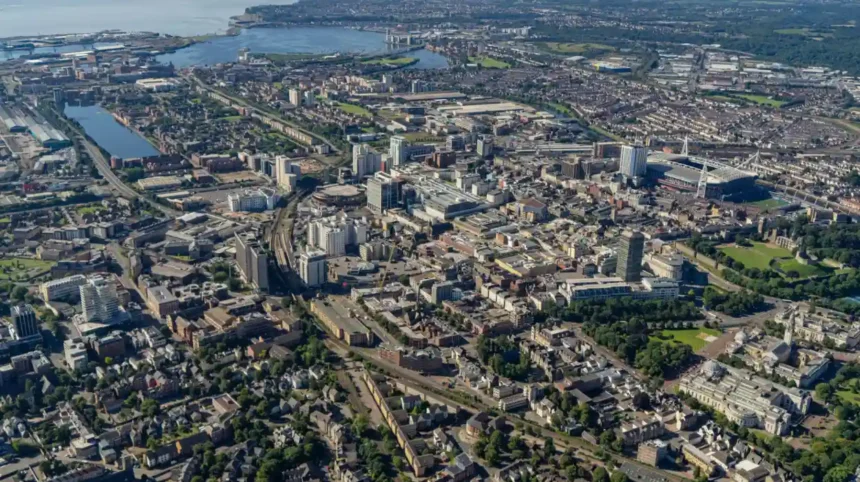
The population of Cardiff expanded from 6,040 residents in 1801 to over 362,300 residents in the 2021 Census, reaching an estimated 391,495 residents in 2026 due to industrial maritime expansion, capital status, and international net migration.
- What Factors Drove the Historical Demographic Spurt in Cardiff?
- What Are the Key Drivers of Population Growth in Cardiff Today?
- How Does Internal Migration Affect the Local Population in Cardiff?
- What Are the Current Demographics of Cardiff?
- How Diverse Is the Language Landscape in Cardiff?
- How Does Population Density Vary Across Cardiff Electoral Wards?
- How Does Population Growth Impact Housing and Infrastructure in Cardiff?
- What Role Does the Cardiff Local Development Plan Play in Managing Growth?
- How Does Cardiff Compare to Other Cities in Wales and the UK?
- What Are the Future Population Projections for Cardiff?
Cardiff transformed from a minor medieval market town into the industrial capital of Wales through rapid nineteenth-century economic expansion. The opening of the Glamorganshire Canal in 1798 and the construction of the Bute West Dock in 1839 established the city as the primary port for global coal exports from the South Wales Valleys. Coal shipment operations brought tens of thousands of workers to the city during the nineteenth and early twentieth centuries.
By 1911, the population of Cardiff reached 182,210 residents. The city experienced steady mid-twentieth-century growth, followed by economic transition as industrial coal exporting declined after the Second World War. Formal designation as the capital city of Wales in 1955 stabilized the regional economy and catalyzed public sector institutional growth.
Decennial censuses administered by the Office for National Statistics reveal consistent modern expansion. The population grew from 310,088 in 2001 to 346,100 in 2011, representing an 11.6 percent increase over that decade. Between 2011 and 2021, the population of Cardiff grew by 4.7 percent, adding roughly 16,200 residents. The total population reached 362,300 in 2021. Estimates from the Office for National Statistics and World Population Review project the city proper population at 391,495 in 2026, while the broader Cardiff Capital Region encompasses 1.5 million people.
What Factors Drove the Historical Demographic Spurt in Cardiff?
Industrialization dictated nineteenth-century migration patterns into South Wales. The development of ironworks in Merthyr Tydfil and coal mining across the Rhondda Valley required a deep-water shipping terminal. Lord Bute financed extensive dock developments that turned Cardiff into the busiest coal port in the world by 1913.
Labor demand attracted workers from three specific geographic regions: West Wales, Western England, and international maritime hubs. Irish laborers migrated to Cardiff following the Great Famine of 1845. English rural workers migrated from Somerset, Devon, and Gloucestershire. Seamen settled around the docklands, founding the multicultural community of Butetown.

What Are the Key Drivers of Population Growth in Cardiff Today?
Modern population growth in Cardiff relies on international net inward migration, higher natural change relative to surrounding authorities, and substantial student retention driven by major higher education institutions like Cardiff University, Cardiff Metropolitan University, and the University of South Wales.
Net inward migration serves as the primary engine for local demographic expansion. The Office for National Statistics identifies net international migration as the largest single contributor to population gains in Cardiff since 2011. The city attracts international workers in healthcare, technology, and civil service, alongside refugee settlement programs and family reunifications.
Natural change, defined as total births minus total deaths, continues to add positive net numbers to the city. Cardiff maintains a younger average age demographic than surrounding local authorities in Wales, resulting in higher birth rates relative to mortality rates.
Higher education draws thousands of young adults into the urban core annually. Cardiff University, Cardiff Metropolitan University, and the University of South Wales enroll a combined student body exceeding 45,000 students. Graduate retention rates show that a significant percentage of international and UK-domiciled students remain in Cardiff post-graduation to enter the local labor market.
How Does Internal Migration Affect the Local Population in Cardiff?
Internal migration patterns show consistent population exchange between Cardiff, surrounding Welsh local authorities, and major English cities. Young professionals aged 22 to 30 move to Cardiff from rural Welsh counties for career opportunities in finance, public administration, and creative industries.
Conversely, middle-aged adults aged 35 to 49 and young children show net outward internal migration from Cardiff to adjacent local authorities. The Vale of Glamorgan, Rhondda Cynon Taf, and Newport record net migration gains from former Cardiff residents seeking lower housing density.
What Are the Current Demographics of Cardiff?
The median age in Cardiff is 34 years, making it the youngest local authority population in Wales, while ethnic minorities account for over 20 percent of residents, including Asian, Black, Arab, and mixed-ethnic populations.
Age distribution data from the 2021 Census confirms Cardiff as an exceptionally young urban area. The median age of 34 years compares directly to the broader Welsh national median age of 42 years. Residents aged 15 to 29 make up nearly 25 percent of the total population, driven by the higher education sector. The population aged 65 and older represents 14.8 percent of residents, which is significantly lower than the Welsh national average of 21.3 percent.
Ethnicity data from the Office for National Statistics demonstrates high cultural diversity. White ethnic groups constitute 79.2 percent of the population. Asian ethnic groups represent 9.7 percent of residents, with Pakistani, Indian, and Bangladeshi communities forming the largest subgroups. Black, African, and Caribbean populations account for 3.8 percent. Arab residents account for 3.3 percent. Mixed-ethnic background individuals comprise 4.0 percent of the urban population.
Religious affiliation data shows that 42.9 percent of residents report no religion. Christianity accounts for 38.3 percent of the population. Islam represents 9.3 percent of the population. Hinduism represents 1.5 percent.
How Diverse Is the Language Landscape in Cardiff?
Language data indicates that English is the primary spoken language for 91.5 percent of residents aged three and older. Welsh language proficiency has increased within the city authority boundaries.
The 2021 Census shows that 12.2 percent of Cardiff residents speak, read, or write Welsh, up from 11.1 percent in 2011. This shift represents the largest percentage point increase in Welsh language speakers among all 22 local authorities in Wales. Over 41,000 residents speak Welsh natively or fluently within Cardiff.
How Does Population Density Vary Across Cardiff Electoral Wards?
Population density in Cardiff averages 2,572 persons per square kilometer across the local authority, ranging from dense urban wards like Cathays and Plasnewydd to low-density suburban wards like Pontprennau and Pentyrch.
Urban geography creates variable density across the 28 electoral wards of the City and County of Cardiff. High-density wards surround the central business district and university campuses. Cathays and Plasnewydd record densities exceeding 8,000 persons per square kilometer, influenced by high-density terraced housing stock and purpose-built student accommodations.
Suburban residential wards in the outer north and west show moderate density levels. Wards such as Whitchurch, Rhiwbina, and Radyr average between 2,500 and 4,000 persons per square kilometer, characterized by semi-detached and detached single-family housing developments.
Rural and semi-rural peripheral wards display the lowest population density. Pentyrch and Creigiau maintain densities below 500 persons per square kilometer, containing substantial agricultural land, forest areas, and protected greenbelt zones.
Which Electoral Wards Are Experiencing the Highest Growth Rates?
Cardiff Council administrative data identifies three specific growth centers within the county boundaries:
- Cathays and Central: High-density apartment developments, student residential towers, and brownfield site conversions in the city center drive growth.
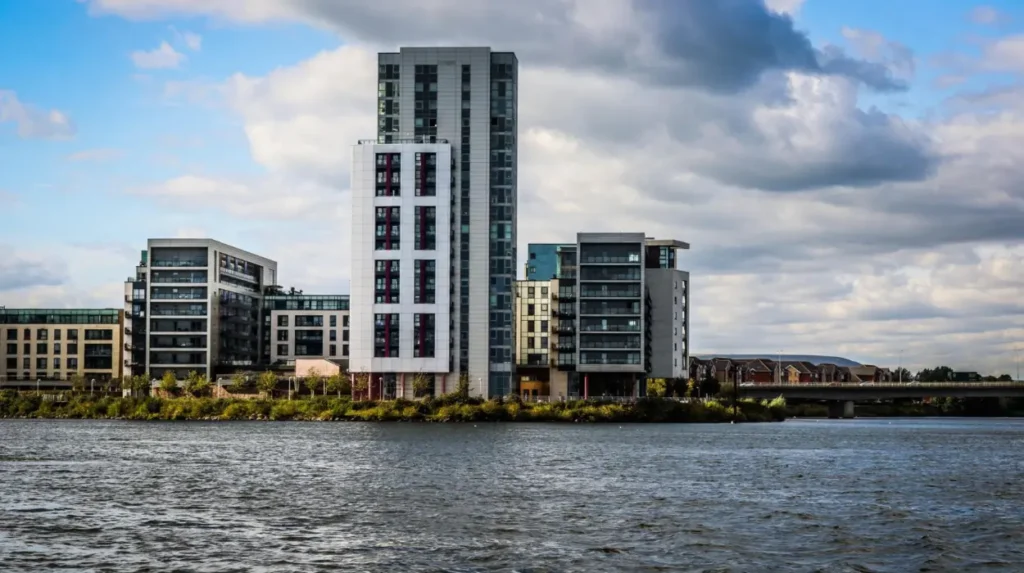
- Butetown and Cardiff Bay: Waterfront brownfield redevelopments, high-density residential towers, and dockland urban renewals contribute to population expansion.
- Pontprennau and Old St. Mellons: Large-scale greenfield housing allocations under the Local Development Plan generate high suburban population growth.
How Does Population Growth Impact Housing and Infrastructure in Cardiff?
Rapid population growth increases housing demand, pushes average property prices upward, strains public transit systems, and necessitates major capital investments like the South Wales Metro and the Cardiff Local Development Plan.
Housing supply represents a critical planning challenge for Cardiff Council. The adopted Local Development Plan identified a requirement for 41,415 new dwellings between 2006 and 2026 to accommodate population expansion. Property prices increased by over 48 percent between 2014 and 2024, raising average house prices in Cardiff to over £260,000. Rental affordability has tightened as private rental yields attract investors while market supply remains constrained.
Transportation infrastructure experiences operational capacity limits during peak travel periods. Highways like the A48, A4232, and M4 Junction 33 experience regular congestion. The South Wales Metro project, managed by Transport for Wales, addresses these issues through electrifying core valley lines, constructing new railway stations, and introducing higher-frequency tram-train services to Cardiff Central and Queen Street stations.
Healthcare and educational infrastructure face capacity pressures. Primary care services under the Cardiff and Vale University Health Board report higher patient-to-general-practitioner ratios in rapid-growth wards. School place allocations in northeast and northwest expansion areas require the construction of new primary and secondary educational facilities under the Welsh Government’s Sustainable Communities for Learning Program.
Explore more Area Guide
Oldest Churches in Llandaff: History, Saints and Cathedral
St Teilo’s Church in Wales High School Cardiff: Complete Guide for Parents and Students
What Role Does the Cardiff Local Development Plan Play in Managing Growth?
The Cardiff Local Development Plan provides the statutory planning framework for managing spatial growth. The plan designates strategic housing sites across the authority to deliver infrastructure alongside residential units.
Key strategic housing sites include Strategic Site A (North West Cardiff) for up to 5,000 homes, Strategic Site C (East of Pontprennau) for up to 4,000 homes, and Strategic Site F (Clwyd Augmentation / Gasworks site) for high-density urban residential regeneration.
How Does Cardiff Compare to Other Cities in Wales and the UK?
Cardiff is the largest city in Wales and ranks as the eleventh-largest city in the United Kingdom, exhibiting higher percentage population growth than Swansea, Newport, or the Welsh national average.
Demographic comparisons demonstrate Cardiff’s status as the principal economic driver of Wales. Between 2011 and 2021, Cardiff grew by 4.7 percent. During the same period, the total population of Wales grew by just 1.4 percent. Swansea experienced a population contraction of 0.2 percent, while Newport recorded a 9.5 percent population increase due to its proximity to the English border and Bristol commuter zones.
Among core UK regional capitals, Cardiff displays similar demographic trends to mid-sized English core cities. Bristol grew by 10.3 percent between 2011 and 2021, driven by technology and finance sectors. Manchester grew by 9.7 percent, while Leeds expanded by 3.6 percent over the same decade.
Cardiff generates roughly 20 percent of total Welsh Gross Value Added (GVA). The concentration of financial services, creative media at BBC Wales headquarters, public administration, and life sciences firms attracts skilled workers from across the UK.
What Is the Demographic Role of the Cardiff Capital Region?
The Cardiff Capital Region represents an economic combination of 10 South Wales local authorities: Cardiff, Newport, Vale of Glamorgan, Bridgend, Rhondda Cynon Taf, Merthyr Tydfil, Caerphilly, Blaenau Gwent, Torfaen, and Monmouthshire.
The region accounts for 1.5 million people, representing nearly 50 percent of the total population of Wales. Cardiff serves as the employment hub for this region, with over 80,000 commuters entering the city daily for work prior to remote work shifts.
What Are the Future Population Projections for Cardiff?
Official projections indicate that Cardiff will grow by an additional 8 to 12 percent over the next fifteen years, reaching approximately 415,000 residents by 2040.
Projections published by the Welsh Government and the Office for National Statistics anticipate continuous long-term population growth for Cardiff. Baseline population models estimate that the county population will reach 400,000 residents between 2030 and 2032, driven primarily by net international migration and internal natural increase.
Aging trends will alter the city’s internal demographic structure by 2040. Although Cardiff will remain younger than rural Welsh counties, the cohort of residents aged 65 and over will expand by over 22 percent. This shift requires social care facilities, accessible public housing, and specialized healthcare delivery systems.
Economic shifts toward green technology, digital industries, and advanced services will influence population retention. The Replacement Local Development Plan (2021–2036) accounts for potential population growth scenarios, guiding land allocations for employment, green spaces, transport hubs, and residential developments across the capital city.
What is the current population of Cardiff?
As of 2026 projections from the Office for National Statistics and World Population Review, the population of Cardiff proper is estimated at 391,495 residents. The broader Cardiff Capital Region encompasses approximately 1.5 million people.