Cardiff has one of the most compact retail centres in Wales, with major shopping streets, indoor arcades, markets and shopping centres concentrated within a relatively small central area. The city’s pedestrianised streets and connected arcades make it possible to combine high-street shopping, independent retail, food, heritage and major attractions in one walking trip.
- What makes Cardiff one of the easiest Welsh cities to explore on foot?
- Which Cardiff shopping area is best for high-street shopping?
- Why is The Hayes one of Cardiff’s best walkable shopping areas?
- What can shoppers find around St David’s Dewi Sant?
- Why should shoppers explore Cardiff’s historic arcades?
- When was Cardiff’s first shopping arcade built?
- What makes Morgan Arcade important for walkable shopping?
- What is the Castle Quarter and why is it easy to explore on foot?
- How does Cardiff Market fit into a walkable shopping route?
- Which shopping streets are best for combining retail with Cardiff attractions?
- How walkable is Cardiff for visitors arriving by train?
- How accessible are Cardiff’s walkable shopping areas?
- How are Cardiff’s pedestrian shopping routes changing?
- What is the best walking route through Cardiff’s main shopping areas?
- Why are Cardiff’s shopping areas particularly suitable for a car-free shopping day?
- Which Cardiff shopping area is best for different types of shoppers?
- What should visitors know before exploring Cardiff’s shopping areas on foot?
- What is the overall significance of Cardiff’s walkable shopping areas?
The strongest walkable shopping areas include Queen Street, The Hayes, St Mary Street, Cardiff’s historic arcades, High Street and Castle Quarter, and the St David’s Dewi Sant area. These districts overlap rather than operating as isolated shopping destinations. That compact layout is a major reason Cardiff city centre works well for visitors who prefer to explore on foot.
Visit Cardiff describes the majority of central shopping as being close together and pedestrianised. Cardiff Council also identifies numerous central pedestrian routes as part of its priority footpath network, including Queen Street, High Street, The Hayes, St Mary Street, Trinity Street and Working Street.
What makes Cardiff one of the easiest Welsh cities to explore on foot?
Cardiff’s central retail district combines pedestrianised streets, covered arcades, shopping centres, markets and nearby attractions within a compact area, allowing shoppers to move between destinations without relying on a car or long-distance public transport.
The structure of Cardiff city centre is particularly suitable for walking because several important retail destinations sit close to one another.
Queen Street provides a major pedestrian shopping route. The Hayes connects directly with St David’s Dewi Sant, Cardiff Market, Central Library and the historic arcades. St Mary Street provides access to additional arcades, restaurants and the southern part of the central retail district.
The city’s historic arcades strengthen this network. Royal Arcade, Morgan Arcade, Wyndham Arcade, Castle Arcade, High Street Arcade and Duke Street Arcade create covered pedestrian routes between major streets.
This arrangement gives Cardiff shopping a distinct urban structure. A visitor can start near Cardiff Central Station, walk towards St Mary Street, explore an arcade, continue towards The Hayes, enter St David’s Dewi Sant, cross towards Queen Street and finish near Cardiff Queen Street railway station.
Cardiff Council’s winter maintenance network specifically identifies many of these streets as high-priority pedestrian routes because of their footfall. The listed routes include Bridge Street, Duke Street, High Street, Queen Street, St Mary Street, The Hayes, Trinity Street and Working Street.
The result is a retail environment where walking forms an important part of the shopping experience rather than simply connecting separate destinations.
Which Cardiff shopping area is best for high-street shopping?
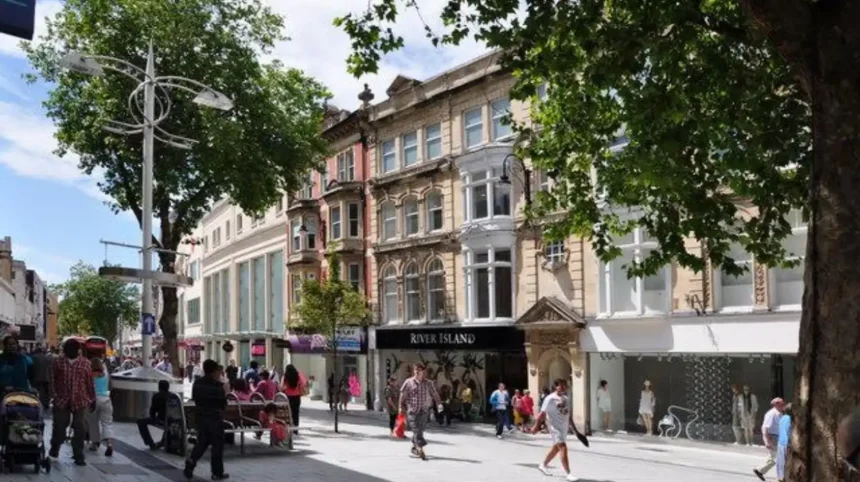
Queen Street is Cardiff’s principal high-street shopping area, combining pedestrianised retail space with major national chains, independent businesses and direct connections to The Hayes, St David’s Dewi Sant and Cardiff’s central attractions.
Queen Street forms the eastern side of Cardiff’s main shopping district. Its pedestrianised environment provides a straightforward route through the city centre and connects major retail destinations.
The street is particularly useful for shoppers looking for mainstream high-street brands. It also provides access to smaller independent businesses and nearby side streets.
Queen Street is not isolated from the rest of Cardiff’s retail core. The Hayes sits nearby, while St David’s Dewi Sant is within easy walking distance. Cardiff’s arcades also provide alternative routes between the major shopping streets.
Visit Cardiff’s visitor information identifies Cardiff Castle, Bute Park, The New Theatre, Cardiff Market, St David’s Dewi Sant and Principality Stadium among destinations within approximately a five-minute walk of the Queen Street area.
That proximity gives Queen Street additional value for visitors. Shopping can be combined with sightseeing without requiring another journey across the city.
Queen Street also connects with Cardiff Queen Street railway station. This creates a practical arrival point for visitors using rail services from Cardiff’s eastern and northern suburbs.
For shoppers who prioritise major retailers and a straightforward pedestrian route, Queen Street is one of the most accessible places to begin.
Why is The Hayes one of Cardiff’s best walkable shopping areas?
The Hayes is a central pedestrian shopping and leisure district linking St David’s Dewi Sant, Cardiff Market, historic arcades, restaurants and public spaces within a short walking distance of Cardiff Central railway station and other major attractions.
The Hayes occupies a strategic position in Cardiff’s central retail network.
Its location between St Mary Street and Queen Street makes it a natural walking corridor. It also provides direct access to Royal Arcade and Morgan Arcade, while St David’s Dewi Sant is positioned immediately nearby.
The area combines retail with food, culture and public space. This makes it useful for visitors who want more than conventional high-street shopping.
Visit Cardiff’s official visitor map lists Cardiff Market, BBC Wales Tours, Central Library, John Lewis, Utilita Arena and St David’s Dewi Sant within a five-minute walk of The Hayes.
The Hayes therefore functions as a central interchange for pedestrians.
It is also one of the best places to understand Cardiff’s retail geography. A shopper can move from the modern shopping centre into a Victorian arcade, then continue towards Cardiff Market or St Mary Street without needing a car.
The area also provides access to public transport connections around the city centre.
For visitors, the most efficient approach is to treat The Hayes as a central starting point rather than a single shopping street. Its surrounding destinations create a wider walkable retail circuit.

What can shoppers find around St David’s Dewi Sant?
St David’s Dewi Sant provides Cardiff’s largest concentration of modern indoor retail, with more than 160 shops, cafés and restaurants, making it a convenient central base for fashion, technology, beauty, food and family shopping.
St David’s Dewi Sant is one of the defining components of Cardiff’s modern shopping centre.
Visit Cardiff states that the centre contains more than 160 shops, restaurants and cafés. Its retailers include major names such as Zara, Sephora, H&M, Apple, LEGO, River Island, New Look, Primark and Marks & Spencer.
The centre is particularly convenient in poor weather because much of the shopping experience takes place indoors.
Its position in the centre also makes it easy to combine with outdoor pedestrian streets. The Hayes sits immediately adjacent to the centre, while Cardiff Market and the historic arcades are nearby.
St David’s is also close to Cardiff Central railway station and Cardiff Queen Street railway station. Visit Cardiff describes the centre as a short walk from both stations.
The centre therefore works particularly well for visitors arriving by rail.
The surrounding Hayes area adds restaurants and cafés, while nearby arcades provide independent retail and historic architecture. The result is a shopping district with both modern and heritage retail environments within a short walking distance.
St David’s also has a 2,000-space car park above the centre, providing an option for visitors who arrive by car and then continue their Cardiff shopping trip on foot.
Why should shoppers explore Cardiff’s historic arcades?
Cardiff’s historic arcades create a network of covered pedestrian shopping passages containing independent retailers, cafés, specialist businesses and restaurants, while preserving Victorian and Edwardian architecture throughout the central shopping district.
Cardiff is widely recognised for its historic shopping arcades. They are an essential part of the city’s walkable retail identity.
The arcades connect major streets through short internal passages. They also provide shelter from rain and create smaller-scale shopping environments away from larger commercial developments.
Visit Cardiff identifies the city’s Victorian and Edwardian arcades as a major feature of its retail scene. The network includes Royal Arcade, Morgan Arcade, Castle Arcade, High Street Arcade, Duke Street Arcade, Wyndham Arcade and Dominions Arcade.
Each arcade has a distinct position within the central shopping network.
Royal Arcade is the oldest. Morgan Arcade connects The Hayes and St Mary Street. Wyndham Arcade links St Mary Street with Mill Lane. Castle Arcade, High Street Arcade and Duke Street Arcade form the Castle Quarter cluster.
This makes the arcades particularly valuable for walking because they provide alternative pedestrian routes between the larger streets.
When was Cardiff’s first shopping arcade built?
Royal Arcade opened in 1858 and is Cardiff’s oldest shopping arcade, establishing an important part of the city’s covered retail network and contributing to the transformation of the central area during Cardiff’s rapid nineteenth-century commercial expansion.
Royal Arcade dates from 1858. Visit Cardiff identifies it as Cardiff’s oldest arcade and the city’s first shopping centre.
Its historical importance extends beyond retail.
The site previously contained cramped residential development. History Points records that the Cardiff Arcade Company acquired plots connecting The Hayes and St Mary Street to create the arcade. The design provided a glass-roofed shopping passage lined with shops and offices.
This development reflected the changing commercial character of nineteenth-century Cardiff.
The city was expanding rapidly because of its role as a major industrial and port centre. Increased commercial activity created demand for improved retail premises and pedestrian routes.
Royal Arcade remains part of the modern shopping network. It connects The Hayes and St Mary Street and contains independent retailers, cafés and specialist businesses.
Its location also allows shoppers to move between modern developments and historic streets within a short distance.
The arcade therefore demonstrates how Cardiff’s current walkability is connected to its nineteenth-century commercial development.
What makes Morgan Arcade important for walkable shopping?
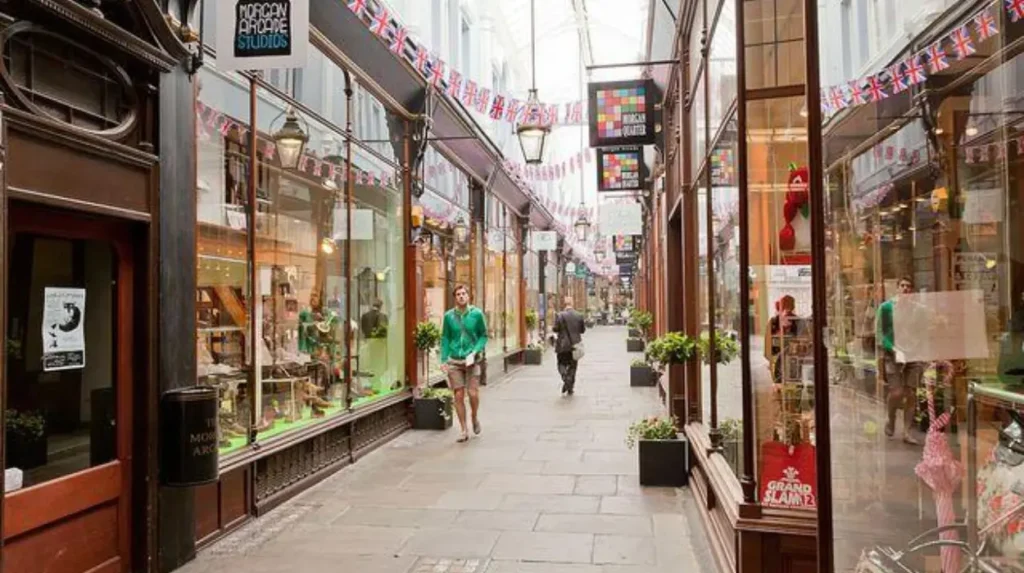
Morgan Arcade connects The Hayes with St Mary Street and combines independent retail with preserved historic architecture, making it one of Cardiff’s most useful pedestrian links between the modern shopping centre and the city’s traditional commercial streets.
Morgan Arcade forms part of the Morgan Quarter alongside Royal Arcade.
Visit Cardiff identifies Morgan Arcade as a destination containing boutiques, cafés, specialist businesses and the famous Spillers Records. It connects St Mary Street and The Hayes.
The arcade’s importance comes from its position.
A shopper leaving St David’s Dewi Sant can reach The Hayes and then enter Morgan Arcade. From there, the route continues towards St Mary Street.
This creates a continuous walking sequence through several different retail environments.
Morgan Arcade also demonstrates the relationship between Cardiff’s independent businesses and its historic architecture. The narrow internal route provides a smaller-scale environment than the large shopping centre nearby.
The arcade is particularly relevant to visitors searching for specialist retail rather than only national chains.
Its connection with Royal Arcade strengthens the Morgan Quarter as a walkable shopping destination. The two arcades sit close together and provide linked pedestrian routes.
What is the Castle Quarter and why is it easy to explore on foot?
Castle Quarter is Cardiff’s historic northern shopping cluster, bringing High Street Arcade, Duke Street Arcade and Castle Arcade together with independent shops near Cardiff Castle, High Street, St John Street and Castle Street.
Castle Quarter is one of the strongest examples of Cardiff’s pedestrian shopping structure.
The area contains three historic arcades: High Street Arcade, Duke Street Arcade and Castle Arcade. The Castle Quarter organisation states that the arcades are home to more than 60 independent shops, bars, restaurants and specialist businesses.
The district is positioned close to Cardiff Castle and Bute Park.
That location makes it useful for visitors who want to combine retail with heritage and green space.
High Street provides the main connection towards the central retail district. Duke Street and Castle Arcade create additional pedestrian routes within the cluster.
The area is also historically significant. High Street Arcade dates from the nineteenth century, while Duke Street Arcade was completed in 1902. Cardiff’s conservation documentation records the development of the historic arcade network as part of the city centre’s commercial expansion.
The walkable nature of Castle Quarter is strengthened by its proximity to major attractions.
Visit Cardiff identifies Cardiff Castle, Bute Park, Cardiff Market, St David’s Dewi Sant, Principality Stadium and The New Theatre as destinations close to the Queen Street and central shopping area.
This creates a practical shopping-and-sightseeing route through the northern part of the city centre.
How does Cardiff Market fit into a walkable shopping route?
Cardiff Market adds food, produce, specialist retail and independent trading to the city-centre shopping network, occupying a historic building between St Mary Street, High Street and The Hayes and remaining easy to reach on foot.
Cardiff Market is an important part of Cardiff’s retail heritage.
The current market building opened in May 1891. Cardiff Council Property records that a farmers’ market existed on the site from the eighteenth century. The building was designed by Borough Surveyor William Harpur and contains two shopping levels.
The market provides a different shopping environment from St David’s Dewi Sant.
Instead of concentrating on large national retailers, it supports market trading and specialist businesses. Visitors can find food, fresh produce, cafés, gifts, clothing and other products.
Its location makes it especially convenient for pedestrians.
The market sits within the central shopping network and is close to The Hayes, St Mary Street, High Street and the historic arcades.
This allows visitors to combine market shopping with traditional high-street retail.
The market also contributes historical depth to the walking experience. Its nineteenth-century architecture represents an earlier stage of Cardiff’s commercial development, while its current use maintains the site’s long association with trading.
Which shopping streets are best for combining retail with Cardiff attractions?
Queen Street, The Hayes, High Street and St Mary Street are the strongest streets for combining shopping with attractions because they sit close to Cardiff Castle, Cardiff Market, Principality Stadium, Bute Park, museums, theatres and major transport connections.
Cardiff’s compact centre allows shopping to be combined with sightseeing without long journeys.
Queen Street sits close to The New Theatre and connects with the wider retail district. High Street provides access to Cardiff Castle and the Castle Quarter. The Hayes connects shopping centres, the market and arcades. St Mary Street links the retail core with Cardiff Central and the southern central district.
Cardiff Castle is particularly important to the northern shopping circuit.
The castle stands immediately beside Castle Street and High Street. Bute Park extends north from the castle, providing a major green space close to the retail district.
Principality Stadium is positioned near the western side of the city centre. This means shoppers can also reach the stadium area from the main retail streets.
Visit Cardiff highlights the concentration of major attractions within walking distance of Queen Street.
The proximity of these destinations supports a combined retail and sightseeing itinerary.
How walkable is Cardiff for visitors arriving by train?
Cardiff’s central shopping district is highly accessible by rail because Cardiff Central and Cardiff Queen Street stations are both close to major retail streets, allowing visitors to begin shopping without arranging a separate city-centre transfer.
Cardiff Central is the principal railway station for the city centre. It sits close to St Mary Street, the southern arcades, The Hayes and St David’s Dewi Sant.
Cardiff Queen Street station provides access to the eastern side of the shopping district. Queen Street and nearby retail streets are directly connected to the station area.
Visit Cardiff confirms that St David’s Dewi Sant is within a short walk of both Cardiff Central and Cardiff Queen Street stations.
This arrangement reduces the need for taxis or cars for central shopping trips.
Visitors arriving at Cardiff Central can walk north towards St Mary Street, Royal Arcade, Morgan Arcade and The Hayes. Visitors arriving at Cardiff Queen Street can enter the shopping district through Queen Street and move towards The Hayes and St David’s.
The railway network therefore reinforces Cardiff’s walkable retail geography.
How accessible are Cardiff’s walkable shopping areas?
Cardiff provides several accessibility measures across its central shopping district, including pedestrian routes, accessible public spaces and a free mobility buggy service connecting key locations such as Cardiff Central, Queen Street, The Hayes and High Street.
Accessibility is an important part of evaluating a walkable shopping area.
Cardiff’s central streets include extensive pedestrian routes. The city also operates a free mobility buggy service for people who find it difficult to travel around the city centre.
Visit Cardiff states that the service operates between prearranged locations and can carry up to three passengers. Its listed central locations include Castle Street, High Street, St Mary Street, Queen Street, The Hayes and Cardiff Central Station.
This provides an alternative to walking the entire distance.
The city centre also contains a mixture of pedestrianised streets, indoor arcades and shopping-centre environments. Indoor routes provide additional shelter, while pedestrianised streets reduce interaction with general traffic.
Accessibility conditions can differ between individual buildings, shops and historic arcades. Visitors with specific requirements should check individual venue arrangements before travelling.
The mobility buggy is therefore an important part of Cardiff’s broader pedestrian-access strategy rather than a replacement for the city’s walking network.
How are Cardiff’s pedestrian shopping routes changing?
Cardiff continues to invest in pedestrian connections, cycling infrastructure, public-realm improvements and transport links, with current works around Castle Street designed to improve paving, crossings, lighting, drainage and connections between central destinations.
Cardiff’s walkability is not a static feature.
The city is continuing to change its central transport and public-realm infrastructure.
Cardiff Council’s Castle Street improvement programme includes a permanent segregated cycleway, upgraded paving, drainage, lighting, signage and road surfacing. The project also includes pedestrian crossing changes and improvements around the junctions with High Street, Queen Street and other central routes.
The council states that the Castle Street works are scheduled within the period from 2026 into 2027.
The project is particularly relevant to shopping because Castle Street connects the Castle Quarter with other central pedestrian routes.
Cardiff Council also identifies improvements around the city-centre east area, including pedestrian improvements around Dumfries Place and Station Terrace and better connections to Queen Street Station.
These projects reinforce the role of walking within the central transport system.
For shoppers, the long-term significance is straightforward. Better crossings, improved paving and clearer connections make it easier to move between retail districts.
What is the best walking route through Cardiff’s main shopping areas?
A practical central shopping circuit starts at Cardiff Central, continues through St Mary Street and the historic arcades, crosses The Hayes and St David’s Dewi Sant, then follows Queen Street towards Cardiff Queen Street station and the Castle Quarter.
A structured walking route helps visitors experience the greatest concentration of Cardiff retail without unnecessary backtracking.
Start at Cardiff Central Station. Walk towards St Mary Street and explore the southern arcades, including Royal Arcade and Morgan Arcade.
Continue towards The Hayes. This brings the route close to Cardiff Market, St David’s Dewi Sant and Central Library.
Move through St David’s Dewi Sant for modern high-street and major-brand shopping.
Continue towards Queen Street. The pedestrianised street provides another major retail corridor and connects towards Cardiff Queen Street railway station.
For additional independent shopping and heritage, walk west and north towards High Street and Castle Quarter. Explore High Street Arcade, Duke Street Arcade and Castle Arcade.
Finish near Cardiff Castle and Bute Park.
This route combines modern shopping, historic arcades, market trading and major attractions.
The precise distance depends on the individual shops and arcades visited, but the central retail network is compact enough for a single walking-focused day.
Why are Cardiff’s shopping areas particularly suitable for a car-free shopping day?
Cardiff’s central shopping districts are concentrated around pedestrianised streets, covered arcades, public transport stations and nearby attractions, making a car-free shopping day practical for visitors who want to minimise driving and parking.
Cardiff’s retail geography reduces dependence on private vehicles.
St David’s Dewi Sant provides extensive indoor shopping. Queen Street provides a major pedestrian high street. The Hayes connects several retail destinations. St Mary Street and the arcades create additional routes. Cardiff Market provides traditional market shopping.
Public transport reinforces the network.
Cardiff Central and Cardiff Queen Street stations provide rail access, while bus stops serve the surrounding city-centre streets.
The city centre also has parking facilities for people who need to drive, including the 2,000-space car park above St David’s Dewi Sant.
Visitors who drive can therefore park centrally and continue their shopping trip on foot.
Cardiff Council’s pedestrian priority network also demonstrates the importance of central footpaths. Its list includes the major shopping streets and connecting routes across the city centre.
For visitors, this creates a simple choice: arrive by train, bus or car, then complete most of the shopping itinerary on foot.
Which Cardiff shopping area is best for different types of shoppers?
Queen Street suits mainstream high-street shopping, The Hayes suits mixed retail and leisure, St David’s Dewi Sant suits major brands, the arcades suit independent shopping, Cardiff Market suits specialist goods, and Castle Quarter suits heritage-focused retail.
The best area depends on the purpose of the shopping trip.
For high-street brands, Queen Street and St David’s Dewi Sant provide the strongest concentration.
For indoor shopping, St David’s Dewi Sant provides more than 160 shops, cafés and restaurants.
For independent retail, Cardiff’s historic arcades provide the strongest concentration of specialist businesses.
For historic architecture, Royal Arcade and Castle Quarter stand out because of their nineteenth- and early twentieth-century origins.
For market shopping, Cardiff Market provides the most traditional environment.
For combined shopping and sightseeing, The Hayes and Castle Quarter are particularly useful because of their proximity to major attractions.
This distribution means shoppers do not need to choose a single shopping street. Cardiff’s compact structure allows several retail environments to be combined within one walking itinerary.
Explore More Area Guide
Business Growth in Cardiff’s Eastern Suburbs: Cardiff 2026
How Local Markets Support Cardiff Communities
What should visitors know before exploring Cardiff’s shopping areas on foot?
Visitors should plan around Cardiff’s pedestrianised central network, allow time for historic arcades and market shopping, check individual store opening hours, and account for temporary road and public-realm works affecting routes around Castle Street.
Cardiff is straightforward to explore on foot, but route planning remains useful.
Opening hours differ between shopping centres, individual stores, market traders and restaurants. St David’s Dewi Sant currently publishes separate weekday, Saturday and Sunday opening hours.
Weather also matters. Cardiff’s covered arcades provide useful sheltered routes between several central streets.
Visitors should also monitor transport and public-realm changes. Cardiff Council currently lists Castle Street works running during 2026–2027, with access to shops and buildings maintained during construction.
The most efficient strategy is to group destinations geographically.
Start at either Cardiff Central or Cardiff Queen Street depending on the direction of arrival. Explore the nearest shopping streets first. Use the arcades as connecting routes. Finish at Cardiff Market, Cardiff Castle, Bute Park or another nearby attraction.
This approach reduces unnecessary walking while preserving the advantages of Cardiff’s compact central retail district.
What is the overall significance of Cardiff’s walkable shopping areas?
Cardiff’s walkable shopping network combines modern retail, historic arcades, market trading, pedestrianised streets, public transport and major attractions, creating a compact city-centre environment where shopping and sightseeing remain closely connected.
Cardiff’s walkability is rooted in both history and modern urban planning.
The nineteenth-century arcades created covered pedestrian shopping routes. Cardiff Market opened in 1891 and reinforced the city centre’s commercial role. Later pedestrianisation and modern shopping developments expanded the retail network.
Today, Queen Street, The Hayes, St Mary Street, High Street, St David’s Dewi Sant, Cardiff Market and the historic arcades form an interconnected central shopping system.
The scale of the area is one of its strongest characteristics. Visitors can move between modern shopping centres, independent arcades and historic attractions without crossing large distances.
The city continues to invest in public-realm improvements. Castle Street upgrades include improved pedestrian crossings and paving, while broader city-centre transport planning focuses on better connections around Queen Street Station and surrounding streets.
Cardiff’s central shopping district therefore remains relevant for visitors seeking a car-free retail experience.
The strongest walking itinerary does not depend on one shopping destination. It uses the connected network of Cardiff’s retail streets, arcades, market and shopping centre.
That network is the defining feature of Cardiff’s most walkable shopping areas and explains why the city centre remains easy to explore on foot.
What is the most walkable shopping area in Cardiff?
The Hayes, Queen Street, St Mary Street and the surrounding historic arcades form Cardiff’s most walkable shopping network. These areas are close together and connect major retailers, independent shops, cafés, Cardiff Market and St David’s Dewi Sant.