


Cardiff uses civil parking enforcement to regulate on-street parking, resident bays, yellow lines, pay-and-display spaces and other controlled areas. A parking contravention results in a Penalty Charge Notice (PCN) rather than a criminal fine. Cardiff Council currently lists parking PCNs at £50 or £70, depending on the level of the contravention, with a 50% reduction when paid within 14 days.
- What is a Cardiff parking fine?
- Why does Cardiff issue parking penalty charge notices?
- What parking offences result in a PCN in Cardiff?
- How much is a Cardiff parking fine?
- How long do drivers have to pay a Cardiff parking PCN?
- How can you pay a Cardiff parking fine?
- How can you challenge a Cardiff parking fine?
- What evidence should you provide when challenging a Cardiff PCN?
- What happens after a Cardiff parking PCN is ignored?
- Can you appeal a Cardiff parking PCN after the council rejects your challenge?
- What happens if you lose a Cardiff parking PCN appeal?
- What happens if a Cardiff parking debt reaches enforcement agents?
- How many parking PCNs does Cardiff issue?
- Where does Cardiff parking-fine income go?
- How can Cardiff drivers avoid parking fines?
- What should Cardiff drivers do after receiving a parking PCN?
The system operates under the wider Welsh civil enforcement framework established through the Traffic Management Act 2004 and Welsh regulations governing penalty charges, notices, representations and appeals.
Understanding the difference between a parking restriction, a PCN, a Notice to Owner, a formal representation and an independent appeal helps Cardiff drivers respond correctly and avoid unnecessary enforcement costs.
What is a Cardiff parking fine?
A Cardiff parking fine is a Penalty Charge Notice issued when a vehicle breaches a parking restriction enforced by Cardiff Council. The standard parking penalty is £50 or £70, based on the contravention level, with a 50% early-payment reduction.
A Penalty Charge Notice is commonly called a parking fine, but the legal terminology is important. A PCN is a civil penalty created through the civil enforcement system. It is different from a criminal fixed penalty issued for a road traffic offence.
Cardiff Council uses civil enforcement to manage parking restrictions across the city. The enforcement system covers restrictions designed to control where and when vehicles can park.
A Civil Enforcement Officer can issue a PCN when they observe a parking contravention. Certain restrictions can also be enforced using approved devices and other permitted enforcement methods under the Welsh legal framework.
The amount depends on the contravention. Cardiff Council identifies higher-level and lower-level parking contraventions. Its published information states that the full charges are £70 and £50 respectively.
The distinction matters because the discounted payment amount is calculated from the applicable penalty.
Why does Cardiff issue parking penalty charge notices?
Cardiff issues parking PCNs to enforce legal parking restrictions, manage limited road space, protect controlled areas and address illegal or inconsiderate parking. Enforcement applies to restrictions such as resident bays, yellow lines, pay-and-stay bays and dropped kerbs.
Parking controls form part of Cardiff’s wider traffic management system. They determine where vehicles can stop or park and establish conditions for using particular spaces.
Resident parking areas protect parking availability for eligible residents. Pay-and-stay areas require drivers to comply with payment and display conditions. Yellow-line restrictions control parking and waiting. Other restrictions protect pedestrian access and road safety.
Cardiff Council states that enforcing parking restrictions addresses illegal and inconsiderate parking in the city.
The legal foundation extends beyond Cardiff Council’s local rules. Part 6 of the Traffic Management Act 2004 provides the framework for civil enforcement of road traffic contraventions. Welsh regulations establish the procedures used for penalty charges and enforcement in Wales.
The purpose of a PCN is therefore connected to enforcement of a traffic restriction. It is not simply a charge for using a parking space.
What parking offences result in a PCN in Cardiff?
Cardiff parking PCNs cover several common contraventions, including parking in resident bays without the required permit, parking on yellow lines, using pay-and-stay bays incorrectly, restricted loading and parking beside dropped kerbs.
Cardiff Council’s published enforcement data identifies several recurring parking contraventions.
Resident permit violations are among the most frequently enforced restrictions. Code 12 covers parking in a residents’ or shared-use parking place without displaying a valid permit or other required evidence.
Yellow-line restrictions are another major category. Code 01 covers parking in a restricted street during the relevant restriction period.
Loading restrictions also generate PCNs. Code 02 relates to parking or loading in a restricted street where the applicable loading prohibition is in force.
Pay-and-stay restrictions have separate enforcement requirements. Code 06 covers parking in a pay-and-stay bay without a valid ticket or without clearly displaying the required ticket.
Dropped kerbs are another protected area. Code 27 covers parking adjacent to a dropped footway or carriageway at relevant locations.
Cardiff’s 2022–23 data recorded 88,644 parking PCNs. The five leading parking contraventions included resident-bay violations, yellow-line restrictions, loading restrictions, pay-and-stay violations and dropped-kerb parking.
These examples show why checking road markings, signs, permits and payment conditions is essential before leaving a vehicle.
How much is a Cardiff parking fine?
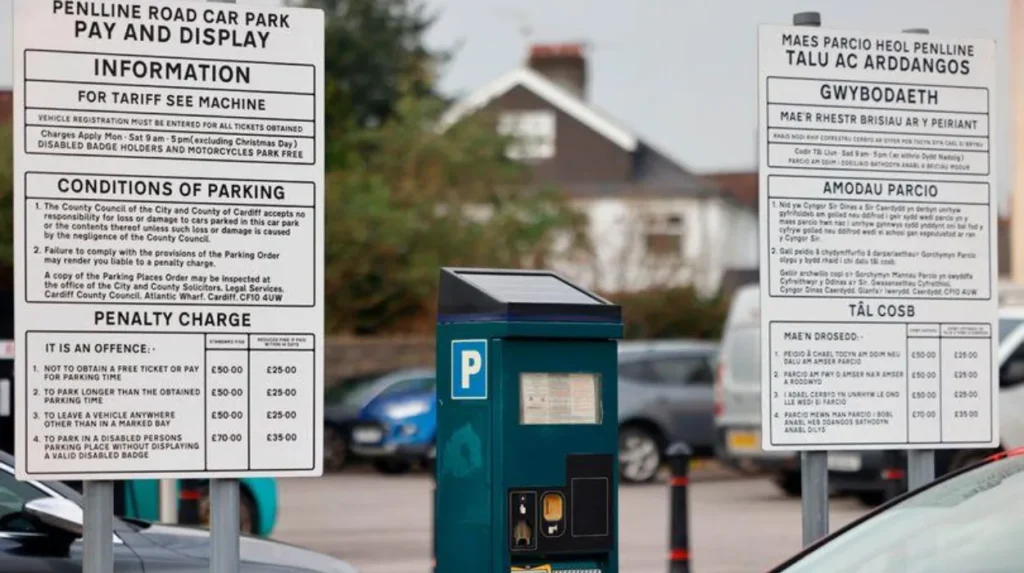
A Cardiff parking PCN is currently £50 or £70 depending on the parking contravention. Cardiff Council states that paying within 14 days reduces the applicable charge by 50%, making the discounted amounts £25 or £35.
The higher-level parking penalty is £70. The discounted amount is £35 when the PCN qualifies for the 50% reduction and payment is made within the stated 14-day period.
The lower-level parking penalty is £50. The corresponding discounted amount is £25 within the same early-payment period.
The exact amount shown on the PCN is the controlling figure for an individual case. Drivers should check the notice rather than relying on a general online figure.
Cardiff’s historical parking reports also recorded the £70 and £50 penalty structure. The council’s 2021–22 and 2022–23 reports state that prompt payment reduces a parking PCN by 50%.
Drivers should distinguish parking PCNs from bus-lane and moving-traffic PCNs. Cardiff Council separately enforces restrictions such as bus lanes, banned turns, no-entry restrictions and box junctions.
Those traffic contraventions have their own enforcement rules and should not be confused with ordinary parking penalties.
How long do drivers have to pay a Cardiff parking PCN?
Drivers who accept a Cardiff parking PCN can use the 50% discount by paying within 14 days. If the PCN is ignored, Cardiff Council states that the penalty increases by 50% after a charge certificate is issued.
The first decision is whether to pay or challenge the PCN.
Payment within the discount period closes the matter at the reduced amount. Cardiff Council currently states that the discounted period is 14 days.
Drivers who want to challenge the PCN should not pay first. Cardiff Council states that payment represents an admission of liability and a challenge can then be affected.
If the PCN is ignored, enforcement progresses through additional statutory stages. Cardiff Council states that a charge certificate increases the fine by 50% and removes the normal opportunity to appeal.
The increased charge therefore creates a substantially higher financial liability than the original discounted amount.
How can you pay a Cardiff parking fine?
Cardiff Council accepts payment for parking PCNs through its online payment system, by automated telephone payment and by post using an eligible cheque or postal order. Drivers need the PCN number and vehicle registration.
Online payment is available through Cardiff Council’s parking-fine service. The council states that the PCN number begins with QC and that the vehicle registration number is required.
Telephone payment is available through Cardiff Council’s automated payment service. The council publishes 029 2044 5900 for this service and states that the telephone line operates seven days a week for debit and credit card payments.
Postal payment is also available using a cheque or postal order made payable to Cardiff Council. The PCN number should be marked as required by the council.
Cash should not be sent through the post. Cardiff Council states that it does not accept cash payments for parking fines.
A driver who intends to challenge a PCN should submit the challenge rather than making payment first.
How can you challenge a Cardiff parking fine?
Drivers can challenge a Cardiff parking PCN when they believe the penalty should not apply. Cardiff Council provides an informal challenge stage and a formal representation stage, followed by an independent appeal if the formal representation is rejected.
An informal challenge allows a driver to explain why the PCN should be cancelled. Cardiff Council’s published enforcement information states that an informal challenge can be made within 14 days of the PCN being issued.
A challenge should address the specific circumstances. Relevant evidence includes photographs, permit records, payment information, signs, road markings and other documents connected with the alleged contravention.
The council then considers the information and decides whether to cancel the PCN or continue enforcement.
A formal representation applies after a Notice to Owner has been served or where a PCN has been issued through the applicable postal process. Cardiff Council provides a separate process for this stage.
The Notice to Owner is important because the civil enforcement process generally places responsibility on the vehicle owner rather than simply the person who was driving at the time. The Welsh regulations define the relevant owner and establish the formal enforcement process.
What evidence should you provide when challenging a Cardiff PCN?
A strong Cardiff parking challenge identifies the exact contravention, explains why the restriction did not apply or why cancellation is justified, and supplies relevant evidence such as photographs, permits, payment records, signage details and supporting documents.
The evidence should directly address the reason for the PCN.
Photographs can show road signs, bay markings, yellow lines, vehicle position and nearby restrictions. The images should establish the location and relevant conditions.
Permit evidence is important for resident parking disputes. A valid permit, visitor permit or other authorisation can support a challenge where the PCN concerns a permit-controlled bay.
Payment records are relevant to pay-and-stay disputes. A ticket, digital payment record or transaction information can demonstrate the payment made and the relevant vehicle or location details.
Drivers should explain the facts in chronological order. The challenge should identify the PCN reference and explain the specific grounds relied upon.
Cardiff Council’s published figures show that challenges are a significant part of its enforcement process. In 2022–23, the council received 12,472 informal challenges and 22,116 formal challenges.
The council reported that 57% of informal challenges and 72% of formal challenges were recorded as resulting in cancellation of the relevant PCN, subject to the council’s qualification that cancellation does not always mean enforcement stopped because a new PCN can be directed to another liable party.
What happens after a Cardiff parking PCN is ignored?
Ignoring a Cardiff parking PCN starts a statutory enforcement process. The charge can increase through a charge certificate, the debt can be registered, an Order for Recovery can follow, and further enforcement action can result if payment remains outstanding.
The first major escalation is the charge certificate. Cardiff Council states that the penalty increases by 50% when the charge certificate is issued.
After the relevant period, Cardiff Council can apply to the Traffic Enforcement Centre to register the unpaid debt. The council states that registration adds a £9 court fee.
An Order for Recovery and an In Time Witness Statement then form part of the enforcement process.
At this stage, the grounds for disputing the charge are limited. Cardiff Council identifies circumstances such as not receiving the PCN or Notice to Owner, making a relevant appeal without receiving a response, making representations without receiving a rejection notice, or already paying the fine.
If the debt remains unresolved after the relevant notices and deadlines, the case can proceed towards enforcement-agent action.
The escalation demonstrates why responding to the original PCN is important. Early payment or a timely challenge prevents the matter from progressing unnecessarily.
Can you appeal a Cardiff parking PCN after the council rejects your challenge?
Yes. A driver who receives a rejection of a formal representation can appeal to an independent adjudicator through the Traffic Penalty Tribunal. The tribunal provides an independent stage separate from Cardiff Council’s own enforcement decision.
The Traffic Penalty Tribunal handles appeals relating to civil traffic enforcement in Wales.
The independent appeal stage becomes relevant after the enforcing authority rejects a formal representation. Cardiff Council expressly identifies the right to appeal to an independent adjudicator at the Traffic Penalty Tribunal.
The Welsh legal framework provides for representations and appeals against road traffic penalty charges. The 2013 Welsh regulations cover parking, bus-lane and moving-traffic contraventions and provide the adjudication framework.
A driver should follow the deadline and instructions contained in the rejection notice. Missing an appeal deadline can affect the ability to contest the penalty.
An independent adjudicator is separate from Cardiff Council. The purpose of this stage is to provide an independent determination of the disputed penalty.
What happens if you lose a Cardiff parking PCN appeal?
If an independent appeal does not cancel the PCN, the penalty remains payable. Drivers should follow the adjudicator’s decision and the payment instructions provided by Cardiff Council or the relevant enforcement authority.
An unsuccessful appeal does not create a new parking offence. It confirms that the existing penalty remains payable.
Drivers should check the decision notice for the payment deadline and applicable amount.
If the penalty is left unpaid, the statutory enforcement process continues. The legal framework allows recovery of increased penalty charges through the relevant enforcement mechanisms.
The safest approach is to act on the decision promptly and retain copies of the appeal decision, correspondence and payment evidence.
What happens if a Cardiff parking debt reaches enforcement agents?
A Cardiff parking debt that reaches enforcement-agent enforcement can include additional enforcement costs. Cardiff Council states that a Notice of Enforcement requires payment of the outstanding balance and added costs, with a £75 fee listed when the debt is passed to enforcement agents.
A Notice of Enforcement is a later-stage document. It should not be confused with the original parking PCN.
Cardiff Council states that the enforcement-agent reference number appears at the top of the notice and begins with 21 or 22. The council provides payment options and states that a payment plan can be available where the full amount cannot be paid immediately.
Additional enforcement costs increase the total amount owed. The financial consequences therefore become more serious as the case moves through successive statutory stages.
Drivers receiving an enforcement notice should read the notice carefully and respond within its stated deadline.
How many parking PCNs does Cardiff issue?
Cardiff issues tens of thousands of parking PCNs each year. Council data records 88,033 parking PCNs in 2022–23, while 2025–26 council figures show £3.625 million in parking-PCN income.
Cardiff Council publishes historical civil enforcement figures covering parking, bus lanes and moving traffic.
Parking PCN volumes were 80,937 in 2018–19, 72,268 in 2019–20, 27,451 in 2020–21, 75,069 in 2021–22 and 88,033 in 2022–23.
The 2020–21 figure was substantially lower than surrounding years. Cardiff Council attributed the reduction to the Covid-19 pandemic and reduced enforcement activity.
For 2025–26, Cardiff Council reports £3.625 million in parking-PCN income. It separately reports £7.314 million from bus-lane and moving-traffic PCNs.
These figures demonstrate the scale of civil traffic enforcement in Cardiff. They also reinforce the importance of understanding the distinction between parking penalties and other traffic penalties.
Where does Cardiff parking-fine income go?
Cardiff Council states that income from parking fees and enforcement is governed by Section 55 of the Road Traffic Regulation Act 1984. Eligible uses include highways and roads projects, environmental improvements and public transport services.
Parking enforcement income is therefore subject to statutory controls on how qualifying surplus income is used.
For 2025–26, Cardiff Council reports total parking-related income of £19.331 million across on-street parking, car parks, permits, parking PCNs, bus-lane and moving-traffic PCNs and other services.
The same report records £10.615 million in surplus income. Cardiff Council reports contributions of £8.649 million to schemes under Section 55 and £1.966 million to its Parking Reserve Account.
The figures cover multiple parking and traffic income categories. Parking PCN income alone was £3.625 million in 2025–26.
The statutory framework is therefore broader than the individual payment made by a driver. The council’s annual parking reports provide the relevant financial and enforcement context.
Explore More Area Guide
Cardiff Parking Permits Explained: Cardiff Council Guide
Free Parking in Cardiff: Cardiff Council Driver Guide
How can Cardiff drivers avoid parking fines?
Drivers can reduce the risk of a Cardiff parking PCN by checking signs and road markings, confirming permit requirements, paying for controlled parking correctly, observing restriction times and avoiding protected areas such as yellow lines and dropped kerbs.
The first step is to identify the restriction before leaving the vehicle.
A resident parking bay requires the relevant permit or authorisation. A pay-and-stay bay requires payment and compliance with the displayed conditions. Yellow lines require drivers to observe the applicable waiting restrictions.
Drivers should check whether restrictions apply at the time they park. Signs and road markings communicate the conditions that control a particular location.
A payment transaction should also be checked before leaving the vehicle. Drivers should confirm the vehicle registration, location and payment duration where the payment system requires those details.
A Blue Badge does not create unrestricted parking rights. Cardiff Council provides separate information about Blue Badge parking and the rules applying across the city.
Drivers should also distinguish ordinary parking controls from bus lanes, bus gates, banned turns, box junctions and other moving-traffic restrictions. Cardiff Council enforces these categories separately.
What should Cardiff drivers do after receiving a parking PCN?
A driver receiving a Cardiff parking PCN should check the contravention, amount and deadline immediately, then choose between paying within the discount period or submitting a timely challenge. Ignoring the notice increases financial and enforcement consequences.
The PCN contains the information needed to identify the alleged contravention.
Drivers should verify the vehicle registration, location, date, time, contravention code and penalty amount. They should also examine any available photographs or supporting evidence.
If the PCN is accepted, paying within the 14-day discount period reduces the £50 or £70 penalty by 50%.
If the driver disputes the penalty, the challenge should be submitted through Cardiff Council’s specified process. Payment should not be made first when the driver intends to challenge because Cardiff Council treats payment as an admission of liability.
If the challenge is rejected, the driver should follow the formal representation and independent appeal procedures applicable to the PCN.
The central rule is simple: do not ignore a Cardiff parking PCN. The statutory process becomes more expensive and restrictive when deadlines are missed.
Cardiff’s parking system forms part of a wider civil enforcement framework designed to regulate limited road space and maintain compliance with traffic restrictions. Knowing the penalty amount, discount period, challenge process and enforcement stages gives drivers a clear route from receiving a PCN to resolving it.
What is a Cardiff parking fine?
A Cardiff parking fine is usually a Penalty Charge Notice (PCN) issued by Cardiff Council when a driver breaches a parking restriction. It is a civil penalty rather than a criminal fine.