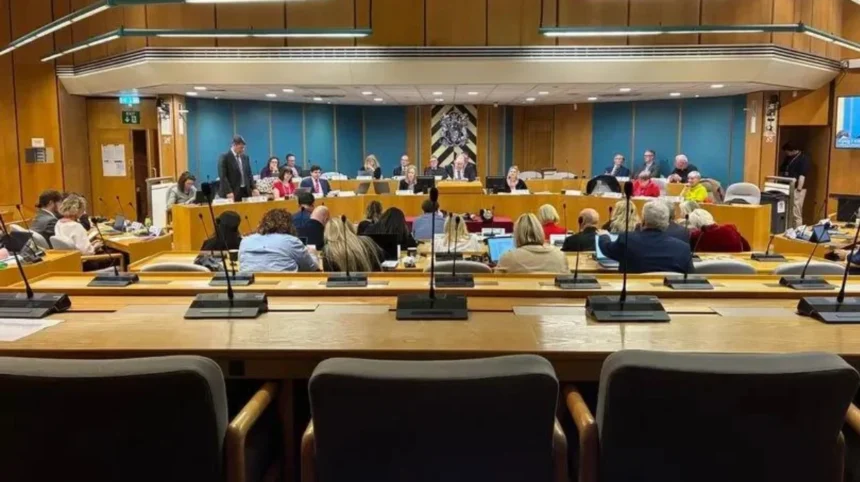
Cardiff has a two-tier local government structure in the areas that have community councils. Cardiff Council is the principal local authority, while community councils provide a more local level of elected representation and services. In 2026, six Cardiff community councils are recognised: Lisvane, Old St Mellons, Pentyrch, Radyr and Morganstown, St Fagans and Tongwynlais.
- What is a community council in Cardiff?
- How did community councils develop in Cardiff and Wales?
- Which community councils currently operate across Cardiff?
- Lisvane Community Council
- Old St Mellons Community Council
- Pentyrch Community Council
- Radyr and Morganstown Community Council
- St Fagans Community Council
- Tongwynlais Community Council
- What services do Cardiff community councils provide?
- How do Cardiff community councils get their money?
- How are Cardiff community councillors elected?
- How do community councils work with Cardiff Council?
- How do community councils influence planning in Cardiff?
- How transparent are Cardiff community councils?
- What role do community councils play in local democracy?
- What challenges face community councils in Cardiff and Wales?
- How can Cardiff residents engage with their community council?
- How could Cardiff community councils remain relevant in the future?
Community councils are the lowest tier of local government in Wales. They represent defined communities and operate within powers established mainly by the Local Government Act 1972 and subsequent Welsh legislation. They work alongside, rather than instead of, Cardiff Council.
The distinction is important because Cardiff’s electoral wards and its community council areas are not the same thing. Cardiff Council represents the city’s principal electoral wards, while community councillors represent residents within specific community council areas. Some parts of Cardiff therefore have a community council and others do not.
What is a community council in Cardiff?
A community council is an elected local authority serving a defined community within Cardiff. It represents residents, manages local facilities and services within its powers, raises a council-tax precept, and works with Cardiff Council and other organisations on local priorities.
Community councils are statutory bodies. They are not residents’ associations, neighbourhood groups or informal community organisations. Their councillors are elected through local government elections, and their proceedings are governed by legislation, standing orders, financial controls and ethical requirements.
The Welsh Government describes community and town councils as the level of government closest to local communities. Across Wales, there are 875 communities, with 732 having a community or town council, according to Welsh Government research published in its review of democratic health.
Cardiff has a more limited community council structure. Six councils currently operate within the Cardiff Council area:
- Lisvane Community Council
- Old St Mellons Community Council
- Pentyrch Community Council
- Radyr and Morganstown Community Council
- St Fagans Community Council
- Tongwynlais Community Council
Cardiff Council’s current parish council contact register confirms these six bodies.
What makes a community council different from a residents’ group?
A community council has statutory powers and responsibilities. A residents’ association is a voluntary organisation without the same legal status. Community councils can set budgets, raise a precept through council tax, make formal decisions, own or manage assets and provide certain local services.
This legal status gives community councils an established place within Wales’s local government system. Their decisions must follow applicable legislation and governance requirements.
How did community councils develop in Cardiff and Wales?
Community councils were created through the Local Government Act 1972 and came into operation in Wales in 1974, replacing parish councils. Later legislation, especially the Local Government (Wales) Act 1994 and Local Government (Wales) Measure 2011, changed their structure and powers.
Before the 1972 reforms, Wales had administrative counties, county boroughs, urban districts, rural districts and parish councils. The Local Government Act 1972 reorganised this system and introduced community councils for Wales. The new arrangements came into effect in 1974.
The terminology reflected Wales’s distinct local government arrangements. Community councils became the Welsh equivalent of parish councils in England, while their boundaries and functions developed through Welsh local government legislation.
The Local Government (Wales) Act 1994 subsequently reorganised Welsh local government. It reduced the number of principal local authorities and helped establish the modern relationship between principal councils and community councils. Cardiff became part of the current principal council system.
The Local Government (Wales) Measure 2011 introduced further provisions affecting community governance. These included arrangements for establishing, dissolving and grouping community councils, community meetings, co-option, youth representatives and community-area reviews.
Why is the 1974 date important?
The 1974 implementation created the modern community-council tier in Wales. It separated the smallest level of elected local government from the larger county and district structures created by the 1972 reforms.
The system has continued to evolve through subsequent legislation. The basic principle remains that community councils represent defined local communities while principal councils provide services across the wider local authority area.
Which community councils currently operate across Cardiff?
Six community councils currently operate within Cardiff: Lisvane, Old St Mellons, Pentyrch, Radyr and Morganstown, St Fagans, and Tongwynlais. Cardiff Council’s 2026/27 council-tax records identify all six community areas as precepting authorities.
The six councils cover particular parts of Cardiff rather than the whole city. Their boundaries reflect community areas rather than Cardiff Council’s wider electoral ward structure.
Lisvane Community Council
Lisvane Community Council serves the Lisvane community in north Cardiff. Cardiff Council’s 2026/27 council-tax base records 3,394 as the tax base for Lisvane’s community area.
Lisvane is one of Cardiff’s established community council areas. Residents within the area can therefore have representation from both Cardiff Council and Lisvane Community Council.
Old St Mellons Community Council
Old St Mellons Community Council serves the Old St Mellons community in eastern Cardiff. Cardiff Council’s 2026/27 figures record a council-tax base of 2,744 for the area.
The community council has its own clerk, meetings and administrative arrangements. Cardiff Council lists its contact location at Old St Mellons Village Hall on Newport Road.
Pentyrch Community Council
Pentyrch Community Council serves the Pentyrch area and its associated community wards. Cardiff Council records a 2026/27 tax base of 3,945 for the Pentyrch community area.
Pentyrch has a rural and semi-rural setting on Cardiff’s western and north-western edge. Its community council therefore operates within a substantially different local environment from central Cardiff neighbourhoods.
Radyr and Morganstown Community Council
Radyr and Morganstown Community Council serves Radyr and Morganstown. Its 2026/27 council-tax base is recorded as 4,297, the largest tax base among Cardiff’s six community council areas in the published figures.
The council provides a local democratic structure for an area containing established residential communities west of central Cardiff.
St Fagans Community Council
St Fagans Community Council serves St Fagans. Cardiff Council’s 2026/27 council-tax base for the community area is 2,065.
St Fagans has a distinctive heritage environment, including St Fagans National Museum of History. The community council represents the local community separately from the management of national museum functions.
Tongwynlais Community Council
Tongwynlais Community Council serves Tongwynlais in north-west Cardiff. Its 2026/27 council-tax base is 819, the smallest of the six Cardiff community council areas listed in Cardiff Council’s published figures.
Cardiff Council lists the council’s contact location at The Tanyard on Queen Street, Tongwynlais.
What services do Cardiff community councils provide?
Community councils provide local services and facilities within their statutory powers and available budgets. Examples include local amenities, community buildings, public spaces, grants, events, information and other neighbourhood-scale activities that complement services delivered by Cardiff Council.
Community councils do not operate Cardiff’s entire public-service system. Cardiff Council remains responsible for major principal-authority functions such as education, social services, environmental health and town and country planning.
Community councils instead operate at a smaller geographical level. Their responsibilities depend on their legal powers, local decisions, available resources and arrangements with Cardiff Council.
What types of facilities can community councils support?
Welsh legislation gives community and town councils powers covering areas such as public buildings, village halls, burial grounds, information, entertainment, arts, land acquisition and tourism.
The precise services provided differ between individual councils. A community council can decide how to use its available resources within the legal framework.
This creates visible differences between community council areas. A council serving a village environment can have different local priorities from one serving a larger suburban community.
How do Cardiff community councils get their money?
Cardiff community councils primarily finance their local activities through a council-tax precept, which is collected alongside Cardiff Council tax. The amount is determined by each community council’s budget and then included in residents’ council-tax bills.
A precept is a sum requested by a local authority from the principal council for collection through council tax. The money funds the community council’s approved expenditure.
Cardiff Council’s 2026/27 records show different tax bases for the six community areas, reflecting differences in their chargeable-dwelling calculations. Lisvane has a tax base of 3,394, Pentyrch 3,945, Radyr 4,297, St Fagans 2,065, Old St Mellons 2,744 and Tongwynlais 819.
The published 2024/25 Cardiff accounts also show community council precepts. The recorded amounts were £73,000 for Lisvane, £195,000 for Pentyrch, £165,000 for Radyr and Morganstown, £52,000 for St Fagans, £55,000 for Old St Mellons and £29,000 for Tongwynlais.
These figures demonstrate that community councils operate with their own local financial resources rather than forming part of Cardiff Council’s general service budget.
How are Cardiff community councillors elected?
Community councillors are elected representatives of defined community areas. Where a Cardiff resident lives in an area with a community council, local government elections can include a separate vote for a community councillor as well as a vote for a Cardiff Council ward councillor.
This produces an important distinction on election day.
A resident in a community council area can vote for representation at two local-government levels. One vote concerns Cardiff Council. Another concerns the community council.
Cardiff Council explains that residents in areas with a community council receive two ballot papers at local government elections. One elects a councillor for the Cardiff Council electoral ward, while the other elects a community councillor.
The system therefore gives residents two separate forms of local representation.
Why do some Cardiff residents not vote for community councillors?
Not every Cardiff neighbourhood has a community council. Cardiff Council’s official information states that only some areas have community councils. Residents outside those areas therefore do not have a separate community council election.
This is why the terms “Cardiff ward” and “Cardiff community” should not be treated as interchangeable.
How do community councils work with Cardiff Council?
Community councils and Cardiff Council operate at different levels of local government. Cardiff Council provides principal-authority services across the city, while community councils represent specific communities and deliver local functions. Cooperation connects local priorities with wider Cardiff services.
The relationship is formal as well as practical. Cardiff has a Community Councils Charter that sets out a framework for cooperation between Cardiff Council and its community councils.
This relationship matters because many local issues cross administrative responsibilities. A community council can raise local concerns while Cardiff Council retains responsibility for principal-authority services.
What does the Cardiff Community Councils Charter do?
The charter establishes a framework for partnership between Cardiff Council and the six community councils. It recognises the distinct roles of each level and provides a basis for communication and cooperation.
The arrangement supports information sharing, consultation and coordinated work where local and citywide responsibilities overlap.
How do community councils influence planning in Cardiff?
Community councils do not replace Cardiff Council as the local planning authority. Cardiff Council is the local planning authority for the city, while community councils provide local representation and can engage with planning matters affecting their communities.
Planning authority status is important because development plans and planning applications are handled through the principal planning system.
Cardiff Council prepares development plans and considers planning applications as the city’s local planning authority.
Community councils provide another local democratic channel. Their councillors and meetings give residents an opportunity to raise neighbourhood concerns, discuss development proposals and communicate local views.
This distinction prevents confusion about who makes formal planning decisions. A community council can contribute to local democratic discussion without becoming the statutory planning authority.
How transparent are Cardiff community councils?
Community councils operate under statutory transparency and governance requirements. They publish meeting information, notices, documents and members’ interests through electronic channels, helping residents examine decisions, council business and local democratic activity.
The Local Government (Democracy) (Wales) Act 2013 introduced requirements concerning electronic information from community councils. Welsh Government guidance explains that councils must publish specified information electronically and make relevant meeting papers and registers of members’ interests available.
Transparency therefore forms part of the formal structure rather than being optional community communication.
Residents can use council websites, agendas, minutes and public notices to follow local decisions.
What role do community councils play in local democracy?
Community councils provide a direct democratic link between residents and the smallest formal tier of Welsh local government. Their elected councillors represent defined communities, manage local budgets and facilities, and participate in wider partnerships affecting neighbourhoods.
The wider Welsh system contains hundreds of community and town councils. Welsh Government research identifies them as the level of local government closest to communities.
Their scale creates a local focus that differs from the responsibilities of a principal council.
For Cardiff residents, this distinction is especially relevant when identifying which organisation handles a particular issue. A neighbourhood amenity, community facility or local grant can involve a community council, while education, major planning responsibilities and social services sit with Cardiff Council.
What challenges face community councils in Cardiff and Wales?
Community councils face challenges involving participation, contested elections, vacancies, transparency, digital communication and changing local expectations. Welsh Government research found limited electoral competition across Wales, including many uncontested seats and vacant positions at the 2022 local elections.
The Welsh Government’s democratic-health review reported that almost two-thirds of community council seats were uncontested at the May 2022 local elections. It also reported that one in six seats were vacant and required subsequent election or co-option.
The review identified wider issues involving digital communication, meeting accessibility and public engagement. These issues affect the wider community and town council sector rather than Cardiff alone.
For Cardiff’s six community councils, participation remains important because community councils depend on residents standing for election, attending meetings, submitting views and understanding the division of responsibilities between different local authorities.
Explore More Area Guide
How Cardiff Ward Boundaries Changed: Cardiff Council History
Weekend Heritage Walks Around Cardiff: Historic Routes & Sites
How can Cardiff residents engage with their community council?
Residents can engage by attending public meetings, reading agendas and minutes, contacting their community councillors, responding to consultations and participating in local elections. Residents can also contact Cardiff Council when an issue falls within principal-council responsibilities.
The first step is identifying the relevant community council. Cardiff Council maintains contact information for Lisvane, Old St Mellons, Pentyrch, Radyr and Morganstown, St Fagans and Tongwynlais.
Residents should then check the council’s published meeting information and determine whether the issue concerns the community council or Cardiff Council.
This approach avoids sending local service enquiries to the wrong authority.
What should residents check before contacting a council?
Residents should identify the location, understand the nature of the issue and determine which level of government has legal responsibility.
For example, Cardiff Council is the local planning authority, while a community council handles its own local functions and budget.
Checking the published agenda and council contact information also helps residents direct enquiries to the appropriate clerk or elected representative.
How could Cardiff community councils remain relevant in the future?
Community councils remain relevant because they provide local democratic representation within Cardiff’s broader local government system. Their future role depends on effective public participation, transparent decision-making, responsible financial management, digital access and constructive cooperation with Cardiff Council.
The legal framework continues to develop. Welsh legislation has expanded requirements around transparency, democratic participation, governance and the organisation of community councils.
The Local Government (Wales) Measure 2011 also provided mechanisms for community councils to promote well-being and strengthened aspects of their organisational framework.
Cardiff’s six community councils therefore form a continuing part of the city’s local-government structure. Their geographic coverage is smaller than Cardiff Council’s area, but their role is specifically local.
Understanding that division makes Cardiff’s local democracy easier to navigate. Residents can identify their community council, distinguish its responsibilities from Cardiff Council’s responsibilities and use the appropriate democratic channel for local issues.
What is a community council in Cardiff?
A community council is the lowest tier of local government in Wales. It represents a specific community, has elected councillors, manages its own budget and provides local services within its legal powers.